
Loading...
Loading...
Yu Province
August 17, 2026 at 03:48 PM
Added the confirmed scale of the replacement Nine Provinces map and the named faults in the current Yu Province map it is meant to fix
Yu Province (Chinese: 豫州) is the playable open-world region in the Early Access build. In the legendary Nine Provinces division of ancient China the region sits in the central plains. The developer has stated that future Early Access updates will extend the playable map outward from Yu Province toward the full Nine Provinces.
Yu Province in the current build is divided into a clear hierarchy of administrative units, each with its own fights, settlements, and stories.
Unit | Count |
|---|---|
Prefectures | Seven |
Cities | Seven |
Counties | Forty-one |
Conquerable strongholds | Around fifty |
Interconnected villages | Over three hundred |
Cloud-quest provinces | Four (extending the world stories beyond Yu Province itself) |
Cities anchor each prefecture as economic and political hubs. Counties fan out from the cities and each holds a cluster of villages, secret realms, and travel routes. Strongholds sit between cities and counties, controlled by clans, bandit groups, or rival factions, and can be conquered, ruled, or razed.
The seven prefectures and seven cities in Yu Province each have their own economic specialty, faction loyalty, and named retainers. Some are loyal to the seven warring states, others are independent or contested. The hub article for the cities is Prefectures and Cities.
Sanchuan County (Chinese: 三川县) is the starting area for a new run within Yu Province. A June 2026 update made it gentler for new players by removing the large groups of roaming bandits and beast packs that previously wandered the county, so a fresh character is less likely to stumble into a fatal fight in the opening hours. Other counties in the province keep their wandering threats.
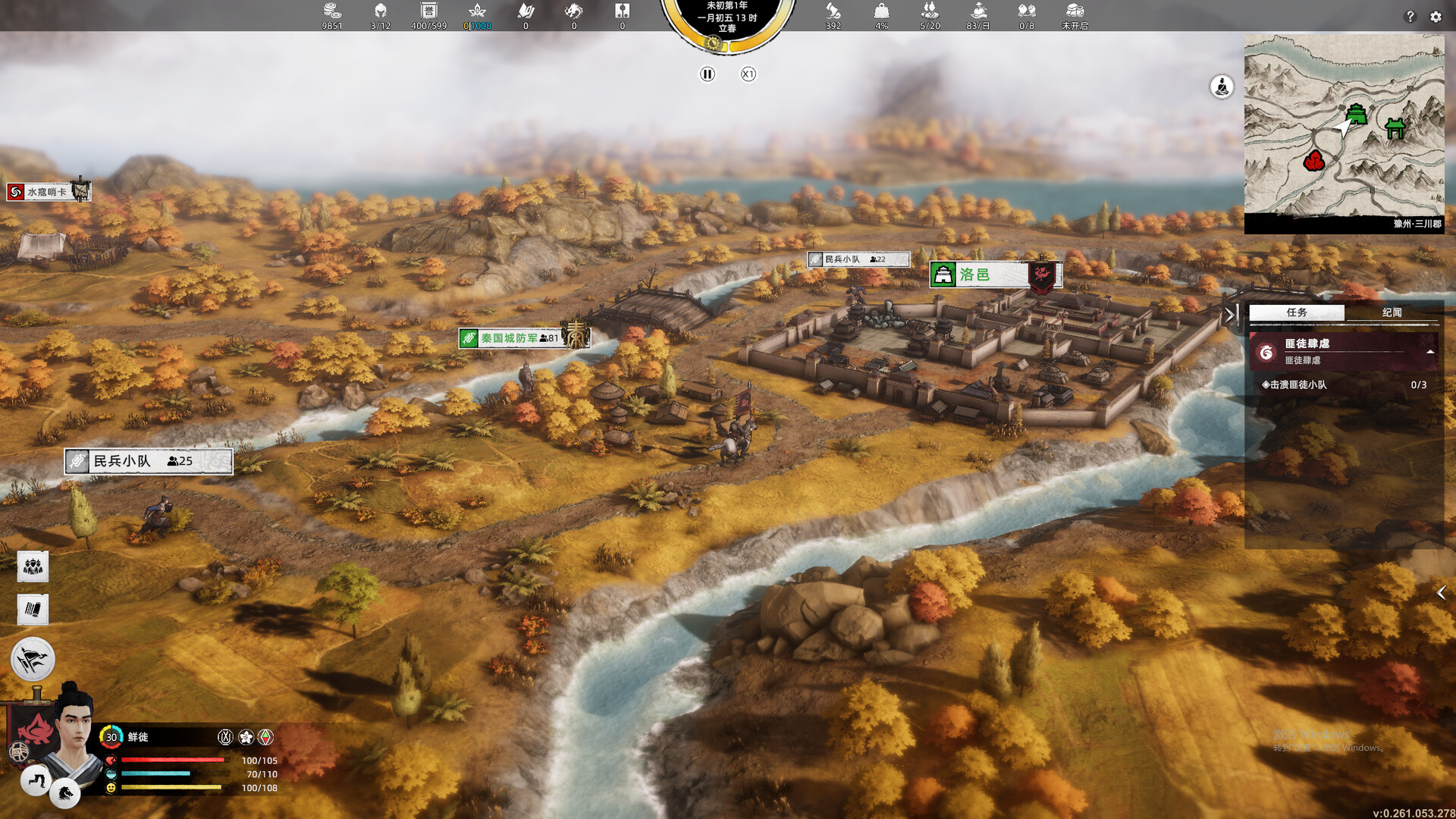
Strongholds are the smallest unit of conquerable territory. There are roughly fifty across Yu Province. Most start under the control of a faction or independent group, and many can be aligned with the player through diplomacy, conquest, or quest chains. The Mohist Academy is the named example tied to the Mohism school. The Gaoluo ethnic settlement is a named example tied to a frontier ethnic-minority storyline. The Strongholds page indexes the named strongholds as they are confirmed in the build.
Villages are the most numerous settlement type, with over three hundred connected through roads, rivers, and mountain passes. Each village hosts trade, recruitable NPCs, hunting grounds, and event chains. Villages are also the smallest unit a player can settle in for a quiet life, and many serve as travel waypoints between cities.
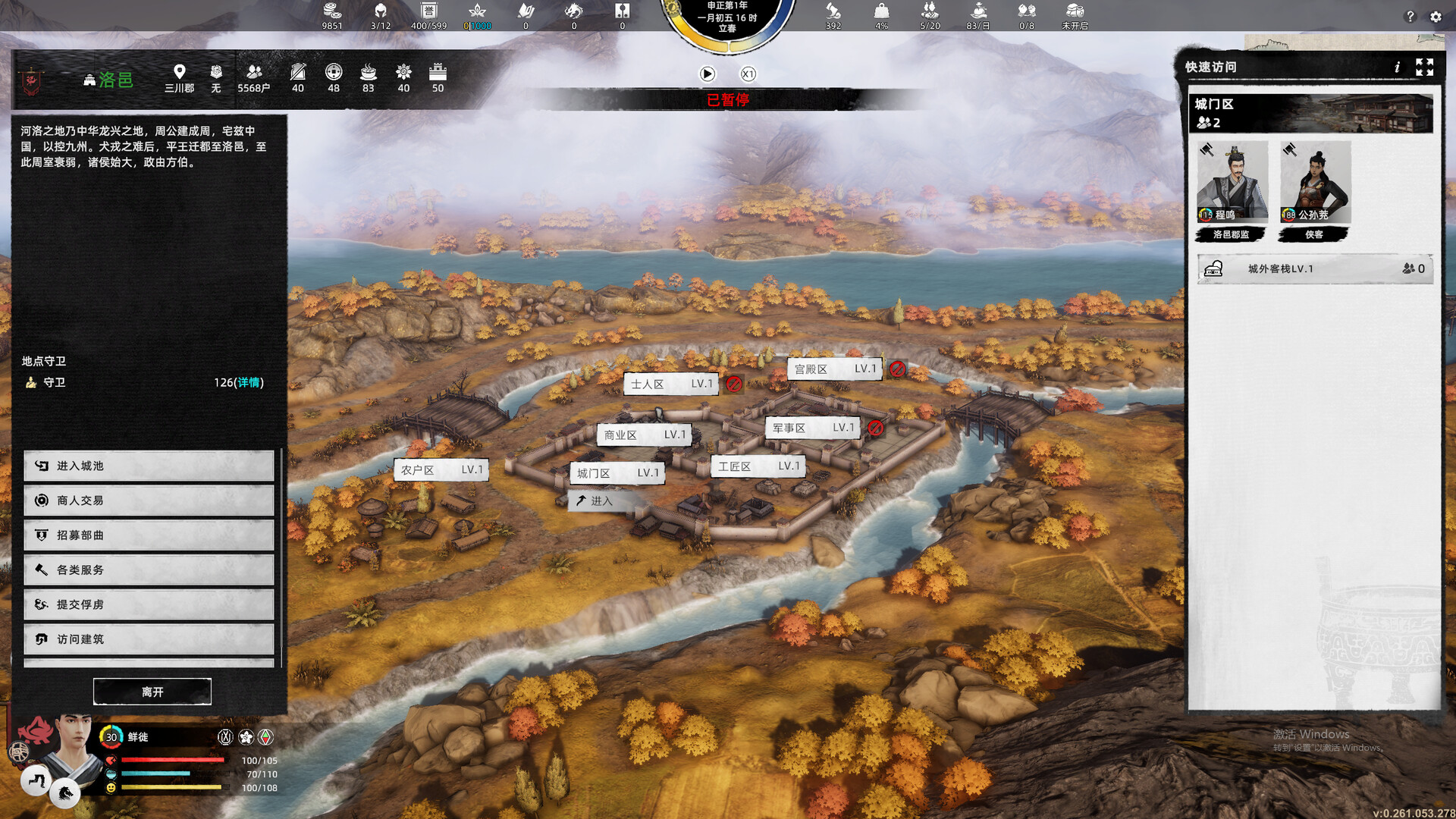
Beyond Yu Province itself the build features cloud quests in four neighboring provinces. These quests link the player to stories and historical figures whose presence extends the game world without requiring the full geographical map. Named historical figures connected with these stories include Han Feizi and Xiang Liang. Cloud quests are how the build stretches its narrative reach during Early Access while the playable map is still focused on Yu Province.
Movement on the world map is shaped by terrain, season, and faction control. Mountain passes can choke army movement, river crossings depend on bridges and weather, and bandit-held strongholds threaten merchants and unaccompanied travelers. The world advances through day-night cycles and seasonal shifts that affect agriculture, sieges, and travel times.
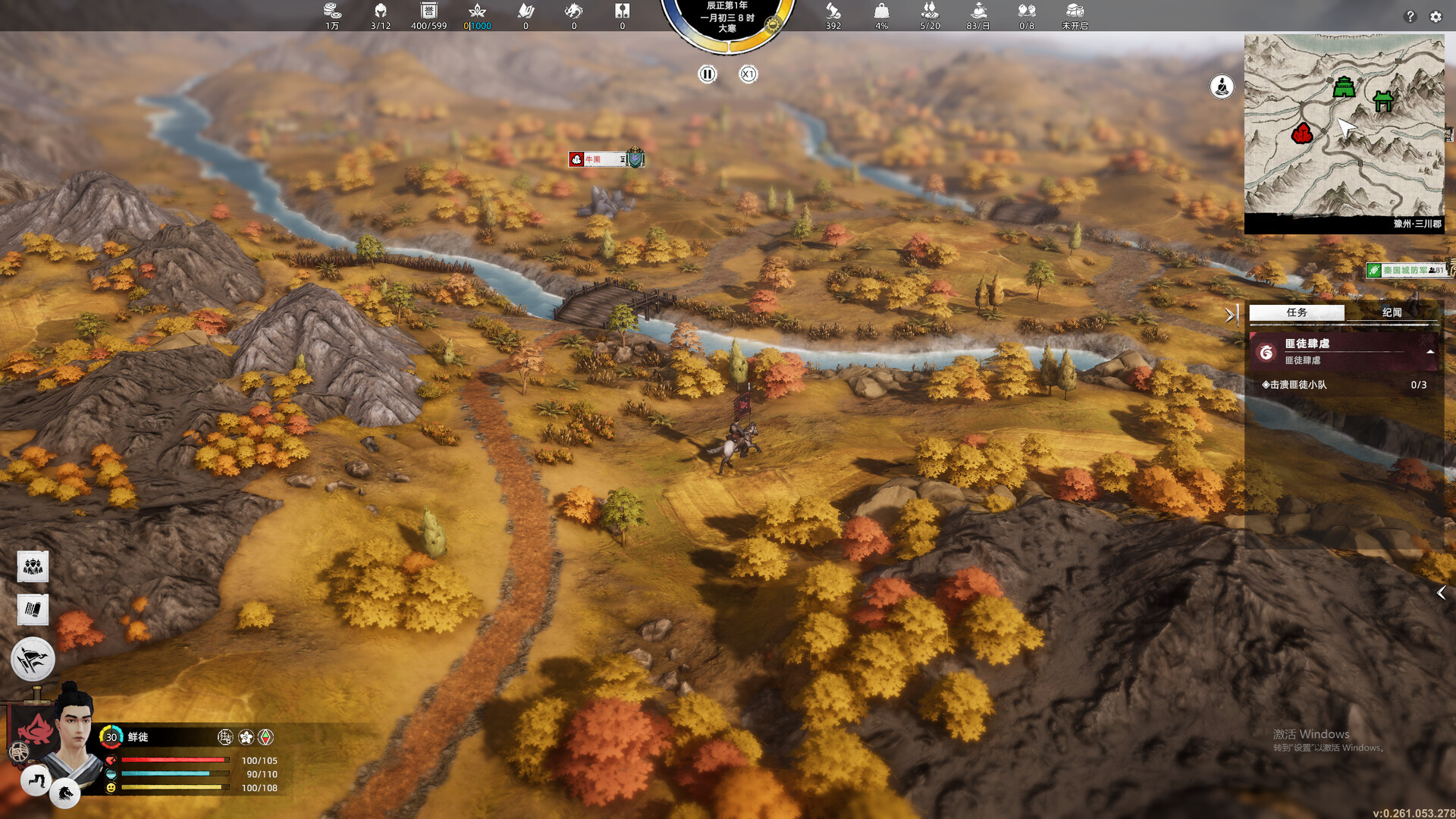
The full Nine Provinces map is a stated long-term goal. As Early Access progresses, further provinces will open with additional cities, villages, counties, and strongholds. Until then, Yu Province plus the four cloud-quest provinces represent the playable world.
The studio put a figure on the gap on July 31, 2026: the Yu Province map in the current build covers only about one ninth of the full Nine Provinces area, which is why opening the rest is staged behind its own update rather than folded into a routine patch. The announced schedule places the full map in the September to October 2026 window, after the retainer-development work lands. See Early Access Roadmap for the dated schedule.
Two August 2026 posts filled that picture in. The replacement map is nine times the playable area of the current region, and the raw area inside its boundary is more than ten times larger because it takes in zones that are not playable, named as the Southeast Sea and the Loess Plateau. Base terrain texturing is finished and trees, mountains, and water are placed; village and stronghold positions were still being laid out in mid-August, along with the passes and routes that connect cities to strongholds.
The studio also named three faults in the current Yu Province map that the replacement is meant to remove: roads narrow and winding enough to force long detours between places that are close together, mountain and water interleaved so tightly that units could not get through, and a fight on a road sealing that road for everyone else. On the new map units will be able to cross mountains and water directly at a reduced movement speed, and spacing between strongholds has been reworked. Each state also carries its own terrain colouring with an on-screen notice when a border is crossed. The target for the full nine provinces and seven states is around October 2026, which makes every line above announced rather than shipped. See Early Access Roadmap.
Strongholds: index of named strongholds and their controllers.
Prefectures and Cities: city and prefecture index.
Setting and Lore: the wider mythological and historical backdrop.
Factions: the seven powers contesting Yu Province and the wider realm.
