

Power in the world of Huaxia: Warring States is divided among seven major warring factions and a long tail of smaller clans, bandit groups, and ethnic enclaves. The seven follow the historical Warring States set: Qin, Chu, Yan, Zhao, Han, Wei, and Qi. Each has its own territory, doctrine, and elite high-tier unit types, and the player can serve, defy, or eventually topple any of them.
The Seven Warring States
Each of the seven appears in the game as an active faction with its own court, retainers, armies, and policies. The notes below are starting points; specific stats, generals, and territorial holdings are subject to change between Early Access updates and should be cross-referenced with the current build.
Faction | Historical Identity | In-Game Flavor |
|---|---|---|
Qin (秦) | Western state, eventual unifier in real-world history | Heavy emphasis on Legalist doctrine, disciplined armies, and centralized administration. Strong central infantry and crossbow tradition. |
Chu (楚) | Southern state with vast territory and distinctive culture | Forested terrain, riverine warfare, and a mix of classical and unconventional military doctrine. |
Yan (燕) | Northern state, often pressed by frontier nomads | Frontier-style cavalry, a defensive posture against the north, and a tradition of brave but outnumbered armies. |
Zhao (赵) | Northern state famous for cavalry reforms in real-world history | Strong cavalry tradition, particularly mounted units that flow from the open northern terrain. |
Han (韩) | Smaller central state, sandwiched between greater powers | Compact territory, defensive doctrine, and famous in the period for crossbow craftsmanship. |
Wei (魏) | Central state, an early Warring States power | A mixture of classical heavy infantry and engineering-focused units, contesting central trade routes. |
Qi (齐) | Eastern coastal state, wealthy from salt and trade | Wealth-driven economy, naval inclination on the eastern coast, and a strong scholarly tradition. |
Faction-Specific Units and Doctrines
Each faction has access to its own elite high-tier formations, accessible through service, marriage, or treaty. Faction unit types interact with terrain, season, and five-element, yin-yang, and eight-trigram affinities, which means a Qin crossbow line behaves differently in a fire-aspected battle than a Chu river ambush.
Doctrine matters as much as roster. A faction aligned with Legalism produces a different state apparatus than a faction aligned with Confucianism. The Hundred Schools of Thought article covers the doctrinal layer in detail.
Smaller Clans and Independents
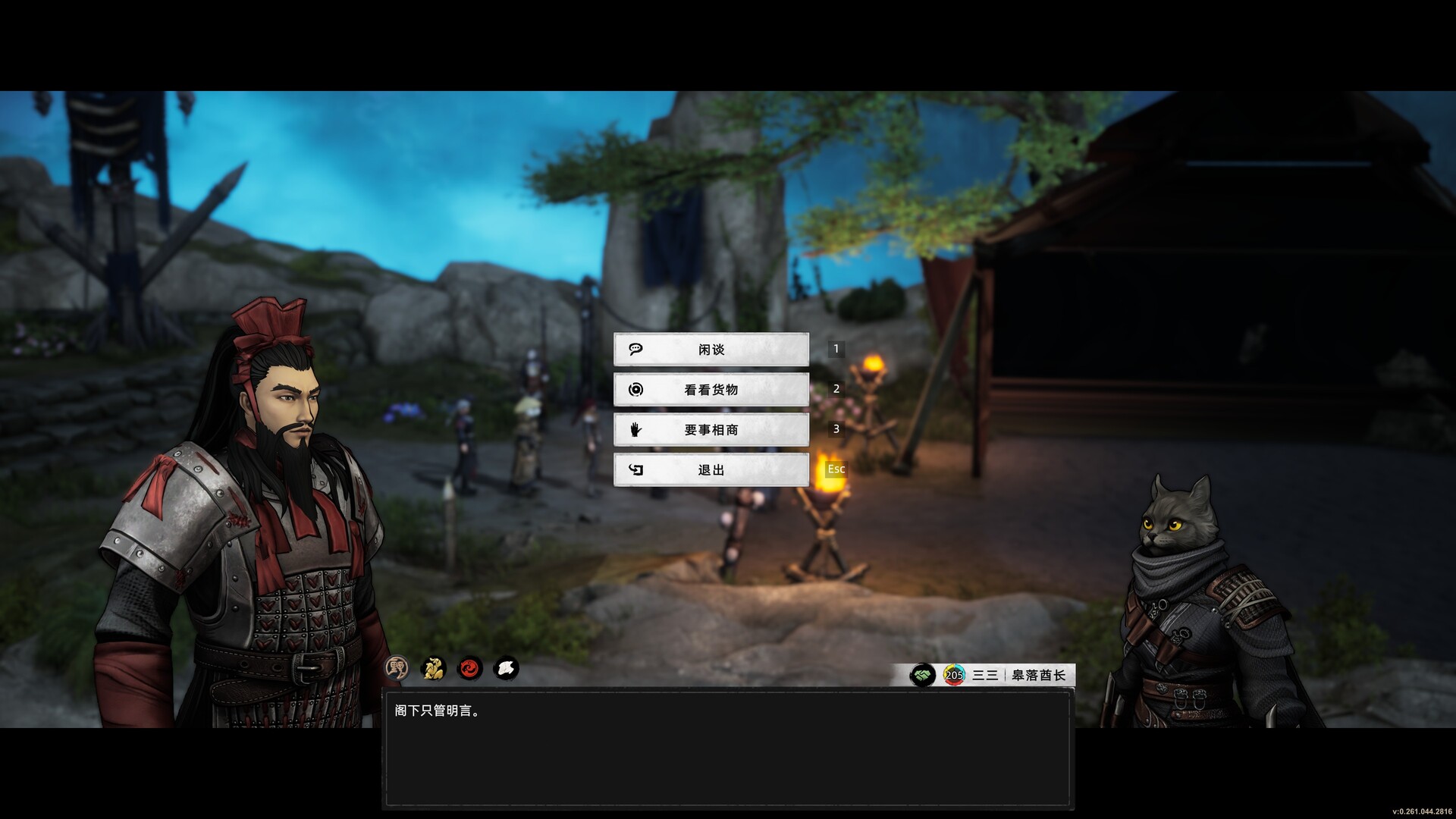
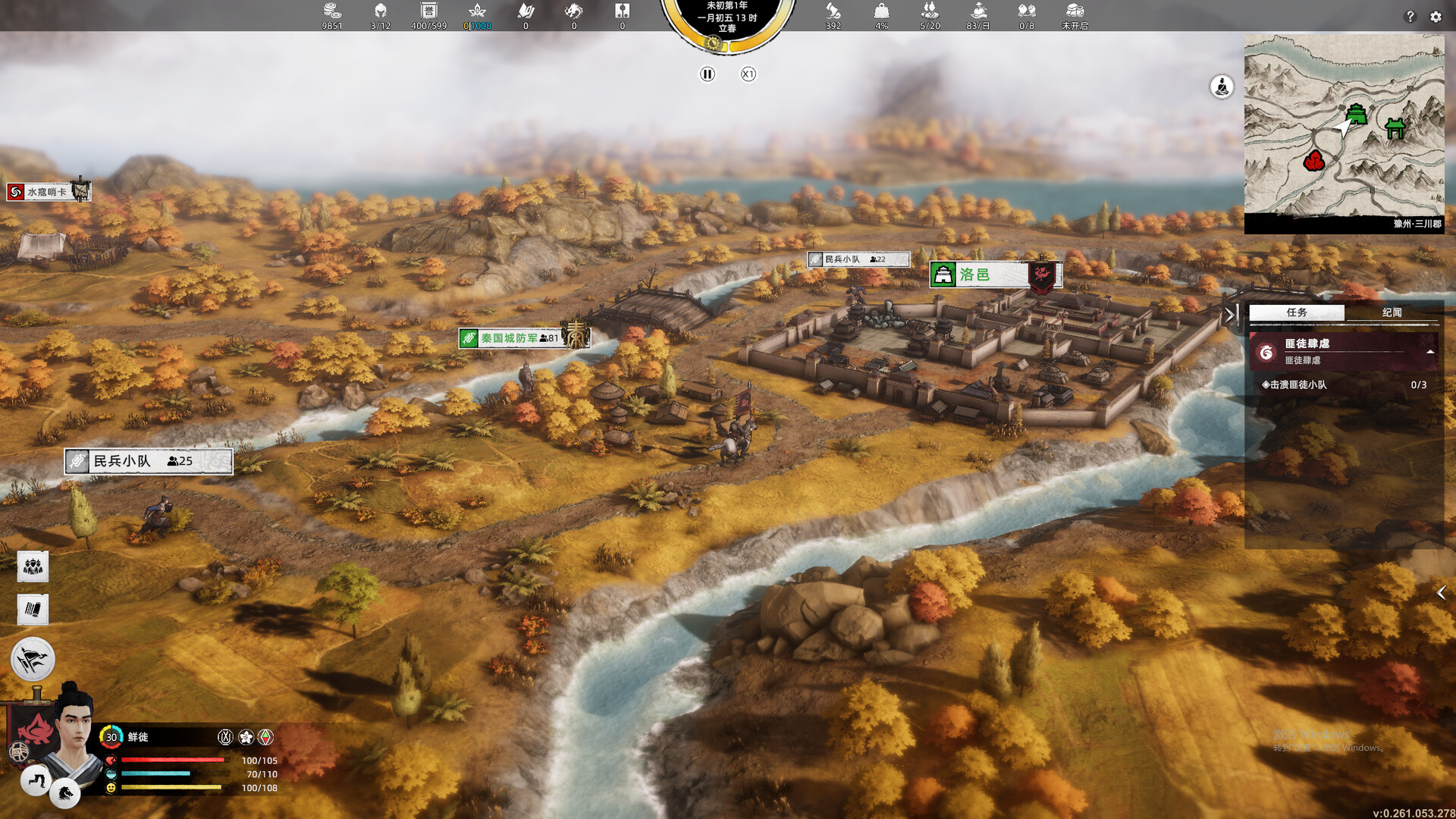
Below the seven warring states, the world is full of smaller clans, frontier groups, and independent strongholds. Many can be allied, conquered, or absorbed without ever picking a fight with a major state. The Gaoluo ethnic settlement is one named example: a frontier ethnic-minority community with its own quest chain. Bandit-controlled strongholds and rogue clans are scattered across Yu Province as targets for early-game conquest.
Faction Relationships
Each major faction tracks relationships with the player and with every other faction. Common dynamics:
Bordering factions feel pressure from each other. A treaty with one rival can reshape the diplomatic map across the realm.
Factions that share a doctrine are easier allies than ideological opposites.
A clan that grows quickly through conquest will trigger coordinated diplomatic and military pressure from rivals.
Retainer recruitment from a hostile faction can be read as a provocation, particularly for senior figures.
See Diplomacy for the day-to-day diplomatic verbs and the planned vertical and horizontal alliance systems.
Serving, Defying, or Toppling
There are several ways to interact with the seven faction system over a campaign:
Strategy | What It Looks Like |
|---|---|
Serve | Become a vassal or retainer of a faction. The state covers some costs in exchange for service. |
Ally and grow in parallel | Maintain a sovereign clan while working alongside one or two factions through treaty. |
Defy | Operate independently, building a clan strong enough to survive without faction backing. |
Topple | The endgame conquest path: conquer a faction's territory and absorb its administrative apparatus. |
States on the Map
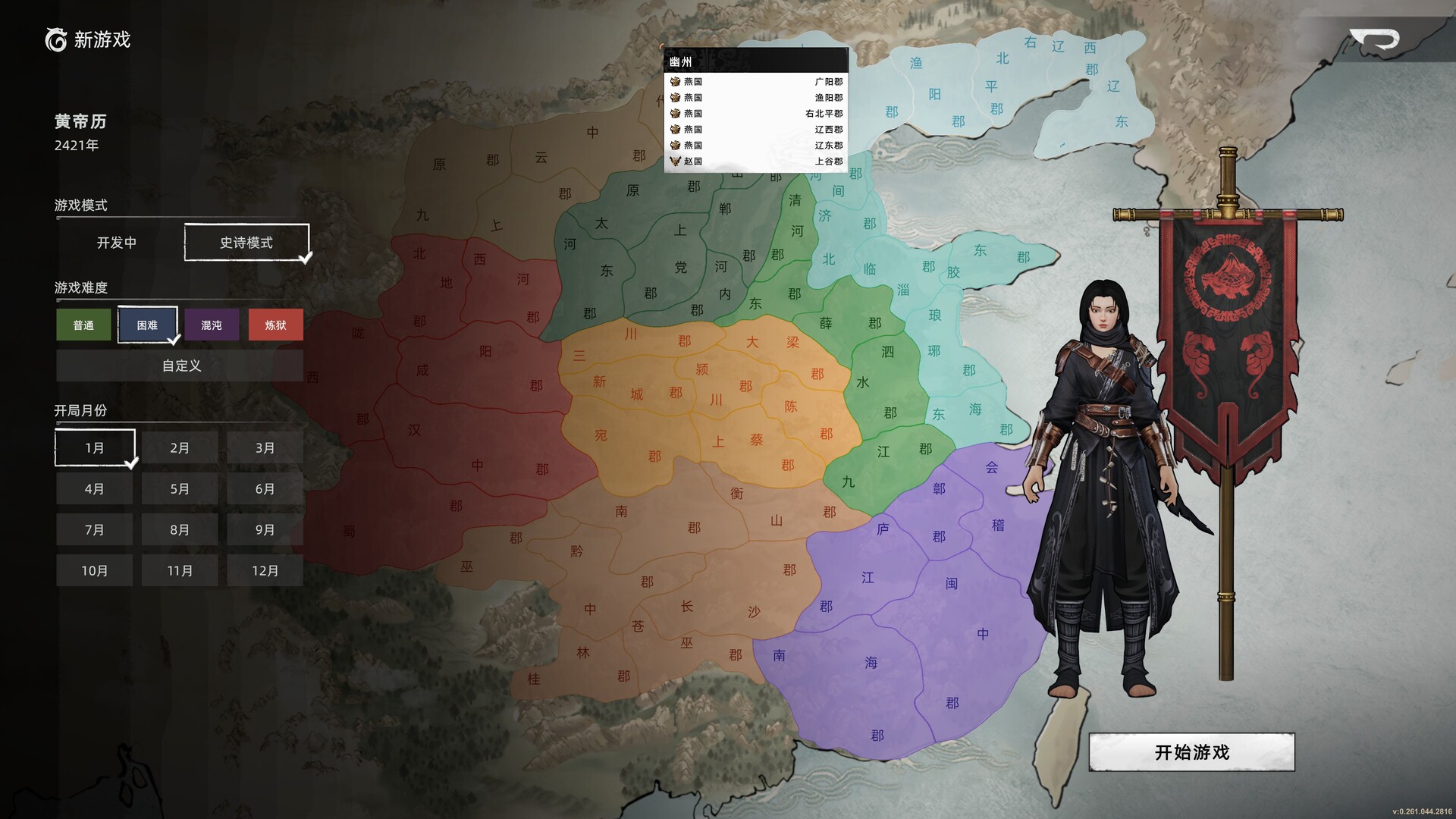
The map used to pick a starting position shows the whole Nine Provinces, not just the region the current build lets you play. States are drawn as contiguous colour blocks and each block is subdivided into named commanderies, with a hover panel listing which state holds each one. Border commanderies frequently belong to a different state than the province around them, which is where much of the early friction between the seven comes from. The current Early Access build opens only the Yu Province portion of that map. See Yu Province.
On August 14, 2026 the studio said it would spend the following weeks setting out the troop roles and distinguishing characteristics of each of the seven states, so that players can pick a starting state on more than flavour once the full map opens. The dated roadmap places the seven-state clan factions, their elite higher-tier units, and their own promotion lines in the September to October 2026 window, and each state's terrain now carries its own colour on the new map with an on-screen notice when a border is crossed. Treat all of that as announced rather than shipped. As of September 21, 2026 the per-state troop roles had not been published, and no post since August 14 has repeated the October target; the August 28 update said only that the seven-state troop system is being reworked around each state's cultural core with clearer roles and counters. See Unit Types and Early Access Roadmap.
Notes on the Faction Roster
Stat-level claims about specific factions, named generals, and territorial breakdowns are deliberately light on this page during Early Access. Faction rosters and territories continue to shift between patches as the developer rebalances the world. Where faction-specific facts appear elsewhere in the wiki, they are timestamped against the build they were last verified against.
Related Pages
Diplomacy: how you negotiate with the seven warring states.
Conquest: when negotiation gives way to armies.
Unit Types: the elite formations each faction fields.
Yu Province: the contested map most playthroughs begin on.
Non-State Factions and Tribes
Alongside the major States, the world contains non-state factions and tribes that interact with the wider political map. These groups hold their own settlements and fortresses, conduct their own diplomacy, and can come into conflict with neighbouring States. The recent patch cycle confirmed at least one such group by name (the Gaoluo tribe), and the developer's bug fixes for unintended war states and incorrect conquest rules make clear that tribes are first-class political entities in the simulation, not generic bandit groups.
Tribes are not enumerated exhaustively in this wiki yet. The current build's tribe roster is still being clarified through patches and player reports. Treat non-state factions as present, active, and worth tracking in your campaign without expecting the wiki to list every name. Players who encounter a tribe with distinctive lore should report the name and location to the community so the wiki can add it once confirmed.
The May 22 update tuned faction mechanics so that faction leaders are no longer captured in edge cases tied to conquest and tribe-territory transitions. This addresses earlier player reports of leaders disappearing from the seven-state map after unintended capture events.
A July 2026 nation-AI update made the seven states behave more dynamically toward one another. They form and break alliances more readily, unite against whichever power grows too strong, seek peace when they are outmatched, and commit their full strength when their survival is at stake.