
Loading...
Loading...
Colossal Gods
September 12, 2026 at 11:15 PM
Added the first scale figures (eight to ten large-scale bosses, ten god-body regions, sixty-plus enemy types), identified the Sun Tree as Fusang with its per-locale names, added the team’s internal "colossal beings" term, cross-linked the first named boss, and softened the unsupported claim about the scope of the PlayStation collaboration
Colossal Gods are the enormous boss enemies of Genigods: Nezha and are the centrepiece of the game’s presentation. The studio describes them as ancient gods towering like mountains, and fighting them works differently from ordinary combat.
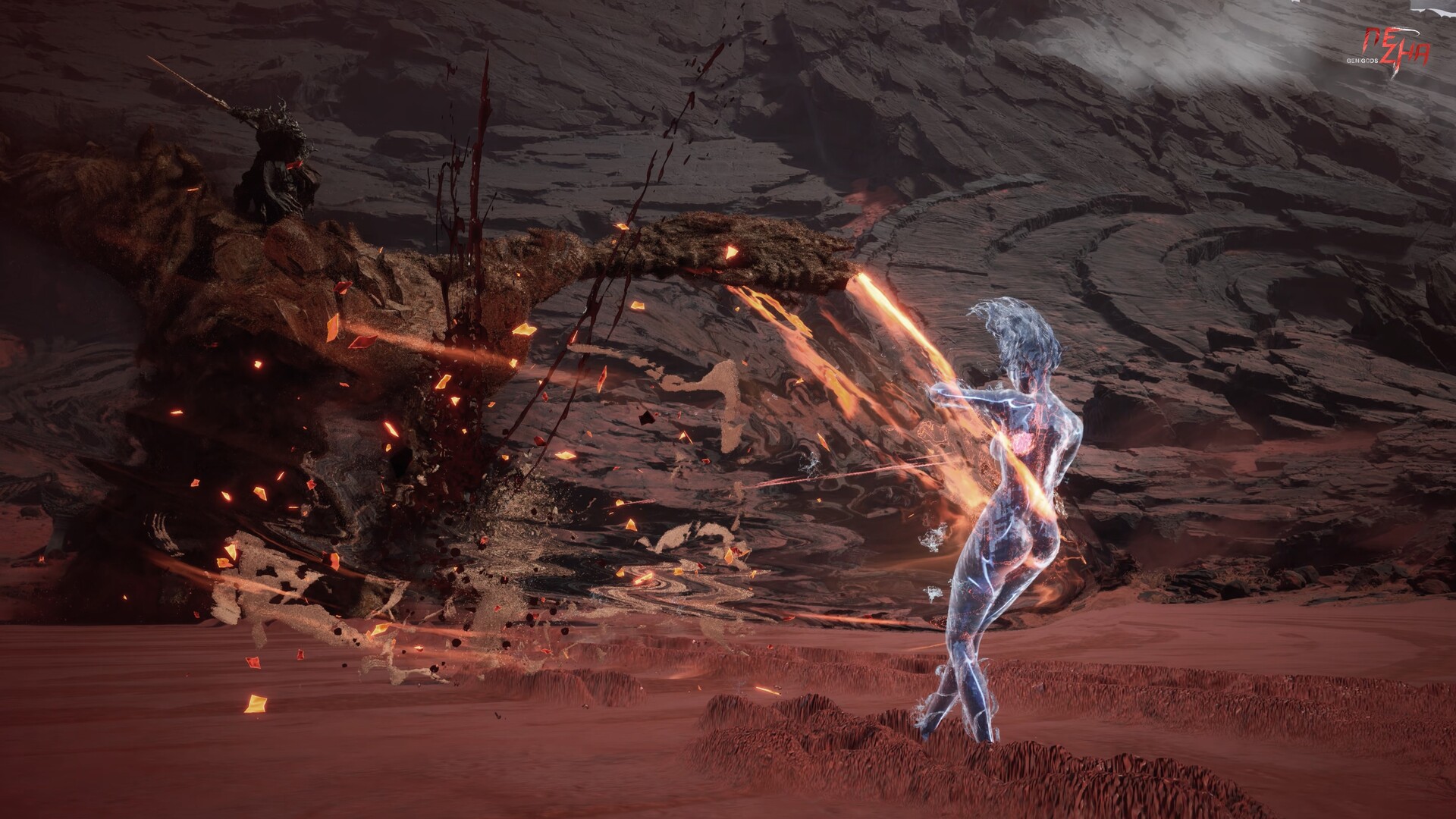
Rather than fighting a large enemy from the ground, players climb these gods and fight by traversing the contours of their bodies. The encounter surface is the boss itself, which makes traversal part of the fight rather than a preamble to it. Aerial mobility from the Wind Fire Wheels is the obvious connection here, though the studio has not stated explicitly how Dual Stances is used during these encounters.
Three figures have been given, none of them in English-language materials, and they are the only numbers attached to the game’s bestiary.
Figure | Stated as | How well sourced |
|---|---|---|
Large-scale bosses | 8 to 10 planned | Given first-hand by the studio’s chief executive on two separate occasions, at gamescom 2026 and again in September 2026, with the same figure both times. The strongest of the three. |
Regions | 10, each designed on the body of an ancient god | From a first-party feature published through the Epic Games Store. It reaches this wiki only in translation, so treat the exact number as approximate. |
Enemy types | 60 or more | Repeated in two separate write-ups, both tracing back to the same round of interviews. Approximate. |
The region figure matters most for this page. If ten large regions are each built on the body of an ancient god, then the Colossal Gods are not only opponents but terrain. That reading fits the description of Pangu’s corpse as a set of multi-layered sandbox levels laid out across his arms, legs, torso and head, which Story and Setting covers.
"Colossal Gods" is the storefront wording. The development team’s own English term for these bosses is "colossal beings", which the studio used when it briefed press at gamescom 2026. The Chinese and Japanese builds use 巨神, or 上古巨神 in the simplified build, and those characters are identical across simplified, traditional and Japanese text. Chinese coverage has also called the encounters a 巨神战场, a battlefield of giant gods, though that phrasing reached Chinese through a Japanese interview rather than from the game’s own Chinese text.
The most detailed sequence described so far involves the Sun Tree, which bridges the mortal and celestial realms. With the help of the giant Kuafu, the player scales the Sun Tree and draws a bow to shoot down nine suns, saving a realm that the suns have scorched.
The English name loses what the Chinese and Japanese names identify. The tree is 扶桑 (Fusang), a specific named tree in Chinese cosmography rather than a generic solar tree. The simplified-Chinese build calls it 扶桑通天树, the traditional-Chinese build 扶桑通天神木 and the Japanese build 扶桑の通天樹, all of which carry the sense of a tree that reaches through to heaven. Chinese coverage also shortens it to 扶桑神树. On this wiki the English "Sun Tree" and Fusang are the same tree.
This ties several threads together. Ten suns searing the land is one of the four disasters named in the game’s premise, Hou Yi’s Bow is a usable mythic treasure, and Rainbow-Piercing-the-Sun Archery is a confirmed Relic-Fusion skill. Whether the Sun Tree sequence uses that specific fusion has not been stated.
Kuafu is described as a giant who helps the player scale the Sun Tree. His name is written 夸父 with identical characters in simplified Chinese, traditional Chinese and Japanese. This is the only confirmed instance of an ally assisting in an encounter, and it is not known whether Kuafu is a one-off story character, a recurring companion, or himself a Colossal God at some point.
Exactly one boss in this game has a published name: Xingtian, a four-phase fight against a severed head that the studio put in its 2026 public demo. He has not been identified as a Colossal God, and the producer describes him as an early boss rather than as one of the game’s set-piece giants, so the two are recorded separately here. He is the only place a reader can currently see what a named boss in this game actually looks like.
The game is built in Unreal Engine 5 and the studio has stated it is optimised for PlayStation, describing the result as a one-of-a-kind Chinese-style colossal adventure.
The scope of the PlayStation work has never been described. Genigods Lab’s fullest public statement on it is a single clause saying the studio is also working with PlayStation, with nothing about publishing, funding or exclusivity attached. A January 2026 story that framed it as deep cooperation with Sony was later taken down. The collaboration is real and the detail is absent, and this page no longer states more than that.
Whether the planned eight to ten large-scale bosses and the Colossal Gods are the same set, or whether one label is broader
Any Colossal God’s name. Xingtian is the only named boss and has not been placed in this group
Whether these encounters are mandatory or optional
Whether climbing has a grip, stamina, or shake-off mechanic
Whether Colossal Gods can be refought
Whether each of the ten god-body regions contains a Colossal God fight, or only some of them do
Note that the ten suns of the premise and the nine suns shot from the Sun Tree are both stated in first-party material. The traditional myth accounts for the difference, but the game has not explained it, so both figures are recorded here as given.
