

This article is incomplete
Some sections are missing or need additional details. Help improve it by contributing.
Genigods: Nezha is set in a version of ancient Chinese creation mythology at the point where creation has broken down. The studio’s stated ambition is to let players live the myths rather than read them, and the story is built around restoring a world that its own gods have wrecked.
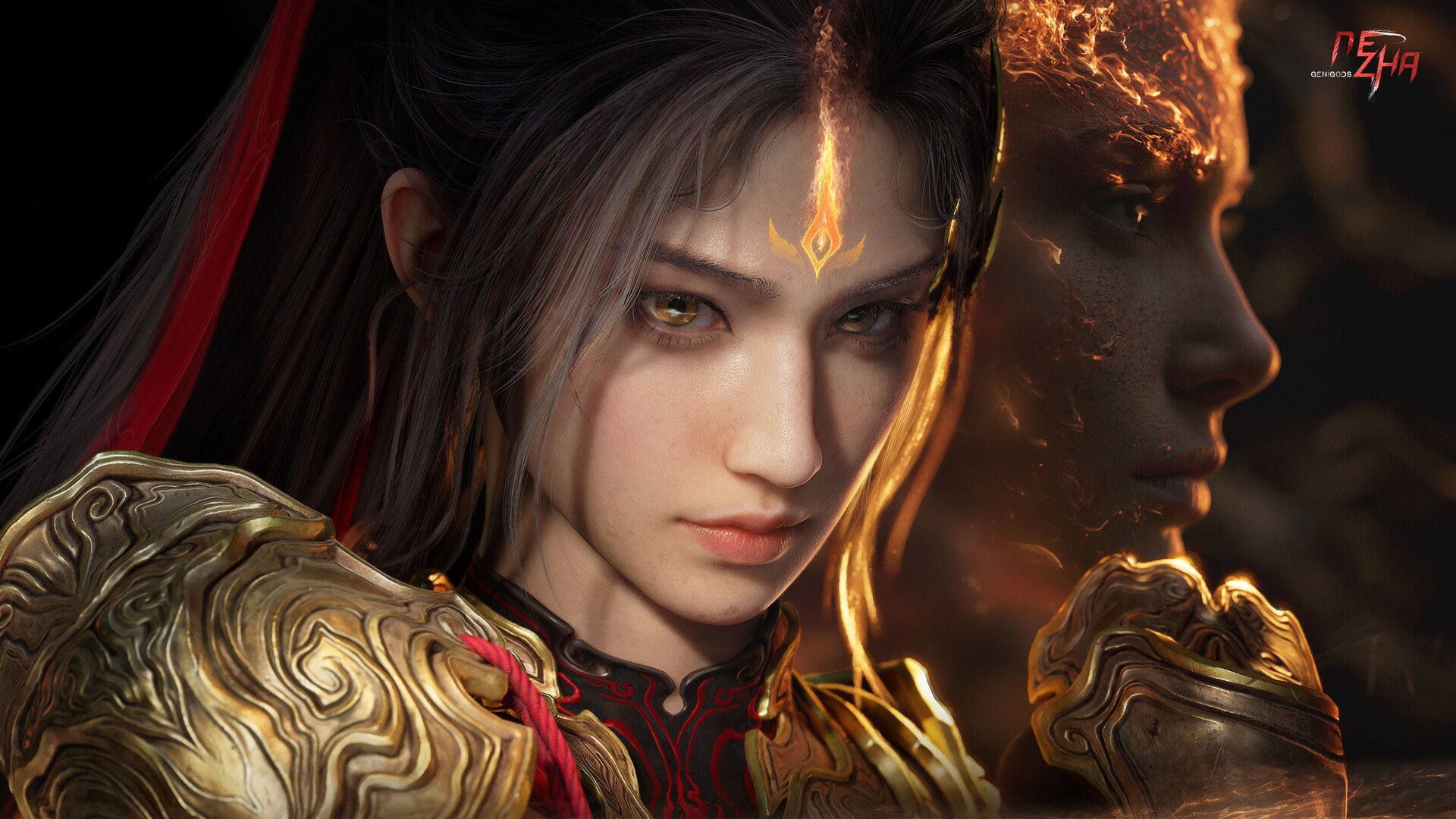
Two Titles, and What They Reveal
The game ships under two names that are not translations of each other. In English it is Genigods: Nezha, named for the protagonist’s later incarnation. In simplified Chinese it is 《古神:风里希》 and in traditional Chinese 《古神:風裡希》, named for Nüwa. The Chinese store text states why: 风里希 (Feng Lixi) is Nüwa’s true name. The Japanese edition is 『太古の神:哪吒』, which follows the English in naming the protagonist.
One consequence is worth stating plainly. The word 哪吒 appears nowhere in the simplified- or traditional-Chinese text of the game’s own store page. It appears in the Japanese title, where the characters happen to be identical to the Chinese ones, which makes it very easy to mistake a Japanese form for a Chinese one. On this wiki 哪吒 is recorded as Japanese-edition naming, never as the game’s Chinese naming.
The studio has explained where the name came from. It cites the Tang-dynasty scholar 司马贞 and his 《补史记·三皇本纪》, in which Nüwa’s clan name is given as 风 and her style as 女希氏. It adds that the name is corroborated by 「女娲的传说」, the Nüwa legends registered as intangible cultural heritage in 河北涉县. For the protagonist it cites the Ming-dynasty 《封神演义》, in which 灵珠子 is a primordial treasure of 乾元山 fated to be reborn as Nezha.
These are the studio’s stated reasons for choosing its names. They are not a statement that the contents of those texts are in the game, and this wiki does not treat them as one. Nothing from 《封神演义》 is part of this game’s story except what the game itself has shown.
The working title was 《古神:女娲》. It changed because the younger members of the team rejected it as 「太土了,太老了」, too corny and too old-fashioned.
A World in Ruins
The English store text says Pangu, the Genesis God, has succumbed to an eternal slumber, and that the realm fell into chaos in his absence. Developer briefings put it harder than that: Pangu is dead. His body became the stars and the earth. His soul now wants to come back, and if it did, the new world made from his corpse would be destroyed. Stopping that resurrection is stated as the protagonist’s task.
That is a much larger plot axis than the English materials describe, and it is the clearest statement anyone has given of what the player is actually trying to prevent. It comes from a direct briefing by the studio’s chief executive, and independently from a second account of the same premise. Both framings, eternal slumber and outright death, are first-party, so both are recorded here rather than one being written over the other.
Four consequences of the collapse are named directly:
Ten suns sear the land, birthing a crimson desert.
Gods wage ceaseless wars that rend the sky asunder.
The celestial pillars have collapsed.
Ferocious monsters ascend from the abyss.
This is a setting defined by damage that has already happened. The player is not preventing a catastrophe but working inside the wreckage of one, and now also working against the return of the god whose death caused it.
Pangu’s Body as the Map
The setting is not a landscape that happens to contain a dead god. The dead god is the landscape. The studio has described Pangu’s corpse as designed in parts, with the arms, legs, torso and head each built as a multi-layered sandbox level that the player walks across. Chinese coverage lists the same parts as 手臂、颈部、头部、躯干.
A related figure, which reaches this wiki second-hand, puts the game at ten large regions each designed on the body of an ancient god. If that holds, corpse-as-terrain is the organising principle of the whole map rather than one sequence. The game is not open world: the structure described is hub-based, and the producer has said the experience is currently a primarily linear one. Colossal Gods covers those bodies as encounters.
The Spirit Pearl
The player character is the Spirit Pearl, described as the first life forged by Nüwa from the essence of earth, water, and fire. The Spirit Pearl is later reincarnated as Nezha in the English materials, and Nüwa gives the player the Heart of the Spirit Pearl, a heart infused with divine water that serves as both a constant companion and the wellspring of the player’s power.
First-party material does not settle on one epithet for Nüwa, and this wiki does not choose one for it. The English store page calls her the Goddess of Life in one place and the Goddess of Creation in another. The simplified-Chinese build calls her 华夏创世神, a creation deity; the traditional-Chinese build calls her 華夏開天女神, a sky-opening goddess; the Japanese build uses 華夏の創世神. That is three distinct English epithets and three distinct CJK ones for one character, all of them first-party.
The Three Quests
The studio frames the player’s destiny around three titanic quests, which give the game its stated structure:
Quest | Objective |
|---|---|
Mend | Repair the shattered sky using the Five-Colored Stones. |
Uncover | Discover the truth of the Spirit Pearl’s own origin. |
Descend | Enter the Abyss of Return and seal the spacetime rifts that are devouring the world. |
The three are presented as parallel goals rather than as sequential acts, and it has not been stated whether they can be tackled in any order.
The Chinese materials name the third destination specifically. It is 归墟 (Guixu), a named gulf in Chinese cosmography said to lie east of the sea and to have no bottom, and "Abyss of Return" is a loose English rendering of that. The rifts are 时空震, spacetime quakes, in the studio’s own Chinese press text; a later interview relayed the term as 时空裂隙, spacetime rifts. The press form has the better provenance. The Five-Colored Stones are 五色石 in Chinese, named alongside 炼石补天 and 抟土造人.
The count of quests also varies by locale. The English text lists three. The simplified-Chinese store text lists two, 补天 and 寻己, mending the sky and seeking oneself, with the third appearing only in interview coverage as 封印时空裂隙. The difference has not been explained.
Nezha’s Transformation
Press materials describe the protagonist evolving across three stages of existence: beginning as a porcelain vessel, becoming the first mortal human, and finally ascending into a celestial warrior. The store page separately refers to awakening a three-headed, eight-armed form. Note that Three Heads and Six Arms is also the name of a mythic treasure used in Relic-Fusion, so the two are distinct references that happen to share imagery.
The studio has since said these three stages are the game’s growth curve rather than narrative flavour, with a collection loop attached to each: the vessel gathers what it needs to become human, and the human gathers 法宝, mythic treasures, to become a god. Weapons and Relics covers that side.
Mythological Figures Named So Far
Every figure below has been named by the game or by its developers. Several are named and nothing more, and those are marked as such.
Figure | Naming in the game’s own text | Role in released material |
|---|---|---|
Nüwa | 女娲 in simplified Chinese, 女媧 in traditional and Japanese. True name 风里希 in simplified, 風里希 in the traditional body text and in Japanese, 風裡希 in the traditional title field | Forged the Spirit Pearl and gave the player the Heart of the Spirit Pearl. Associated with mending the sky. |
Pangu | 盘古 in simplified Chinese, 盤古 in traditional and Japanese | The Genesis God. English materials say eternal slumber; developer briefings say he is dead, that his body became the world, and that his soul seeks resurrection, which the player must prevent. |
Nezha | 哪吒, in the Japanese title only. Absent from the Chinese text | The form the Spirit Pearl is reincarnated into in the English materials, and the player character. |
Kuafu | 夸父, identical characters in all three scripts | A giant who helps the player scale the Sun Tree, which the Chinese and Japanese names identify as 扶桑 (Fusang). |
Hou Yi | 后羿 in simplified Chinese and Japanese, 後羿 in traditional | Associated with shooting down the suns. Hou Yi’s Bow is a usable mythic treasure. |
The Yellow Emperor | 轩辕帝, also given as 黄帝 | Stated to appear in this game. The player fights alongside him against Chiyou. The 轩辕剑 that beheaded Xingtian carries his name. |
The Yan Emperor | 炎帝 | Stated by the studio to appear in this game. Named only; no role has been described. |
Chiyou | 蚩尤 | The opponent in the battle fought alongside the Yellow Emperor. |
Yu the Great | 大禹 | Named as another mythic hero who appears. This is the same figure the January 2026 English materials called Yu the flood-tamer. Named only, in both languages, with no detail. |
Taotie | 饕餮 | Named once in Chinese materials, in the same breath as Xingtian. No role given, and it is not known whether this is a boss, an enemy type or set dressing. |
Xingtian | 刑天; the encounter is 刑天的傲骨 in Chinese and 刑天の傲骨 in Japanese | The only boss named so far. Beheaded by the 轩辕剑, and the player fights his severed head. See Xingtian. |
Scope Note
These figures come from a much larger body of Chinese mythology, and recent animated films have made Nezha’s story widely familiar. Only what the game itself has confirmed belongs on this wiki. Traditional accounts and film adaptations are not evidence of what appears in Genigods: Nezha, and the studio has described its approach as reinventing these legends rather than retelling them.
Two boundaries follow from that, and both are easy to cross by accident. The animation team behind the recent Nezha films is confirmed as a collaborator, but first-party material describes that collaboration in specific terms: real-time fluid simulation for fire, water, clouds and cosmic effects. It is a visual-effects collaboration. It does not make any film’s plot, character design or dialogue part of this game. Separately, the studio’s citation of classical texts explains where it found its names; it does not import the contents of those texts as this game’s story.
Figures named as present but given no detail, currently the Yan Emperor, Yu the Great and Taotie, live in the table above and nowhere else. They do not have their own pages, and they will not until the game says something about them.