

Overview
Duo is a card gambling minigame in Crimson Desert based on the traditional Korean card game Seotda. Each player is dealt five numbered sticks (cards). Three of those sticks must combine to total exactly 10, 20, or 30. The remaining two sticks form the player's final hand, called the Duo. The player with the highest-ranking Duo wins the round and takes the pot.
The game blends luck with psychological strategy. Reading your opponents, bluffing with aggressive raises, and knowing when to fold are all essential to winning consistently. Duo is one of the fastest ways to earn Silver in the game, making it a popular activity for players looking to build their funds quickly.
The Deck
Duo is played with a deck of 20 numbered sticks. There are two copies of each number from 1 to 10, with one stick colored Red and the other Yellow. While stick color does not affect hand rankings in standard Duo (unlike Five-Card, where color matters for special hands), both colors exist in the deck. The distinction becomes relevant when using the cheat ability, since the player chooses both a number and a color when injecting a stick into their hand.
Locations and Buy-Ins
Duo can be played at two locations in Pywel. Each location has a different buy-in cost, which determines the stakes and potential winnings.

Location | Buy-In | Notes |
|---|---|---|
15 Silver | Located in the Gambling Den on the second floor of the Hernand Inn. Enter the inn and head upstairs, then go through the closed door on the right side. This is the first Duo table most players encounter. | |
Tomasso | 300 Silver | A high-stakes table located in the northeastern part of the world map. No main quest leads here, so players must travel there on their own. The much higher buy-in means larger pots and bigger potential winnings. |
You need at least enough Silver to cover the buy-in before you can sit down and play. If your Silver drops below the entry fee after a loss, you will not be able to continue until you earn more. Silver can be obtained by selling items, completing quests, defeating enemies, and other activities throughout Pywel.
How to Play
A round of Duo proceeds through several steps. Understanding the flow of the game is essential before diving into strategy.
Dealing and Hand Formation
Each player at the table is dealt five numbered sticks. The numbers on the sticks range from 1 to 10. Once the sticks are dealt, the game automatically selects three of the five sticks that add up to exactly 10, 20, or 30. These three sticks are set aside, and the remaining two sticks become the player's Duo hand.
For example, if a player receives sticks numbered 2, 3, 5, 7, and 8, the game might group 2 + 3 + 5 = 10, leaving 7 and 8 as the Duo hand. Since 7 + 8 = 15, the last digit is 5, making this a 5-point hand. The game automatically picks the three-card grouping that results in the strongest possible Duo hand for the player.
Bust
If none of the five sticks can be combined into a group of three that totals exactly 10, 20, or 30, the hand is called a Bust. A Bust is an automatic loss regardless of what the opponents hold. There is no way to bet or bluff out of a Bust. This is one reason why some rounds are unwinnable from the start.
Visible Opponent Cards
During a round, you can see one of each opponent's cards. This partial information allows you to make educated guesses about the strength of their hands. If an opponent's visible card is a 10, for instance, there is a chance they hold a Ten Pair or a strong points hand. Use this information to adjust your betting decisions.
Betting Phase
After the Duo hand is formed, you have 10 seconds to choose a betting action. If the timer expires without a selection, the game automatically performs a Call on your behalf. The player with the First Turn marker leads the betting for that round. Betting proceeds sequentially among all players at the table. Once everyone has acted or folded, the remaining players reveal their hands and the highest-ranked hand takes the entire pot.
You can face between one and three AI opponents at the gambling table. The number of opponents at the table varies depending on the day. Rounds continue as long as you have enough Silver to pay the buy-in.
Dealing Rights and First Turn
At the start of a match, the First Turn marker is assigned to one player. The player holding this marker deals the cards and makes the opening bet. After each round, the winner takes over as the dealer for the next round. This rotation matters because the cheat ability can only be activated when Kliff is the one dealing. Winning a round is therefore a prerequisite for cheating in the following round.
Betting Actions
The following betting actions are available during each round of Duo.
Action | Effect |
|---|---|
Check | Pass your turn without adding Silver to the pot. Only available if no opponent has raised before you in the current round. |
Half Raise | Add Silver equal to half of the total current pot. |
Double Raise | Add Silver equal to double the amount of the previous raise. |
All-In | Bet all of your currently held Silver. |
Call | Match the amount raised by the previous player. This is the default action if the timer runs out. |
Fold | Forfeit the current round and lose any Silver you have already placed in the pot. |
Hand Rankings
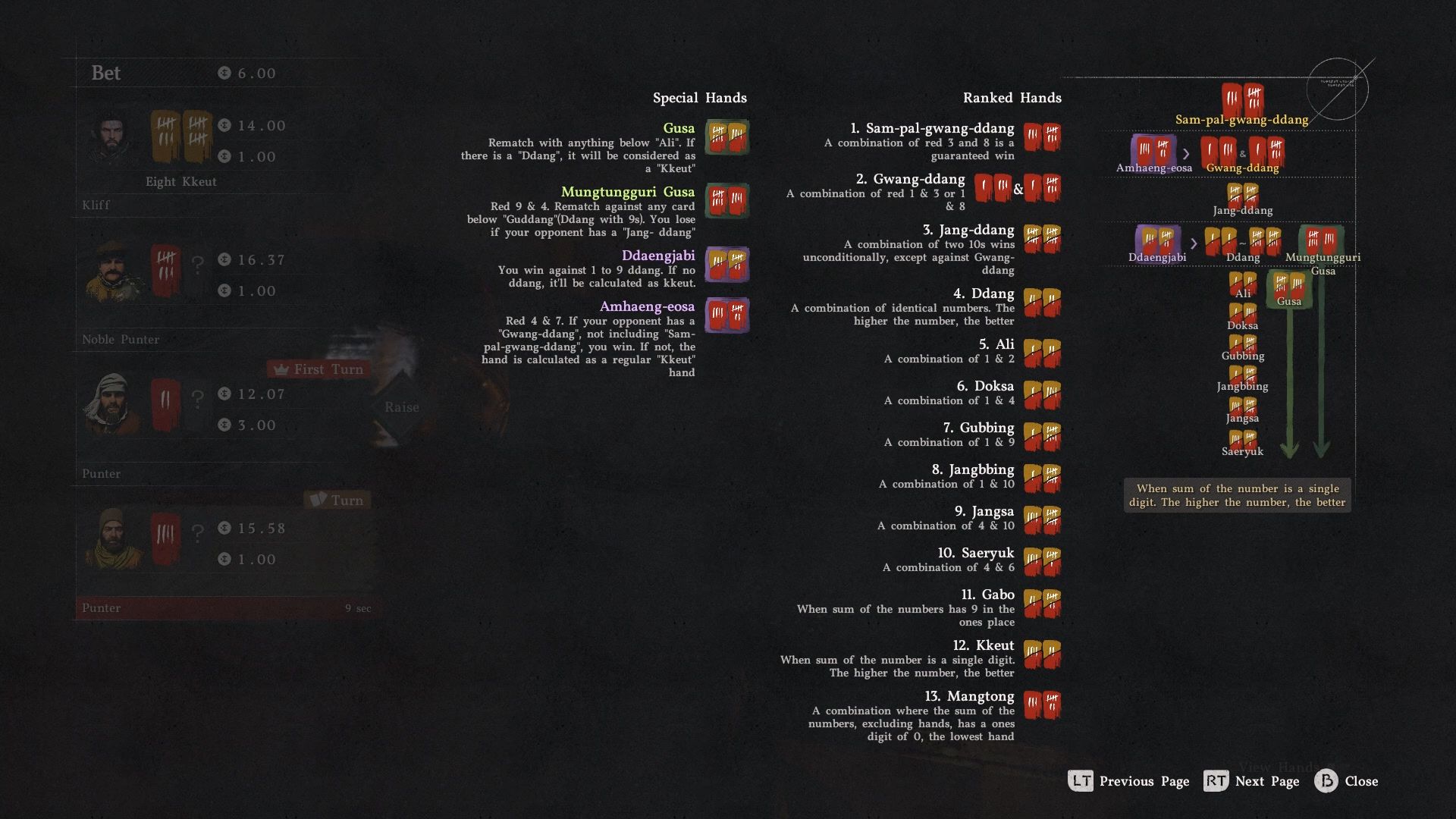
Hands in Duo are ranked in a strict hierarchy. The strength of your Duo (the two remaining sticks after the three-card grouping) determines whether you win the round. The complete ranking from strongest to weakest is listed below.
Rank | Hand | Description |
|---|---|---|
1 | Ten Pair | Both remaining sticks are 10s. This is the strongest hand in Duo and is a guaranteed win against any non-Bust opponent. |
2 | Pair (9 down to 1) | Both remaining sticks share the same number. Higher pairs beat lower pairs. A 9 Pair beats an 8 Pair, and so on down to 1 Pair, which is the weakest pair. |
3 | Perfect Nine | The two remaining sticks sum to exactly 9 (for example, 2 + 7 or 4 + 5). This is the strongest non-pair hand. |
4 | Points (8 down to 1) | The sum of the two remaining sticks as a single digit. If the sum exceeds 9, take the last digit (for example, 6 + 7 = 13, so the hand is worth 3 points). Higher point values beat lower ones. |
5 | Zero | The two sticks sum to exactly 10 or 20, resulting in 0 points. This is the weakest possible hand (aside from a Bust). Also called Mangtong. |
Note that Duo does not use color-based hand rankings. Special hands such as Bright Pairs, the Executor, the Judge, and Warden effects are exclusive to the Five-Card minigame, which is a separate and more complex variant played at Beighen.
Korean Terminology
Since Duo is based on the Korean card game Seotda, many hand names use Korean terms. These names appear in in-game tooltips and community discussions. The table below lists the Korean name for each hand rank.
Hand | Korean Name | Romanization |
|---|---|---|
Ten Pair | 장땡 | Jang-ddang |
9 Pair | 9땡 | 9-Ddang |
8 Pair | 8땡 | 8-Ddang |
7 Pair | 7땡 | 7-Ddang |
6 Pair | 6땡 | 6-Ddang |
5 Pair | 5땡 | 5-Ddang |
4 Pair | 4땡 | 4-Ddang |
3 Pair | 3땡 | 3-Ddang |
2 Pair | 2땡 | 2-Ddang |
1 Pair | 1땡 | 1-Ddang |
Perfect Nine | 갑오 | Gabo |
Points | 끗 | Kkeut |
Zero | 망통 | Mangtong |
Point Calculation
If your Duo hand is not a Pair or Ten Pair, its strength is determined by the last digit of the sum of your two sticks. This is the standard point system used for all non-pair, non-Perfect-Nine hands.
After your Duo hand is formed, the game displays your point total in the top-left corner of the screen, just above the protagonist's name. This quick reference lets you assess your hand strength instantly without adding the stick values yourself.
Card Sum | Point Value | Example |
|---|---|---|
1 to 9 | Same as sum | 2 + 5 = 7 points |
10 or 20 | 0 (Zero) | 4 + 6 = 0 points |
11 to 19 | Sum minus 10 | 7 + 8 = 5 points |
A hand worth 0 points (Zero, or Mangtong) is the weakest standard hand. However, even a low point total can win the round if all opponents Bust or Fold.
Cheating and Accusations
Both you and your AI opponents can cheat during Duo matches. The cheating system adds an extra layer of risk and reward to the gambling experience.
Learning to Cheat
To unlock the cheat ability, you must observe an opponent cheating three separate times. When an opponent cheats, they are highlighted with a blue outline during the dealing phase. After witnessing this three times, Kliff learns how to cheat on his own.
Detecting Cheaters
There are two visual tells that reveal an opponent is cheating during the dealing phase:
Blue outline: A cheating opponent glows with a blue outline while dealing. This is the most obvious indicator, though it can be subtle if you are not watching closely. The blue glow appears during the dealing animation, so keep your eyes on the dealer at the start of each round.
Thumb position: In a legitimate draw, the dealer takes sticks from the top of the deck with their thumb pointing downward. A cheating dealer instead takes sticks from the side of the deck with their thumb pointing upward and the hand held horizontally. Once you know what to look for, this animation difference is often easier to spot than the blue outline.
If you notice either tell and are confident, press and hold the Accuse button to call out the cheater. Be aware that some opponents may cheat multiple rounds in a row. Watching for a pattern of suspiciously strong hands from the same player can also help confirm whether an accusation is worth the risk.
How Cheating Works
The cheat ability can only be used when Kliff is the one dealing cards (the player with the First Turn marker). During the deal, hold the button prompt for the Hide Hand command. This allows you to select a specific number for one of your sticks, which is then automatically included in your hand. By choosing a number that complements your other sticks, you can engineer strong hands like Ten Pair or high-value Pairs more reliably.
When selecting a stick during the Hide Hand prompt, Red 1 is widely considered the safest choice. The number 1 is extremely versatile because it pairs well with almost any other number. It can form a 1 Pair if your other sticks include another 1, and it creates a Perfect Nine when combined with an 8 (since 1 + 8 = 9). Even in the worst case, adding a 1 to your hand produces a reasonable point total. Choosing Red 1 consistently gives you the best odds of landing a competitive hand regardless of your other sticks.
You are free to choose any number and color, so adjust based on what your other sticks look like. If you already hold a 7, for example, picking another 7 guarantees a 7 Pair. However, since you cannot see your full hand before choosing, Red 1 remains the most reliable default option.
Accusing Opponents
If you suspect an opponent is cheating, you can press and hold the Accuse button prompt during the round. Accusations carry significant consequences in both directions.
Correct accusation: The cheating opponent is removed from the game, and their Silver is distributed among the remaining players.
Incorrect accusation: Kliff is kicked out of the Gambling Den and temporarily banned for roughly two in-game days. You lose any Silver wagered in the current round.
Because false accusations carry a steep penalty, only accuse when you are confident that an opponent is actually cheating. Watch for the blue outline during the deal as a visual tell.
Getting Caught
If an opponent accuses you of cheating and the accusation is correct, Kliff is immediately ejected from the Gambling Den. All Silver currently on the table is distributed among the remaining players, and Kliff is temporarily banned from that Gambling Den for roughly two in-game days. The ban prevents you from re-entering the den until the timer expires, so getting caught is a significant setback.
To reduce the risk of being accused, avoid cheating every round. Spacing out your cheats to once every three or four rounds makes the pattern less obvious to opponents. AI opponents do notice if you win suspiciously often while dealing, so restraint is essential for long-term profitability.
Rewards
Winning a round of Duo awards the full pot of Silver wagered by all participants. Since multiple opponents contribute to the pot, a single win against three opponents can yield a substantial return. Consecutive wins compound your earnings quickly, making Duo one of the most efficient Silver-earning methods in Crimson Desert.

There is no upper limit on how much Silver you can win in a single session. Your total winnings are limited only by how much your opponents wager. Going all-in with a strong hand against multiple opponents can produce returns many times larger than the buy-in fee. The Tomasso table, with its 300 Silver buy-in, offers dramatically higher payouts per round compared to Hernand.
Rewards increase when you win consecutively. It is recommended to save your game before entering the Gambling Den, since a string of losses can drain your Silver reserve.
Making Silver with Duo
Duo is one of the fastest ways to accumulate Silver in Crimson Desert. While combat, quests, and selling items all generate income, none match the potential hourly return of a strong Duo session, especially at the Tomasso table.
Hernand Farming
The 15 Silver buy-in at Hernand makes it ideal for early-game grinding. Even with modest hands, a few all-in wins against reckless AI opponents can net 50 to 100 Silver in a short session. The low buy-in means losses are insignificant, so you can play aggressively without worrying about going broke. This is the recommended table for players still learning the mechanics.
Tomasso Farming
Once you have built a bankroll of at least 1,000 Silver, the Tomasso table offers dramatically higher returns. With a 300 Silver buy-in and up to three opponents all adding to the pot, a single all-in win can yield over 1,000 Silver. Two or three strong rounds in a row can double or triple your total funds. However, the stakes cut both ways: a few bad losses can wipe out hundreds of Silver. Always save before sitting down at the Tomasso table.
The Save-Reload Method
Because Duo outcomes are partially luck-based, many players use a save-reload strategy to minimize losses. Before entering any Gambling Den, create a manual save at a nearby bonfire or through the pause menu. If you lose a significant amount of Silver, reload the save and try again. This method is especially useful when farming at Tomasso, where a single bad round can cost 300 Silver or more.
The save-reload method also works for the A Bloom of High Stakes challenge. If you lose your consecutive win streak, reload your save and start the attempt fresh. Since the card draws are randomized each time you load, you will eventually get the hands needed for three wins in a row.
A Bloom of High Stakes Challenge
Duo is tied to the Challenge called A Bloom of High Stakes, found under the Minigame challenge category. Completing this challenge requires meeting four objectives:
Win 3 consecutive rounds of Duo without losing or folding in between.
Win a round against 1 opponent (two players total at the table).
Win a round against 2 opponents (three players total).
Win a round against 3 opponents (four players total, the maximum).
Completing all four objectives awards progress toward the Minigame challenge category. Like other Challenges, you may need to collect the corresponding Sealed Abyss Artifact before progress is tracked.
Strategy Tips
Go All-In Early
One of the most effective strategies is to go all-in early in the match when you have a decent hand. AI opponents are reckless during the opening rounds and frequently call all-in bets even when holding weak cards. Anything above 5 points is generally strong enough to justify an aggressive early bet. If you hold a Pair, going all-in is almost always the correct play. Over multiple rounds, the gains from aggressive early betting far outweigh the occasional losses.
Bluffing
Bluffing works because AI opponents sometimes fold in response to large raises, even if their hand could have won. If your cards are poor but an opponent checks, a bold Double Raise or All-In can scare them into folding. This approach carries risk, since opponents occasionally call your bluff, but over many rounds the gains from successful bluffs outweigh the losses.
Knowing When to Fold
Not every hand is worth playing. If you draw a 0, 1, or 2-point hand with no Pair, folding early preserves your Silver for better opportunities. The Hernand buy-in is only 15 Silver, so a single good win can recover several rounds of folding. Discipline in folding weak hands is essential for long-term profitability. Folding does not count as a loss for the A Bloom of High Stakes challenge streak requirement; only staying in and being beaten counts against your consecutive wins.
Reading Opponent Cards
Since you can see one of each opponent's cards, use that information to estimate their hand strength. If an opponent shows a 10, they could have a Ten Pair or a high points hand. If they show a low number, their hand is more likely to be weak. Combine this with their betting behavior: an opponent who raises aggressively likely holds a strong hand, while one who checks may be sitting on a weak combination.
Using the Cheat Ability
Once unlocked, cheating is most effective when you need a specific number to form a Ten Pair or a high Pair. Since you can only cheat when Kliff is dealing, not every round offers the opportunity. Save your cheats for rounds where the selected number would guarantee a top-tier hand. Be aware that opponents may also accuse you of cheating, so use the ability judiciously.
Bankroll Management
Start with a comfortable reserve of Silver before sitting down. At Hernand, having at least 200 to 300 Silver gives you enough cushion to absorb a few losses while waiting for a strong hand. At Tomasso, you need a much larger bankroll since the 300 Silver buy-in means losses are far more costly. If you lose several rounds in a row, consider stepping away and earning Silver through other means before returning.
Save Scumming
Since Duo outcomes are heavily influenced by luck, saving your game before a Duo session allows you to reload if things go poorly. This is especially useful when attempting the 3 consecutive wins required for the A Bloom of High Stakes challenge. If you lose your streak, reload and try again without losing Silver.
Tips for Consecutive Wins
Achieving three consecutive wins for the A Bloom of High Stakes challenge can be difficult due to the random nature of card draws. The following approach helps maximize your chances:
Play against a single opponent. With fewer players, your odds of having the strongest hand at the table increase significantly.
Fold weak hands aggressively. A fold does not break your win streak for the challenge. Only a loss (staying in and being beaten) counts against you.
Go all-in on strong hands. When you receive a Pair or Perfect Nine, bet aggressively to maximize your return while your hand is strong.
Save before starting. Save your game before beginning a Duo session so you can reload if you lose the streak.
Use the Hernand table. The 15 Silver buy-in means losses are minimal, letting you attempt the streak repeatedly without draining your funds.
Connection to Seotda
Duo is based on Seotda, a traditional Korean card game typically played with Hwatu (flower cards). The hand rankings and betting structure in Duo mirror the rules of Seotda, adapted with numbered sticks instead of the traditional floral artwork. Korean terms like Mangtong (zero) appear in the game's hand descriptions. Players familiar with Seotda or similar Korean card games will find Duo's mechanics immediately recognizable.
For those new to the format, the in-game hand reference (accessible by pressing and holding the View Hands button during a round) displays all valid hand rankings and explains how the three-card grouping and Duo formation work.
Duo vs. Five-Card
Crimson Desert has a second, more complex card minigame called Five-Card, played at Beighen with a 150 Silver buy-in. While both games share the same basic structure of forming a hand from numbered sticks, Five-Card introduces several additional mechanics that do not exist in Duo:
Color mechanics: Five-Card uses both Red and Yellow stick colors, and certain premium hands require specific color combinations.
Special hands: Bright Pairs (Prime Pair, Superior Pair), Named Combinations (One-Two, One-Four, etc.), and Special Function Hands (Executor, Judge, Warden, High Warden) are all exclusive to Five-Card.
Higher complexity: The color-based hand hierarchy and special override effects make Five-Card significantly more complex than Duo's straightforward numerical ranking system.
Players looking for a simpler gambling experience should stick with Duo, while those who enjoy deeper card game mechanics can try Five-Card once they reach Beighen.
Context in the World
Tavern card games fit into Crimson Desert's emphasis on making settlements feel alive and worth visiting. Rather than simply passing through towns for quest markers, the game encourages players to engage with social spaces. Card games, alongside other tavern activities, provide a reason to slow down and experience the world from a different angle. This design philosophy reflects Pearl Abyss's goal of making every corner of Pywel feel interactive.