

Combat and Stealth
Blood Message blends visceral sword-based melee, stealth takedowns, and survival pressure as three intertwined pillars rather than separate modes. The messenger fights with blade and body, moves through shadow, and crosses lethal terrain on the road from Shazhou toward Chang'an.
On This Page
Blood Message presents combat as three intertwined pillars rather than three separate modes. The studio has framed the action loop as a blend of visceral, realistic melee, stealth, and survival, all woven into the same moment-to-moment play. Encounters are not gated as either a fight or a sneak section: the messenger may move through shadow, slip a knife into a sentry, then square up against the next patrol once concealment fails. All three pillars are positioned as equally important to surviving the road from Shazhou toward Chang'an.
Three Intertwined Pillars
Pillar | Role |
|---|---|
Melee Combat | Sword-based engagements with brutal slashes and finishing takedowns, supported by hand-to-hand grapples, throws, and tackles at close range. |
Stealth | Movement through shadow and cover. Stealth takedowns are presented as an alternative to direct combat rather than a separate minigame. |
Survival | Pressure from the world itself: lethal landscapes, exposure, and siege scenarios that shape route choices, rather than hunger or thirst meters. |
Sword and Body
Melee is the loudest of the three pillars and the one the trailer leans on hardest. The messenger fights primarily with a sword, and the on-screen exchanges emphasize weight: heavy slashes, recoveries that leave a beat of vulnerability, and finishing takedowns that close out staggered opponents. When fights collapse to grappling distance, the system shifts to hand-to-hand work. Grapples, throws, and tackles all appear in the reveal footage, used as transitions between sword exchanges or as openings against enemies who close in too tight for a clean strike.
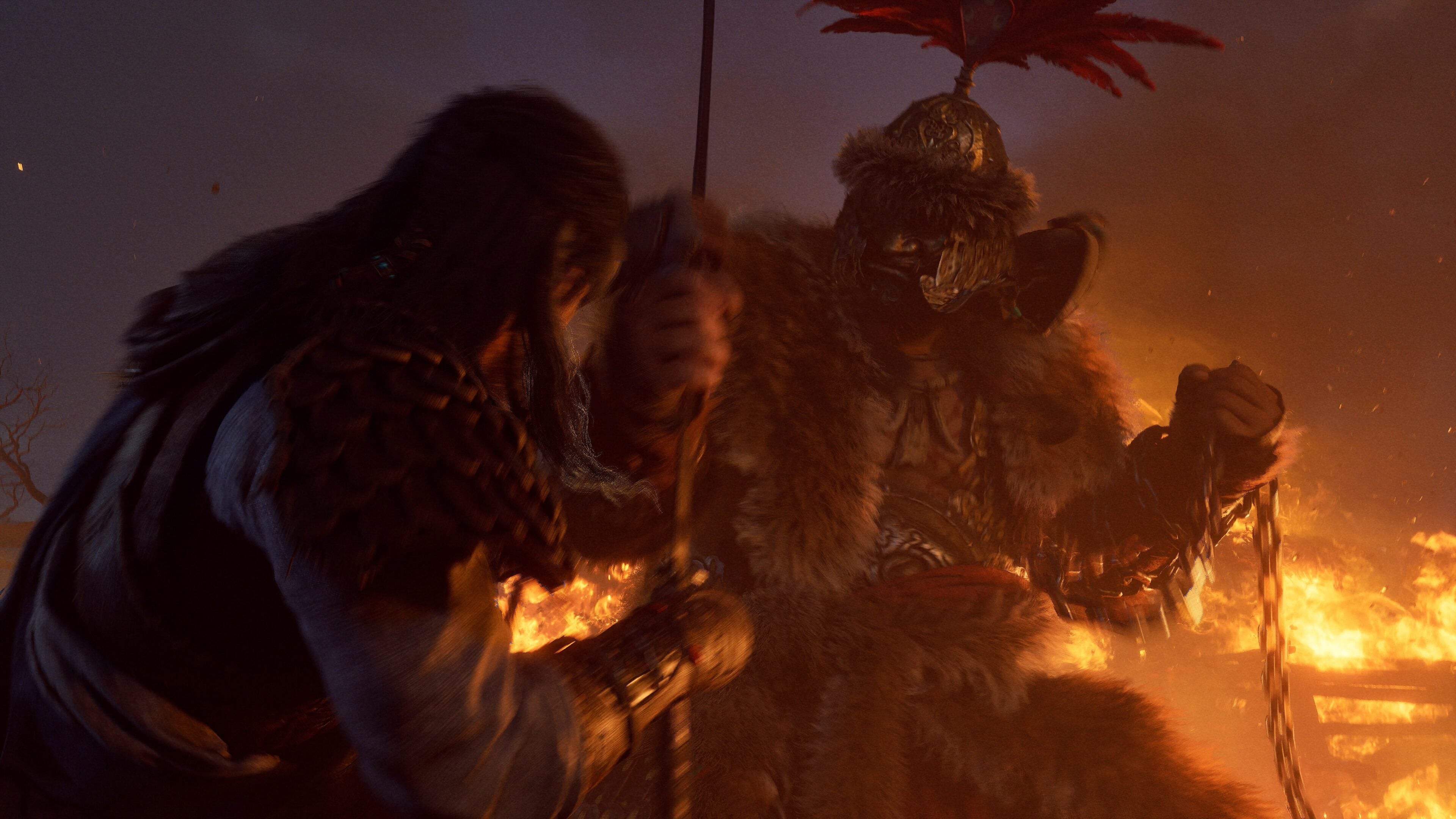
Stealth Takedowns
Stealth is presented as a real alternative path through an encounter rather than a flavor layer on top of combat. The messenger moves through shadow and uses cover to break sightlines, approach guards from behind, and remove threats quietly. Takedowns from concealment thin out a patrol before any open fight begins. Failing a stealth attempt does not end the run; detection rolls naturally into open combat, where the same sword work and grappling carry through, keeping the encounter readable rather than forcing a restart on every alert.
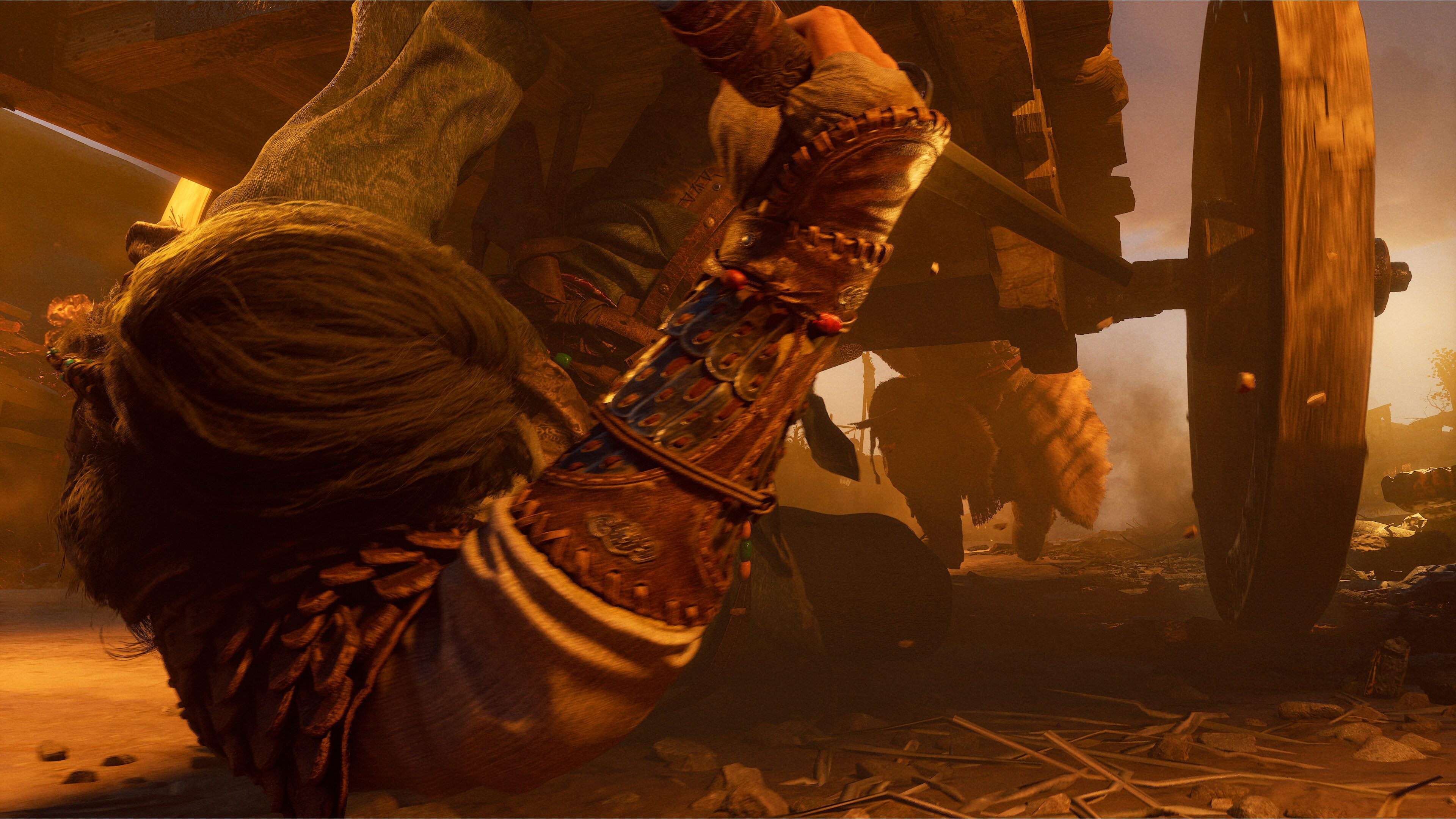
Survival in Hostile Terrain
Survival in Blood Message means surviving the route, not managing meters. The 3,000-li journey crosses Hexi Corridor deserts, mountain passes, and active siege scenarios, and the world itself is the most consistent threat. Environmental hazards, exposure, and the simple fact of moving a child through a war zone shape the pacing more than any hunger system.
This pillar ties directly back to the journey from Shazhou toward Chang'an. Each leg of the road carries a different survival pressure, and the combat and stealth pillars are tools used inside that pressure. Broader framing lives in the Overview and the wider history of the Tang Empire.
Parkour and Traversal
Movement sits alongside the three combat pillars as the connective tissue between them. The reveal showed the messenger swinging across a ravine on a rope, jumping between ledges, and clambering across rough terrain. Traversal openings let the player flank an encampment, drop into a stealth approach from above, or break a chase across ground that pursuers cannot easily cross.
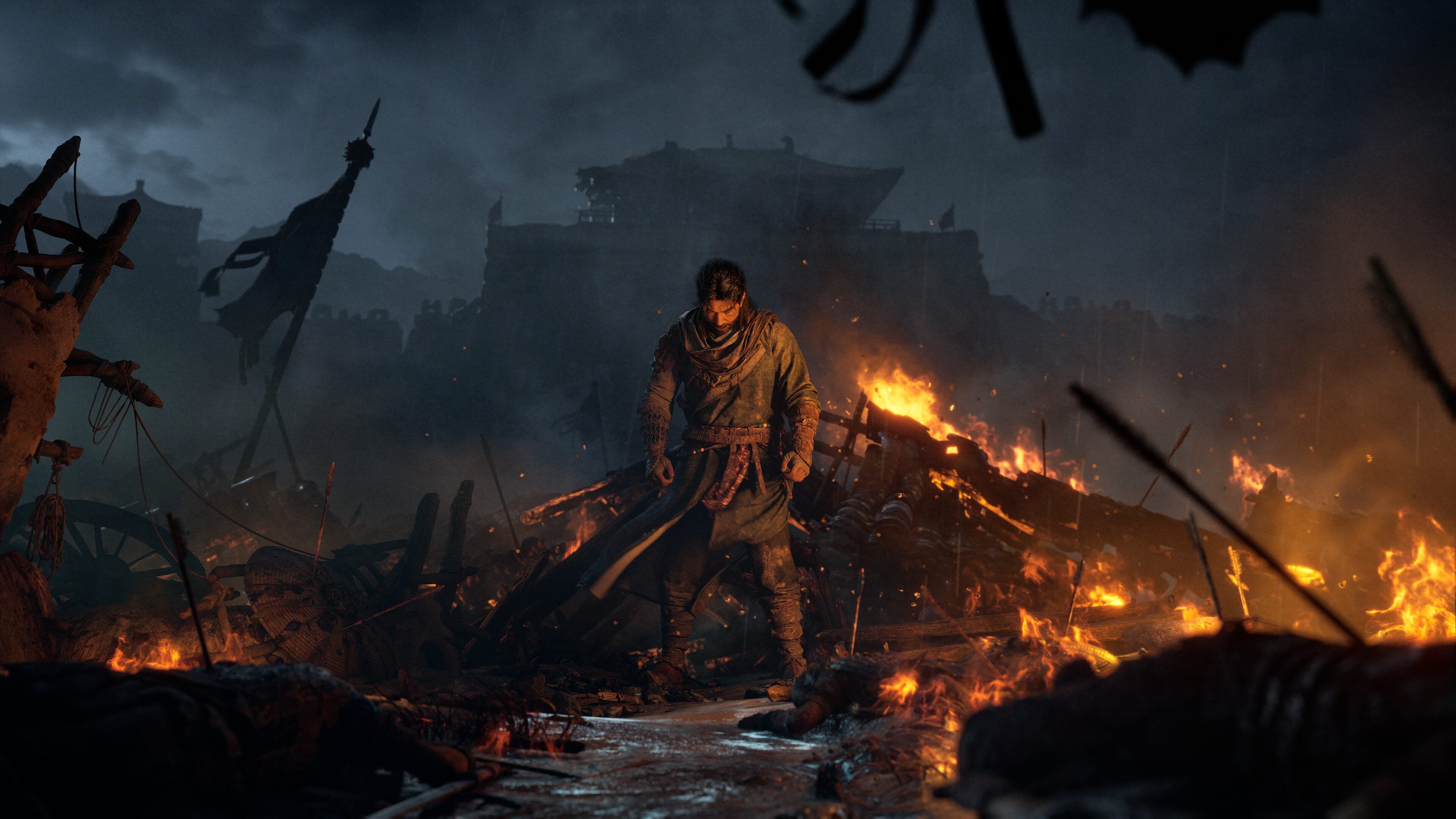
Where the Messenger Fits
All four layers (sword work, grappling, stealth, traversal) are demonstrated by the messenger in the reveal trailer. He is not a superhuman fighter; the action design is built around what an ordinary courier can plausibly do under that pressure.
Confirmed at Summer Game Fest 2026
At Summer Game Fest 2026, the studio released an official 19-minute gameplay walkthrough titled The Letter, set in Shazhou City (the messenger's home city) in an early-game build. It is the first extended look at the game running, and it put a concrete combat verb set on record. The studio frames the loop as realistic combat blended with stealth, and the walkthrough showed light attacks, heavy attacks, dodge, block, parry, counter, and execution working together into what it calls a fluid and brutal exchange.
Confirmed Combat Verbs
Verb | Role |
|---|---|
Light and heavy attacks | Two-weight sword striking, the base of every exchange. |
Dodge | Evasive movement to avoid an incoming blow. |
Block and parry | Hold to block; time a parry to turn a strike aside. |
Counter | Punish an opening created by a parry or a missed enemy swing. |
Execution | Finish a staggered or downed opponent with a dedicated kill move. |
The walkthrough also showed several situational mechanics around that core. Enemies can grab the messenger and force a sword-lock struggle that has to be broken out of. Takedowns are not limited to ground level: the messenger can surprise an enemy from behind and from above, dropping onto a target from height. He can also pick up a shield dropped by a fallen enemy and use it. The studio describes the presentation as moving seamlessly between gameplay and cutscene, with combat ramping up without a visible cut. The walkthrough additionally showed a small hammer carried on the messenger's back used to dispatch enemies, in addition to his sword, though the full weapon set has not been laid out as a list.
On the stealth side, the same demo confirmed that stealth sections are optional rather than scripted set pieces. The messenger can hide in tall grass, read enemy awareness through visibility cues, and choose between quiet takedowns and slipping past a patrol entirely, with detection rolling into open combat rather than failing the attempt. This lines up with how the Overview frames the loop and with the demo's story situation: escaping pursuit through Shazhou City while looking for the messenger's son.
The Rhythm of an Exchange
Against an ordinary soldier the exchange has a readable shape. A light-attack opener usually lands twice before the enemy blocks the third swing and answers with a counter of his own. Blocking that counter on time staggers him, and a short follow-up string then triggers the kill. The loop rewards reading the opponent rather than mashing, which is why hands-on accounts describe light and heavy attacks as something to alternate and the block as the pivot the whole exchange turns on.
The wider design is group choreography rather than duelling. There is no lock-on, no stamina bar, and none of the defensive economy an action role-playing game would use; enemies converge from several directions at once and the answer is to keep moving and repositioning. At grappling range the messenger's repertoire widens well past the sword: elbow strikes, knee strikes, trip throws, snatching a blade out of an opponent's hands, pinning him, and simply ramming him. Nothing in it is acrobatic. There are no aerial spins or held poses, and the animation set stays inside what a working man in a brawl could plausibly do.
The level geometry is part of that. Wall height, loose timber racks, a narrow squeeze, a drop in the floor: each one changes the character's stance, and he adjusts again when he passes an obstacle or brushes past another person. The result is that the space a fight happens in reads as physically real rather than as a flat arena.
Halfsword Strikes and Environmental Finishers
Hands-on coverage of the Summer Game Fest 2026 build sharpened the picture of how the sword is used. For heavy attacks the messenger shifts into a halfsword technique, gripping the blade with one hand and the hilt with the other to drive more weight behind the blow. Those heavy strikes were strong enough to cut through an enemy’s shield in the demo, while a well-timed parry opened a generous stagger window that a quick light attack or an execution could then close out. Light and heavy attacks were meant to be mixed, not spammed, with the parry acting as the pivot between defense and offense.
Finishers extend into the environment as well. Players who tried the build described luring a soldier next to a water fixture and drowning him, shoving an attacker into a wall, and otherwise turning the surroundings into a weapon. Combined with the back-carried hammer used for some of the most brutal kills, the result is a toolkit that favors improvisation. That lines up with the intent the studio described at announcement: combat meant to stay grounded while still leaving room for invention, with the player surviving by reading the moment and turning whatever the surroundings and nearby objects offer into an answer, in fights it framed as desperate and improvised rather than clean duelling. The studio’s deliberate “failing forward” design runs underneath all of it: a botched stealth prompt or a missed counter rolls into open combat or a chase rather than a reload, so a fight keeps moving even when it goes wrong.
Hands-on players of that build described the finisher list as deep and situational rather than a single fixed animation. Beyond the drowning and wall kills, the messenger can hurl a freshly killed body at the next attacker, who throws up a hand to shove it aside, or bury the blade in one soldier and hold the impaled enemy up as a shield to catch a second attacker's swing. A finisher can also be cut short mid-animation by another enemy and flow straight into a different kill, so a crowded brawl rarely resolves the same way twice.
Where the Kill Happens
Which finisher plays depends on where the messenger is standing when the opening arrives, which is why the same fight rarely resolves the same way twice.
Position | What the finisher does |
|---|---|
Open ground | A standing kill driven into the chest, the throat, or across the neck. |
Against a wall | The enemy is pinned to the wall and run through where he stands. |
Beside water | His head is forced under and held there. |
With another enemy close | A directional input turns the kill outward: the body is hurled at the next attacker, who throws up a hand to shove it aside. |
Interrupted mid-animation | Another soldier can cut the finisher short, and it flows straight into a different kill rather than resetting. |
Shield Enemies and the Guard Break
Not every soldier goes down the same way. Shield-carrying guards block ordinary light attacks outright and open with an unblockable charge, telegraphed with a red flash so the player has to dodge it rather than try to parry. Light attacks simply bounce off the raised shield, so the answer is weight: a pair of heavy strikes breaks the guard, and a follow-up prompt tears the shield away, leaving a normal armed enemy behind. A shield knocked loose to the ground can be picked up and used. Because a raised shield shuts down the usual opening, hands-on players treated shielded guards as the first threat to clear in any group fight.
Grabs, Struggles, and Quick-Time Prompts
Some exchanges break out of the normal attack loop. An enemy can seize the messenger from behind, and shaking free is a button-mash struggle; two blades can lock together into a brief overpower contest; and in one chase a soldier slams the messenger against a wall and drives a dagger toward his shoulder, resisted by tapping a prompt in time. The same quick-time prompts run through the escape sequences, punctuating the parkour so a scripted run stays in the player's hands instead of turning into a passive cutscene.
Reading Enemy Awareness
Stealth has its own readout, and it sits on the messenger rather than on the enemy. A white arc around his body means a guard has been alerted; a red arc means he has been seen outright. An alerted guard does not simply return to his patrol: he breaks off it and walks over to the spot where the noise or the silhouette came from, which turns a half-blown approach into a problem that has to be solved rather than a warning that fades on its own.
The environment can blow an approach without any mistake on the player's part. In the walkthrough footage the messenger creeps up behind a sentry and startles a few crows feeding on the ground, and the noise turns the guard around early. Routing wide of the birds instead completes the same takedown cleanly. Detection is never a fail state either way: being spotted rolls the encounter straight into open combat, which is the same failing-forward principle the rest of the design runs on.
Reading a Fight Without a Health Bar
Blood Message keeps the interface almost bare. There is no health bar and next to no on-screen readout during combat, and a single clean hit can be lethal, so the player reads the state of a fight from animation, footing, and audio rather than from a meter. That stripped-down presentation is a deliberate design choice, and it pushes the player to judge every parry and dodge by feel.
Controls in the Demo Build
One hands-on account of the Summer Game Fest 2026 demo recorded the control layout it was played with. These map to that early build and could change before release.
Action | Input (Demo Build) |
|---|---|
Light attack | R1 |
Heavy attack | R2 |
Block and parry | L1 |
Dodge | Circle |
Environment interaction | Triangle |
Climb | Cross |
Crouch | Square |
How the June 2026 Build Handled
The build shown in June 2026 was described by the studio as mid-development and captured from an early slice, and press who played it were candid about the seams. Enemies in a crowd sometimes queued rather than committing together, leaving the messenger trading with one soldier while another waited his turn. The level design deliberately keeps signposting light so that interactive objects blend into the set dressing, which reads well but makes it easy to lose the thread in an unfamiliar room. The camera could also wedge itself into an unusable angle when a fight pushed into a corner, leaving the player judging incoming attacks by sound.
On the technical side the demo ran on a desktop machine with a current high-end graphics card, appeared to be running at 4K, and held above 60 frames per second for most of the session, including the crowded brawls. A few cutscene transitions stuttered. No clipping, texture, or crash faults were reported. None of this is a launch-quality guarantee; the studio attached its own notice to the footage that the build does not represent final quality.
Unconfirmed Details
Several specifics still have not been publicly detailed by the studio and should be treated as open questions. The Summer Game Fest 2026 showing in June 2026 put a great deal more of the combat system on record (covered in the section above), but the points below remain unanswered:
The full weapon catalog beyond the sword and the back-carried hammer shown in the walkthrough.
Whether character growth is handled through skill trees, item upgrades, or another structure.
Parry timing windows, dodge i-frames, and other precise defensive tunings.
Named adversaries, boss-style encounters, and recurring antagonists.
Difficulty modes and any accessibility-focused combat options.
Precise inputs and counter-options for individual takedown and execution prompts beyond what the walkthrough demonstrated.