

This article is a stub
It lacks sufficient information and needs to be expanded. You can help by adding more content.
Nothing a player builds in Anvil Empires stands on its own. Every structure begins to decay after a grace period, and the only way to stop it is to keep Silver flowing into the structure that controls the area. This is the mechanic that stops the map filling up with abandoned buildings, and it is the reason a settlement needs an economy behind it rather than just a builder.
Grace Period
A newly built structure does not start decaying immediately. Most structures have a one-hour grace period. A Homestead Keystone gets three hours, which gives a new player time to establish themselves before the clock starts.
Decay Timers
Once decay begins, how long a structure survives depends on its tier. Higher-tier construction is more durable as well as more expensive.
Structure Tier | Time to Decay |
|---|---|
Tier 1 | 24 hours |
Tier 2 | 48 hours |
Tier 3 | 72 hours |
A handful of structures use their own timers instead of the tier default:
Structure | Decay Time |
|---|---|
Firepit (Tier 1) and Mantlet | 6 hours |
Homestead Keystone (Tier 1), Fortress Keep (Tier 1), Camp Town Center (Tier 1) | 8 hours |
Crafting Table | 12 hours |
Aqueduct pieces, including straight sections, slopes, and pumps | 96 hours |
Preventing Decay
Decay is held off across an entire area by placing Silver in the inventory of the structure that controls it. That controlling structure is a Town Keep, a Fortress Keep, a Homestead Keystone, or a Camp Town Center, depending on what kind of site it is. Everything inside the area is covered by the same payment, so upkeep is a settlement-level bill rather than a per-building one.
Upkeep Rates
The base cost starts at one Silver per hour. Each additional structure raises that figure by roughly 0.07 Silver per hour, which works out to about one extra Silver per hour for every fourteen structures added.
The MS 68 build inflated Silver values across the economy tenfold, covering upkeep, rent, pledging, and status costs, so upkeep figures observed in older tests no longer compare directly to current ones. The rates above reflect the current build.
Cost | Rate |
|---|---|
Base upkeep | 1 Silver per hour |
Each additional structure | About 0.07 Silver per hour |
Rough conversion | About 1 extra Silver per hour per 14 structures |
Each reinforced foundation piece | 3 Silver per hour, after a 12 hour delay |
A few structures do not decay at all and therefore add nothing to the bill. Some Tier 2 crenellation pieces are in this group.
Reinforcement Changes the Maths
Reinforcing a keep foundation is the single most expensive thing a settlement can do to its upkeep. Each reinforced piece is charged a flat three Silver per hour, more than forty times the cost of an ordinary structure, and that charge starts twelve hours after the piece is built. In exchange the piece gains eighty percent damage resistance, which is the same as roughly five times its health against siege damage.
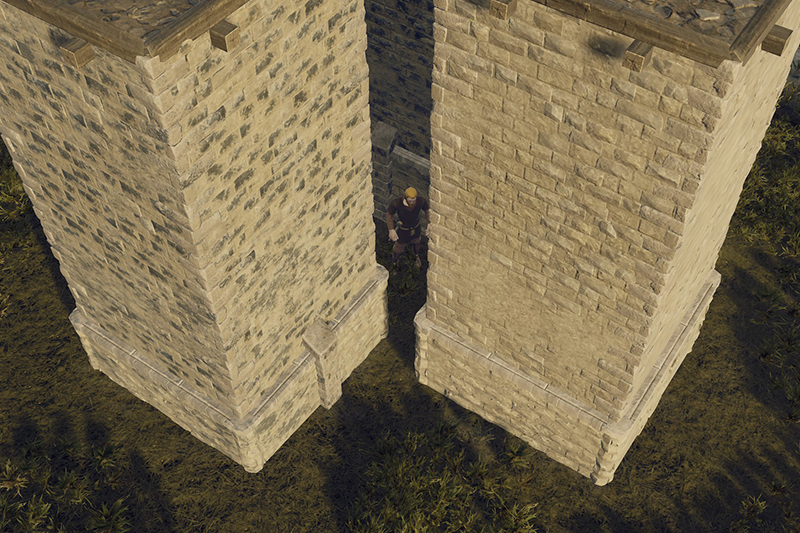
Reinforcement costs one Reinforced Wood per piece and can only be applied by a Lord or a Thane, so it is a leadership decision rather than something any member can do. The twelve hour delay before the buff activates means a settlement cannot reinforce its walls once an attack is already inbound.
Practical Consequences
A settlement that sprawls gets expensive fast. Fourteen decorative or redundant buildings cost the same upkeep as a full extra Silver per hour, indefinitely.
Bounty income and trade both feed upkeep, which is why bounty boards and marketplaces sit at the heart of established towns.
An abandoned settlement collapses on its own within a few days, so ground taken during a war does not need to be demolished piece by piece.
A fully reinforced keep is a strategic commitment. The Silver spent holding walls up is Silver not spent on equipment or supply.