

This article is incomplete
Some sections are missing or need additional details. Help improve it by contributing.
Total War: Warhammer 40,000 is built on the signature Total War formula of a turn-based strategic campaign layer combined with real-time tactical battles. Players manage their forces and expand their territory on the campaign map turn by turn, then drop into direct control of their armies when battles are triggered. The game introduces several systems new to the series, including destructible battle environments, occupiable cover zones, dragged orbital bombardments, deep army customisation, and a meta-progression layer above individual campaigns.
The Total War Formula
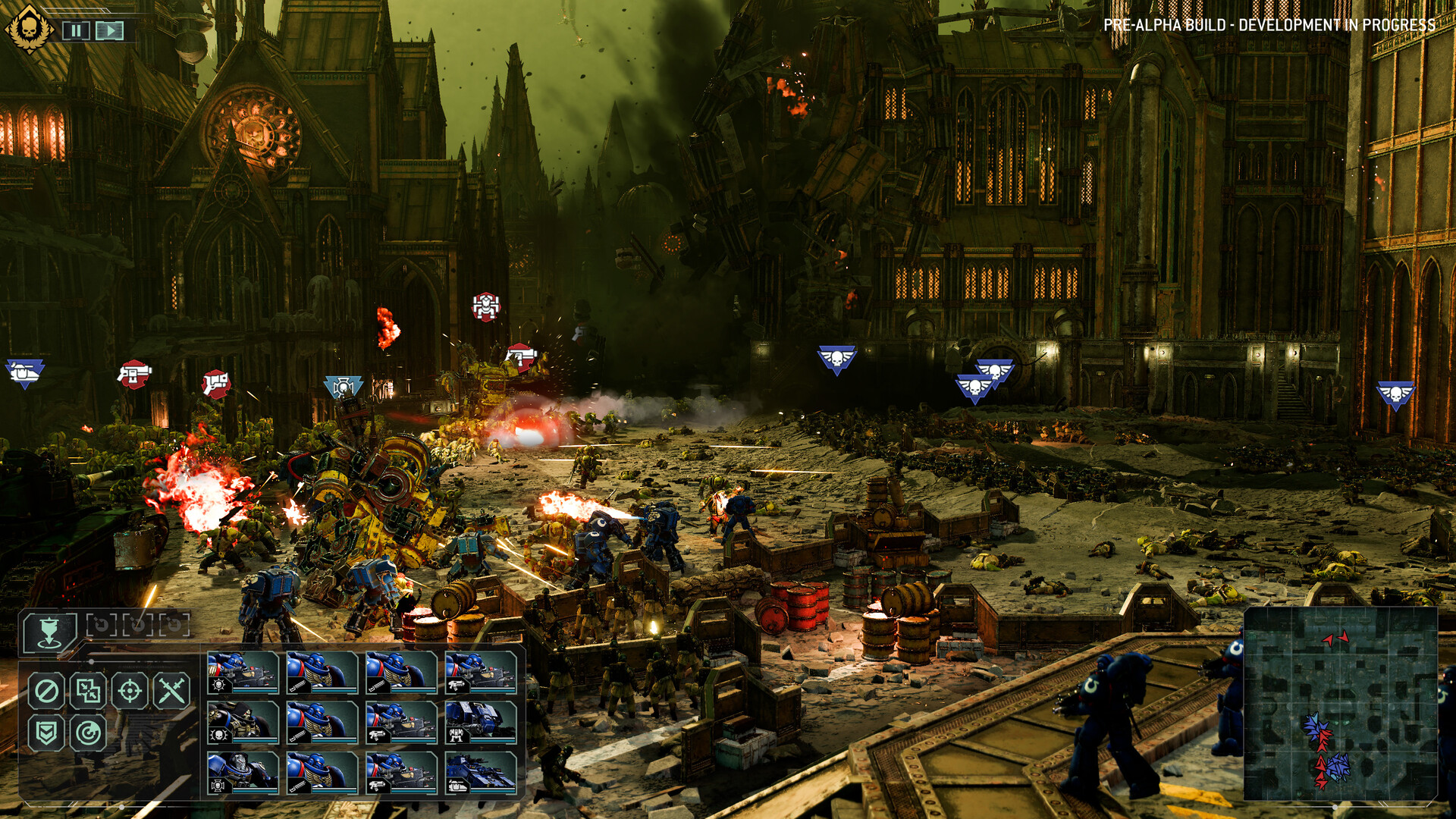
The dual-layer structure will be familiar to veterans of the series. On the campaign map, players take turns capturing regions, moving fleets between planets through Crusade Theatres, and navigating the strategic situation across the 41st Millennium. When armies meet in conflict, the game transitions to a real-time battle in which the player directly commands units across a detailed tactical map. This is the first time the mainline Total War series has launched on consoles. PC, PlayStation 5, and Xbox Series X|S will all receive the game simultaneously, and Steam Workshop mod support is confirmed for the PC version at launch. The game is built on a new internal engine called Warcore.
June 2026 Gameplay Reveal
The first proper look at in-development battle gameplay came during the PC Gaming Show on 7 June 2026, presented alongside a behind-the-scenes developer feature. The footage showed the Astra Militarum clashing with the Orks on the Shattered Expressway, a war-torn stretch of Armageddon, with cover-based firefights and massed unit clashes. Creative Assembly used the same showcase to open registration for the Closed Beta.
Destructible Environments
Battles take place on maps with extensive destructible environments. Buildings can be demolished, forests can be cleared to open lines of sight, and structures can be collapsed onto units below. The destruction layer is described by the development team as the largest mental shift for the series in years: terrain is no longer just a static stage but an instrument of war. Each impact reshapes the battlefield, creating new cover and fresh tactical opportunities.
Extended gameplay shown at the BiliBili World 2026 exhibition in July 2026 underlined how far this destruction reaches. Buildings and objects across a map can be levelled to open new routes, so tearing down a wall can create a fresh line of advance rather than just clearing scenery. Heavy units and armour flatten obstacles as they move, and some terrain cuts the other way: boggy ground slows units that push through it, which gives a defender a way to funnel an attack.
Cover Zones and Building Garrisons
Maps feature designated cover zones where units can take shelter from incoming fire, with the additional option to occupy buildings inside those zones. In one Show and Tell sequence a squad of Astra Militarum Guardsmen was shown garrisoning the upper floor of a building and firing down at attackers, a tactical layer the series has not used before. Different factions value cover differently: heavy ranged armies want to keep their delicate units in cover at all costs, while assault-oriented factions are expected to demolish cover and push forward through the ruin. The reveal footage hinted at the cover system without walking through its full rules.
The July 2026 footage set out the cover rules more plainly. A unit placed in a cover zone or against a solid structure gains two things at once: its defence goes up and the chance of enemy fire landing on it goes down, which makes walls and buildings ground worth holding. Not every unit benefits equally. Heavy assault troops built for close combat gain little from hunkering down and do better pushing forward, so cover rewards a player who can tell fragile shooters apart from brawlers.
Ranged Combat
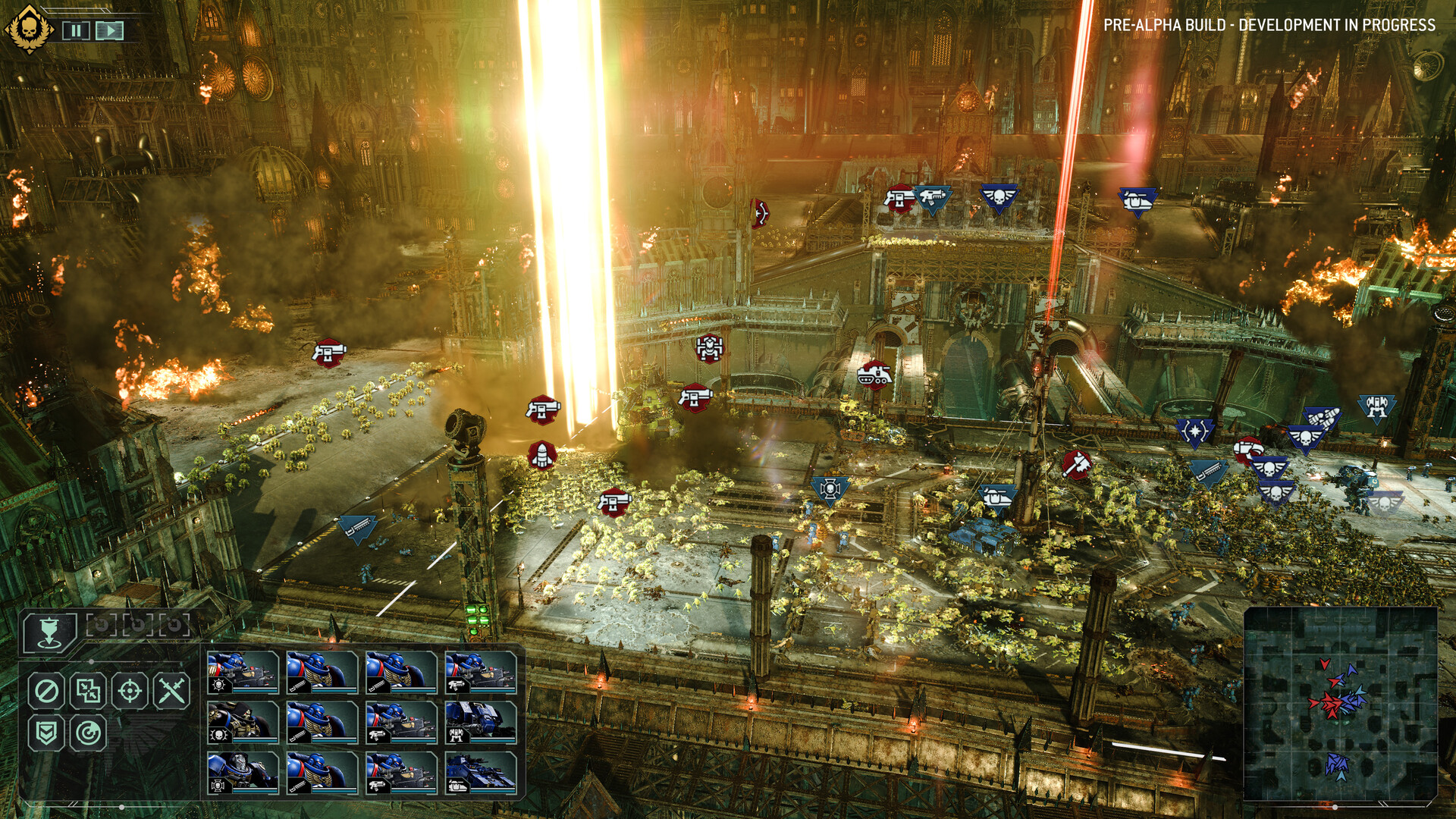
Almost every unit in Total War: Warhammer 40,000 shoots something, and Creative Assembly has rebuilt the series' ranged combat around that fact. A developer livestream on 23 July 2026 walked through the system in detail, using the Armageddon battle between the Astra Militarum and the Orks as the worked example.
Cover, Evasion and Height
Cover zones are placed on maps in advance. A unit inside one gains evasion, a defensive stat representing its chance to avoid incoming fire, so shots aimed at it are more likely to pass high, low or wide than to connect. Cover is also physically simulated: sandbags, walls and other solid objects stop projectiles in flight, and sustained fire destroys them.
Elevation is the counter to cover. A unit firing down from higher ground gains an accuracy bonus and shoots over the obstacles that would otherwise absorb its fire, which the team describes as the direct answer to a dug-in enemy. Holding high ground while in cover is stronger again, and remaining in cover is still better than standing in the open.
Firing Cycle and Projectiles
Every projectile is individually simulated rather than represented by an effect. Shots travel on a real arc and can strike terrain, buildings or an unintended target on the way, and a deflected round can bring down a destructible structure. The engine was given physics sub-steps below its usual tick rate specifically to handle the volume of fire two full armies produce, which can run to hundreds or thousands of rounds in the air at once.
Each soldier runs a full firing cycle rather than a single abstract attack: acquiring a target, aiming, settling, firing, absorbing recoil, then resuming. Several values control it.
Value | What It Controls |
|---|---|
Aim time delay | How long a soldier takes to pick a target and settle before the first shot |
Rate of fire | How quickly rounds leave the weapon once shooting begins |
Mid-burst delay | The recovery pause inside a burst while recoil is brought back under control |
Burst size | How many rounds make up a single burst |
Bursts per magazine | How many bursts a soldier fires before reloading |
Reload speed | How long the reload itself takes |
State is tracked per soldier. A trooper interrupted after three of five rounds keeps the remaining two, fires them when next ordered, and only then reloads. Units do not exhaust their ammunition over a battle: the magazine cycle paces their fire rather than capping it. Trees and similar scenery block shots and are destroyed by them.
Suppression, Flanking and Morale
Sustained fire suppresses a target, degrading what it can do while it is pinned. Flanking fire is handled separately and weighs heavily on morale, which is present in the game and works alongside casualties, so breaking an opponent's will is a route to victory in its own right. Frontage matters for the same reason: a wide firing line brings more weapons to bear on a target than a deep column can.
Movement, Strafing and Sentry Mode
Most units can fire while moving, because upper and lower body animation is handled separately and troops repositioning under fire keep their weapons up. Strafing sideways or backwards while shooting is available to nearly everything, at a cost: moving and firing reduces accuracy for ordinary infantry, while some units are far better at it than others.
Sentry Mode lets a player mark a specific enemy before it is in range. The marked unit holds its position in cover and opens fire the moment that target can be hit, so troops do not break a good position to chase something else. A sentry order can be combined with a move order, keeping the painted target prioritised while the unit relocates. Line of fire is tracked for each soldier rather than for the unit as a whole, so individual troops choose targets from what they can actually see, and a soldier whose view clears when a comrade falls can start shooting. Hovering over an enemy shows whether the line of sight is clear or broken before the order is given.
Grenades and Systemic Destruction
Soldiers can carry more than one weapon and switch between them by context. Each group inside a unit has a primary weapon, usually its longest-ranged all-rounder, plus secondary options gated by range or by target type. Frag grenades are used against infantry and krak grenades against armoured targets, grenade launchers arc their shots over cover, and flamers are one of the counters to an enemy sheltering behind it.
Wrecks and deaths are handled systemically. A destroyed vehicle can veer off, crash and explode rather than simply stopping, splash damage from those explosions catches nearby troops, and units carrying volatile equipment can detonate. An overcharged plasma weapon can kill the soldier carrying it.
Shooting does not replace melee. The development team has been clear that practically every unit carries both something to shoot with and something to punch with, in some cases a power fist, and that massed forces still crash into one another the way they do in earlier games in the series. The rebuilt ranged systems sit on top of that rather than in place of it.
Orbital Bombardment
Fleet assets play a direct role in battle through orbital bombardment abilities. Beyond preset strikes, the developers have demonstrated an orbital lance ability that the player can drag across the battlefield as it fires, sweeping a line of destruction rather than landing on a single point. Aerial strafing runs and artillery bombardments are also available as deployable abilities, with the specific menu of options determined by faction. In the campaign layer, fleets can also fire off-map bombardments at planetary regions before ground forces are committed.
The same showing tied orbital power to the fleet holding position above a battle. Capital ships in orbit over a contested world grant extra orbital abilities during a siege, including strikes aimed at the most dangerous enemy units on the field, so keeping a strong fleet overhead feeds directly into the ground fight.
Battle Objectives
Some real-time battles feature directed objectives beyond simply defeating the opposing army. Examples described by the design team include capturing orbital defence cannons during a planetary assault and rescuing Astra Militarum survivors when playing as the Space Marines. This direction is closer to objective-based tactical games than the open-field engagements typical of prior Total War titles.
Battles are not always started from a clean deployment. The developers have described arriving at a fight already under way, so a player may drop into a battlefield where two other forces are engaged: turning up as Space Marines to find an Astra Militarum force about to be overwhelmed by Aeldari, for example, or as Orks to find an Astra Militarum army already in the field. The framing the team uses is that the player is the flashpoint, fighting the engagement that decides a continent while war continues everywhere else on the planet.
Army Customisation
Total War: Warhammer 40,000 introduces a level of army customisation Creative Assembly has described as tabletop-style freedom and as a first for the Total War series. Players can name their warband, choose its colour scheme, design heraldry and iconography, and tailor each force's wargear, signature traits, and tactical abilities. The system applies to all four launch factions, and is offered alongside renowned named sub-factions and warlords drawn from established Warhammer 40,000 lore.
Unit Categories
Unit types described in broad strokes across the reveal and developer materials include battleline infantry forming the core of most armies, tanks and armoured vehicles providing heavy firepower, walkers bridging the gap between infantry and vehicle, and colossal war engines representing the largest single units on the battlefield. The Ork Stompa is an example of the colossal war engine category.
The June 2026 reveal showed the first named unit rosters, both for the Armageddon battle. The Astra Militarum fielded Cadian Shock Troops, Kasrkin, Ogryns, Sentinels, and the super-heavy Baneblade tank, while the Orks brought Boyz, Gretchin, Stormboyz, Deff Dreads, and a Stompa. Full rosters for the Space Marines and Aeldari have not yet been detailed. See the faction pages for the unit breakdowns shown so far.
Unit Composition and Unit Cards
Units are not uniform blocks of identical soldiers. A single squad can contain several groups of entities with different profiles, gear and weapons, so a line unit might field ordinary troopers alongside a Commissar and a Vox caster, each with their own stats and loadout. Elite squads can mix weapon types inside one unit.
Unit cards therefore carry more information than in earlier games in the series. A basic view shows the core figures, and an expand control opens a more advanced tab with the full stat set, including melee values. Targets are grouped into light, medium and heavy categories that broadly track how many entities a unit has and how well protected it is: light units come in numbers with little armour, medium units are smaller and better armoured, and heavy units are single, very tough models. A card shows what its unit is tuned to damage in those terms.
Specialists and sergeants attached to a squad shift its profile by roughly a fifth toward a different role, for example adding armour-piercing capability or improving performance against light targets. The developers have said a player who wants to position for every weapon in a mixed unit can do so, while a player who does not will still see the unit pick sensible targets on its own.
Reserves and Army Abilities
Armies can hold part of their strength off the field. A player may deploy reserves at the start or keep them back and commit them as a battle develops, and the balance of power bar accounts for reinforcements that have not yet arrived. The Space Marines have been described as bringing reserves in by drop pod and Thunderhawk.
Army abilities sit alongside orbital and aerial support. For the Astra Militarum they take the form of Regimental Orders, which reach only units standing near command elements and voxcasters. Psykers have been referenced by the development team as a source of unit abilities, though the implementation has not been detailed. Named heroes are fielded with customisable bodyguard units rather than as lone models.
Each faction reaches the battlefield differently. Space Marines arrive by drop pod and Thunderhawk, and land hard enough to flatten buildings. The Astra Militarum have the fewest direct insertion options and commit wave after wave of infantry instead. The Orks teleport units in, with a Weirdboy throwing a mob of Boyz into the enemy line. The Aeldari use Webway gates to appear in unexpected places. The balance of power bar reflects this by showing what has already deployed separately from what is still to arrive.
Faction combat doctrines are a further layer. The development team has confirmed that every faction has doctrines, and that a player tailors a faction's combat philosophy for campaign and battle through them, alongside the traits and tactical abilities covered under army customisation.
Blood and Dismemberment
Blood and dismemberment effects are part of the base game rather than a separate purchase, in keeping with the grimdark visual language of the Warhammer 40,000 setting. This is a tonal departure from many earlier Total War entries.
Multiplayer Modes
Single-player, online player-versus-player, and co-operative campaign modes are all confirmed. All three campaign lengths (full, short, and single decisive battle) are available across these modes. The specific breakdown of which campaign options work in each multiplayer configuration has not been detailed in pre-release materials.
The PlayStation 5 store listing puts a number on the multiplayer ceiling: the game supports up to eight online players, with a subscription required for online play and online play itself optional. The same listing records single-player as a supported mode and notes controller vibration and trigger effects. No equivalent player-count figure has been published for the PC or Xbox versions.
Space Anomalies
Concept art and developer commentary indicate that the space between planets is not empty. Anomalies seen in pre-release materials include what appears to be an Ork asteroid fortress, a citadel-like structure, and an object resembling a space hulk. These are presumed to be encountered as random campaign events as fleets traverse Crusade Theatres, although the exact mechanics have not been detailed.
Fleet Combat
Fleets transport armies, drop forces into battle, deliver off-map bombardments and grant vision across the campaign map. The developer roundtable of December 2025 described fleet roles only in those terms, but the development team has since said that two fleets meeting one another does produce an engagement. What that engagement actually looks like has not been shown or detailed, so the shape of fleet-versus-fleet combat remains open rather than ruled out.
Pre-Order Content
Creative Assembly has confirmed that there is no pre-order downloadable content for Total War: Warhammer 40,000. Pre-order bonus details will be shared closer to launch.
Platform Features
The PC version's store listing sets out the following supported features.
Feature | Detail |
|---|---|
Modes | Single-player, multiplayer and online player-versus-player |
Achievements | Supported |
Controller support | Full controller support, including DualShock and DualSense pads |
Family sharing | Supported |
Languages | Thirteen supported languages, with full audio in English, Japanese, Simplified Chinese and Traditional Chinese |
Operating system | Windows 10 64-bit listed as minimum and Windows 11 64-bit as recommended; no processor, memory or graphics tiers have been published |
Content note | Flagged for graphic and realistic depictions of physical conflict, weapons, injury and death |