Featured Article
This article has been recognized for its exceptional quality and comprehensive coverage.
Overview
The God Slayer is an open-world action RPG developed by Pathea Games and published by PM Studios. Sony provides development support and marketing through its China Hero Project Phase 3 initiative. The game's Steam description reads: "Enter an Eastern-inspired steampunk metropolis where gods known as Celestials reign with a divine fist. In this premium open-world RPG, you are an Elemancer who refuses to bow."
Built in Unreal Engine 5, The God Slayer blends Eastern fantasy aesthetics with industrial steampunk technology. Players control Cheng, an Elemancer who channels Qi through the five classical elements, on a quest to liberate humanity from the divine Celestials who rule as gods over the city of Zhou, a densely populated capital inspired by Chongqing, China.
The God Slayer is planned for release around 2027 on PC (Steam, Epic Games Store), PlayStation 5, and Xbox Series X|S. The single-player campaign spans seven chapters with an estimated 40-hour runtime, each chapter ending in a major boss encounter. There are no multiple endings. Creative director Zifei Wu has been direct about the scope: "There's not going to be multiple endings because... our budget is only that big."
The game supports 9 languages (English, French, German, Spanish, Japanese, Simplified Chinese, Traditional Chinese, Korean, and Russian) with full voice acting in English and Mandarin Chinese. It carries a content warning for partial fantasy violence, use of alcohol, and use of tobacco or references.
Gameplay
The God Slayer is a martial arts action RPG built around elemental combat and player creativity. The Elemancer system maps four active attack elements to controller face buttons: Fire, Water, Earth, and Metal. The fifth element, Wood, is passive, providing stat boosts and defensive objects rather than direct attacks. Trigger buttons toggle between elements, allowing instant switching mid-combo without menus or cooldowns.
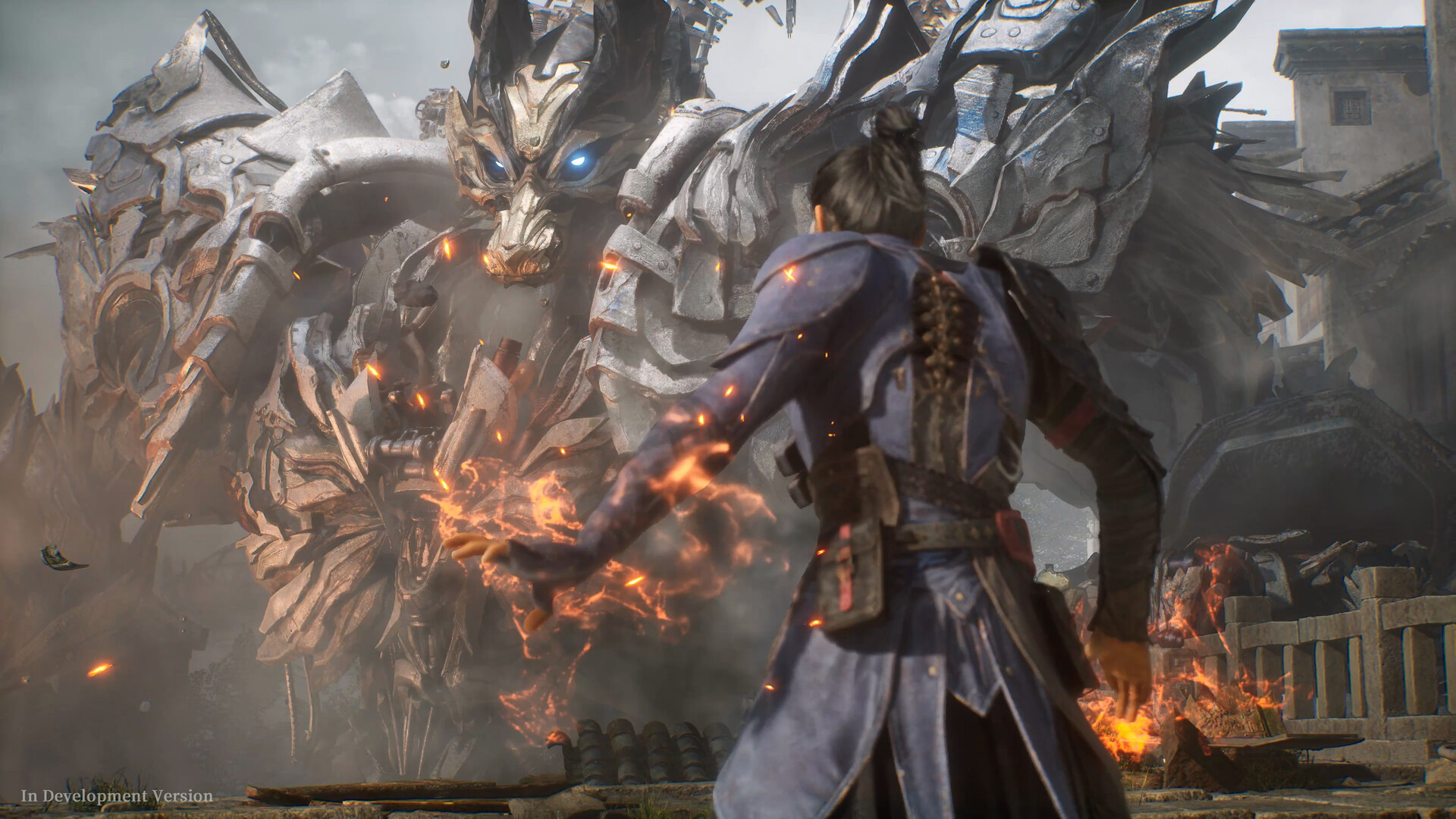
Elements interact dynamically with each other and the environment. The gameplay trailer showed several of these interactions: toppling a water tower to flood a street downhill, then freezing soaked enemies solid; flipping a table during a restaurant fight; ripping rooftop tiles loose for offense and defense during a chase; and chaining a fire-to-water-to-metal combo finish in a single sequence.
The combat system draws from martial arts cinema (Jackie Chan, Jet Li, 1980s Hong Kong films) and games like Sifu and Batman: Arkham. Cheng fights primarily with his fists, augmented by elemental Qi. Weapons dropped by defeated enemies can be picked up and wielded. Missions can be approached through direct combat, stealth, bribery, elemental diversion, or hidden routes.
Setting
The game takes place in Zhou, a sprawling metropolis at the confluence of two rivers emptying into the Eastern Sea. The total map is roughly 5x5 km, with the city proper covering about 3x3 km of dense, vertically layered urban space. The city blends Ming Dynasty-era Chinese aesthetics with industrial steampunk technology: airships float above streets, steamboats travel the rivers, monorails cut through industrial districts, and steam vehicles share roads with traditional market stalls.
Beyond the city walls, the world includes dungeons, underground areas, ancient temples, rice fields, and small villages. Society within Zhou is sharply stratified. Upper-class districts have air-conditioned homes and mechanical washing drums, while the poor labor in exploitative factories.
Story
The narrative follows Cheng, a survivor of The God Fall, a catastrophic night when the Celestials assaulted the Zhou Kingdom, slaughtered its king, and hunted down Elemancers. Cheng's family was killed during this purge. Now living under Celestial rule, Cheng joins the Star Fall Society, an underground resistance movement, and trains under The Master to hone his elemental abilities. The seven chapters follow his path from resistance fighter to the titular God Slayer.
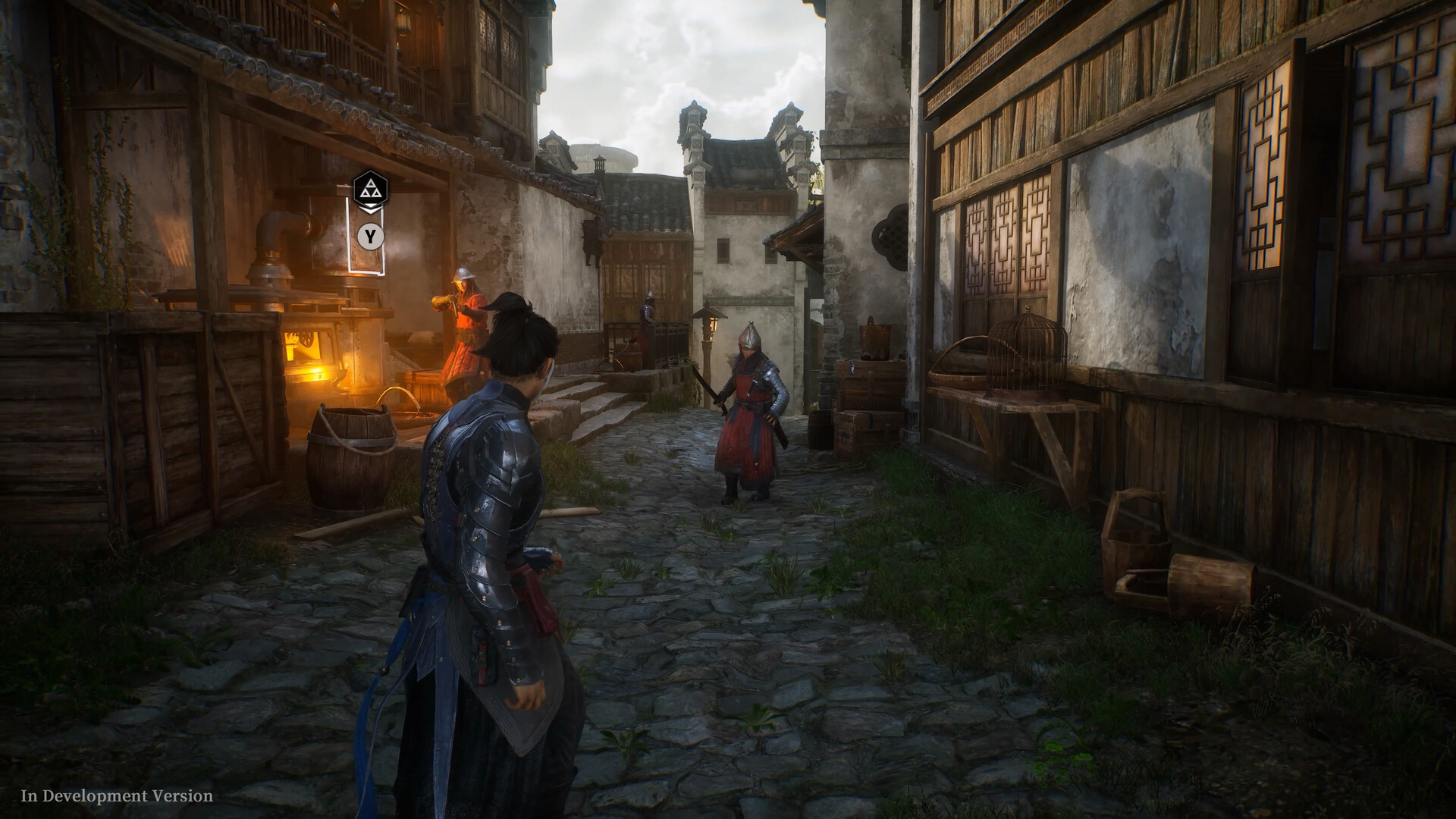
A dual identity system lets Cheng operate masked as a vigilante during missions and unmasked as a civilian in the city, similar to Batman's Bruce Wayne/Dark Knight dynamic. NPCs have their own schedules, relationships affect quest options, and choices in side content meaningfully impact main story difficulty.
Development
Pathea Games, founded in 2012 and based in Chongqing with roughly 160 employees, is best known for the My Time series. My Time at Portia alone earned over 130 million yuan in revenue. The God Slayer is a sharp tonal departure from those cozy simulation games.
The game was first announced at ChinaJoy in July 2023 as part of Sony's PlayStation China Hero Project. It was re-revealed in December 2025 with a CG trailer and a seven-minute gameplay demonstration. Pathea built an in-house motion capture facility for the project, hiring real martial artists and actors to capture combat and cutscene performances. Creative director Zifei Wu has cited influences ranging from Avatar: The Last Airbender to Shadow of the Colossus to Spider-Man.
Difficulty
The God Slayer offers two difficulty modes: Story Mode targets what the developers call "the Final Fantasy crowd," allowing casual play with the option to overlevel past boss bottlenecks. Challenge Mode scales enemies to the player's level and punishes mistakes harshly. The developers aim to make the game accessible to a broad audience while still satisfying action-RPG veterans.