

This article is incomplete
Some sections are missing or need additional details. Help improve it by contributing.
The premise of Swords of Legends is rooted in the order of the Underworld and the authority of the Judge of King Yama, a figure of the netherworld drawn from classical Chinese belief. It is by this Judge's command that the hero, Sipan, is returned to the mortal world as a reborn Arbiter of the Underworld.
Sipan's charge is to seek out souls who cannot find their way home. The work is described in clear steps: listen to each soul's story, sever the worldly ties that bind it, and ferry it across the sea of birth and death. Rather than simply destroying enemies, the Arbiter mediates between the realm of the living and the realm of the dead, guiding the departed onward.
This underworld framing shapes the whole adventure. The hero moves through a world where mortals, gods, and wandering souls walk the same earth, and the act of capturing and judging souls feeds directly into how battles play out. Souls that are caught can return to the field as allies through the Spirit Companion System.
The Office of the Sipan
The team has described the office in more detail than the store copy does. Yanluo, Lord of Yama, is said to have established a position called the Sipan, Judge and Arbiter of Life and Death, and it is that post the player character holds. Sipan is therefore a title rather than a personal name, a point the official English material makes when it says players take on the title of Si Pan, an Underworld Enforcer. The role is set out under Sipan.
Wangchuan, the Boundary
The crossing between the underworld and the world of the living is named Wangchuan, and how it is presented follows from how the team reads the setting. In this tradition life and death are not treated as opposites walled off from one another, so the boundary is staged as beautiful and romantic rather than bleak, which is a deliberate departure from the way an underworld frontier is usually drawn.
Settling a Soul Without a Fight
Not every soul the hero is sent after has to be beaten down. The team has confirmed that combat is one route among several. Some of the dead who refuse to leave are genuinely malign and need rites of deliverance performed over them; others are simply held in place by an attachment, a grievance or a wish left unfinished, and the work is to help settle it. Story scenes and other forms of interaction carry as much of that as fighting does.
This is what the office actually consists of, and it is why each of the encounters collected under Bosses closed on a different settlement screen in the hands-on build. A soul whose attachment runs deep enough can be bound and taken along, which is the point at which the duty turns into the Spirit Companion System.
The Judge's Hall
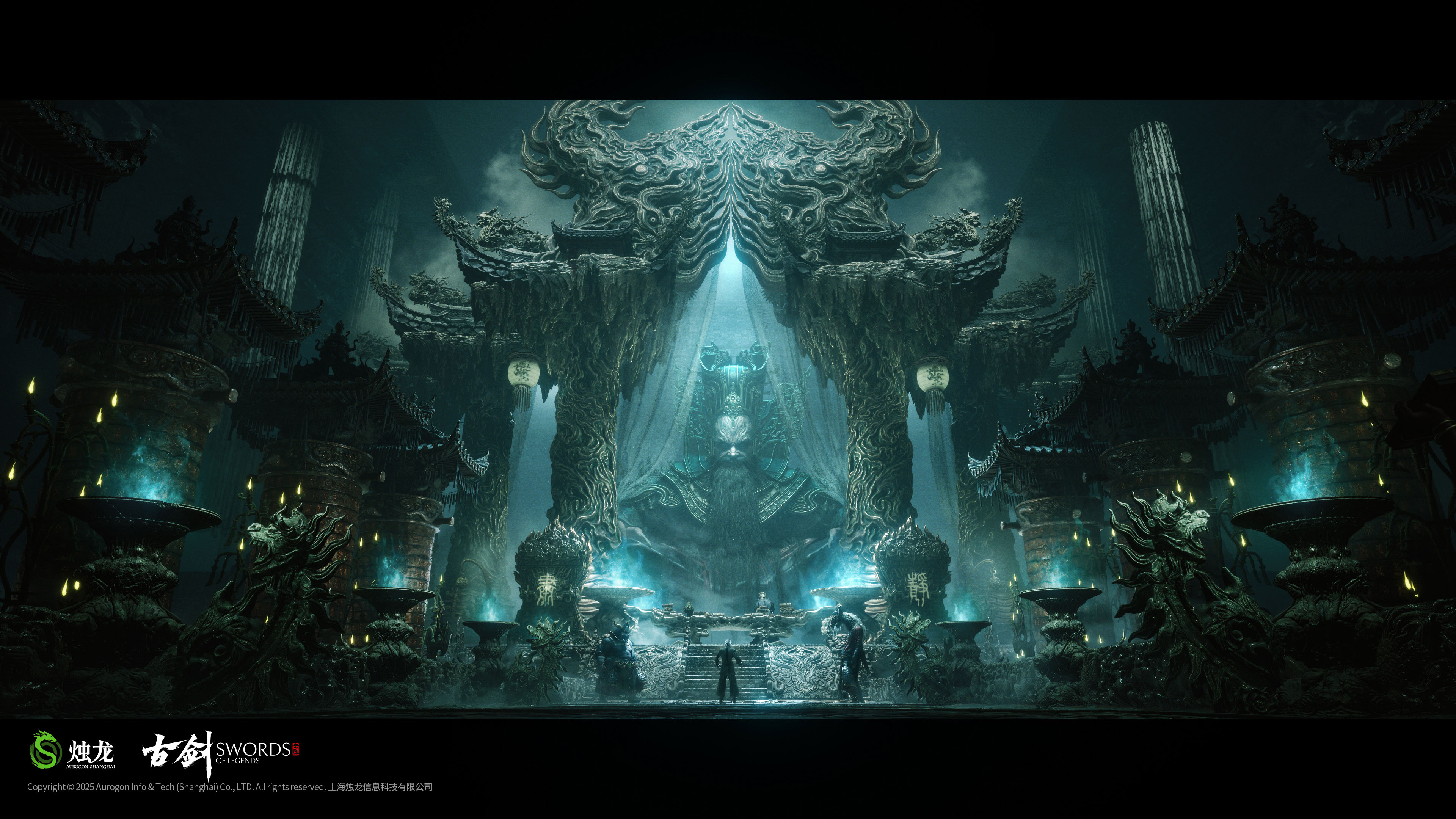
Official key art gives the only look so far at the hall itself, and it is staged as a court of law rather than a temple. An enormous crowned and bearded figure sits enthroned behind a hanging gauze curtain at the head of a stair, flanked by two heavy guardians, while a single small figure stands at the foot of the steps. Tiered halls and pillars fall away into the dark on both sides, lit by pale ghost-fire burning in rows of bronze basins. The two great bronze vessels nearest the dais each carry one seal-script character, the pair traditionally set out to command silence in a Chinese magistrate's court. The staging matches the way the game frames the office of the Sipan as a post with duties rather than a heroic calling.
The Underworld is one of three realms alongside Heaven and the mortal world. Earlier stories from the studio were set mostly in the other two, so an adventure anchored in the Underworld and its bureaucracy is the deliberate change of vantage point for this entry rather than a continuation of an existing thread.
For the broader land these events take place in, see World and Setting, and for the hero who carries out these duties, see Sipan.