

This article is incomplete
Some sections are missing or need additional details. Help improve it by contributing.
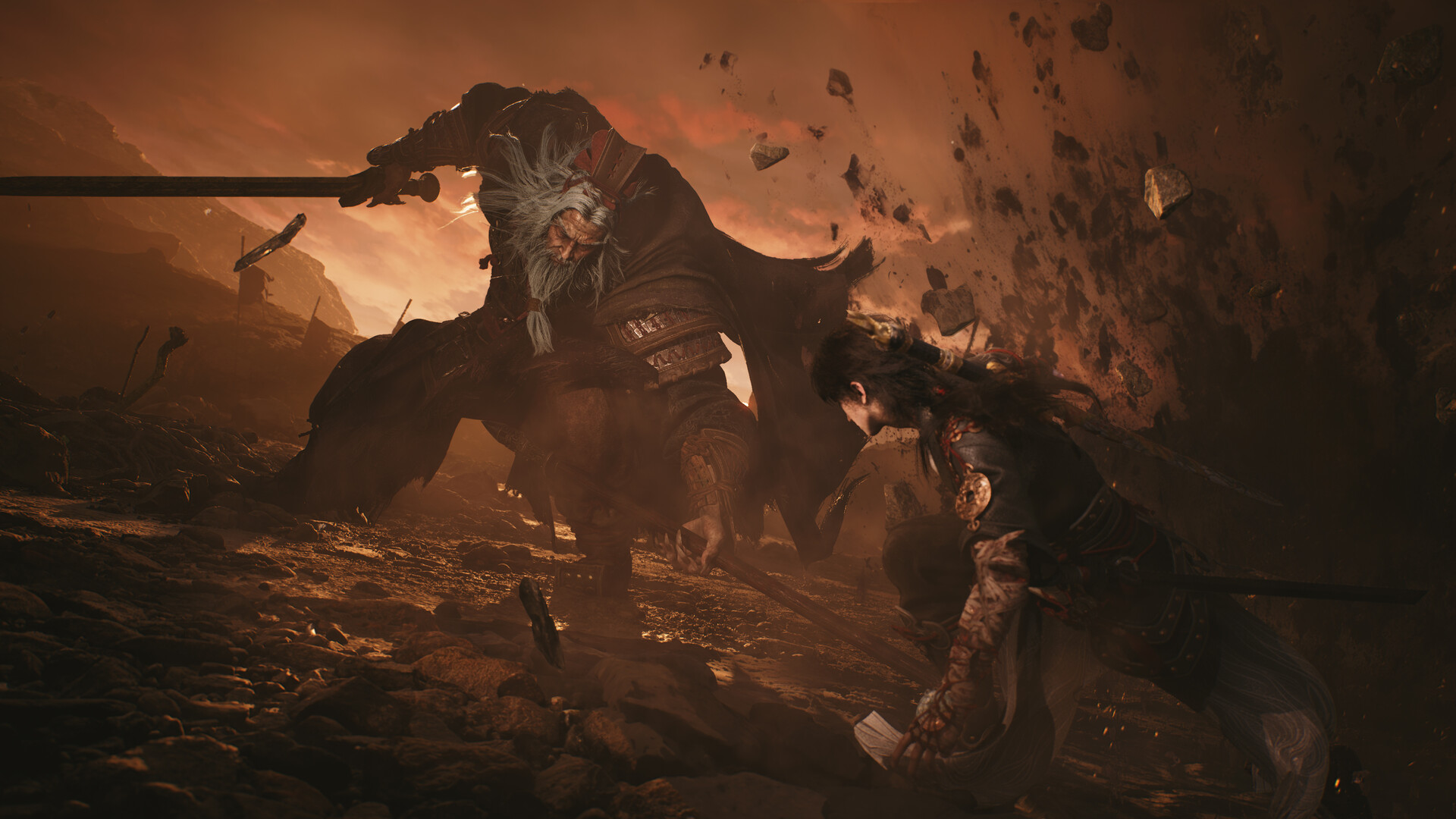
Swords of Legends features large boss battles against striking, myth-inspired adversaries. These encounters have headlined the game's gameplay showings, with the hero Sipan using the full range of weapons, artifacts, and companion abilities to bring each foe down.
Kong Kong Zi, Master of Cantrip
The first boss shown publicly was Kong Kong Zi, Master of Cantrip. This is a theatrical adversary whose every move is staged as a piece of Traditional Chinese Conjuring, the centuries-old tradition of close-up stage magic. Like much of the game's imagery, the boss is grounded in a real cultural form rather than invented from nothing, so the fight plays out as a kind of deadly magic performance.
In the gameplay trailer the encounter unfolds as a multi-phase fight. Sipan switches between two different weapons and calls on a divine artifact and a summoned ally to wear the boss down as it shifts between forms.
Battles like this reward reading an enemy's patterns and weaknesses, then combining mystical techniques, divine artifacts, and a spirit companion to break the foe down. The same toolkit that powers ordinary fights, covered under Combat and the Spirit Companion System, is what carries Sipan through these set-piece encounters.
Design of Kong Kong Zi
The boss grew out of a real Chinese art form called gucai xifa, a style of close-up stage magic still seen at New Year fairs in parts of the country. The team traced it back to Baixi, an ancient variety performance of acrobatics, animal taming, dance, and music, and built the encounter around the way each of the magician’s tricks transforms into something new. To capture the movements faithfully, the studio learned from a traditional performance troupe and recorded the routines through motion capture. The costume was rebuilt from the T-shaped silk painting found in the Mawangdui Han tombs, which dates to the 2nd century BC, and its patterns tie back into the game’s own themes.
There is no body underneath the costume. The boss's main form is the painted silk itself, and the banner that silk is modelled on was never merely decorative: its original function was to summon a soul and carry it safely upward, which is a pointed source for an adversary in a game about ferrying the dead. Building a boss out of cloth proved hard to simulate and harder still to make satisfying to hit, and after the June 2026 showing the team added thread-pulling effects and accumulating sword marks so that strikes read properly. The conjuring form itself traces to the Southern Song period and survives as recognised intangible cultural heritage, with routines including fire-breathing from a pot and the shell game known as Three Immortals Enter the Cave worked directly into the encounter. The full account is at Kong Kong Zi.
Phases of the Fight
Because the source art form has such a deep bag of tricks, the fight is built to escalate from phase to phase, moving from ranged fire to teleportation and then to close-range pressure. Three classic conjuring tricks appear in the showcased footage, and the battle’s music is scored with traditional Chinese opera instruments drawn from the same root as the boss.
Phase / Trick | What Happens |
|---|---|
Breathing Fire | A ranged opening that forces the hero to read the boss from a distance. |
Halberd from a Vase | A halberd leaps out of a vase, shifting the fight into new attack patterns. |
Vanishing a Living Person | The finale trick of the performance, the boss’s signature sleight of hand. |
Bosses in the 2026 Hands-On Build
The offline playtest held in July 2026 put five encounters in front of players inside a roughly hour-long slice, with a sixth unlocked by clearing the rest. Together with the trailer showing, they are the encounters that have been seen publicly so far. The studio has stressed that the difficulty is not meant to be punishing, and that the effort put into bosses is aimed at pulling players into the story rather than gating them.
Boss | Form | What Stands Out |
|---|---|---|
Giant bull | Fought as the tutorial battle. Beating him turns him into a summonable ally, and he returns as the hidden sixth encounter of the build. | |
Decapitated ghost | Fought straight after the tutorial. Carries a sword in each hand and a third in its floating severed head, and is the first fight where a companion joins in. | |
Kong Kong Zi, Master of Cantrip | Bodiless figure of painted silk | Multi-phase conjuring duel. Once damaged enough he hides himself inside one of three spinning vessels. |
Humanoid with a teapot for a head | Waits tables at a mountain inn and fights with a long-spouted teapot used as staff and club, flinging boiling water across the arena. | |
Tri Tail | Three-tailed cat spirit | Begins as an ordinary kitten before swelling into a far larger, heavily muscled form. |
Ox-Head
Ox-Head is the giant bull fought as the tutorial battle, and he addresses the player character as "boss" during the encounter. Defeating him there converts him into a summonable sidekick, which makes him the worked example of how soul capture feeds the Spirit Companion System. He is drawn from Ox-Head and Horse-Face, the paired guardians of the underworld in classical Chinese belief.
He also closes the build. Clearing the tutorial along with the other four bosses unlocks a hidden sixth encounter against a far more serious Ox-Head, who fights with an iron hammer swung on its haft like a flail and enters an enraged state once about a third of his health is gone. His full record is at Ox-Head.
Wu Yang
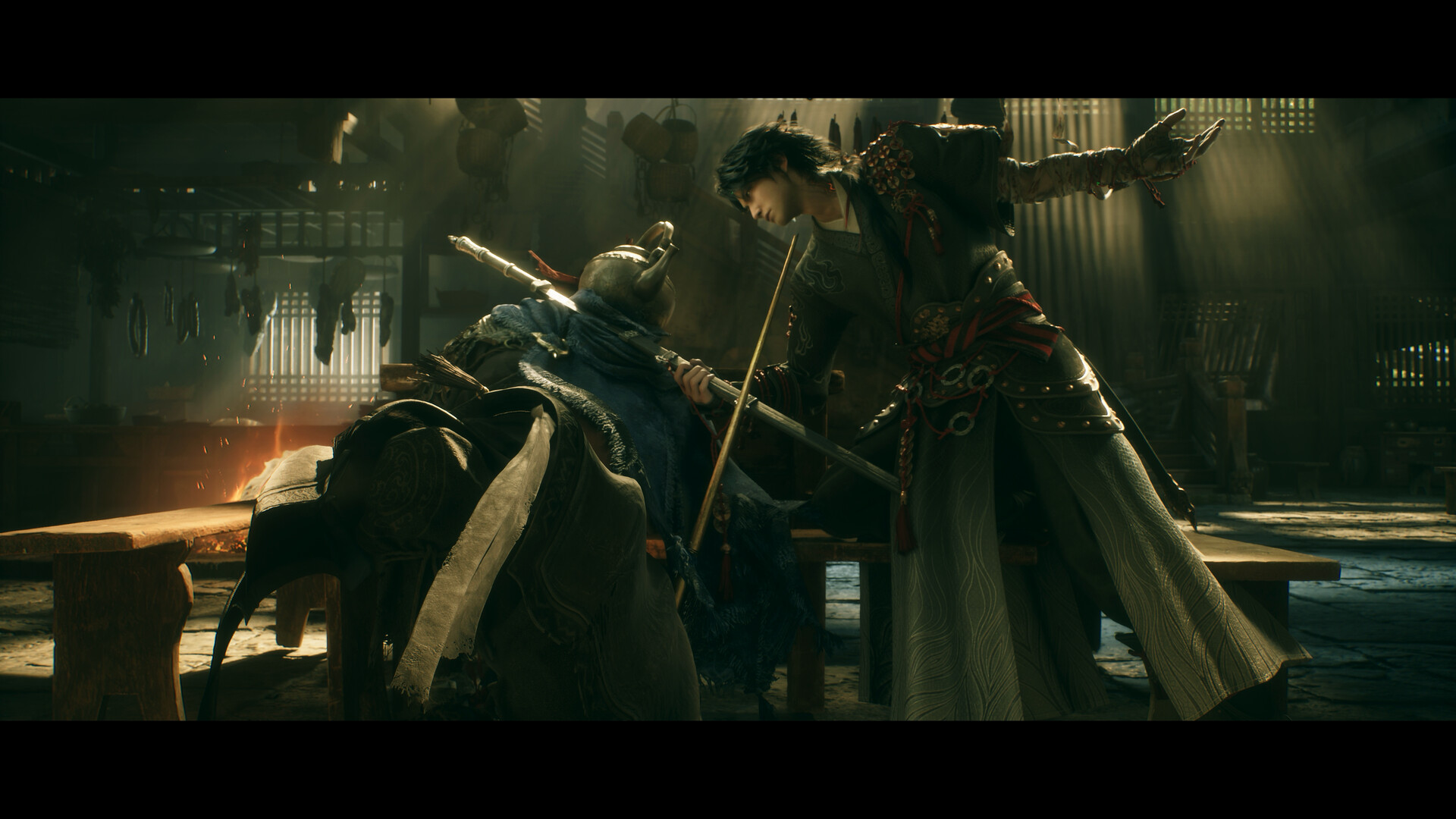
Wu Yang is encountered after the player character sits down for tea at a roadside inn. He wears a teapot on his head in the manner of a helmet and wields a second teapot with a comically long spout as his weapon, swinging it as a long staff and shortening his grip to use the body of the pot as a club. His attacks scatter boiling water around the arena. The design draws on Sichuan long-spout tea pouring, a performance style of tea service, in the same way that Kong Kong Zi draws on stage conjuring.
The design no longer rests on a single account. Official store screenshots published in August 2026 show the character directly: a cloaked figure seated in a room of long tables and benches, wearing a brass teapot over its head with the lid and spout still in place, and trailing from that spout a slender segmented tube several times the length of the pot itself. The player character, recognisable by the wrapped right arm, leans over him across a crossed weapon.
The name is confirmed as well. The project lead discussed the character by name at the July 2026 media session, and the fuller record of his kit, his design intent and the origin of the name is at Wu Yang.
Tri Tail
Tri Tail is a three-tailed cat spirit, and the encounter opens as a joke at the player's expense: it first appears as a harmless, soft-looking kitten, then transforms the moment the hero comes close into a heavily muscled brawler that throws its weight into every punch. Even in that form the animal keeps breaking through, and it will stop mid-fight to lick a paw before resuming.
Through the larger form the animal keeps surfacing: it pounces, scratches, claws, hisses, and gathers a ball together on the spot to hurl at the hero. A rattan ball styled after the old kickball game cuju appears in the inventory during this fight, and it does nothing at all while the boss is at full size, which is why it was first taken for an unexplained prop. It works on the small form. Once the cat reverts to its kitten shape, throwing the ball stops it dead for several seconds.
The encounter was the lightest of the build in both tone and difficulty, and its full record is at Tri Tail.
Headless Swordsman
The Headless Swordsman was the second encounter of the hands-on build, fought immediately after the tutorial, and it is where the hero first takes a summoned ally into a fight. Both of its hands carry a sword and its severed head floats free carrying a third, so three blades come at the hero from three separate positions. Official store screenshots show the fight taking place in a dense stand of bamboo. Headless war-ghosts are named in the game's own Chinese store copy as one of the classes of being the hero meets, alongside flower-spirits and painted-skin beauties.
Headless war-ghosts are one of the classes of being the store copy names, so the fight represents a category rather than a single character. The full record is at Headless Swordsman.