Loading...
Loading...
2026 Offline Playtest
August 26, 2026 at 01:16 AM
Add wikilinks to table cells (4 new links)
The 2026 offline playtest was the first public hands-on event for Swords of Legends and, by the studio's own account, the first event of its kind in the series' history. It ran on 18 and 19 July 2026 at the Shanghai Art Museum, also known as the China Art Museum, and the studio afterwards described it as a thousand-player gathering. It remains the only occasion on which members of the public have played the game.
Registration opened through a questionnaire on the official site and ran from 6 June to 25 June 2026. Places were not first come, first served: the studio said it would select attendees from the questionnaire responses in combination with the capacity of the venue. Applicants had to be at least 18 years old, and everyone who attended received event-exclusive merchandise.
Successful applicants were notified by text message and email at the start of July and then had to return to the official site to complete a real-name confirmation and pick a session before their place lapsed. Five sessions ran each day.
Detail | Information |
|---|---|
Dates | 18 and 19 July 2026 |
Venue | Shanghai Art Museum (China Art Museum), Pudong, Shanghai |
Registration window | 6 June to 25 June 2026 |
Selection | By questionnaire response and venue capacity, not first come, first served |
Minimum age | 18 |
Attendance | Described by the studio as a thousand-player event |
Session length | Roughly one hour per player |
Daily sessions | 10:00, 11:00, 12:45, 13:45 and 14:45 |
Reward | Event-exclusive merchandise |
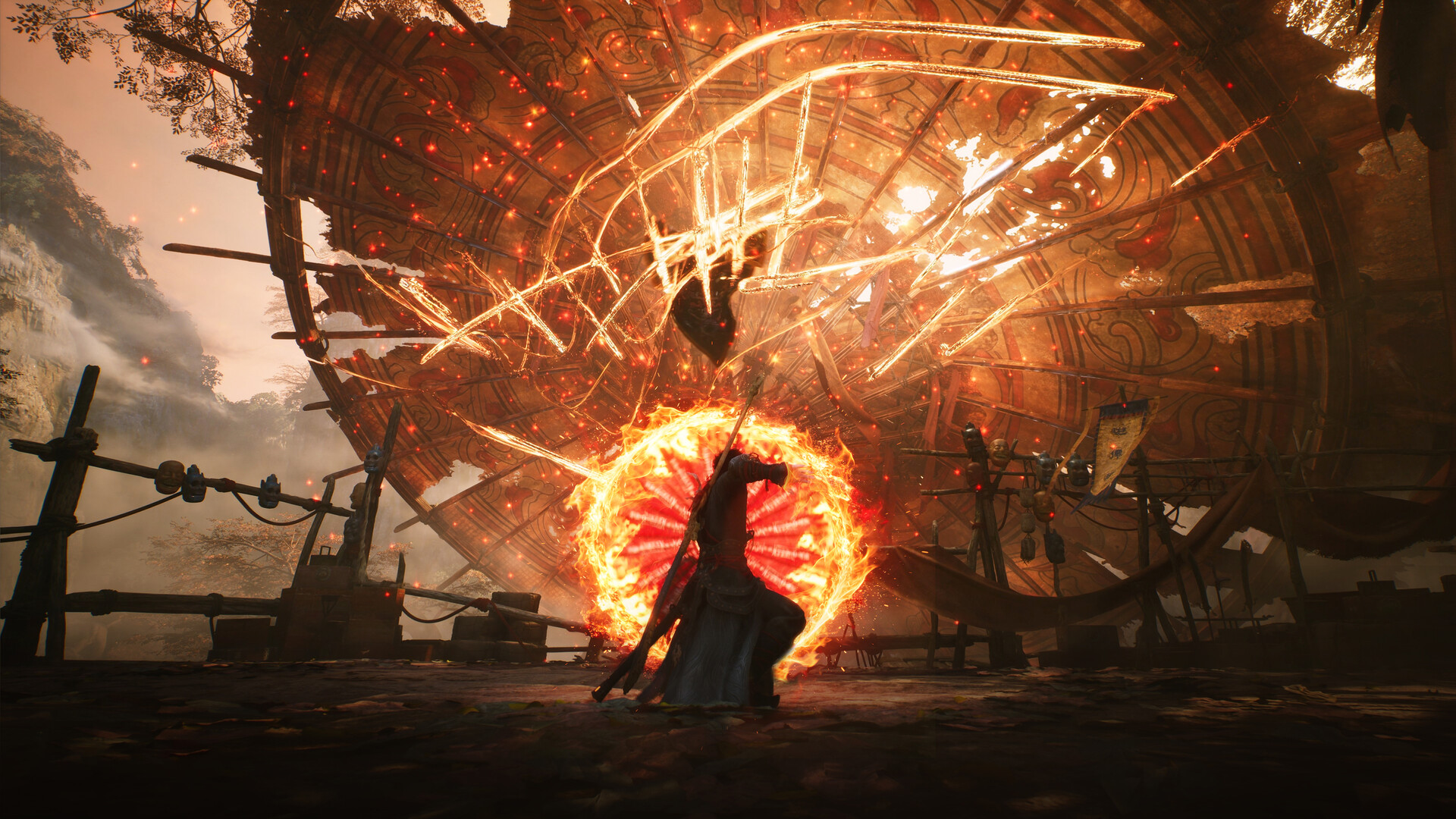
The build was a deliberately narrow slice. The studio said it concentrated on combat because that is the part a player can meaningfully judge and give feedback on within an hour, and the event offered several boss duels along with standalone level segments rather than a continuous run of the game. Four bosses were seen publicly: the tutorial bull Ox-Head, the conjurer Kong Kong Zi, the teapot-headed Wu Yang, and the shape-shifting cat Tri Tail. Alongside them players got one chunk of a linear level.
The combat systems on show were the loadout-driven ones described under Combat: no dedicated block or parry button, with guarding and parrying carried as skills on the equipped artifact or weapon, a mana pool refilled only by potions, and a separate gauge spent on high-damage special attacks. The Spirit Companion System was demonstrated through the Ox-Head fight, which converts the defeated boss into a summonable ally.
Ahead of the two public days the studio ran a separate media session on 17 July, which is where the project team took questions and where several details about the finished game were given for the first time.
The build itself was laid out as four slices plus one, five in total counting the tutorial, with the fifth kept hidden and unlocked only by clearing the other four. One of the slices was a semi-open explorable area rather than a corridor to a boss, carrying teleport points, roaming enemies, branching paths, a maze and explosive barrels. Many of those branches were deliberately walled off for the demo, and the team confirmed afterwards that at least two of the areas shown connect to each other in the finished game.
Slice | Encounter |
|---|---|
Tutorial | Ox-Head, fought as the introduction and then recruited. |
Semi-open area | Kong Kong Zi, Master of Cantrip. |
Mountain inn | Wu Yang, the teapot-headed waiter of the Changsheng Ju. |
Fourth slice | Tri Tail, the three-tailed cat spirit. |
Hidden slice | Ox-Head again, in a far more aggressive rematch. |
The venue ran the build on PCs fitted with current high-end graphics hardware. The development build already supported frame generation with up to six generated frames and a second-generation transformer model, though the settings on the floor were pulled back to three for stability, which held the demo at around 140 frames per second even through the effects-heavy boss encounters. PlayStation 5 test units were also set up and playable on the floor alongside the PCs.
The project team was unusually direct about the omissions. In a letter published on 16 July it wrote that full story sequences, character relationships and the atmosphere the game wants players to sit with could not be conveyed in a slice, and were being saved for a fuller showing later. It also confirmed that a character-growth system familiar from earlier entries in the series, written 星蕴 in Chinese, was switched off for the demo but will be kept and deepened in the finished game. No official English name for that system has been published.
The same letter said returning players might recognise a location from the series rebuilt with new technology, and that the player character will meet more companions over the course of the story, though it declined to say how they enter it. The team framed the whole event as a mid-development checkpoint, held deliberately before the game was polished so that feedback could still change it.
For players who could not attend, the studio ran an official livestream from the event on 18 July, which drew roughly 4,500 advance reservations and showed the build being played on camera. The venue provided the space, and the studio credited a group of hardware partners for supplying equipment for the show floor.
Partner Type | Named Partners |
|---|---|
Venue | Shanghai Art Museum (China Art Museum) |
Platform | PlayStation |
Graphics | NVIDIA |
Systems and peripherals | ROG, Gigabyte, MSI, Colorful, FLYDIGI, AutoFull |
The studio closed the event with a public thank-you on 21 July, saying it knew the game still had shortcomings and room to improve and that every piece of feedback would be recorded and acted on. The Steam store page went live around the same time. Written hands-on impressions from the event began appearing in early August 2026, and they remain the only independent accounts of the game in a playable state.
For where the event sits in the wider production timeline see Development, and for the current release position see Platforms and Release.