
Loading...
Loading...
Mining and Resources
October 18, 2026 at 05:44 PM
Corrected the Last Yield trigger chance to 20 percent, added patch management, module levels, Last Yield II and Increased Output IV, and added remote mining with Extractor Pods
Gathering resources is a foundation of the gameplay loop in SpaceCraft. Planets hold an abundance of natural resources ready to be uncovered and exploited, and mining is how you turn the galaxy into raw materials.
As you explore and scan new systems, you reveal where valuable resources are located. You equip yourself with a variety of tools to extract raw materials, then scan your environment and use your ship to mine, extract, and gather resources.

Gameplay shown by the developer has your ship handle extraction directly using its mining equipment, so in the early game you can gather from a planet without needing to land, mining from the air with your vessel. As your operation grows, you can shift extraction onto dedicated systems and bases rather than mining every load yourself.
Source | Notes |
|---|---|
Planets | Worlds hold an abundance of natural resources to uncover and exploit once scanned. |
Asteroids | Asteroid fields are a source of raw materials to mine. |
Abandoned structures | Abandoned stations and derelict ships are among the sites you can gather from while exploring. |
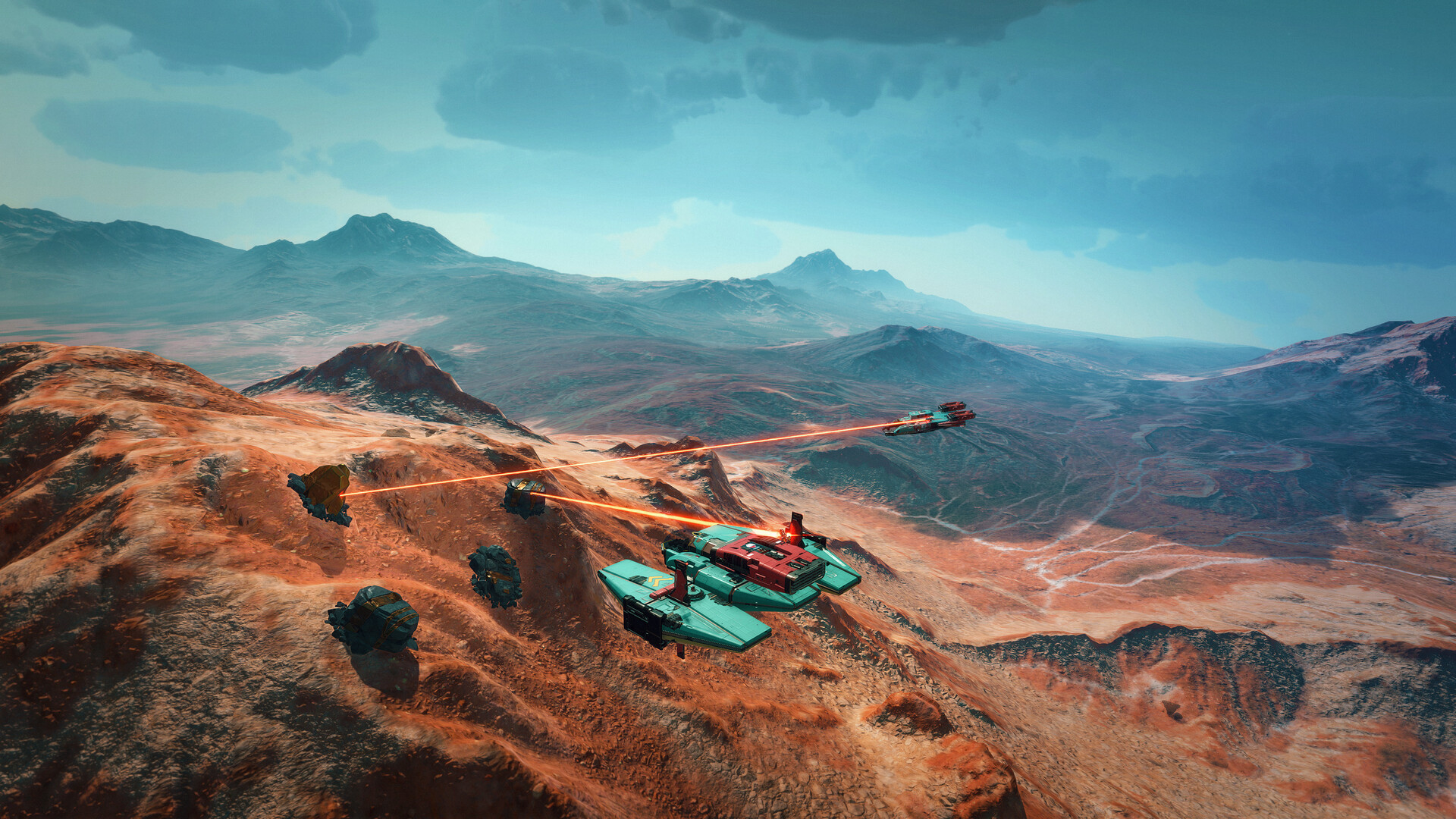
Raw materials are the input to the rest of your operation. You craft these resources into valuable materials or ship parts, and you can trade or sell what you gather. The cycle of mine, craft, and trade is what drives progression.
Early on you mine by hand with your ship and tools. As you progress, you can set up automated mining systems so extraction continues without your direct input, freeing you to focus on strategy and expansion. See Automation and Logistics for how automated mining and supply chains work.
Major Update #1 on October 8, 2026 added Extractor Pods, which you craft and deploy on unclaimed deposits outside your base. When a pod's storage is full it ships everything it gathered to an Extractor Bay at your base. Deposits now carry a Stability statistic: lower stability raises the risk of an accident that leaves the pod dismantlable by anyone, while the extractors in your own base are unaffected. The same update's Advanced Extractors, a level 6 Technology unlock, are 33 percent faster.
Resources are gathered from resource nodes, minable points that provide materials in limited quantities. Nodes spawn in clusters rather than in isolation, and each planet has its own set of nodes, so where you mine determines what you can collect. Certain landmarks hold rarer, more concentrated nodes. You scan a node to reveal what it contains before mining it.
Finding resources starts with scanning. Detector tools sweep the area around you and surface nearby deposits before you commit to mining, and the Crude Resource Detector is the early tool for this; its scanning range was widened in a post-launch update, so it now reveals deposits across a larger area. The first time you obtain a rare find it is recorded in the Resources category of the in-game Encyclopedia, which builds up a personal reference of the materials you have discovered as you explore. Since Community Update #1 on September 16, 2026, an Encyclopedia entry also lists every recipe the item is used in, and seeds display correctly in planet resource lists.
Mining speed and access depend on tool tiers: lower-tier tools cannot mine higher-tier nodes, while higher-tier tools mine faster and can break through tougher nodes. Some resources need specific methods rather than a basic mining laser.
Shells must be broken open with missiles.
Volatile resources heat up when mined and can explode, sometimes requiring cooling tools.
Liquid and gas resources require specialized harvesting tools and storage modules.
Mining lasers accept patches, installed through the patch installation kiosk (and since October 8, 2026 also at a base shipyard), that change how a laser performs, and there is no limit on how many lasers a ship can carry. Three patches are named in the developer's September 2026 notes, and Major Update #1 on October 8, 2026 added higher tiers of two of them. Their bonuses stack across multiple lasers, and before Community Update #1 they stacked without limit, which the developer identified as a bug that let bonuses run far beyond their intended values. Since the update each additional patch is 30 percent less effective than the previous one, and the Mining Power diminishing returns in the Laser Mining skill were corrected at the same time. See Ship Modules and Tools.
Patch | What it affects | Since Community Update #1 |
|---|---|---|
Increased Output | Laser output | Stacks with diminishing returns, each extra patch 30 percent weaker than the last. |
Rare Find | Rare finds while mining | Stacks with diminishing returns, each extra patch 30 percent weaker than the last. |
Last Yield | A triggered bonus yield; the developer has not described what it yields | Triggers with a chance per patch instead of automatically; stacking patches raises the chance. The chance was 30 percent from September 16, and a September 22 patch lowered it to 20 percent for Last Yield I. |
Major Update #1 on October 8, 2026 changed how patches are managed. Patches can now be installed without removing the module from your ship, and they can be removed freely, with an 80 percent chance that the removed patch breaks. Patch management also works at your base's shipyard. Every module now has a level, and a patch needs a module of the same level or lower, so a high-level patch cannot strengthen a low-level module. Modules show their empty and filled patch slots in your inventory. Before this update a patch could not be removed at all; you had to rebuild the module to apply a new one.
Patch | Bonus | Notes |
|---|---|---|
Last Yield II | +40% | A higher tier of Last Yield. An October 9 hotfix corrected its values. |
Increased Output IV | +200% | Only Giant lasers and their overclocked version, unlocked by the Heavy Beam permit, can take it. One line of the patch note calls it Mining Output IV. |
The tutorial focuses on basic materials such as Iron and Copper, later introducing Quartz, with many more resources becoming available as you progress. Raw forms of the same material can differ: for example, both Iron Ore and Iron Nuggets yield Iron Ingots, but at different ratios and inventory costs. Ore is usually faster to mine per second, while nuggets are more space-efficient.
Raw Form | Yield | Inventory Cost |
|---|---|---|
Iron Ore | 2 Ore = 1 Iron Ingot | 10 Storage Units |
Iron Nuggets | 4 Nuggets = 1 Iron Ingot | 4 Storage Units |
Beyond solid resources, the game has a distinct liquid system (Water, Sulfuric Acid, and more) collected from geysers and stored in tanks and cisterns. See Liquid Resources for the full system. Refining solids into usable ingots happens at a station; see Crafting.