
This article is a stub
It lacks sufficient information and needs to be expanded. You can help by adding more content.
Crafting turns what you mine into what you build and sell in SpaceCraft. It is the bridge between gathering raw materials and assembling ships or trading on the marketplace.
What You Craft
You craft raw materials into valuable materials or ship parts. Refined materials and components are both useful in their own right and as the building blocks for ships. The same crafted goods can be kept for your own use, traded, or sold.
How Crafting Fits the Loop
Input | Output | Use |
|---|---|---|
Refined materials | Higher-value goods to use, trade, or craft further. | |
Refined materials | Components assembled into custom ships. | |
Items to sell on the player-driven marketplace. |
Crafting and Ship Building
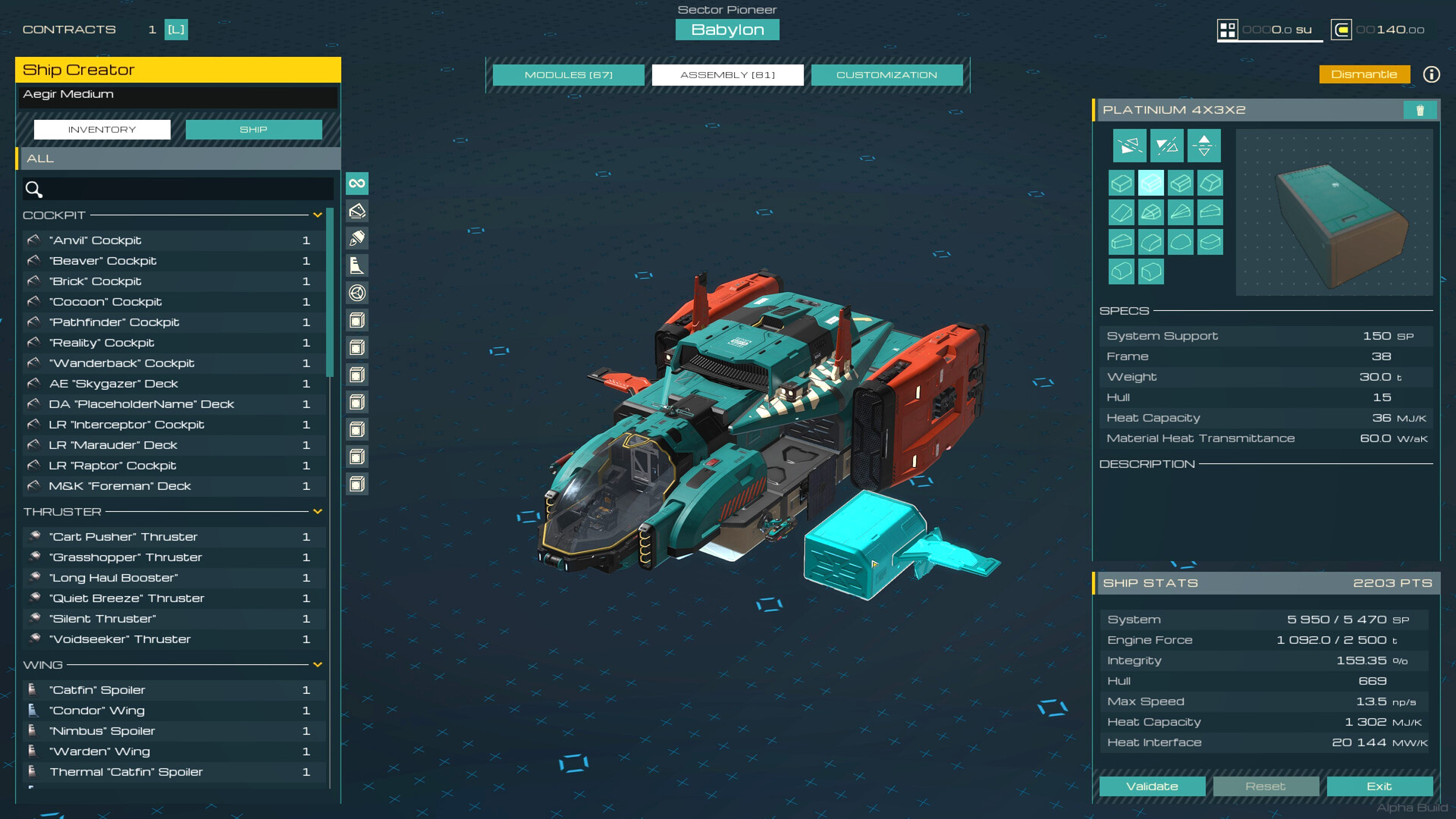
Crafted parts are what you assemble into ships. Each component you craft and add to a vessel impacts its performance, so what you craft directly shapes how your ship flies and what it can do. See Ship Building and Blueprints for assembly and ready-made designs.
Crafting and the Economy
Crafting also feeds the player-driven economy. You can sell refined materials and ship parts on the marketplace, where every transaction affects prices. Skilled crafters can build a business around supplying parts and materials to other players. See Trading and the Player-Driven Economy.
Refining at a Station
Crafting begins by refining raw materials at a space station. The Smelter converts ore and nuggets into ingots, which took about five seconds per ingot before Community Update #1 doubled Smelter speed, and The Company charges a commission of roughly 15 percent of the output’s market value. The Workshop then turns ingots into components, tools, and ship modules, with a smaller commission that scales with the value of the crafted item.
As a worked example, the Scanalyzer Alpha (an early scanning tool) is crafted from 1 Small Module Kit, 1 Iron Sheet, and 2 Wire, which you assemble from refined ingots. See Space Stations and Progression: Permits and Experience for where refining fits and how recipes unlock.
Step | Building | Notes |
|---|---|---|
Smelting | Smelter | Ore/nuggets to ingots, about 5s per ingot, around 15% Company commission. |
Crafting | Workshop | Ingots to components, tools, and modules; smaller commission by item value. |
Crafting With Liquids
Crafting that uses liquids happens in a Chemical Factory. One confirmed recipe is the Vanadium Battery, made from Sulfuric Acid, Vanadium, and Graphite, which extends battery life in dark environments. Sulfuric Acid can also be produced from Water and Sulfur. See Liquid Resources for the liquid system.
Workstation Automation and Queueing
Community Update #1, released on September 16, 2026, reworked how the Smelter and Workshop behave. The changes were previewed on August 21, 2026 and are now live in the game. Balancing is described as ongoing, so check Updates and Patch Notes for later adjustments to the numbers below.
Change | What it means now |
|---|---|
Production continues after you leave | The Workshop and Smelter keep crafting after you walk away from the workstation, so you no longer stand and wait for a progress bar. |
Crafting queue and auto-craft | You can queue up to ten minutes of crafts, and the queue automatically produces any intermediate resources a recipe needs instead of you crafting each step by hand. |
Manual crafting scope | The preview described a five-minute cap on manual crafting, with longer jobs meant for base automation. A September 22 patch note refers to a 10-minute manual crafting timer, the same length as the crafting queue. No shipped note restates the five-minute cap, so treat it as design intent rather than a confirmed number. |
Warehouse integration | Workshop crafting pulls items directly from an Advanced Warehouse when one is linked. See Storage and Warehouses. |
Encyclopedia | Each item now lists every recipe it is used in. |
Retuned timings | Assemblers and Factories craft six times faster, Recyclers three times, Smelters twice as fast, and Micro Furnaces one and a half times faster with ten times the storage; the manual Workshop is one and a half times slower. |
The reasoning the developer gave is worth noting because it explains the direction: manual crafting had become more efficient than automation even for recipes meant to benefit from a production line, which made building one feel pointless. The retuning is meant to give manual crafting and base automation distinct jobs rather than having one dominate.
Crafting Changes Since Community Update #1
Date | Change |
|---|---|
September 22, 2026 | Fixed a bug that let players bypass the 10-minute manual crafting timer, a bug that blocked starting a manual craft after claiming the previous one, and a possible loss of resources when repeatedly starting and stopping crafting at the Smelter or Workshop. |
October 8, 2026 | Search bars added to the Workshop, Shuttle Pad, Assemblers, Factories and other screens, and the base Smelter can draw on Advanced Warehouse storage. Extractor Pods became craftable. |
October 9, 2026 | Extractor Pods became craftable in the Workshop, with a lower crafting cost. |
October 13, 2026 | The Isotopic Generator became craftable in the Workshop after a recipe change. |