

Tom Clancy's Rainbow Six Tactics is a turn-based tactical game, but it does not spend the whole mission in turns. A deployment moves through a reconnaissance stage that plays out in real time, a synchronised assault that resolves as one simultaneous action, and only then a conventional turn-based firefight. That shape is the game's central idea, and it is what the reveal material spent most of its time on. Mission Structure walks through the sequence in order; this page covers the systems you use inside it.
Commanding the Squad
You take up to four Operators into a mission, chosen from a roster of fifteen. Selection happens before you deploy, from headquarters, and the point of it is that different jobs want different tools: a mission with hard interior walls wants someone who can open them, a mission with long approach lines wants reach, and a mission where you expect to absorb fire wants someone who can stand in front of it. Ubisoft has framed squad composition as something to experiment with rather than solve once, and the roster is a mix of Siege attackers and defenders rather than attackers only.
Each Operator brings a signature ability and specialised gear, and each has a distinct progression path described on Skill Trees. Ubisoft has said no two missions play out the same way because of the interaction between those abilities, the objective and the terrain.
The Turn-Based Layer
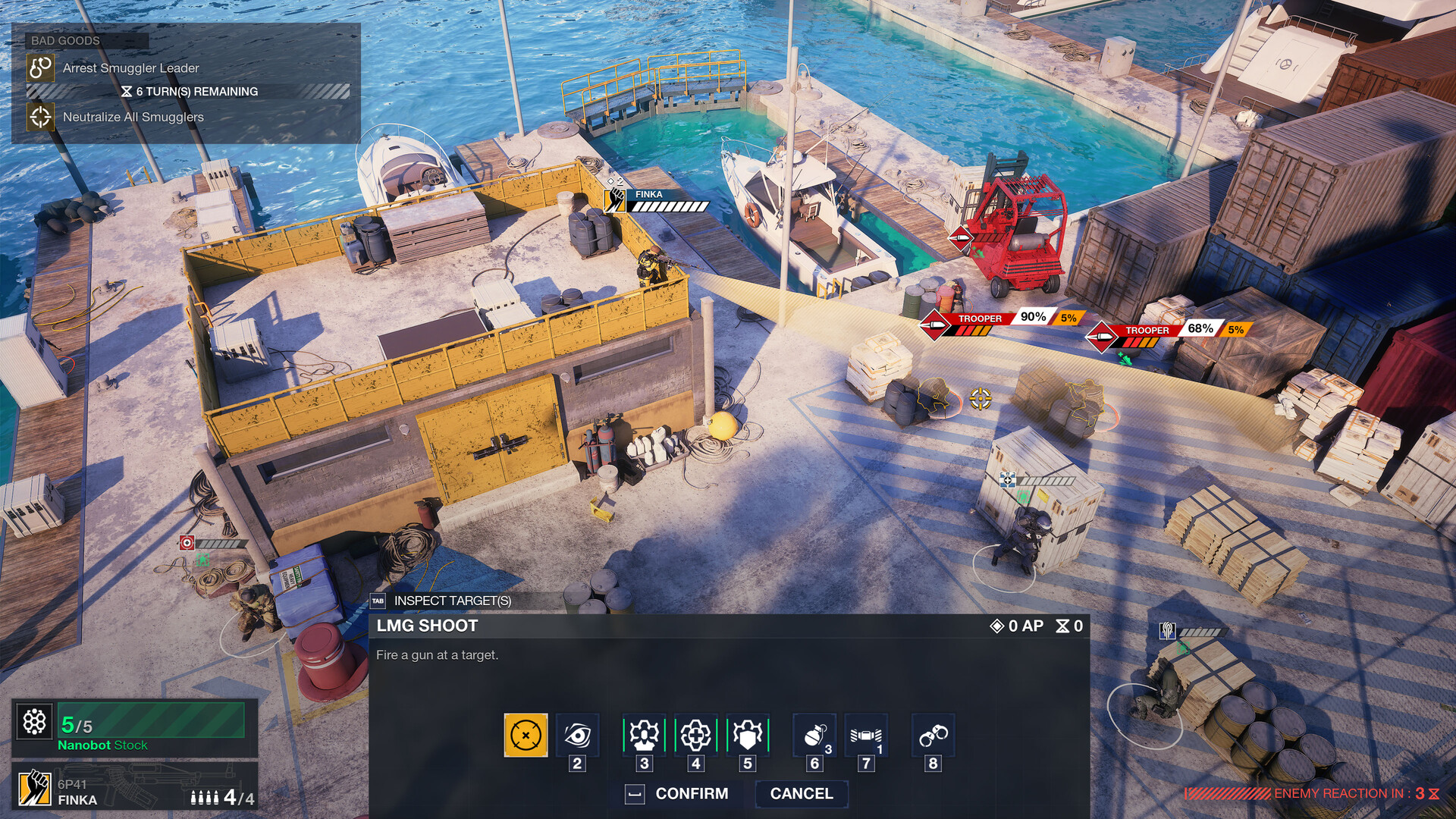
Once the shooting starts, the game resolves in turns. The vocabulary shown at reveal is the familiar one for the genre and was described as central rather than incidental.
System | How It Works |
|---|---|
Movement | You move each Operator across the field within their range for the turn |
Cover | Terrain and objects reduce or block incoming fire, and cover can be destroyed |
Overwatch | An Operator can be set to hold an area and fire on anything that enters it |
Sightlines | What each Operator can see determines what they can shoot, and lines can be opened or closed by destroying terrain |
Abilities | Signature Operator abilities are used as actions during the turn |
Order Points | A pool spent mid-mission on temporary boosts such as extra damage or extra movement |
Order Points are worth understanding early because they are not one-sided. The enemy accrues and spends them too, and a counter on screen shows when the opposition is next due to buff itself. Holding a strong position for one more turn can therefore be worse than committing immediately, which gives the turn economy a rhythm rather than a steady state.
Vision and Reconnaissance
Vision is handled differently indoors and outdoors. Open outdoor areas have no fog of war: you can see the field and plan against it. Interiors do have fog of war, and the only way to lift it before you walk in is to scout. That is what the drones are for.
Drones are deployed in the real-time reconnaissance stage that opens each mission. They are used to establish the interior layout and to pinpoint enemy positions, and the map they build is what the Breach planning stage is then drawn against. Scouting badly does not lock you out of the mission, but it does mean planning a synchronised assault into a room you have not actually seen.
Destruction as a Tool
Environments come apart. Shots and explosions damage the parts of the level they pass through, so a wall that looked like cover on turn one may not be cover on turn four, and a wall that blocked a shot can be turned into a firing position. The stated uses are opening new lines of sight, removing enemy cover to expose a target, and creating a new point of entry where the level did not offer one. Destruction covers this in detail.
Enemies
Opposition is made up of armed groups working for the shadow organisation the campaign is chasing, and the missions shown at reveal were all assaults on fortified positions held by them. Ubisoft has said the game includes several enemy archetypes intended to test different parts of your roster. None of those archetypes has been named or described.
Difficulty and Consequence
Difficulty settings exist, and an optional mode layered on top of them makes Operator losses permanent for the rest of the campaign. Because that mode can be enabled at any difficulty, the stakes and the combat challenge are tuned separately. See Permadeath Mode.
Outside the Mission
Progress does not reset between deployments. Intelligence recovered in the field feeds the investigation and unlocks the next assignment, and the headquarters layer converts that progress into upgrades, training and better-equipped Operators. Headquarters and Intelligence covers that side, and Maps covers where the missions themselves take place.
Not Yet Confirmed
The action economy in detail: action points per turn, movement ranges, and how many actions an ability costs.
Whether there is a hit-chance percentage system, and how cover modifies it.
How Order Points are earned, whether they cap, and the full list of boosts they buy.
Names, statistics and behaviours for any enemy archetype.
Difficulty tier names and what each one changes.
Whether missions have turn limits, and whether reinforcements arrive over time.
Camera controls, control schemes and accessibility options.