

Missions in Tom Clancy's Rainbow Six Tactics are built as a sequence rather than a single mode. The reveal demonstration ran through the same order every time: scout in real time, plan and execute a synchronised entry, then fight it out in turns. Understanding the sequence is the fastest way to understand why the game does not feel like a straight turn-based shooter.
The Three Stages
Stage | How It Plays | What You Are Doing |
|---|---|---|
Reconnaissance | Real time | Deploying drones to read the ground and locate enemies before committing |
Entry | Planned, then simultaneous | Choosing entry points, placing breaching charges and scripting the whole squad's opening actions. See Breach |
Combat | Turn based | Fighting the engagement out with cover, overwatch, abilities and destructible terrain |
Reconnaissance
Each mission opens in real time. Drones are sent ahead to map the objective and pinpoint defenders. This matters most indoors, because outdoor areas have no fog of war while interiors do, so the drone pass is the only way to see inside a building before you are standing in it. The layout you uncover during this stage is the layout the planning stage is drawn against, which makes a sloppy recon expensive later rather than immediately.
Entry
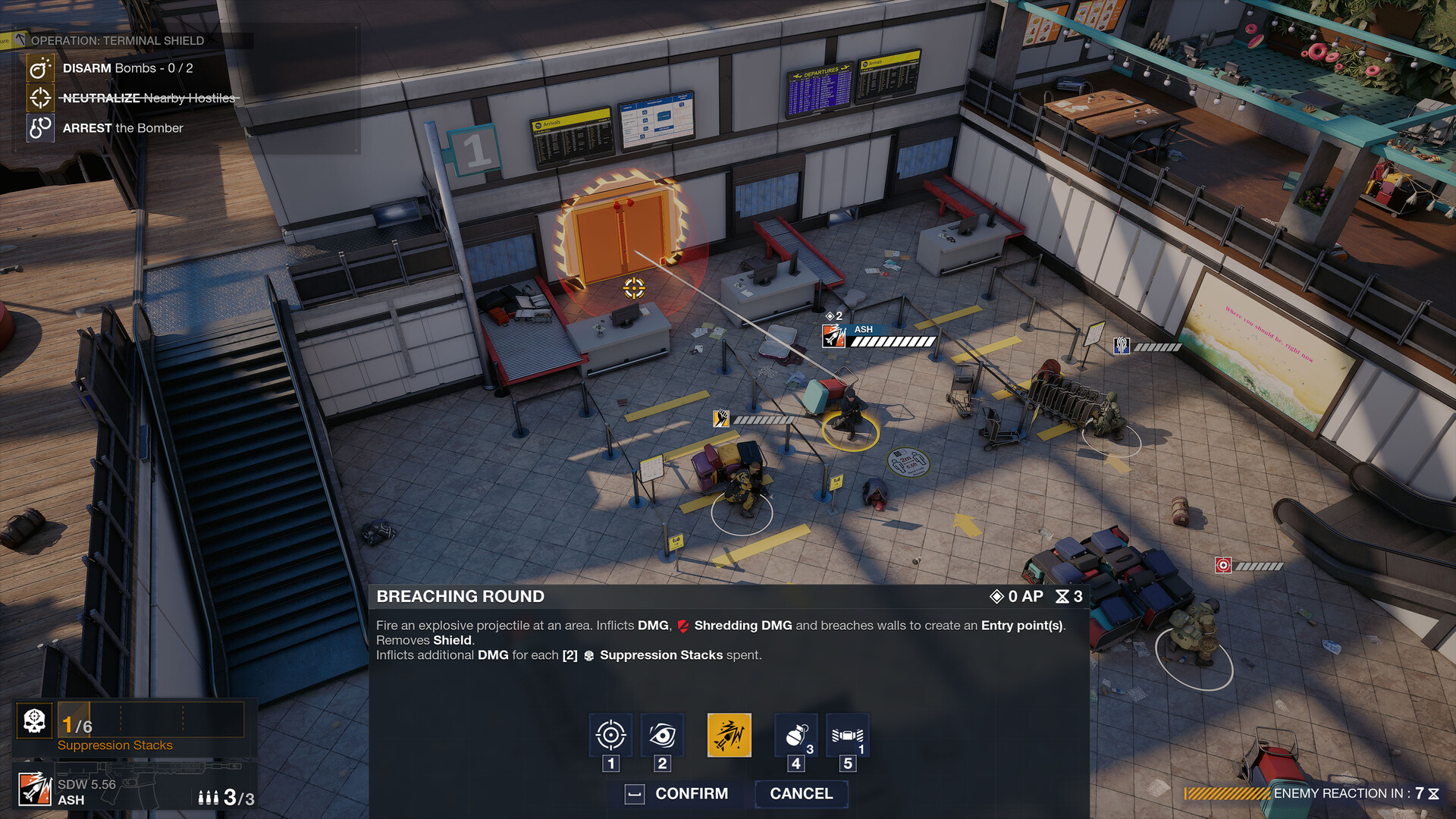
With the interior mapped, you choose where the squad goes in. Entry points are selected per Operator, breaching charges can be laid on walls rather than using the doors the level provides, and the whole squad's opening movement and fire is plotted out before anything happens. Then it executes at once: everyone moves together, takes their assigned positions and fires on the way in.
Combat
After the entry resolves, the mission settles into turns. This is where cover, overwatch and sightlines take over, and where the environment continues to change as shots and explosions cut through it. Gameplay covers the turn-based systems in detail.
Objective Types
Ubisoft has named three mission types, and a fourth objective was shown at reveal.
Objective | Goal | Status |
|---|---|---|
Hostage Rescue | Locate and extract civilians held by the enemy | Officially named |
Bomb Disposal | Find and defuse an explosive device | Officially named |
Target Elimination | Remove a specific high-value individual | Officially named |
Capture | Take a person of interest alive and escort them out | Shown at reveal, not yet in official feature copy |
The capture objective was the back half of the demonstration mission. After clearing a warehouse, the squad picked up a man and had to walk him out of the building and across open ground to a waiting boat, which turned the return leg into an escort under fire rather than a repeat of the approach.
A Mission As Shown
The squad infiltrated an industrial dock and crossed it in the open, using cover and overwatch against defenders on the ground.
At the warehouse on the far side, drones went in first to establish the interior layout and mark enemies.
The squad's entry was plotted against that interior map and executed simultaneously, with the team taking assigned positions and firing as they moved.
The interior fight continued in turns, with shots passing through thin walls and destroying parts of the structure.
The objective was recovered and escorted back out to a boat, with Order Points spent on the return leg to buff the squad while an on-screen counter tracked when the enemy would next buff themselves.
Before and After the Mission
Missions are chosen rather than queued. From headquarters you assess the intelligence you have, pick a high-stakes assignment, assign up to four Operators to the squad based on what their abilities bring to that job, and decide on a plan of attack. Afterwards, what you recover feeds the investigation and the upgrade layer. See Headquarters and Intelligence. Where those missions take place is covered on Maps, and the consequences of failure are covered on Permadeath Mode.
Not Yet Confirmed
How many missions the campaign contains.
Whether missions are strictly ordered, chosen from a branching set, or generated on a schedule.
Whether failed missions can be retried, and what a failure costs.
Whether the reconnaissance stage is timed or can be detected by the enemy.
Whether more than one Breach can be executed in a single mission.
Optional objectives, side objectives and mission scoring.
Extraction rules, and whether an Operator can be left behind.