
Loading...
Loading...
Aquariums
August 7, 2026 at 10:06 AM
Image pass: matched each screenshot to the topic it illustrates and replaced the placeholder alt text with a description of what the image shows
Aquariums are one of Planet Zoo 2's headline additions and a first for the series, giving a zoo somewhere to keep fully aquatic species. Frontier describes them as a brand new habitat type rather than a placeable tank, and building one works much like building a terrestrial habitat: place barriers, set their size, orientation, and height, then attach a staff gate and connect it to the path network so keepers can reach the animals. Ready-made blueprints cover the same ground for players who would rather drop in a finished build, and community creations are available through the workshop described under Building and Construction. The colour tone of the water itself can be tuned to taste.
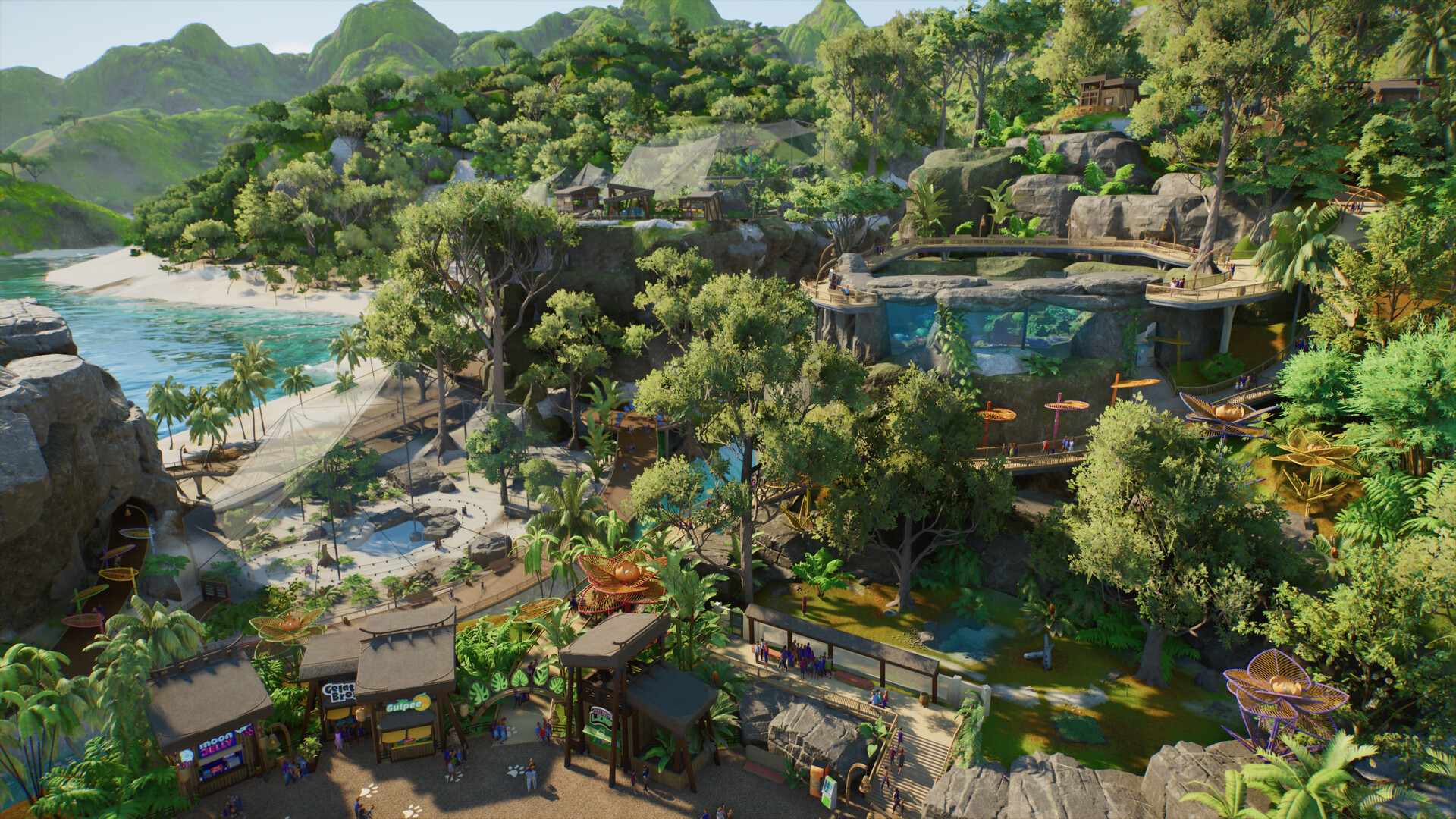
Aquatic animals share most of their welfare requirements with land animals, including space, food, stress, and a suitable environment. What sets them apart is the water itself, and three properties of it have to be managed.
Property | How It Works |
|---|---|
Salinity | Critical to survival. A network of water filters attached to each aquarium supplies its water and can be configured for freshwater, saltwater, or brackish conditions. A saltwater species will not survive in fresh water. |
Temperature | Species have their own temperature preferences. Water temperature is set through the staff gate attached to the aquarium, alongside options such as the tank's lighting. |
Cleanliness | Dirty water makes animals harder for guests to see and raises the chance of disease. The filtration network keeps water clean, and staff still need to suit up and dive in to clean the windows. |
Aquariums also degrade if neglected. Left without maintenance they can spring a leak, and the different barrier types on offer give varying levels of protection against cracks appearing.
Getting guests a good view is a design problem in its own right. Adding a guest gate lets a tunnel be built through the water so visitors walk beneath the surface, and tunnels can sit at different heights within the same tank for multiple vantage points. Barriers can be modified the same way terrestrial habitat barriers can, including one-way glass and concave or convex sections.
The bigger difference from a land habitat is verticality. Where a terrestrial enclosure is usually designed around wide, well-shaped ground, a good aquarium is built upward and downward: complex multi-storey and subterranean tanks are supported, and players willing to use invisible habitat barriers and scenery can shape naturalistic underwater spaces instead of obvious boxes.
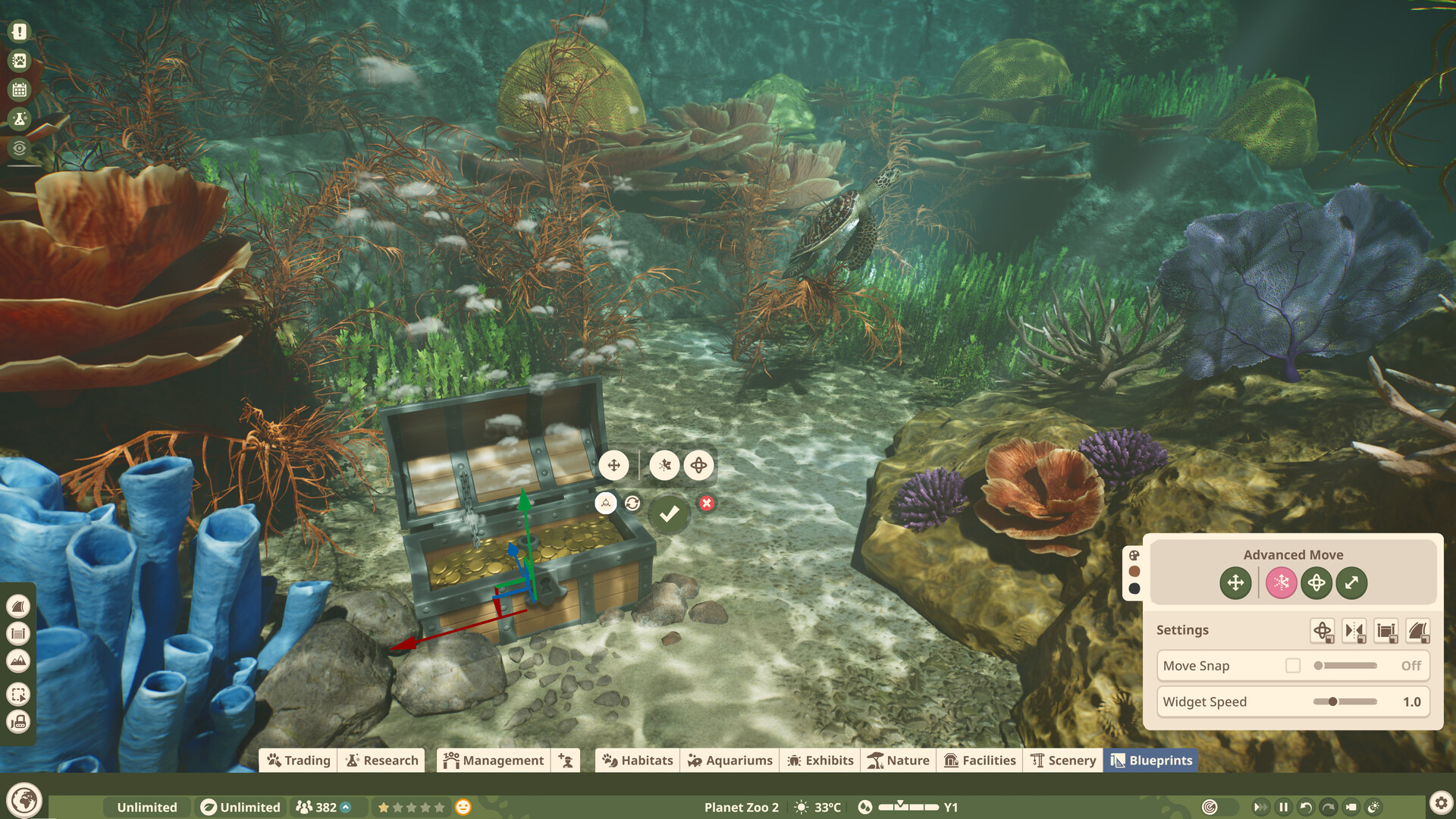
Aquatic animals move through all three dimensions of a tank, so almost every interaction had to be rebuilt for them. Most species have a preferred position in the water column, abstracted from real depth zones so that players are not expected to dig hundreds of metres down. A Blacktip Reef Shark tends to stay nearer the surface than a Great Hammerhead, for example. The seafloor is a separate navigation surface, with animals aligning to the ground, rocks, coral, plants, and enrichment placed on it.
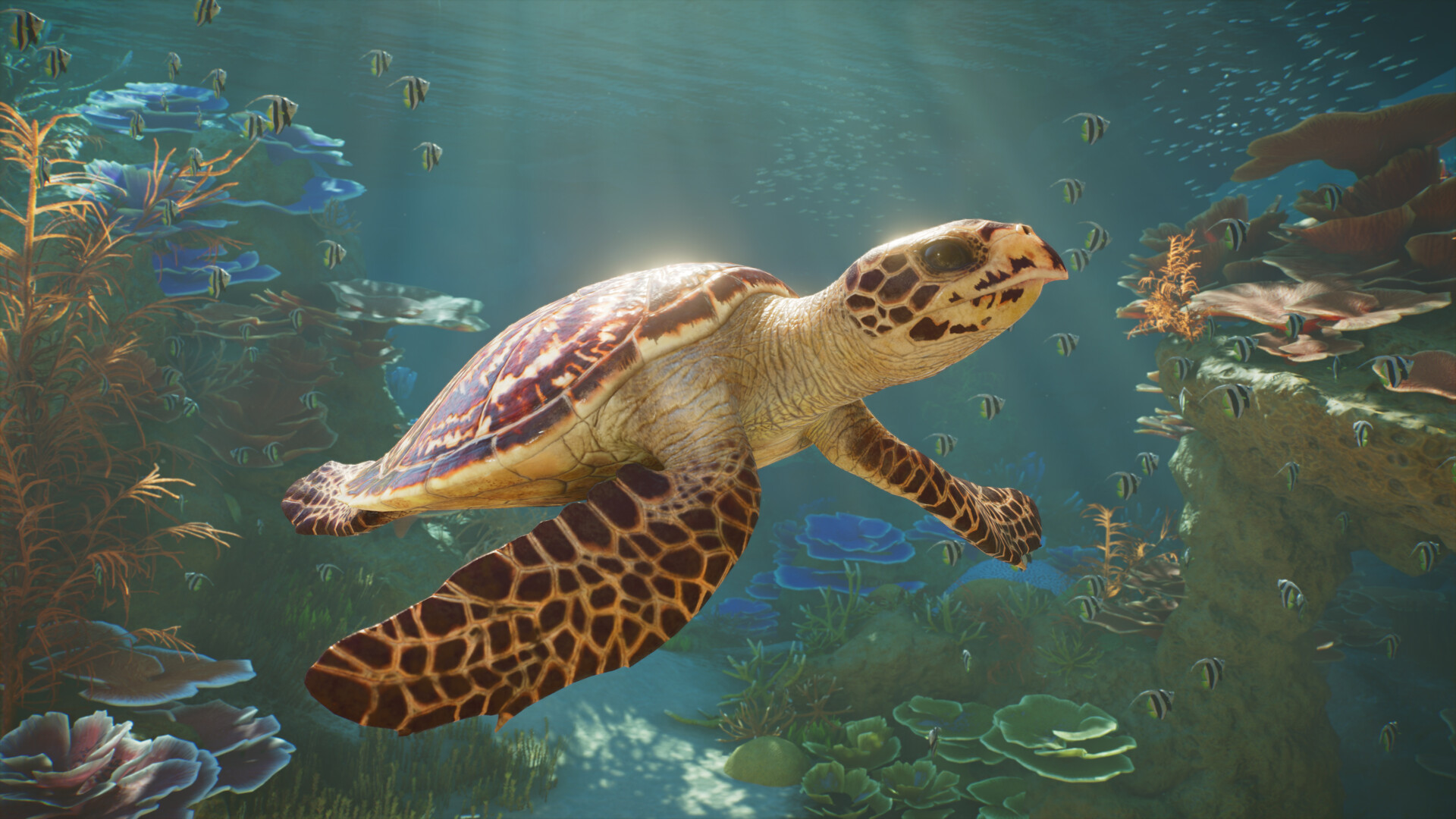
Rest needed its own answer. Fish do not sleep the way land animals do, so Frontier added a hover state in which an animal drifts with little propulsive movement, while other species settle onto the seafloor overnight.
Schooling species are handled as shoals: a single group entity rather than hundreds of individuals. Both the player and the game manage the shoal as one thing, and even welfare is tracked for the group rather than per fish. Movement runs on a flocking system that controls the shoal's direction, cohesion, and separation, and its shoaling parameters shift with circumstances. A shoal that meets a predator packs tighter and moves faster for a while afterwards, and shoals also move out of the way of larger animals and of staff divers.
Larger aquatic animals are simulated individually, with welfare and behaviour as detailed as any land animal's. Species that must keep swimming to breathe, such as the Blacktip Reef Shark, kept moving erratically in early builds until Frontier reproduced a real aquarium behaviour called window surfing, in which a shark follows the edge of its tank to make use of long straight runs. Paths are now generated along barrier segments with a probability weighting rather than picking random points in open water, and other large species use the system occasionally too. The Ocean Sunfish, for instance, will drift along the viewing glass to look at the guests.
Individual quirks got the same attention. A pufferfish puffing up is normally a stress response, but Frontier liked the animation enough to make it a rare ordinary behaviour as well.
Underwater feeding needed a new approach because there is no dry ground to leave food on. Keepers now generate free-floating feeders so fully aquatic animals still get fed even when a player has not placed a feeding station, and aquatic species can forage from specific underwater foliage in the same way land animals graze from trees and bushes.
Aquatic entries in the in-game reference span reef predators, open-ocean swimmers, freshwater fish, and aquatic reptiles. The full catalogued roster, with taxonomy and conservation data, is listed under Animals and Welfare.
Species | Group | Found In |
|---|---|---|
Blacktip Reef Shark | Shark | Indo-Pacific reefs and coasts |
Indo-Pacific Leopard Shark | Shark | Indo-Pacific reefs and lagoons |
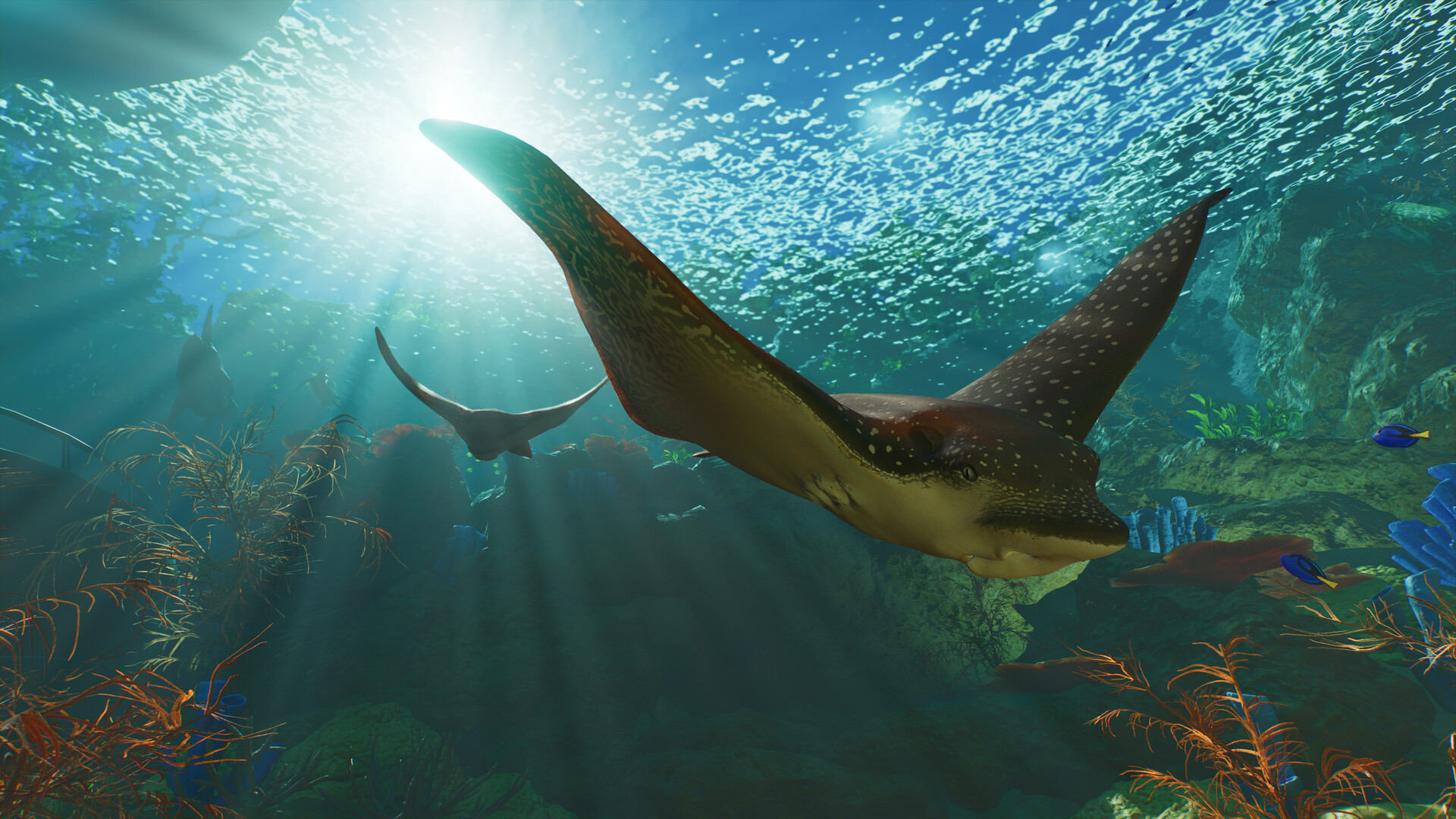
Ocellated Eagle Ray | Ray | Indo-Pacific reefs and coasts |
Ocean Sunfish | Fish | Worldwide |
Hawksbill Turtle | Reptile | Worldwide tropical and temperate oceans |
Red Lionfish | Fish | Western Indo-Pacific Ocean |
Humphead Wrasse | Fish | Indo-Pacific reefs and coasts |
Schooling Bannerfish | Fish | Indo-Pacific reefs |
Blackspotted Puffer | Fish | Indo-Pacific reefs and lagoons |
Golden Trevally | Fish | Indo-Pacific reefs and coasts |
Indo-Pacific Sergeant | Fish | Indo-Pacific reefs and coasts |
Dolphinfish | Fish | Atlantic, Indian, and Pacific Oceans |
Pacific Sardine | Fish | Pacific, Indian, and Atlantic Oceans |
African Tigerfish | Freshwater fish | Africa |
Blunthead Cichlid | Freshwater fish | Africa |
Brown Trout | Freshwater fish | Europe, Western Asia, North Africa |
Clown Loach | Freshwater fish | Asia |
Aquariums sit alongside the new aviaries as the two habitat types that most clearly separate the sequel from its predecessor.
