
Loading...
Loading...
Kiyomizu-Dera Temple
September 7, 2026 at 01:17 AM
Added official location art to the top of the page
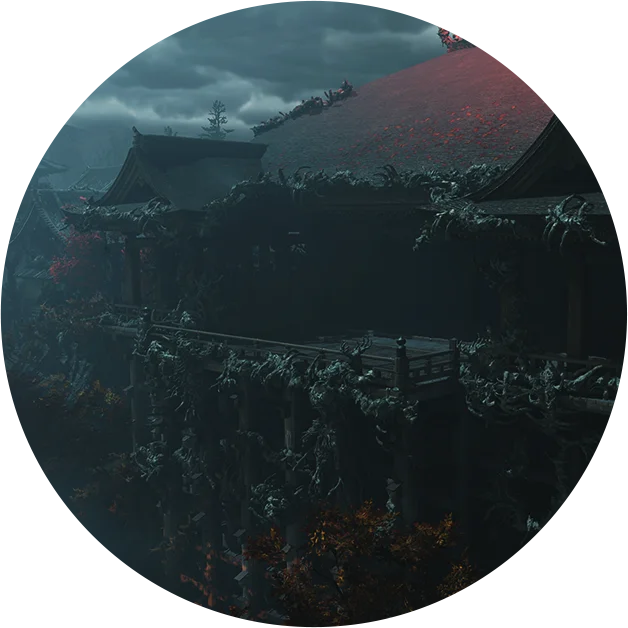
Kiyomizu-dera is one of the real-world Kyoto locations Capcom rebuilt inside Onimusha: Way of the Sword. It is one of the historical sites Musashi Miyamoto visits across the game's dark-fantasy version of Edo-Era Kyoto, and Capcom used its closing arena as the first public demo for the game's signature combat systems. The in-game Kiyomizu-dera is not a fictional pastiche. It is a direct recreation of the real temple complex that still stands in eastern Kyoto, reinterpreted under a layer of Malice and overrun by Genma.
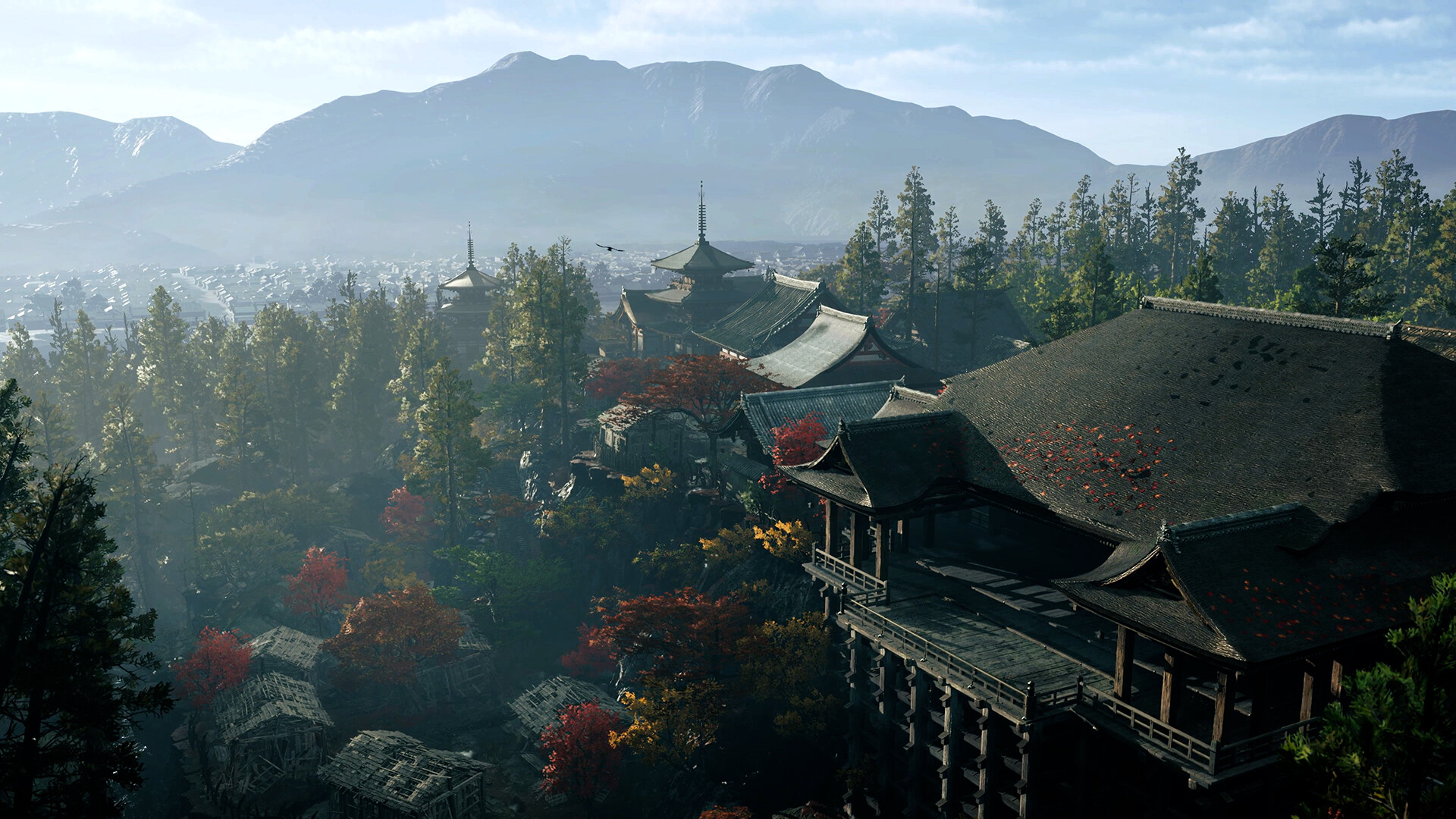
The real Kiyomizu-dera, whose full name is Otowa-san Kiyomizu-dera, is a Buddhist temple in the Higashiyama district of eastern Kyoto. It was founded in 778 in the early Heian period by a monk named Enchin, and the statesman Sakanoue no Tamuramaro is credited with donating the main hall soon after. The temple takes its name from the clear spring water that flows out of Mount Otowa behind the complex; the characters read as Pure Water Temple. It was added to the list of UNESCO World Heritage Sites in 1994 as one of the Historic Monuments of Ancient Kyoto, and it remains an active place of worship today.
The most famous structure on the grounds is the main hall, or hondo, with its broad wooden veranda that extends out over the hillside. This veranda is known as the Kiyomizu Stage, and it was built using a traditional Japanese construction method that interlocks timber columns and beams without a single nail. The current hall and stage were rebuilt in 1633 with a donation from the shogun Tokugawa Iemitsu after the previous structure burned down in 1629. That reconstruction date is significant for the game: it sits almost exactly in the window in which Way of the Sword is set, meaning the version of the temple the player walks through is very close to the building that actually stood in Kyoto at the time.
Below the main hall lies the Otowa waterfall, where a single spring is divided into three channels of falling water. Visitors traditionally drink from the streams using long-handled cups. Each of the three streams is said to grant a different blessing, longevity, academic success, or fortunate love, and drinking from all three is considered greedy. The waterfall is the origin of the temple's name and a small but recognisable detail of the real site that helps orient any recreation of the place.
In the game, Musashi travels to Kiyomizu-dera to investigate the appearance of Malice on its grounds. The temple has been overrun by Genma, and the approach up through the complex forms the backbone of an extended combat mission. Players climb through the layered terraces of the temple, fight through groups of demons along the stone-paved paths, and eventually emerge onto the high platform of the main hall for the mission's final encounter. The route tracks closely with how a visitor would actually walk through the real temple: up from the entrance gates, past the outer buildings, across the main courtyard, and onto the elevated stage with the city falling away beneath it.
The corruption of the place is a central part of the scene's mood. Clouds of Malice cling to the timber beams, the forested slope is darkened, and the buildings that are normally full of worshippers and visitors stand empty of anyone but demons. The game uses that contrast deliberately. Kiyomizu-dera is one of the most familiar silhouettes in all of Kyoto, and showing it overrun is the strongest single image the game has of the corruption reaching places it is not supposed to reach.
Capcom's own official location page describes Kiyomizu-dera in terms that match the game as shipped: "A famed spot in Kyoto known for its main hall and stage that sit atop a cliff. However, the encroaching Genma and Malice have twisted its appearance." Retail-build press coverage adds that Otowa Falls, the waterfall beneath the main hall, is reproduced in detail as part of the temple, down to features fine enough for a visitor to the real site to compare directly.
Capcom's Steam achievement list confirms a specific boss encounter tied to the temple: "Defeat the Byakue at Kiyomizu-dera Temple." The Byakue is an axe-wielding Genma whose power grows the more its own blood stains it, and its achievement placing it here confirms a second named boss encounter at the temple alongside the Sasaki Ganryu duel already documented below.
Capcom's location material also confirms that Dark Mass phenomena, manifestations of resentment left behind by people killed in an area, can be observed at Kiyomizu-dera specifically. Absorbing one into the Oni Gauntlet shows Musashi a vision of the suffering that created it.
Producer Akihito Kadowaki has stated publicly that Capcom worked directly with the officials of the actual Kiyomizu-dera to get the in-game version right. The collaboration went beyond a licensing agreement. The team was given access and cooperation to study the layout, architecture, and atmosphere of the real site, and the goal they set was to present the temple realistically both in terms of how it is laid out today and how it would have looked during the Edo period the game takes place in. A local historian was also consulted to help ground the period detail.
That dual aim is visible in the in-game environment. The modern footprint of the temple is preserved, so anyone who has walked the actual grounds will recognise the sequence of gates, halls, and platforms. Details that belong to the 17th century rather than to today, such as the absence of certain later additions and the period-correct condition of the timber, are restored in the reconstruction. The aim is a version of Kiyomizu-dera that could plausibly be the temple as it stood in the early Edo period, before centuries of later repairs and additions.
Authenticity Element | How It Appears In-Game |
|---|---|
Temple layout | The route through the complex mirrors the approach a real visitor takes, from the entrance up to the main hall. |
Main hall and stage | The elevated timber platform of the hondo is the climactic arena, matching the famous Kiyomizu Stage. |
Period-correct detail | Capcom worked with a local historian to reflect how the temple looked during the early Edo period, not only today. |
Official cooperation | Temple officials gave the studio direct access and approval for the recreation. |
Kyoto City permission | The first game cleared by the city to depict these shrines and temples, which is why the temple keeps its real name in-game. |
Stair gradient | The steep steps up to the real stage were deliberately softened so the climb and the fighting along it play well. |
The clearance went beyond the temple's own officials. Way of the Sword is the first game to have obtained permission from Kyoto City to feature these shrines and temples inside a game, and Kiyomizu-dera is the flagship case for it. That permission is the reason the temple appears under its own name and its own silhouette instead of as a renamed lookalike, which is the usual compromise a game makes with a landmark this recognisable.
One departure from the real site is deliberate and easy to miss. The approach to the real stage climbs a steep flight of steps, steep enough that fighting up and down it did not play well, so the team softened the gradient for the game. It is a small edit against an otherwise faithful reconstruction, and it marks the line where authenticity gives way to what a combat arena actually needs.
The mission ends with a duel against Sasaki Ganryu, Musashi's legendary rival, on the temple's high platform. Capcom chose this encounter as the centrepiece of the gamescom 2025 playable demo. It ran on the show floor as a roughly ten-minute slice that carried the player through Kiyomizu-dera and into the duel, and it was also the featured setpiece of the studio's Tokyo Game Show 2025 live stage demo, played on stage by Musashi's Japanese voice actor.
The fight served as the game's first public show for the Break Issen body-part targeting mechanic. As Musashi wears Ganryu down through repeated parries and pressure, the encounter shifts into a state that allows the player to target specific body parts with focused finisher strikes. Ganryu himself uses an Oni Gauntlet of his own, so the duel is the first time the player sees the game's central weapon mirrored across the arena. Choosing Kiyomizu-dera as the stage gives the duel its iconic backdrop: the open elevated platform of the main hall, with the forested slope of Mount Otowa falling away behind the fighters.
The visual design of the in-game temple leans on the things a visitor to the real site would pick out first. The scale of the approach up the hill, the stacked tiled rooflines, the heavy timber platforms, and the forested slope that Kiyomizu-dera is built into all translate directly into the game. Lanterns, stone steps, and the narrow passages between outer buildings fill the smaller beats of the mission, and the final platform of the hondo is a wide, open arena that opens up the combat after the tighter spaces below.
Over that foundation the game lays the supernatural register it uses throughout the city. Clouds of Malice drift through the beams, the light of the temple is shifted into a darker key, and the normally busy grounds are emptied of worshippers and crowded instead with Genma. The effect depends on the accuracy of the base environment. Because the temple reads as real first, the corruption reads as an intrusion rather than a stylistic choice. The Kiyomizu the player defends still looks like the Kiyomizu a Japanese audience would recognise, which is precisely why watching it fall under attack has the weight it does.
Kiyomizu-dera is the most prominent confirmed environment in the game so far, but it is not the only landmark the player will visit. The Edo-Era Kyoto setting is built around a set of real districts and sites, with merchant quarters, theatre districts, and other temple grounds also appearing in trailers and promotional material. Kiyomizu-dera sits within this wider map as the flagship example of Capcom's authenticity push, and the degree of care the studio has put into recreating it is the benchmark the rest of the city is measured against.
Location | Relationship to Kiyomizu-dera |
|---|---|
The broader setting that frames the temple as one landmark inside a corrupted version of the old capital. | |
Rokudo-chinnoji Temple | A second temple environment shown in official imagery, depicted with scenes tied to other cast members. |
Merchant and theatre districts | Streets and public spaces of Kyoto that appear in promotional material, contrasting with the temple's elevated calm. |
Underground Laboratory | A hidden facility beneath the city whose spread of Malice is what overruns temples like Kiyomizu-dera in the first place. |
Kiyomizu-dera holds an unusual position in the game's development history. The director has said it was the prototype map he created when starting the project, drawn there by the appeal of Kyoto's eerie folklore and by the contrast of a site steeped in occult tales that is also one of the city's best-known tourist destinations. It is, in his words, a place that holds a special place in his heart.
That origin matters because it means the temple was not added to fill out a location list. It was the testbed the game's look and combat were first built against.
The recreation goes further than a general likeness in places. Capcom has cited matching the actual number of pillars supporting the temple's famous stage as an example of the level of detail being pursued, and the temple's own staff verify details as development proceeds rather than only signing off at the start.
At the same time the team has been explicit that accuracy is not the only goal. Deliberate adjustments were made so the space plays well, and the stated hope is that players will notice both kinds of moment: the parts that match the real temple exactly, and the parts that clearly do not.
Kiyomizu-dera is the clearest single expression of the studio's authenticity push for the game. Capcom leaned hard on real-world Kyoto geography for the setting, and using real temple officials as collaborators on a location this recognisable reinforces that commitment in a way that a fictional shrine never could. It also raises the stakes on the encounters that take place there. The player is not fighting Genma in an invented temple. They are fighting them on the Kiyomizu Stage, inside a landmark that millions of people have actually walked through, and the duel with Sasaki Ganryu carries the memory of that place on top of its own narrative weight.
