

Onimusha: Way of the Sword is set in a dark-fantasy version of Kyoto in the early Edo period of 17th-century Japan. The setting is rooted in the real historical capital but reshaped by Malice and by the presence of demonic Genma inside the city. The chosen period is not incidental to the plot. It is the hinge between an older age of open warfare and the long, closely-governed peace that the Tokugawa shogunate was in the process of imposing, and the game uses that uneasy transition as the backdrop for a corruption that has begun to spread outward through the old capital.
Early Edo, Not Sengoku
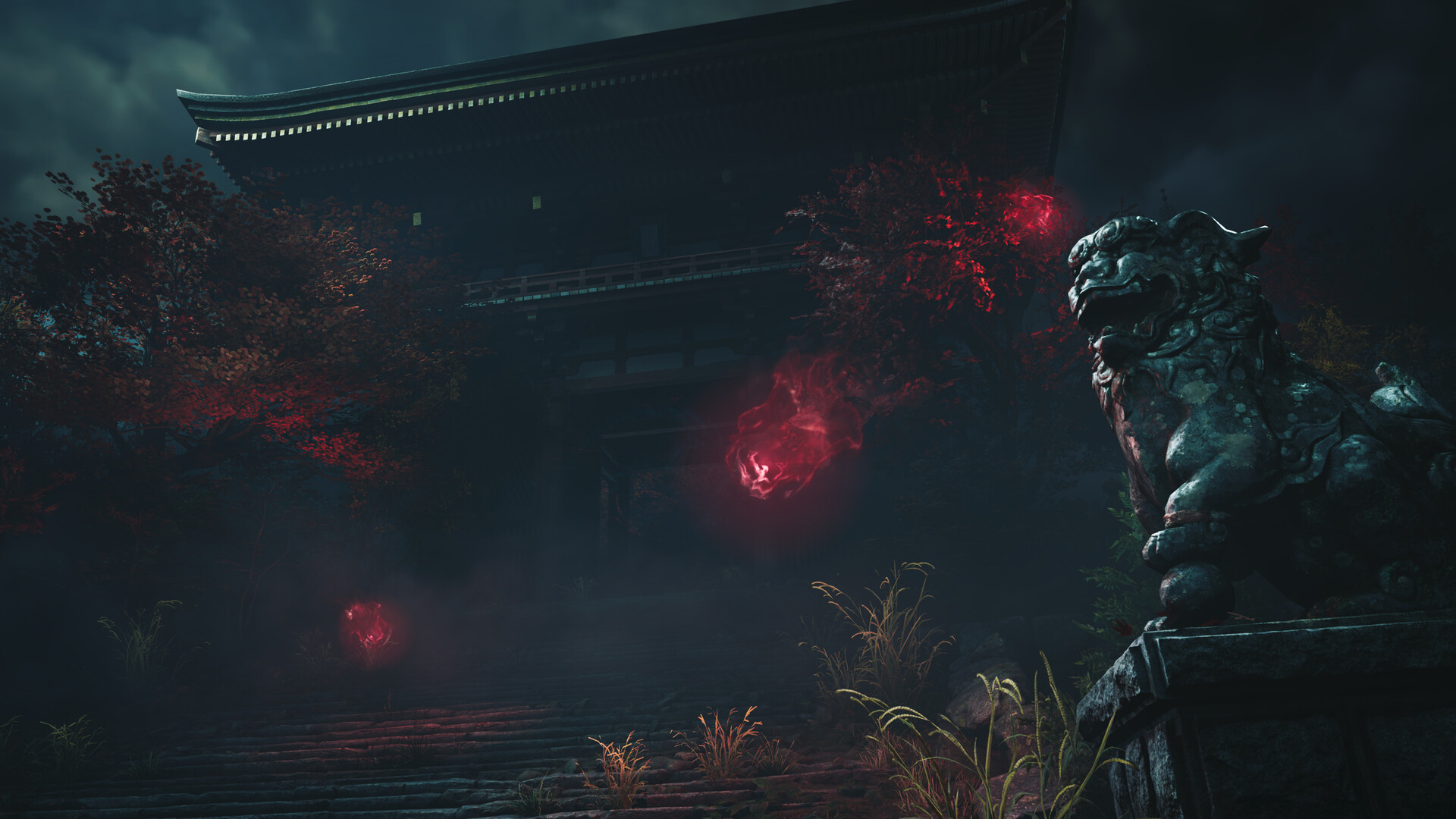
The Onimusha series was traditionally set in the Sengoku period, the era of warring states that dominated the 15th and 16th centuries. Way of the Sword moves forward in time to the early 17th century, the first decades of the Edo period, when the country had begun to consolidate under the Tokugawa shogunate after the decisive battle at Sekigahara in 1600. That shift puts the game in the same historical window that produced its real-world cast: Musashi Miyamoto at his prime, Izumo No Okuni performing the dances that would become kabuki, and the famous duel against Sasaki Ganryu on the horizon of the historical timeline.
The choice of this exact window shapes the atmosphere more than a straightforward Sengoku setting would. The active war between great houses has ended. Soldiers and masterless swordsmen still walk the roads, but the country is moving toward an enforced peace that leaves many of them without a clear place in it. That liminal quality, of a world in the middle of changing shape, is the mood the game is aiming for, and it is the reason a wandering swordsman like Musashi makes sense as the protagonist rather than a general or a daimyo.
Historical Kyoto in the Early Edo Period
Kyoto had been the imperial capital since 794, but by the time Way of the Sword takes place, the practical seat of government had shifted east. When Tokugawa Ieyasu assumed the title of shogun in 1603, the de facto centre of political power moved from Kyoto to Edo, the city that would eventually become Tokyo. Kyoto retained the imperial court and its enormous cultural prestige, but the day-to-day business of running the country was handled elsewhere.
That loss of political centrality did not diminish the city. In many ways it freed it. The early 17th century was a period of intense urban reorganisation in Kyoto. Between the reforms begun by Toyotomi Hideyoshi in the late 16th century and the work continued by the Tokugawa shogunate in the opening decades of the 17th, the city was redrawn. Important institutions were relocated, and districts were defined or redefined so that members of a particular social class, warriors, merchants, craftsmen, or religious orders, would live together in clearly demarcated neighbourhoods. The Kyoto that the game depicts is therefore a city in the middle of a long reshaping, its old imperial bones overlaid by new administrative lines.
The period also produced some of the most famous works of Japanese architecture. Nijo Castle's Ohiroma audience hall is a classic example of the shoin style, with its tokonoma alcove and carefully differentiated areas for the Tokugawa lords and their vassals. Katsura Imperial Villa, built between 1620 and 1624 on the southwestern edge of Kyoto, is the most celebrated attempt to fuse a refined interpretation of Heian-era aesthetics with the architectural ideas that had emerged around the tea ceremony. Outside these grand projects, the city's streets filled with machiya, the narrow merchant townhouses built to fit the tight urban grid, and with samurai residences whose measured wooden architecture gave the samurai class its distinctive domestic footprint. All of these forms inform the look of the game's environments.
Historical Figures in a Supernatural City
The game's version of Kyoto mixes real historical figures with its supernatural elements. Musashi leads the cast, joined by Ono No Takamura and Izumo No Okuni. The rival swordsman Sasaki Ganryu also walks these streets, and the antagonist Dokyo is drawn from a different strand of Japanese history and folklore rather than from pure invention. By anchoring the cast in figures a Japanese audience would already know by name, the game frames the supernatural invasion as an intrusion into a recognisable past rather than as a story set in a generic fantasy feudal Japan.
In-Game Districts and Landmarks
Capcom has described the city the player will move through as a mix of traditional temples, merchant districts, and residential areas, all bearing the marks of the Malice. The shift between those registers is part of the design. Players move from the open, daytime space of a famous temple to the narrow, lantern-lit alleys of a merchant quarter and then into secret interiors that do not appear on any real map of the period. Each district registers the corruption in its own way. The effect is a city that still looks like itself on the surface while steadily losing coherence beneath it.
Location | Role in the Story |
|---|---|
A real Kyoto landmark rebuilt inside the game with the cooperation of actual temple officials. Mission space in an early demo. | |
Merchant and theatre districts | Streets of Kyoto shown in the Tokyo Game Show 2025 story trailer, tying the story to the public life of the city. |
Rokudo-chinnoji Temple | Temple grounds depicted in official imagery, including scenes with Izumo No Okuni. |
Residential areas | Machiya townhouses and samurai residences set within the tight urban grid of early Edo-period Kyoto. |
Underground Laboratory | A hidden facility beneath the city where Dokyo conducts her experiments on Genma and Malice. |
A Kyoto mountain range beyond the city proper, shown in the release-date trailer. Overrun by the Genma and held by the colossal boss Shuten Doji. | |
Yasui Konpiragu Shrine | Rasho-Gan holds court here as a false deity. The real shrine is known for severing bad ties and binding good ones, and the game builds the encounter out of that reputation. |
Kennin-ji | A Zen temple whose twin-dragon ceiling is reproduced in-game, despite the painting itself dating from 2002. |
How the City Opens Up
Way of the Sword does not stay tightly scoped. Capcom has described the shape of the campaign as missions with tighter scopes flowing into a wider location, and Kyoto itself is far larger than anywhere else the game visits. What holds the player back early is not level geometry but the demonic occupation: hellish structures erupt from the earth and a toxic fog sweeps through the streets, and together they form blockades that seal off districts and trap the locals who have not managed to flee.
Liberating the city is therefore a sequence of removals. Rifts where the Genma manifest have to be sealed one at a time. The barriers come down once Musashi has Oni Strength, granted by the shrine guardians after the fight with Rasho-gan. The fog clears when the eerie plants it seeps from are cut down, an objective guarded by the Genma Byakue. Each removal visibly widens the map, and when the haze lifts the townsfolk come back out into the streets.
Progress is funded by combat. Souls absorbed from fallen Genma, together with treasures found while exploring, upgrade Musashi's gear and unlock new abilities, so pushing further into the city is what pays for the tools needed to keep going.
Permission from Kyoto City
The city itself signed off on the reconstruction. Way of the Sword is the first game to obtain permission from Kyoto City to feature these shrines and temples in a game, which is why the landmarks keep their real names instead of appearing as renamed stand-ins. That clearance covers the temple and shrine sites the campaign passes through, and it is the reason the in-game map can be read against a real one.
How Big the City Is
The Kyoto of the game is not a one-to-one copy of the real street plan. The team first tried building the map at true scale and found the walking exhausting, so travel distances were compressed to roughly half of the real thing while the buildings themselves were kept close to real size. Producer Akihito Kadowaki has framed it as deforming only the roads: a structure still looks the size it ought to when you stand in front of it, but the walk between two of them is shorter than it would be in Kyoto today.
Wide-Linear Fields
The field structure has been described as wide-linear. Areas are open and worth exploring, and a trail of light points the player toward the current objective, but this is not an open-world game. Free roaming across Kyoraku opens up once Musashi returns from the Oni Refuge, and the team has described that stretch of the city as far larger than anything shown before launch. Random events layered on top send him to rescue townspeople for rewards.
Eastern Kyoto
Eastern Kyoto is Capcom's own official English name for the region the player explores, corresponding to the Japanese Rakuto. Capcom's official manual and retail-build press coverage both describe it as a wide-linear field: open enough to explore and to find things in, with a trail of light pointing toward the current objective, but not an open-world game and not a purely linear corridor either.
Clearing Corruption
Capcom's official manual documents a specific mechanic gating exploration: "Parts of Eastern Kyoto are afflicted with concentrated Malice, restricting your freedom of movement." Some parts carry a high enough concentration that they "cannot be entered" until the player purifies the source of that Malice, and the manual notes that some corrupted areas require purifying other areas first before they themselves become accessible. This is the official framing behind the removals this article already describes: rifts sealed, barriers lowered, and toxic fog cleared.
Rifts
Capcom's manual defines rifts directly: "Rifts are portals to hell created by dense Malice. The Genma use these portals to enter the mortal realm." Sealing one requires defeating all the Genma near it, then holding the absorb input to draw the rift into the Oni Gauntlet until it is fully absorbed.
Rescuing Townspeople
The manual confirms that Genma attack ordinary residents in the streets, and that helping a townsperson escape one earns "a token of their thanks." Capcom's Steam achievement list separately confirms specific rescue milestones, including rescuing 30 townspeople and rescuing a merchant, which makes this a tracked system rather than a one-off scripted beat.
Three Story Types
The manual describes three types of story the player follows through Eastern Kyoto, and states plainly that all three can be pursued at the same time.
Story Type | What It Is |
|---|---|
Way of the Sword | The main story. Must be cleared to advance the campaign. |
Mysteries of Kyoto | Requests from a certain individual, encountered while advancing the main story. Optional, and only a few affect the main narrative, but completing them earns rewards. |
Chance Encounters | Helping residents who still need assistance even after an area has been cleared of corruption. Optional, and only a few affect the main narrative, but responding earns rewards. |
The Map, Legend and Johari Shard
The manual documents the map's legend directly: it displays Musashi's location, his destination, icons for the Way of the Sword, Mysteries of Kyoto and Chance Encounters story types, clue markers for the latter two, a player-placed marker, and Spirit Mirrors, which appear dark on the map until unlocked. A marker can be set on any map icon, but the manual specifies that "this function can only be used within the Eastern Kyoto area."
The Johari Shard is a separate wayfinding tool documented in the manual: "a valuable item that will guide you to locations in Eastern Kyoto." It is obtained at a certain point in the story, is not carried on Musashi's person, and is not consumed when used. Holding both triggers while exploring shines a light guiding the player toward their destination.
Capcom's Confirmed Locations
Capcom's own official location page lists five named settings for the game: Kiyomizu-dera Temple, the Oni Refuge, the Underground Laboratory, Mount Oe and Yasui Konpiragu Shrine. Kennin-ji Temple and Rokudo-chinnoji Temple are confirmed elsewhere in Capcom's own material, the character page and the official manual respectively, rather than on the location page itself.
Beyond those officially confirmed sites, trusted retail-build press coverage names further real Kyoto landmarks reported to appear as stages: Nijo Castle, the Kyoto Imperial Palace, Gojo Bridge, Yasaka Pagoda, Arashiyama and Rendaino. Capcom has not confirmed these directly, and no official chapter-by-chapter breakdown of where each one appears has been published.
Rokudo Chinno-ji Temple
Rokudo Chinno-ji Temple is Musashi's base of operations, and one of several real Kyoto sites rebuilt for the game. Legend places it at the crossroads between the world of the living and the gates of hell, which is a pointed choice for a sanctuary in a city being invaded from the underworld. Musashi and his allies make their home there once the Malice above Kyoto begins to thin.
The temple's real claim to fame is the legend of Ono No Takamura, the courtier said to have served the king of hell by night and to have commuted there through a well on these grounds. The game reproduces both wells, the one he went down and the one he came back up through. The site's head priest has said the team visited repeatedly and studied the legend and the history closely enough to genuinely surprise him. Turning a place built around a door to hell into the safe house of a game about an invasion from the underworld is exactly the kind of choice this setting keeps making.
Kiyomizu-zaka Slope
Kiyomizu-zaka is the pilgrim road that climbs the hillside toward Kiyomizu-dera Temple, the site where the story began. Capcom has described it as holding the key to unlocking much of Kyoto, and reaching it requires getting past some of the game's most formidable foes, which makes the slope a threshold rather than a corridor.
Beyond the City
Not every named location sits inside Kyoto. The Oni Refuge is a separate otherworldly dimension of floating islands and conjured ruins, Yasui Konpiragu Shrine is where Rasho-gan holds court as a false deity, and Mount Oe carries its own folklore weight. Capcom also lists Dark Mass among its location material: these are manifestations of accumulated resentment that, when absorbed into the Oni Gauntlet, show Musashi a vision of the suffering that created them.
Yasui Konpiragu Shrine
Yasui Konpiragu is a real Kyoto shrine best known for severing bad ties and binding good ones, and people still visit it for that. Director Satoru Nihei has said the team built it into the game from the idea that those wish-fulfilments might really be the work of the Genma, which is how a shrine with a gentle-sounding purpose ends up as the seat of Rasho-gan.
Eight stone statues stand on the real grounds, the Hachidairikison. In the game they govern how Musashi's abilities grow, and the script writes the eight as brothers. That family relationship is an invention for the game rather than something the real statues carry, and the shrine approved it.
Kennin-ji and a Deliberate Anachronism
Not every detail in the reconstruction belongs to the 17th century. Kennin-ji's twin-dragon ceiling is reproduced in the game even though the painting itself dates from 2002, which puts it four centuries out of place in an early Edo setting. The team kept it anyway, on the reasoning that a player who visits the temple after finishing the game should find the same thing on the ceiling that they saw in-game. It is the one point where the project openly chose the tourist's Kyoto over the historian's.
The Sound of the City
The authenticity work extended to what the city sounds like. Ambient audio, including the rustle of trees and the calls of crows, was field-recorded in Kyoto rather than pulled from a stock library, and it was authored positionally so the streets place their sounds around the player rather than in front of them.
Kiyomizu-Dera
The Kiyomizu-Dera Temple is the most prominent confirmed location in the game so far. It is a real-world Kyoto landmark, still standing today, and the development team obtained permission from the responsible personnel at the actual temple for its appearance in the game. Kiyomizu-dera became something like a prototype for the project: a place steeped in occult tales yet widely known as a tourist destination, a site whose real history could be turned toward the story without inventing it from nothing.
In an early demo, the player fought their way through the temple complex, and the mission ended with a confrontation against Sasaki Ganryu. The scale of the approach, the timber platforms, the stacked rooflines, and the forested slope the temple is built on all translate directly from the real site. The Malice visible in that environment, the clouds hanging off the wooden beams and the way the grounds darken as the player moves deeper into the space, is the visual shorthand the game uses to signal that the corruption has reached even the most protected places in the city.
Theatre and Merchant Districts
The game's city is also the Kyoto of public performance. Izumo No Okuni's historical troupe performed on the dry riverbed of the Kamo River at Shijogawara around 1603, and that stretch of ground remains tied to her to this day through the bronze statue that still stands near the Minami-za theatre. Placing a kabuki dancer in a game set in early Edo Kyoto is not a free invention. It is the same decade in which kabuki itself was being invented in those districts, and the game leans on that to tie its supernatural plot to the ordinary public life of the capital.
The merchant quarters sit alongside the theatre districts in both history and in the game. Kyoto's machiya townhouses, with their narrow street frontage and long interiors stretching back into deep lots, were designed to optimise space inside a dense urban grid. The trailers show street-level fights moving through exactly this kind of environment: paper lanterns hanging over shop fronts, vendors and passersby scattering, alleys narrow enough that combat spills out of one lot and into the next. These quarters are what give the Kyoto of the game its street-level intimacy, and they are where the corruption has the most visible human cost.
Dokyo's Underground Laboratory
Beneath the surface city sits a location that has no historical analogue: a hidden facility where Dokyo conducts her experiments. Capcom has confirmed this underground laboratory as the origin point of new Genma and as the source of the Malice that spreads outward into the streets above. It is the structural inverse of the temple grounds. Where Kiyomizu-dera is daylit, open, and anchored in real public memory, the laboratory is subterranean, closed, and purely invented for the purposes of the story.
That contrast is doing deliberate work. The city the player defends is a place that still follows the rules the player knows from history: recognisable temples, recognisable districts, recognisable names. The laboratory is the thing eating that city from underneath, and the fact that it sits beneath Kyoto rather than at its edge is the geographical reason the Malice reaches every district the player walks through.
Visual Design and Authenticity
The authenticity effort extends beyond Kiyomizu-dera. Producer Akihito Kadowaki has described the Kyoto setting as one of three core pillars for the game, alongside compelling characters and what the team calls ultimate sword-fighting action. The studio's research push included professional swordsmen brought in for motion capture and direct collaboration with real temple officials on heritage sites like Kiyomizu-dera, and that research anchors the setting pillar rather than sitting off to one side.
The result is an environment that reads as recognisably early Edo before the supernatural elements are factored in. Timber construction, tiled roofs, paper screens, stone-paved approaches, and the compact urban grid of merchant and samurai quarters all match the historical record. The corruption is then layered over that foundation: drifting clouds of Malice cling to roofs and beams, familiar landmarks take on a darker register as the story progresses, and the city's ordinary public life, the stalls, the worshippers, the performers, is pushed out of frame by the demons in its streets.
Producer's Pillars
The Kyoto setting is tied to the game's broader structure in a way that previous Onimusha titles did not always make explicit. Kadowaki's framing of the three pillars sets out the city as a design equal to the cast and the combat, which is why the investment in real-world consultation and architectural research sits at the centre of the project rather than at its margins. Musashi's Oni Gauntlet may be the player's weapon, and the cast may be the story's cast, but the capital itself is the environment that both of those pillars have been built around.
Pillar | Description |
|---|---|
Kyoto setting | Dark-fantasy reimagining of early Edo-period Kyoto built on real historical research and temple collaboration. |
Characters | A cast anchored by real historical figures, Musashi and his allies against Dokyo and her servants. |
Sword-fighting action | Combat designed around the Oni Gauntlet and motion-captured swordsmanship. |