

Daily Life and Routine
Nivalis is structured around a daily rhythm that shapes how you play. Each day starts in your apartment, gives you a limited number of hours to work, explore, and socialize, and ends with a 2 AM curfew. Within that framework, you decide how to spend your time: running your businesses, cooking, fishing, building relationships, or simply walking the streets and soaking in the atmosphere. There is no combat, no weapons, and no survival mechanics. The game does not tell you what to do each day. It gives you a city full of possibilities and a clock that keeps ticking. That clock is a daily rhythm, not a deadline on the game: the lead writer said on the official forum on 18 September 2026 that "there's no time limit or anything" and that "You can ignore the story if you want." The developers have also confirmed on the same forum that the player character eats, drinks and sleeps.
The Day-Night Cycle
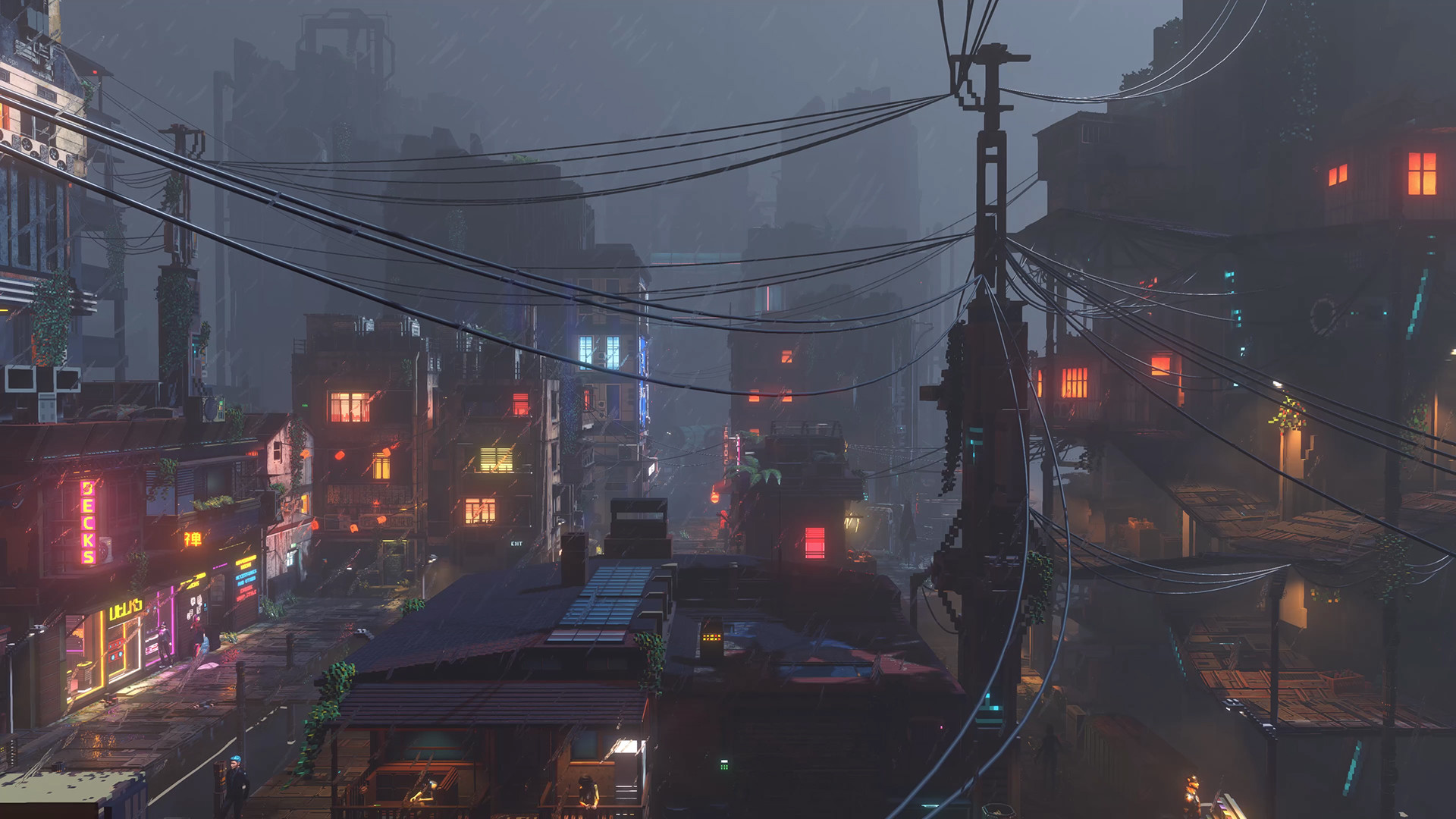
Nivalis has a full day-night cycle that affects the city in ways that go beyond just the lighting. During the day, foot traffic patterns follow commuter rhythms. Workers head to their jobs, shops open, and the streets buzz with people running errands and going about their lives. As afternoon turns to evening, the character of the city shifts. Shop lights start to flicker on. The food and entertainment districts get busier as people look for somewhere to eat and unwind.
At night, the city transforms. Neon signs come alive against the dark. This reflects off wet surfaces and cutting through the fog. Bars, nightclubs, and late-night food stalls see their peak hours. Energy demand spikes as heating systems and entertainment venues draw power, creating opportunities for black-market energy trading. The night is also when certain dangers become more present; the lower levels get quieter, and the people who stay out late tend to be either working or looking for trouble.
The Heads-Up Display
An official gameplay video published in September 2026 shows the in-game HUD. Across the top centre it shows the day counter with a weekday name ("DAY 6, SATURDAY"), a 24-hour clock ("13:02") and the player's coin balance, with a location banner underneath naming the district the player is standing in, in that case Meridian Market. The top left carries a "Shopping List" prompt opened with a single key, and the right-hand side holds a task panel listing the venue and an outstanding job, "Ramen Noir / Restock ingredients". The balance in that footage is a showcase-build figure, not a starting balance, and the layout can change before launch.
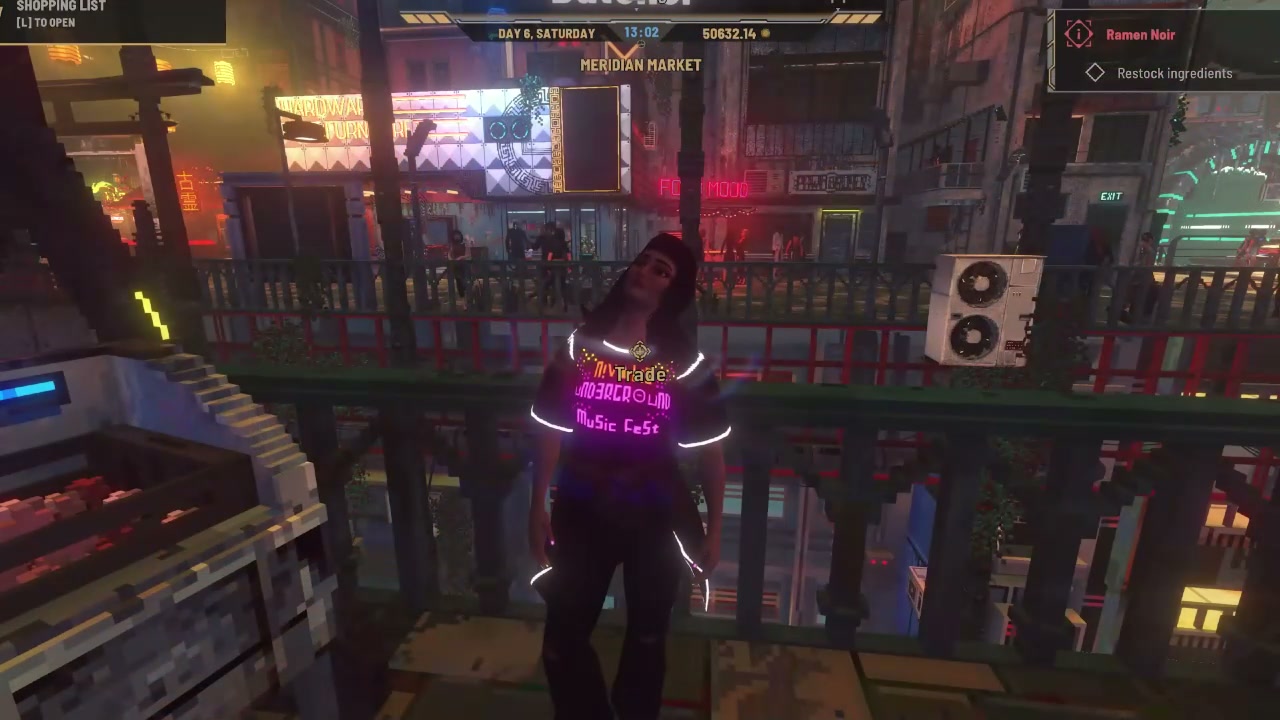
The video's caption cards, which are marketing text rather than in-game interface, sum up the intended shape of a day as a to-do list: go to work, feed people, buy supplies, farm, fish, explore the city, get to know the neighbours, and "sleep... or don't".
Weather
The weather in Nivalis is not cosmetic. It is a gameplay system that affects your businesses, your movement through the city, and the behavior of the NPCs around you. Rain drives foot traffic indoors, benefiting businesses with indoor seating while hurting outdoor stalls. Snow reduces outdoor movement significantly and spikes heating demand, raising energy prices for traders. Fog makes boat navigation trickier and gives the lower city an even more enclosed atmosphere.
Weather | Gameplay Effect |
|---|---|
Sunshine | Standard conditions. Foot traffic flows normally. Good for outdoor food stalls. |
Rain | Drives foot traffic indoors. Businesses with indoor seating benefit. Streets are slick and atmospheric. Can affect greenhouse-related decisions, since a quiet street is a natural window for greenhouse work; conditions inside a greenhouse are controlled separately. |
Snow | Reduces outdoor foot traffic significantly. Heating demand increases, raising energy prices. Snow accumulates on surfaces. |
Fog | Reduces visibility on the streets and waterways. The city feels more enclosed and mysterious. Boat navigation becomes trickier. |
Thunderstorms | Heavy rain with lightning and wind. Strongest impact on outdoor businesses. Most NPCs seek shelter. Dramatic visual and audio atmosphere. |
Weather changes throughout the day and between days, adding variety to your routine. A week of sunshine followed by a three-day rain spell changes how your businesses perform, which ingredients you can source, and how you plan your fishing trips. Learning to read the weather and adapt your plans accordingly is part of the strategy.
The 2 AM Curfew
Every day in Nivalis ends with a curfew at 2 AM. Staying out after it is possible but risky: the security systems that guard the streets and rival premises are active, and the developers frame after-hours activity as the cover for sabotage rather than as normal working time. The curfew is still the game's core time-management constraint. It means you cannot do everything in a single day, and that is the point. Do you spend the evening cooking a batch of dishes for tomorrow's restaurant service, or do you head to a bar to build a relationship with a contact who could open doors for you? Both are valuable, but you can only pick one.
The curfew also serves a narrative purpose. Nivalis is not a safe city after dark, and the 2 AM limit reflects the reality that even in a place where danger is constant, there is a time when it is simply too risky to be out. The gangs that operate in the lower levels are more active late at night, and CorpSec patrols thin out as the hours get later.
The same footage includes a night segment in a dark alley lit by sweeping searchlight cones, with the player crouched low and a newspaper lying on the ground. It matches the store description of security systems active during the curfew, but nothing in the sequence is labelled, so how the searchlights work in play is not yet known.
The Morning Newspaper
Each morning when you wake up, you receive a newspaper summary of what happened in the city overnight. This is not a passive lore dump; it is a briefing that can affect your decisions for the day. The newspaper might report on market price changes, new business opportunities, crime in your neighborhood, factional movements, or story developments.
The newspaper also reflects your influence on the city. As your businesses grow and your decisions ripple outward, the stories in the paper start to reflect what you have done. A successful grand opening might get a mention. A deal gone wrong might make the crime section. Reading the paper is a quick ritual that grounds you in the world each day and reminds you that the city keeps moving even when you are asleep.
Your Apartment
Your apartment is your home base. It is where you start each day and where you return each night. Apartments in Nivalis range from minimal studios to cozy lofts to standalone houses. The starting apartment is modest, but as your income grows, you can rent better spaces. Standalone houses are available on Calypso Island, the warm port area, offering more room and a different atmosphere from the dense apartment towers of the main city.
In pre-release footage the starting apartment holds a bed, a desk with a monitor and keyboard, and a lamp, and objects in it can be interacted with: an on-screen prompt names a "Potted Plant", and a small icon strip at the bottom of the screen shows the keys currently available.
You can rent multiple apartments if you have the money. Having an apartment near your primary business and a second one in a different district saves commute time and gives you flexibility in how you plan your days. Some apartments have balconies or terraces with skyline views, which adds to the sense of upward mobility as you climb from the lower levels.
Furniture and Interior Design
Decorating your living space is one of the game's more relaxed activities. Furniture vendors are scattered across the city, each with unique assortments, styles, and materials. One vendor might specialize in industrial metal pieces while another carries warmer wood furnishings. Shopping for furniture doubles as exploration, since finding new vendors in unfamiliar districts gives you more options.
Interior design is not limited to your own apartments. You can take on side jobs furnishing NPC homes to their taste. These are paid contracts where an NPC tells you what kind of look they want, and you select and arrange furniture to meet their expectations. Completing these contracts earns money and builds relationships with the NPCs who hired you. It is a quiet, creative gameplay loop that provides a break from the pressure of managing businesses.
Photo Mode
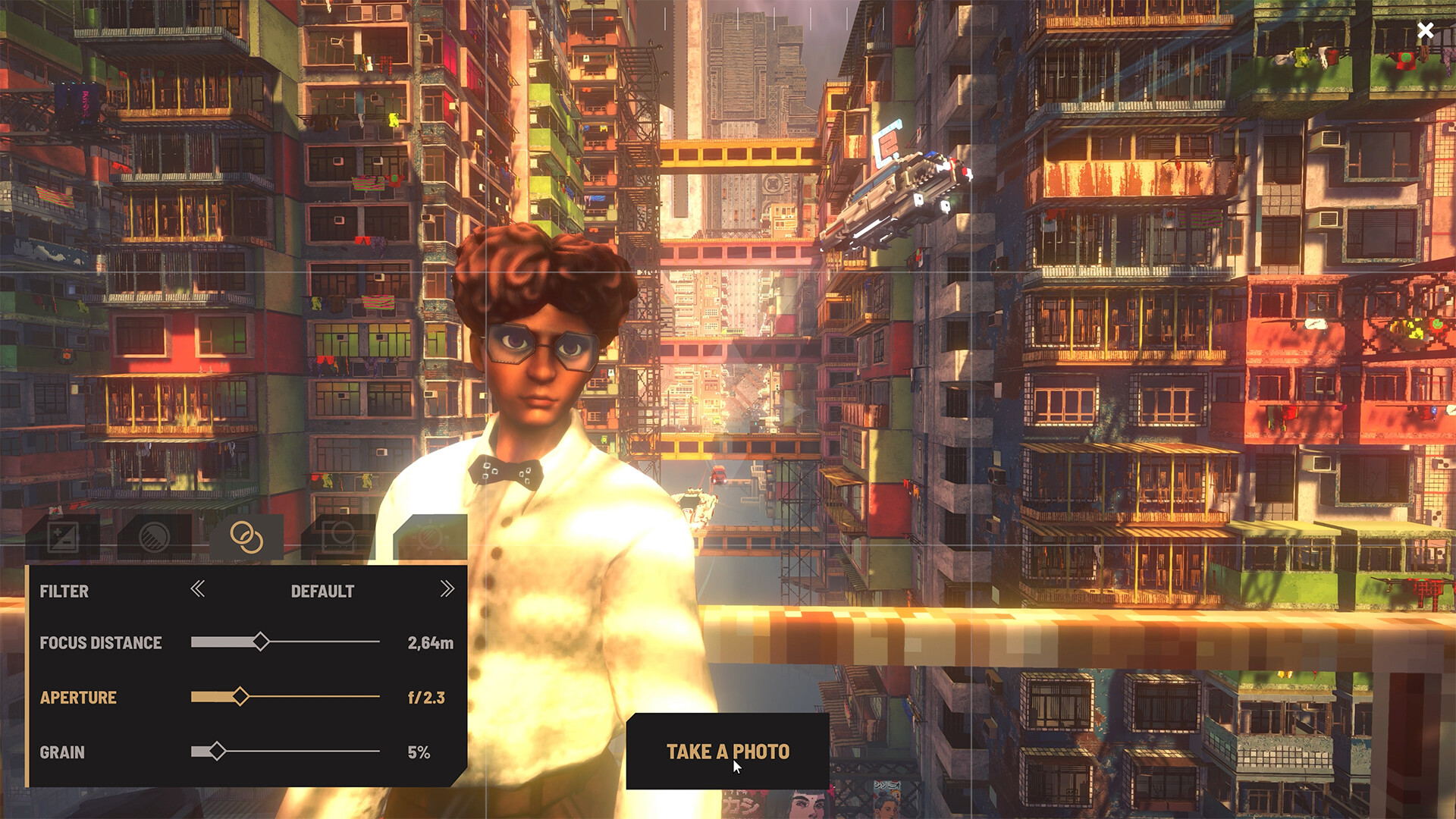
Nivalis includes a photo mode with extensive customization options. You can adjust focus distance, aperture, focal length, field of view, and apply creative filters to capture the city exactly as you want to see it. The photo mode is accessible at any time during gameplay, letting you pause the action and compose a shot.
Given the game's visual identity, with its voxel art style, neon lighting, rain effects, and atmospheric fog, photo mode is well-suited to the setting. The lower levels of the city are full of photogenic scenes: neon signs reflected in puddles, steam rising from food stalls, the silhouettes of towers disappearing into the clouds above. The adjustable aperture is particularly effective for depth-of-field shots in the narrow corridors of the lower city, letting you isolate a subject against a beautifully blurred background of neon and rain.
Minigames and the Chess Tournament
Alongside the business loop there is a lighter track built around challenging the city's inhabitants to minigames. The studio first mentioned it in passing during a March 2026 developer Q&A, describing it only as "another mini-game where you can challenge some of the inhabitants" and promising details later. Those details arrived with the release-date materials: the headline example is a high-stakes cyberpunk chess tournament, described as something you can set out to master rather than a one-off diversion.
How the tournament is structured, whether it runs on a schedule, and what it pays out have not been published. What is confirmed is the shape of it: minigames are played against named inhabitants of the city rather than against menus, so they sit naturally in the same part of the day as socialising, and they are one of the things you can spend an evening on instead of another shift behind the counter.
Quests
Alongside the open-ended loop of running businesses, cooking, and fishing, the game supports a substantial amount of structured content. The quest framework covers 100 quests, localized across all 11 supported text languages. These give your days direction when you want it: a thread to follow, a contact to meet, or a task that ties into the city's factions and characters. Because the day is bounded by the 2 AM curfew, deciding which quests to pursue and which to set aside is part of the same time-management calculus that governs the rest of your routine.
A Typical Day
While every day in Nivalis is different, a typical day might look something like this. You wake up in your apartment and read the morning newspaper. Based on what you learn, you plan your priorities for the day. Maybe ingredient prices dropped, so you head to the shops to stock up before they bounce back. You stop by your noodle bar to check on Banor and make sure the morning shift is covered. Midday, you head to the docks for a fishing trip, catching a few fish that you cook into dishes that evening.
In the afternoon, you handle a meeting with a contact from one of the city's factions, negotiating a deal that could open up a new business location. Evening arrives, and you open your bar for the night crowd, keeping an eye on customer flow and adjusting staff as needed. Around midnight, you make a quick energy trade on the black market, buying low from the grid and selling high to a contact who needs power for an off-books operation. At 1:45 AM, you head home, passing wanted posters for the Aseptic on every other wall. You make it to your apartment with minutes to spare, and the day ends.
Tomorrow, the newspaper will tell you what happened while you slept, and the cycle starts again.