

Cooking and Recipes

Cooking in Nivalis is more than a minigame bolted onto the business system. It is the engine that drives your restaurants, stalls, and bars. Every dish on your menu starts as raw ingredients that you have to source, prepare, and combine. The quality of what you serve directly affects customer satisfaction, which in turn affects your revenue and reputation. A restaurant with mediocre food in a great location will still struggle, while an excellent cook working out of a cramped noodle stand can build a loyal following.
Sourcing Ingredients
There are three main ways to get ingredients in Nivalis, and most successful business owners use all three depending on what they need and what they can afford.
Buying from shops is the most straightforward option. Ingredient vendors are scattered throughout the city's many districts, each carrying a selection of goods that reflects their neighborhood. Shops near the docks tend to stock seafood and marine-adjacent products, while vendors in the upper levels carry more refined and expensive items. Prices fluctuate with supply and demand on a neighborhood-by-neighborhood basis, so the cost of any given ingredient can shift from day to day and vary between districts.
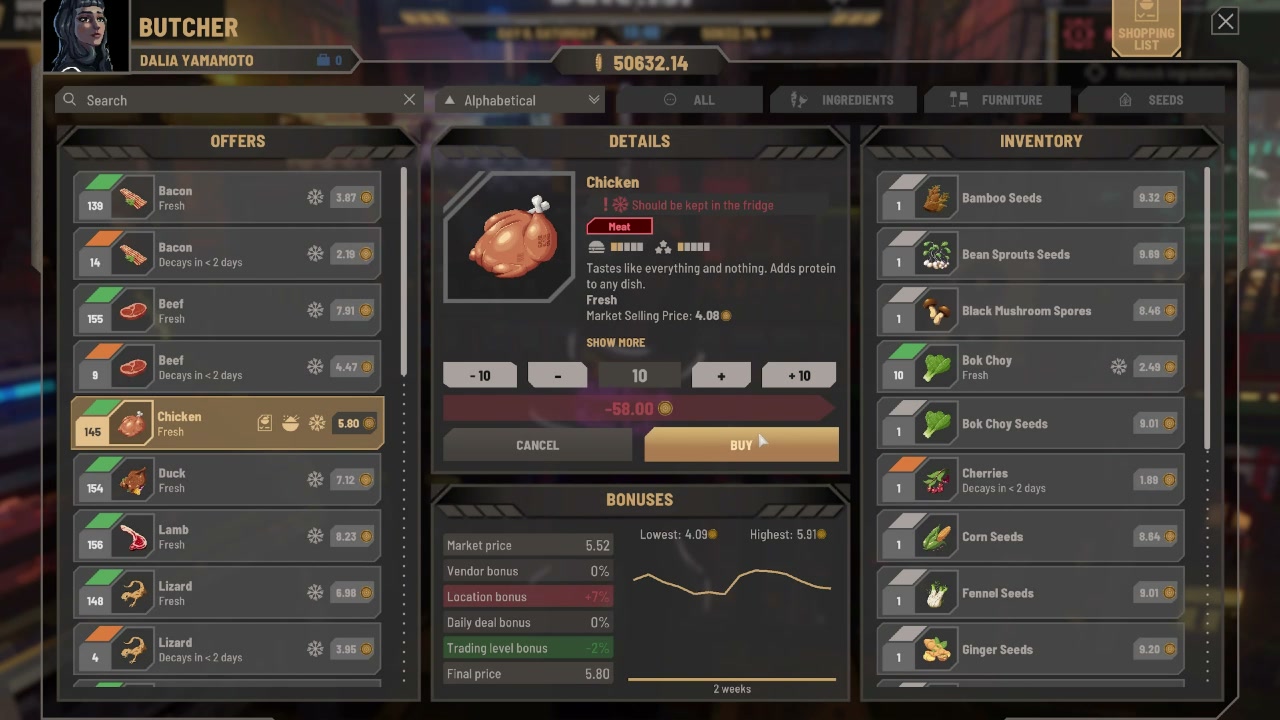
Pre-release footage of a butcher's stall gives a look at one vendor's shelf. The stall, run in that footage by a vendor named Dalia Yamamoto, filtered its stock into ingredients, furniture and seeds tabs and its visible offers included bacon, beef, chicken, duck, lamb and lizard, the last sold as a meat like any other. Each meat was listed as fresh stock, and several appeared a second time flagged as decaying within two days at roughly 57 percent of the fresh price. Selecting an item opened a detail card carrying a fridge warning ("Should be kept in the fridge"), a Meat tag, two five-pip meters whose labels were not shown, a line of flavor text, the item's condition and a separate market selling price; the chicken card read "Tastes like everything and nothing. Adds protein to any dish." Prices and stock counts in that footage come from a showcase build and can change at launch. The full price list, and the bonus lines that build up a final price, are on the Economy and Dynamic Pricing page.
Growing your own is the most cost-effective method in the long run. Near the docks, you have access to a greenhouse where you can plant, tend, and harvest your own produce. Growing takes time, so you need to plan ahead. If you are running through tomatoes faster than your greenhouse can produce them, you will need to supplement with store-bought stock. With enough money, you can rent multiple greenhouses, spreading your crops across several growing spaces to keep up with demand from expanding businesses.
The same footage shows what a seed inventory looks like in practice: the player was carrying Bamboo Seeds, Bean Sprouts Seeds, Bok Choy Seeds, Corn Seeds, Fennel Seeds and Ginger Seeds plus Black Mushroom Spores, each with a per-unit value beside it, along with a stack of fresh bok choy and some cherries flagged as decaying. Growth times and module requirements for those crops were not shown.
Fishing is the third source. Your personal boat at the docks lets you head out into the waterways between the city's support pillars to catch fish and other aquatic ingredients. What you catch depends on where you go and, to some extent, on luck. Fresh-caught fish is a high-value ingredient that can make certain dishes stand out on your menu.
The Greenhouse

The greenhouse near the docks is your personal growing space. It is available from relatively early in the game and provides a steady supply of produce once you invest time in setting it up. You choose what to plant from a selection of seeds available at shops or earned through gameplay. Over time, you unlock new seed varieties and advanced greenhouse modules that expand your growing capabilities.
What sets the greenhouse apart from a simple planting system is the control consoles. Each greenhouse has adjustable settings for temperature, humidity, and light levels. These three variables directly affect crop growth speed. Dialing in the right combination for each plant type is part of mastering the system. A tropical fruit might thrive in high humidity and warm temperatures but stall out if the light is too low. A root vegetable might prefer cooler conditions and moderate humidity. Experimenting with these controls is how you optimize your harvests.
Plants grow on a real-time cycle tied to the game's day-night system. Some produce grows quickly and can be harvested every couple of in-game days. Other plants take longer but yield more valuable or versatile ingredients. Managing your greenhouse space means balancing quick-turnaround crops for daily use against slower-growing items that give you access to better recipes.
As your business empire grows, a single greenhouse may not be enough. You can rent additional greenhouses with enough money, each with its own set of control consoles. Running multiple greenhouses lets you dedicate each one to a specific crop type with optimized environmental settings, which is more efficient than trying to grow everything in a single space with compromised conditions. If you have hired a Manager at venue level 3, they can collect goods from your greenhouses and distribute them to your restaurants automatically.
Preparing Dishes
Once you have ingredients, you can prepare dishes at any kitchen you own. The cooking interface presents you with available recipes, each listing the required ingredients and the steps involved. Some recipes are simple: combine two or three components and you are done. Others involve multiple stages of preparation, timing, and attention.
The dishes you create become menu items at your businesses. Each dish has a base cost determined by its ingredients, a quality level influenced by your cooking skill and the freshness of the ingredients, and a customer appeal rating that varies by business type and clientele. A hearty noodle bowl might be perfect for a street-level food stall but out of place at a high-end restaurant, and vice versa.
Whether a menu item can be promoted as a signature dish has not been described in first-party material. Earlier wiki text described a Signature Dish option in the Menu tab of the management interface that would be promoted to customers and become part of the business's identity; treat that as unconfirmed until the launch build shows such an option. What the developers have said is that your restaurants are defined by the recipes you unlock, so a dish that customers respond to is still the natural centre of a menu.
Menu Categories
Dishes are grouped into a set of menu categories that you can draw on when stocking the venues you own across the city. Serving a spread that fits the venue and its clientele matters as much as the quality of any single item: an exclusive plate aimed at a refined palate belongs somewhere different from a quick snack. Alongside the recipe and the ingredients, each dish also needs the right equipment in the kitchen before you can prepare it.
Menus can lean meat-free if the recipes allow it. Asked on the official forum in August 2026 whether a restaurant could be vegan or vegetarian, a developer replied: "Your restaurants will be defined by the recipes that you're offering on the menu. You can choose vegan or vegetarian options, for sure, depending how many of the recipes you unlock."
Category | Notes |
|---|---|
Meat dishes | Cooked mains built around meat ingredients. |
Fish and seafood | Draws on the catch you bring back from fishing trips as well as vendor stock. |
Salads | Light plates that lean on greenhouse produce. |
Sandwiches | Quick counter food suited to high-turnover venues. |
Pizza | Includes the Meridian Pizza, a slice associated with the district. |
Soups | The category the starting noodle bar's ramen bowls sit in. |
Desserts | Sweet courses for sit-down service. |
Snacks | Small items such as the crispy Cola Chicken. |
Drinks | A colourful range of beverages, from VegCoffee to bar cocktails. |
A handful of named dishes have been shown ahead of launch: Cola Chicken, a crispy snack; the Summer Salad, presented as a warm-weather plate; Meridian Pizza, named for Meridian Market; VegCoffee, a drink. Some dishes are described as considerably more exclusive than others, so part of building a menu is deciding which kind of customer you want to satisfy. A brochure poster also advertises a new recipe under the name Ramen Noir, which pre-release footage shows to be the name of the player's noodle bar rather than a dish. The dish behind that flag has not been named.
Ramen Noir is the venue, not the dish. In an official gameplay video published in September 2026 the noodle bar's management screen is headed Ramen Noir, the on-screen task tracker reads "Ramen Noir / Restock ingredients", and in promotional art from the same month a terminal outside the bar reads "Ramen Noir / OPEN / 10:00 to 22:00". Three separate placements use the name for the premises. The brochure poster reading "RAMEN NOIR / NOODLES / NEW RECIPE!" is therefore best read as the bar advertising a new recipe, and what has actually been shown of that recipe is the poster's artwork of a hot noodle bowl set against repeated noodle lettering. No card has been published for the dish, so its ingredient tags, its calorie and exclusivity ratings, the kitchen equipment it needs and its flavor text are all unknown, and it has not been stated whether it belongs to the soups category alongside the bar's ramen or sits elsewhere on the menu. The bar shown under that name employs Banor in the same footage, which is consistent with it being the starting noodle bar inherited from Thaddeus Carminus, though no first-party text has said so. The venue itself is covered on the Meridian Market and Business Management pages.
Dish Cards and Dish Stats
Every dish is presented on a card that carries the same set of information, and those cards are the clearest look so far at how recipes are structured. A row of color-coded tags across the top names the ingredient categories the dish draws on, such as Cereal, Meat, Vegetable, Herb, Spicy, Bread, Oil, Dairy, and Fruit. The dish name sits below the tags, followed by a short line of in-world flavor text. Two five-point meters come next: Calories and Exclusivity. Flanking the dish itself are two columns of icons. The left column shows the kitchen equipment needed to cook the dish, and the right column shows the ingredients that go into it, so a card tells you both what to buy and what to build before a recipe is available to you.
Exclusivity is the stat to watch when you are planning a menu. Some dishes are described as considerably more exclusive than others and aimed at the most refined palates, which lines up with the way customers in different districts have different spending power. A high-exclusivity plate is not automatically the right thing to serve: it has to match the clientele your venue actually draws. See Economy and Dynamic Pricing for how district wealth feeds into what people will pay.
Four dishes have been shown in full card form:
Dish | Ingredient Tags | Calories | Exclusivity | Card Text |
|---|---|---|---|---|
Gyudon | Cereal, Meat | 4 of 5 | 3 of 5 | This hearty dish will fill you up and make you forget about the horrors. |
Stinky Tofu | Spicy, Vegetable, Herb | 1 of 5 | 5 of 5 | Don't let the name fool you. It's not really tofu. |
Subland | Bread, Meat, Vegetable, Oil | 4 of 5 | 5 of 5 | Fresh ingredients and not too much mayo. |
Sweet Waffle | Bread, Dairy, Fruit | 4 of 5 | 5 of 5 | You can put anything on a sweet waffle and it tastes good. Fruit works best. |
Gyudon is a useful worked example of how the two icon columns read. Its ingredient column lists rice, beef, and eggs, and its equipment column lists three separate appliances, so a rice-and-beef bowl still depends on having a properly fitted kitchen rather than a single stove. Stinky Tofu sits at the opposite corner of the same design: the lowest calorie value of the four but the highest exclusivity, on five ingredients and only two appliances. What a dish costs you in prep is not the same thing as what it signals on a menu.
Mixing Cocktails

Bars and nightclubs rely on drinks rather than food, and the cocktail mixing system gives you a hands-on way to create your beverage menu. The mechanics mirror the cooking system in structure but focus on combining liquors, mixers, garnishes, and flavorings. Balance matters: too much of one component and the drink tastes off, too little and it lacks character.
Like food, cocktails become menu items that you price and serve to customers. Drinks have faster turnaround than full meals, which means a busy bar can serve a high volume of orders in a short time. The tradeoff is that individual drink margins tend to be smaller unless you are serving premium cocktails at elevated prices.
Stocking Your Businesses
The connection between cooking and business management runs through your inventory system. Prepared dishes and mixed cocktails need to be stocked in the fridges and freezers at each of your establishments. If a business runs out of a menu item, customers who order it get turned away, which hurts both revenue and reputation.
Keeping your businesses stocked requires planning your cooking sessions around your sales volume. A popular restaurant can burn through ingredients quickly, so you need to either cook in bulk, keep extra stock on hand, or be prepared to make quick resupply runs to the shops. At higher restaurant levels, ingredient management becomes genuinely challenging as your menu expands and customer volume increases. The Inventory tab in the management interface shows you real-time stock levels, and keeping an eye on it helps you avoid running dry during peak hours.
Recipe and Ingredient Variety
The cooking system is built around a large pool of content. The kitchen and shop interfaces support over 240 distinct ingredients and 190 meals, and all of that content is localized across the game's 11 supported text languages. That breadth is what makes signature-dish experimentation worthwhile: with hundreds of ingredients to source from shops, your greenhouse, and fishing trips, there is a wide space of recipes to discover and combine into menus that set your businesses apart.
The sheer number of ingredients and meals also feeds into the city's economy. Because vendors across different districts stock different goods, and prices shift by neighborhood, the practical cost of assembling any given dish depends on where and when you shop. The larger the catalog, the more room there is to find an under-priced ingredient in one district and turn it into a high-margin signature dish somewhere else.
Ingredient Sourcing Summary
Source | Cost | Speed | Notes |
|---|---|---|---|
Shops | Variable (fluctuates daily) | Immediate | Neighborhood-specific stock. Prices affected by supply and demand. |
Greenhouse | Low (seeds + rent) | Slow (growth cycle) | Control consoles for temperature, humidity, light. Can rent multiples. |
Free (time cost) | Variable | High-value seafood ingredients. Depends on location and conditions. |