Loading...
Loading...
Stamina and Energy
August 25, 2026 at 11:17 PM
Embedded an official capture of a melee exchange
Most melee fights in HUNGER are not lost to bad aim or a shortage of numbers. They are lost to resource mismanagement: a player overextends, panics, or commits too early, and arrives at the deciding moment with nothing left to spend. Two pools govern that outcome. Stamina covers movement and traversal, Energy covers melee attacks and blocks, and they recover under different conditions. Stamina decides whether a player can enter or leave a fight. Energy decides who controls it once they are in one.
The studio built melee from a deliberately simple base, because firearms change what a melee system has to do. Rather than borrowing wholesale from melee-only first-person games, which would have produced something irrelevant next to the ranged half of the game, the design aims for depth in melee against melee while staying viable against a gun at close range. The system is still being tuned, so specific values shift between builds.
Resource | Spent On | Recovers When | Modified By |
|---|---|---|---|
Stamina | Sprinting, jumping and vaulting: the actions that reposition, disengage, or buy space | The player is stable and grounded | Masteries, Food and Drink, trinkets and other items |
Energy | Every melee attack and every block, representing physical exertion in close quarters | Pressure is released; fighting on through exhaustion prevents recovery entirely | Masteries, Food and Drink, trinkets and other items, and the type of Weapons being used |
The goal of Stamina is not to restrict movement but to make it deliberate. Players who manage it well dictate tempo and spacing across a region; players who burn it carelessly arrive late and struggle to recover once pressure lands. Most melee builds need efficient Stamina management, while builds specialised into firearms often trade it away for other efficiencies.
A core design principle separates committing to an action from holding it. Charged heavy attacks hit hard, but holding one without releasing drains Energy before any value has been gained, and initiating a heavy and then missing is punished on purpose. Heavy attacks work best when they are used decisively; starting one and hesitating produces fatigue without pressure and leaves the attacker worse off than waiting would have.
Blocking follows the same logic. It is a survival tool, but sustained blocking is one of the fastest ways to lose control of an exchange.
Feints let a player apply pressure without spending Energy. During a brief window at the start of an attack animation, pressing R cancels the strike and returns the character to idle. Executed correctly, a feint costs nothing. If it provokes a defensive reaction, the opponent pays the Energy cost instead. Forcing someone to block on your terms is already a positional and resource advantage, which is what makes the mechanic about timing and mind games rather than raw damage output.
Blocking is never free, but not every block costs the same.
Block | Energy Cost |
|---|---|
A perfect block, the shortest possible block raised to intercept an incoming strike | A small, fixed amount |
A block held beyond the moment of impact | Drains rapidly, turning defence into attrition |
Consistent success in melee comes from late, brief, intentional blocks rather than early or sustained ones. The cost profile is shaped that way on purpose, to reward tempo and make turtling a losing habit. Blocks are also directional and contextual rather than absolute, so positioning and read matter as much as the press itself.
Running Energy to zero leaves a character Exhausted, and the effects are systemic rather than cosmetic. Attacks slow and lose effectiveness, defensive actions become unreliable, and blocks begin to leak damage. At that point the player is not merely inefficient but exposed. The intended flow of a fight rewards pushing an opponent into exhaustion and then capitalising while recovery is out of reach.
Weapon choice changes defensive capability directly. Larger weapons cover a wider block arc and forgive imperfect positioning. Smaller weapons cover less and demand tighter timing and spacing. This is a deliberate balance decision rather than a straight power ranking: small weapons stay defensively viable, but only when used precisely, while larger ones trade speed and commitment for reliability. Weapon type also feeds back into the Energy pool, since what a player is swinging sets how much each attack and block costs.
Every melee weapon can strike from eight directions: top right, top left, top as an overhead swing, thrust, left, right, bottom left, and bottom right. Each weapon also has its own charged heavy attack.
Direction is not decoration. Varying it thwarts an opponent's directional blocking, and matching the direction to the weapon maximises damage and drains the defender's Energy faster. An overhead swing with an axe lands properly; a thrust with the same axe delivers a weaker blow. Thrusts and other narrow attacks are usually the right call in tight spaces, where a wide swing collides with walls and furniture instead of the target. Repeating an obvious swing into a prepared block is not meant to work: the fight is about finding the weakness in an opponent's setup rather than forcing an exchange.
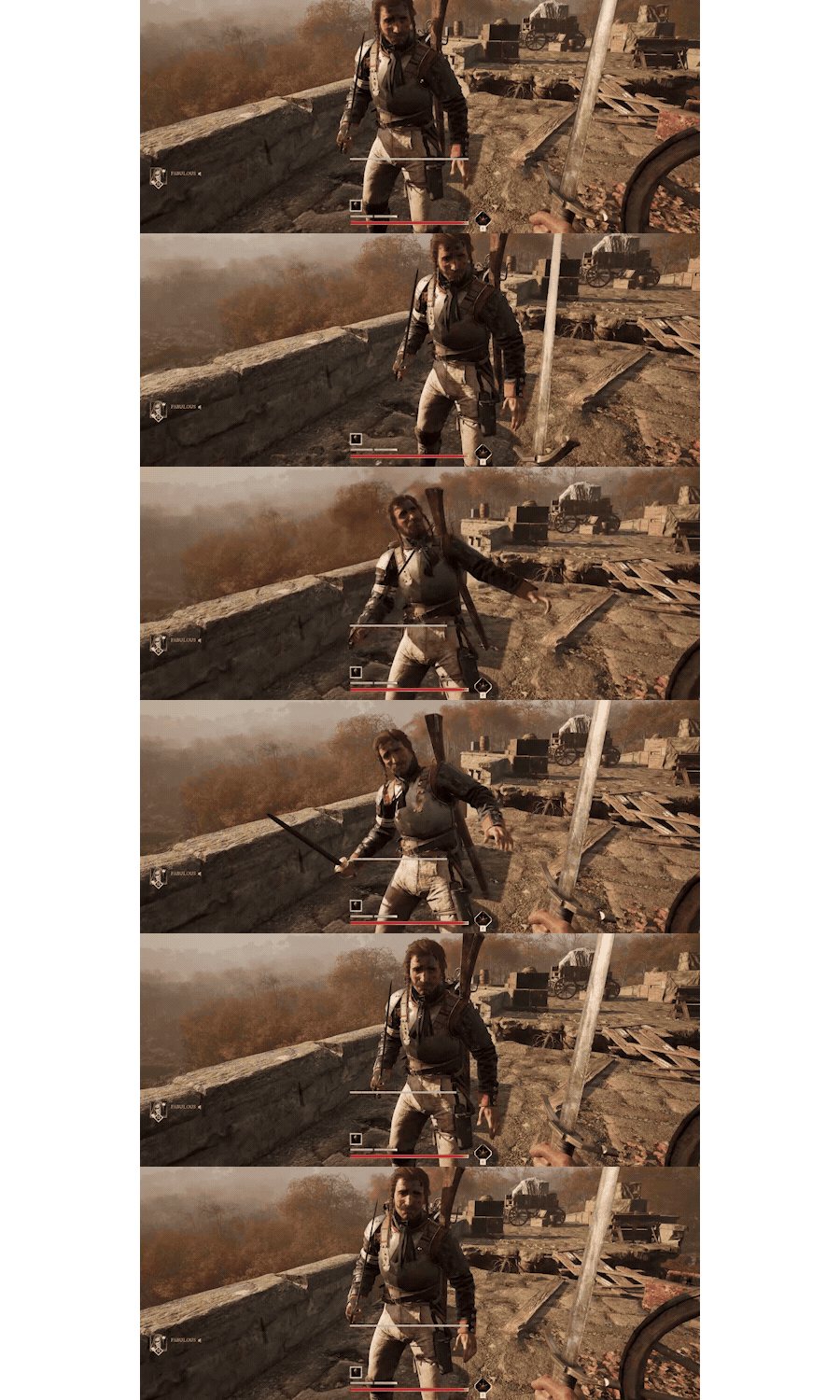
The studio frames Energy as a constraint to manage rather than a currency to spend. Players who panic-swing exhaust themselves, and players who defend too early drain their reserves before the pressure actually arrives. Staying composed, blocking only when necessary, committing with intent, and disengaging at the right moment is what leaves a Living with options at the decisive moment. A stamina-based dodge, bound to Left Alt together with a movement direction, gives another way to spend the movement pool defensively instead of relying on blocking alone. See Weapons for the arsenal itself, Armor for the protection layer above Health and Healing, and Gameplay for how close combat fits the wider loop.