

This article is incomplete
Some sections are missing or need additional details. Help improve it by contributing.
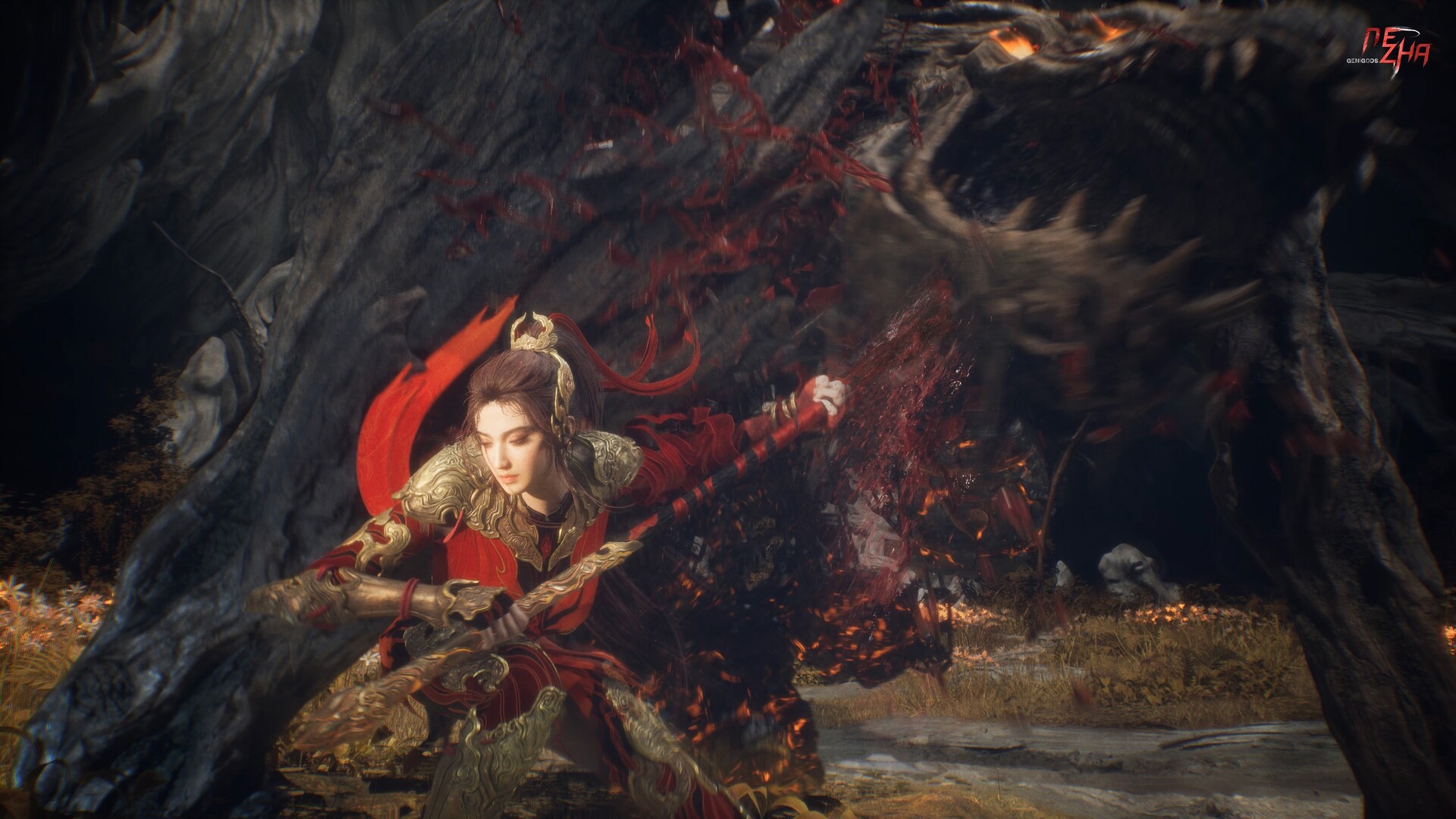
Genigods Lab describes combat in Genigods: Nezha as Chinese-style celestial showdowns, built to flow seamlessly between heaven and earth. It is billed as hardcore, and the studio has been explicit that it rewards a defensive, reactive style rather than aggression.
The Named Systems
The English store text names three systems. The Chinese and Japanese builds name a fourth, and it has no English name at all in any store text, press release or interview, so English-language material describes this game without ever naming the layer the fights are built on.
System | Name in the Chinese and Japanese builds | What it does |
|---|---|---|
地空双架势 (simplified Chinese), 地空雙架式 (traditional Chinese), 二つの構え (Japanese) | Switches combat between ground and air. The Fire-Tipped Spear handles close-quarters combos and parries on land, while the Wind Fire Wheels handle high-speed raids and combos in the sky. | |
Fluid-mystic | 化玄 in all three builds, under the section heading 水之化形 | Taps the Heart of the Spirit Pearl to awaken fleeting mythic abilities, and focuses its power to imbue weapons with sacred water for EX effects. |
法宝神通 (simplified), 法寶神通 (traditional) | Pairs mythic treasures together to produce unique skills that neither produces alone. | |
The 斗法 duel (no English name) | 斗法系统 (simplified), 鬥法系統 (traditional), 闘法システム (Japanese) | The resource contest that runs underneath every fight: your 器 against the opponent, with 神力 as the meter that decides who breaks first. |
Each of the first three has its own page: Dual Stances and Relic-Fusion are covered in detail, and the Fluid-mystic system is described under Spirit Pearl because it draws directly on the Heart of the Spirit Pearl. The English build spells that third system two ways on the same page, as Fluidmystic in the heading and Fluid-mystic in the body.
The 斗法 Duel
斗法 is the simplified Chinese name; 鬥法 is the traditional Chinese form and 闘法 the Japanese one, which uses the shinjitai character 闘 where Chinese uses 斗. It is one system written in two scripts, not two systems. No English-language store text, press release or interview gives it a name.
Term | Script and locale | What it is |
|---|---|---|
器 | Written 器 in the simplified and traditional builds; the Japanese build glosses it as 体力 | The health bar, and literally "the vessel". The simplified build spells the gloss out as 器(血条). The name reaches back to the porcelain vessel the protagonist begins as, so the health bar and the origin story are the same object. |
神力 | The same two characters in the simplified, traditional and Japanese builds | Divine power, shown as a contest between you and the opponent. The opening split of the bar is set by the ratio of the attacker's 神力 to the defender's. |
EX 神通 | EX 神通 (simplified and traditional), EX神通 (Japanese) | The EX form of an ability, produced by pouring 神力 into it. See Relic-Fusion for how that works with a relic. |
红光神通技 | 红光神通技 (simplified), 紅光神通技 (traditional), 紅光神通 (Japanese) | A red-flash counter skill used to reverse an incoming heavy attack. The English build never mentions it. |
崩溃 | 崩溃 (simplified), 崩潰 (traditional), 崩壊状態 (Japanese) | The break state that follows running 神力 to zero. Once you are in it the opponent destroys your 器, which is how the fight ends. |
On screen, in the playable demo build, the boss carries a conventional HP gauge and the 神力 contest bar sits directly beneath it. Your half of that bar is blue and the boss's half is red. Landing hits grows the blue portion, taking hits shrinks it, and emptying it triggers 崩溃. That settles a question earlier accounts of the demo left muddled, namely whether this game has a health bar at all: it has one, and the contest bar is a second meter underneath it rather than a replacement for it.
Water Philosophy and Jeet Kune Do
The English build frames the entire combat system around Bruce Lee's "Be Water" philosophy, expressed mechanically through the divine water carried within the character. Players channel that flowing power by focusing it, and use mystic artifacts to extend it.
That framing is locale-dependent, and the difference is worth recording. The simplified and traditional Chinese store builds name neither Bruce Lee nor Jeet Kune Do. They use only the Daoist phrase 上善若水, "the highest good is like water". Bruce Lee and 截拳道 do return when the developers discuss combat in Japanese, so the attribution is genuine rather than an English marketing invention, but it is an English-language and interview framing rather than something the Chinese storefront says.
Two techniques are named as adaptations of Jeet Kune Do:
Technique | Name in the Chinese and Japanese builds | Effect |
|---|---|---|
One-Inch Flash | 寸拳一闪 (simplified), 寸拳一閃 (traditional and Japanese) | Condenses water into a piercing, armor-breaking blow. |
Dragon's Kick | 龙踢 (simplified), 龍踢 (traditional), 龍の蹴り (Japanese) | Releases water as a sweeping attack used for fluid crowd control. |
The stated design intent is that the system requires precise parrying and countering, adapting with the precision of water itself. This is the clearest signal that the game expects defensive mastery rather than damage output.
Stated Influences
The developers have named specific games as reference points for how this game should feel. Every entry below is a stated influence and nothing more. None of them means a mechanic from that game appears here, and none of them is a claim about shared content or shared staff.
Game named | What the developers point to |
|---|---|
Dragon Ball | The reference for fusing ground and aerial fighting into one combat system rather than treating flight as a separate mode. See Dual Stances. |
God of War III | The explicit target for how the game should feel. The CEO has described the balance the team wants between action and role-playing as closest to that game. |
Street Fighter 6 | The input model. The team compares its simplified command scheme to that game's modern controls, the aim being that elaborate strings do not demand fighting-game execution. |
Devil May Cry | Combo support. The game is built to help the player produce flamboyant strings rather than requiring them to be executed cold. |
Elden Ring | Named as a contrast rather than a model. The CEO placed it on the slow side of the pacing scale and put this game nearer God of War III. |
Difficulty and the Soulslike Question
Genigods: Nezha carries a Souls-like user tag on Steam, and player discussion in Chinese and Japanese has reached for the same comparison. The developers reject the label. The creative director has said flatly that this is not a soulslike game. The CEO, separately and in another language, placed Elden Ring on the slow side of the pacing scale and put this game closer to God of War III. The producer has placed the difficulty between Stellar Blade and Devil May Cry rather than in soulslike territory, and has distinguished the game from titles that chase high difficulty for its own sake. A storefront tag records how an audience reads a trailer; it is not a classification the studio has given.
Two confirmed facts sit awkwardly beside that denial, and both belong here rather than being smoothed away. 灵气 (spirit energy) is a named collectible the player gathers to unlock basic abilities. And repeated death is written into the fiction: on the way back to the boss of the playable demo the player passes many previous failed versions of themselves, which is why that boss greets a returning player by asking how many attempts this makes.
A death loop plus a gathered resource that buys progression is a structure many readers will recognise from soulslike design. The developers deny the label; the structure is still the structure. Both are on the record, and this page records both rather than choosing between them.
One further piece of context on difficulty, from the producer: the demo boss appears early, is not one of the game's core bosses, and the difficulty of the build shown to the public was deliberately lowered for a roughly ten-minute hands-on. Impressions of how hard the game is were formed on a build tuned for a show floor.
Progression
Progression is not a separate layer bolted onto the story. The three-stage evolution from porcelain vessel to first human to god is itself the growth curve, with a collection loop at each stage, and relics are unlocked by allocating skill points. Relic-Fusion covers both in detail.
Boss Encounters
Fights against the largest enemies are structured differently from standard combat. Players climb ancient gods that tower like mountains and fight by traversing the contours of their bodies. Colossal Gods covers these encounters and the Sun Tree sequence. The development team's own English term for these creatures is "colossal beings"; "Colossal Gods" is the storefront rendering of it.
Not Yet Confirmed
Whether there are weapons beyond the Fire-Tipped Spear and Wind Fire Wheels
Whether 斗法 governs ordinary enemy encounters or only boss fights
Whether EX abilities and the 神力 contest bar draw on the same pool, and what caps either
How 灵气 is spent, what counts as a basic ability, and whether it is lost on death
How skill points are earned and what an unlock costs
Whether there is a stamina, posture, or poise system separate from 器 and 神力
The full list of Fluid-mystic abilities
Whether difficulty is adjustable