

Kalona is the fictional city where the whole of Gears of War: E-Day takes place. The campaign, every Horde Siege map and all six Versus maps are set in or around it. Narrowing a planet-wide catastrophe down to one place was a deliberate early decision: at global scale the human impact stops registering.
Built as One City
Kalona is not a series of disconnected levels. It is built as a single integrated city in the engine, and the camera can be lifted in the editor to see the whole thing at once. The practical consequence is that when you look at another district from inside a level, you are looking at the real location of that place rather than at a painted backdrop.
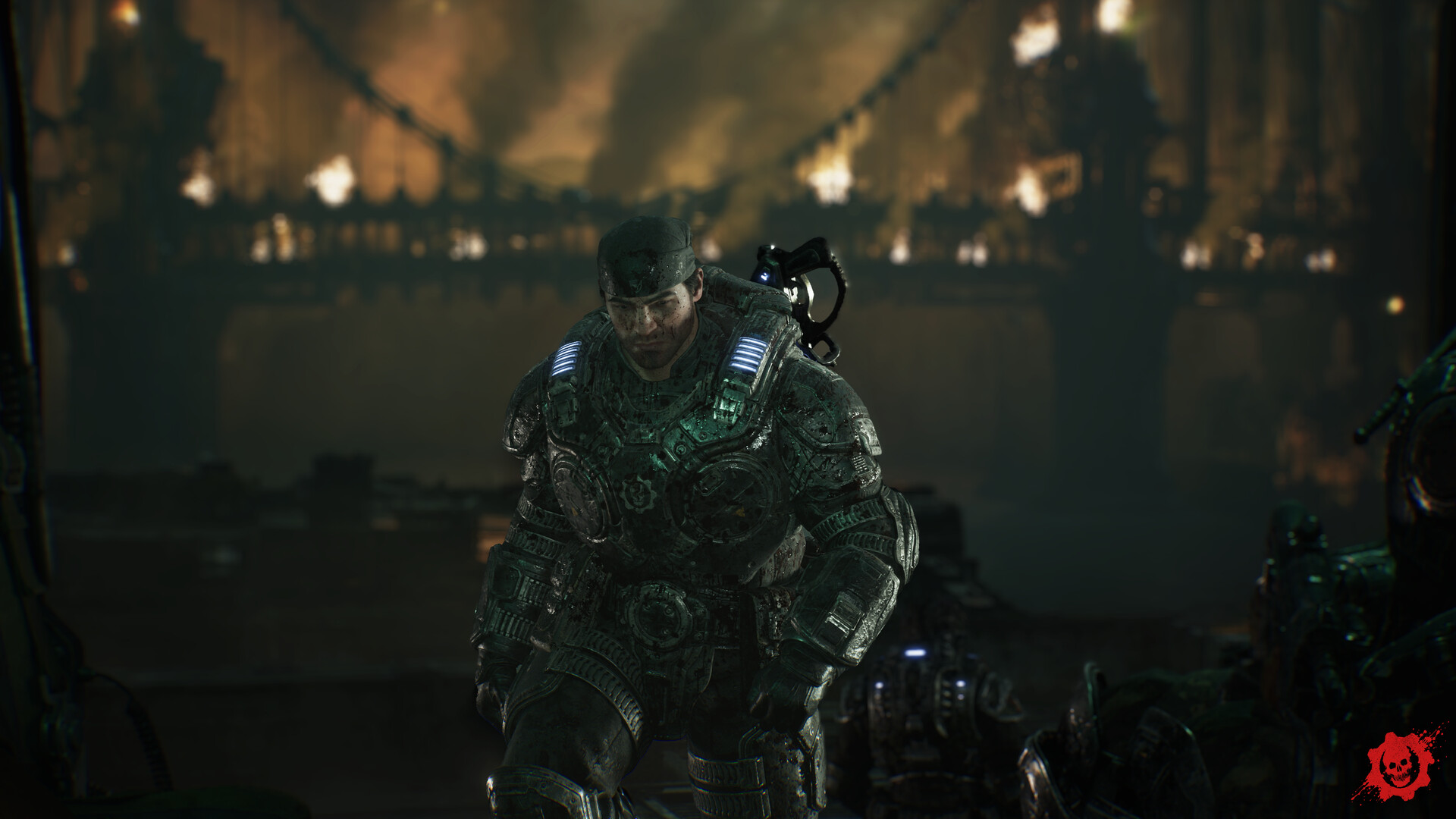
That continuity is what makes the destruction land. You revisit areas that were intact and find them smoking ruins. The studio set out to make the city feel like another character in the story, so that losing it registers as a loss rather than as scenery changing. Building it from the ground up as a real city was the method: the team wanted players to understand what it was to live in Kalona before watching it come apart. The set pieces and landmarks are built to be memorable, and those landmarks change as the campaign progresses.
The city is also new to the series rather than a return to established ground. The studio describes Kalona as a destination built specifically for this game, so its layout, its landmarks and its history all begin here.
Confirmed Locations
Location | What is known |
|---|---|
Downtown Kalona | The city core. Two Versus maps are described as overlooking or sitting on the coast of it. |
Golden Quarter | The historic district. It was the Horde Siege map used during the Open Beta, set in the aftermath of the battle for it. |
Kalona Police Department | A police station, and the setting of the Versus map Precinct the day after it was decimated. It also appears in the campaign, where the squad goes looking for help on the first night. |
Kalona Public Market | A seaside market, and the setting of the Versus map Market. |
Pay N' Save | A store in the city. Its parking lot, with shopping carts, a produce display and parked cars, is the scene used in published material demonstrating the game's ray-traced geometry. |
Imulsion Refinery | Where Mags Carter works when the invasion starts. Residential neighbourhoods are stacked around the refineries that sustain them. |
Coastal park and zoo | A park built around a zoo on the coast of downtown, and the setting of the Versus map Park. |
Shipyard and waterfront | An industrial working waterfront, with a wartime vessel in post-war deconstruction serving as the Versus map Battleship. |
Sports stadium | Named as part of the city's skyline. |
Airfield | At the city's edge. |
Military camp | An abandoned camp overlooking downtown with a training facility attached, serving as the Versus map Outpost. |
Rooftops | The interconnected roofs above the city, used for the Versus map Skyward. |
City Hall | Hastily converted into a COG base of operations once the emergence begins, part medical triage and part command centre. It is where Bravo Squad officially assembles and reports for duty. |
A Kalona landmark transformed into a forward operating base for military operations, and where Bravo Squad links up with Tai Kaliso and Theta Squad. | |
Rail station | A station near Oria Stadium. Securing it is a campaign objective, and it ends in a brutal, multi-level fight. |
Bridge | Securing access to a bridge is one of Bravo Squad's earlier objectives in the city fight. |
Individual campaign settings named so far include a bar, a grocery store, a pharmacy, a subway and a sky train. Full map descriptions are on Versus Maps.
Design References
The studio is based in downtown Vancouver, between the stadium district and Yaletown, looking out over a stadium, a working waterfront and the mountains behind it. Kalona is fictional, but its geography was drawn from what the team sees out of the windows. For the era, the reference was 1970s New York, which is where the city's slightly older and clunkier feel comes from.
The Retro-Tech Rule
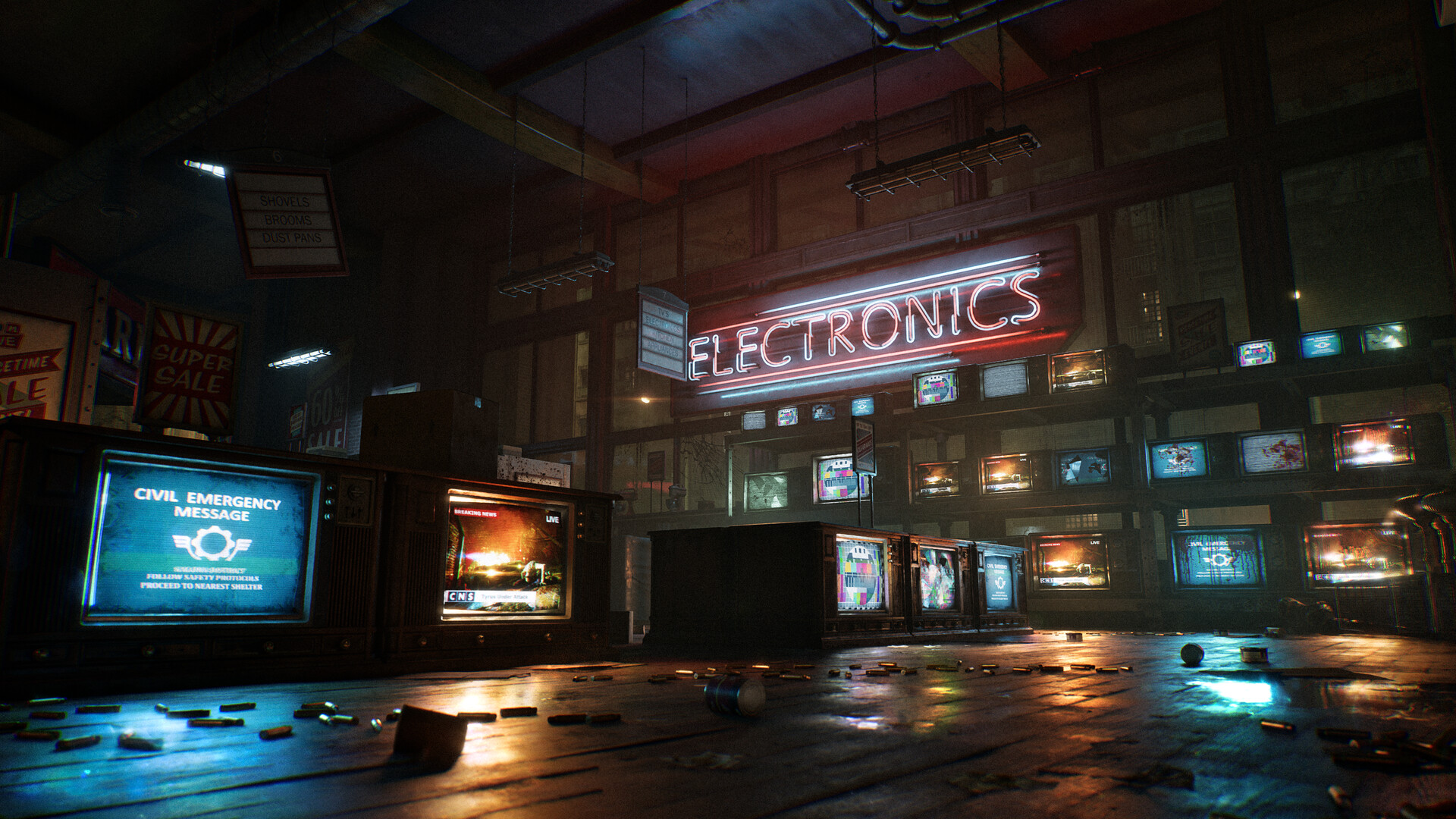
The city sits before anything the series has previously shown, so the technology is deliberately dated. There are no flat panel displays anywhere: televisions are cathode-ray sets with wood panelling, cash registers are mechanical, vending machines are period-appropriate. Cars are blocky 1970s shapes, which also makes them useful cover, and the team refers to the whole aesthetic as retro tech.
A City at Peace
Kalona is shown alive before it is destroyed, which no earlier game in the series has done. Peacetime signage is scattered everywhere: victory celebrations, peace time discounts in the grocery store, veteran centres and recruiting centres. The game does not spend hours walking around in peacetime, but the echoes are visible throughout the first night.
Building a living city was also the harder technical problem. Earlier games in the series began after everything had already been destroyed, which is easier to construct. Here the detail had to be dense enough for the city to read as inhabited before it could credibly be torn apart.
The City Under Attack
Kalona is where cover comes from, and the variety is the point: cars, buildings, planters, trains and the organic shapes left when the ground is ripped up. Sinkholes swallow vehicles and whole buildings, and micro-destruction chips away at cover across a range of materials. Emergence holes can open anywhere and flood the space with red light. Beneath the streets, Locust tunnels are extensive enough that the COG has to map them, which is the entire premise of the R.I.G. devices in Horde Siege.
Setting the game in a city was itself a cover-shooter decision. Cars, buildings and debris sit everywhere, so cover options are spread across the whole space with a lot of variety in what is available. The mechanics that use them are on Movement and Cover.
The fight is never confined to the street the squad is standing in. Other COG units run their own assignments down distant streets and across the buildings around you, so the battle for Kalona plays out in several places at once rather than as a series of set pieces staged for one unit.
Civilian life is shown interrupted rather than already gone. The clearest example is a train overrun by Locust and full of civilian casualties, left where it was caught.
The Tourist Map
Navigation is handled in fiction. Early on the player picks up a tourist map of Kalona as a makeshift guide, and that pamphlet then serves as the actual in-game map.
Who Runs the City
Kalona still has a civilian government trying to function while the city is being torn open. The mayor is exhausted and fighting to protect Kalona's civilians, which sits badly with Colonel Trench, the hard-line COG officer who takes military command during the emergence. A strategy briefing between the two is built around that clash of priorities: one side is trying to save people, the other is trying to run a war.
The published material does not name the mayor, so the office is recorded here without one.
Unconfirmed Geography
Wider geography for the city and its region circulates from other sources with no support in official material for this game. Only the locations listed above are recorded here.