

Movement is where Gears of War: E-Day changes most against earlier games in the series. The whole system was rebuilt from scratch with nothing carried over, and the stated aim was to keep the weight of an armoured Gear slamming into cover while adding fluidity and more ways out of a bad position.
Cover is still the centre of the design. The team calls out cover as one of its four pillars alongside movement, weapons and enemies, and the cover system itself supports a wider range of cover types, heights and actions than any previous entry. Waist-high boxes have not gone away, but the team describes the set as having moved well past them: that kind of cover still exists, it is just not all boxes.
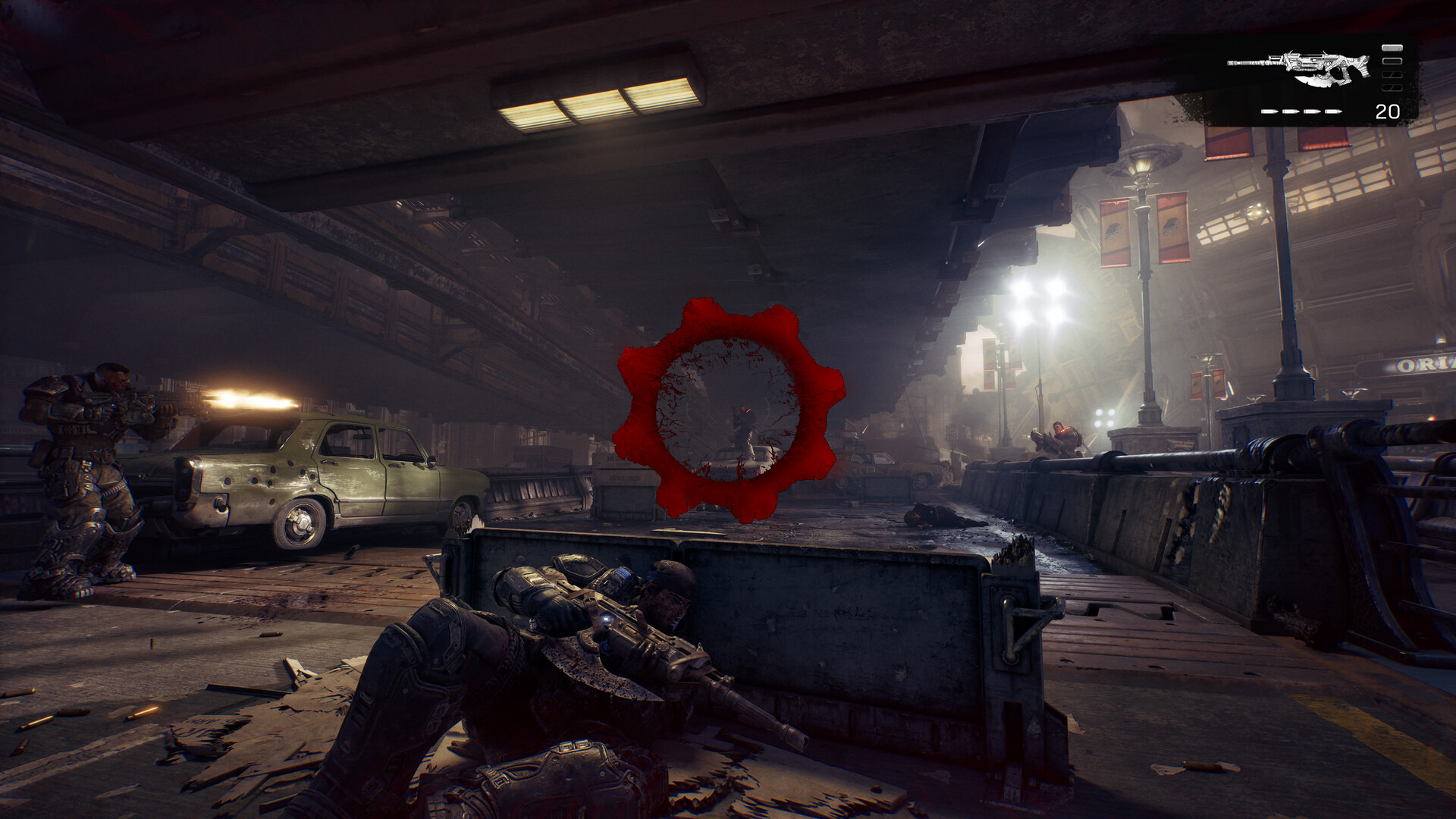
New Traversal
Mechanic | How it works |
|---|---|
Jump and climb | Jumping toward a wall, ledge or vehicle within arm's reach lets a Gear grab the ledge and haul up. For the first time in the series you can mantle and climb without entering cover first: face the object and press the button, in or out of cover. |
Slide | Triggered from a sprint. Used to get low approaching a target, slip under a vehicle or through a gap, or cover ground into a distant piece of cover. You can shoot during a slide. It cannot be spammed, so timing matters. |
Sprint | Opens with a hunched plant for the first few steps as a nod to the series' Roadie Run, keeping a lower profile during quick cover-to-cover moves. The sprint camera sits further out for more battlefield awareness on longer runs. |
Low-ground cover | A new cover type behind low walls and debris. A Gear can also drop prone when the top half of their protection is shot away, lying back-to-wall with slower movement and a more exposed profile. |
Cover gaps | Low gaps such as the space under a truck or a hole in a wall can be passed by ducking or sliding. You can post up on the edge and lean out low, and aim and fire through narrow openings such as car windows. |

Jumping in particular reshapes encounters. Some maps use gaps to open flanking routes that only exist if the jump is timed correctly, and in the campaign it means climbing onto a truck or a freezer unit to drop in behind an enemy position. The risk is symmetrical: you cannot always see where you are landing, and dropping into a surrounded position means a squadmate has to come get you.
The Locust Move Too
The extra player mobility was matched on the other side of the fight by design. The stated goal was for the Locust to feel dangerous and smart, so the abilities handed to the player were handed to them as well: you can do these things, and now they can do them too. Climbing onto a truck to outflank an enemy works, and an enemy can climb the same truck and drop in behind you. Enemy behaviour in detail is on Enemies.
The Four Movement Principles
The rebuilt movement is tuned against four named principles, each with a stated consequence for how fights play out.
Principle | Rule | What it means in play |
|---|---|---|
Commitment | Cover entry can only be cancelled within 1.5 metres of the cover object, rather than at any point during the enter action. | Players must travel further toward cover before cancelling, which puts them on a more predictable trajectory. Chained cover cancels have to be paced more slowly and used deliberately. A player on the far side of the same cover has to come into Gnasher range before cancelling. |
Momentum | Every action and reaction carries a consistent motion transfer. Stopping dead and instantly reversing direction is gone. | There is a tangible weight that is easier to read. During a cover cancel a player can slow down quickly, but shifting direction completely takes a moment, which leaves an opening for a well-timed counter. |
Speed | Entering cover is still one of the fastest actions available, but overall speed across the sandbox is more balanced. | Sprinting, evading and sliding are all reasonable alternatives with their own trade-offs. Bouncing between cover is no longer the only way to stay fast. |
Fidelity | Every action is readable and connects to the next one, with movement backed by animation rather than by instant state changes. | You can track where an opponent's weapon is pointing, how long it will take them to fire after committing to an action, how many steps they need to reach cover and how far they will slide. That creates counterplay that was harder to read before. |
The blunt version the team uses for the first principle is that there is no more hyper-bouncing, and the version for the fourth is that slow is smooth and smooth is fast.
Pre-Launch Tuning
After the Open Beta, the studio made strafe movement more responsive, adjusted cover enter speed and the distance of the cover-enter cancel, reduced Cover Slip speed and reduced slide distance. No new values were published, so the 1.5 metre cancel distance in the table above is the pre-beta figure and may no longer be exact. The full list is on Patch Notes.
A Trade-Off Worth Knowing
Adding a jump button cost something. A controller has a finite number of buttons, and because the game was rebuilt from scratch the team re-decided where every mechanic sat. Some mechanics from earlier games in the series are simply not present as a result. The studio has since named some of what is missing at launch, including Meat Shields and Chainsaw Duels, and has said it is weighing what to bring back after launch or in its next title.
Where Movement Shows Up
The same movement set runs across all three modes because the sandbox is unified. Versus maps are built around it, with layouts that include risk and reward opportunities keyed to the new traversal, and Horde Siege uses much larger spaces that reward flanking. Two onboarding modes exist specifically to teach the new controls, and both are covered on the Versus page. Weapon handling during all of this is covered on Combat and Gunplay.
How much any of this matters shifts with the space. The campaign is linear, but parts of Kalona open into considerably wider sectors where the main path is one route among several and the player can step off it for optional objectives and off-path rewards. In the tight streets and interiors the movement set is about closing or breaking a single sightline. In the wider sectors it is about choosing an approach at all, and the largest arenas add a couple of storeys of verticality on top of that. It is worth being clear about what that does and does not mean: the wider sectors are still authored spaces inside a linear campaign, not an open world.