
Loading...
Loading...
Stations and Structures
August 27, 2026 at 09:51 AM
Dated the undetailed-structure statement to 27 August 2026
Stations and orbital installations are how a faction turns a star system into usable territory in Falling Frontier. Players establish and upgrade a network of structures that build ships, hold supplies, handle raw resources, and watch the space between planets. Because every resource in the system is finite and physically transported rather than drawn from a shared pool, these installations are also the points an opponent will try to break.
Four structures have been named in official material as the ones a faction establishes and upgrades. As of 27 August 2026 what each one produces, what it costs, and how its upgrade tiers work have not been detailed; they will be documented here as they are confirmed.
Structure | Role |
|---|---|
Shipyard | Where ships are built. In-game notifications report finished vessels as having been completed at a named shipyard, and shipyards are established and upgraded as a faction builds out its industrial base. |
Supply Depot | A node in the supply network. Named as a priority target for raids against an enemy's supply chain. |
Refinery | Established and upgraded alongside shipyards and depots. Also named as a priority target for supply-line raids. |
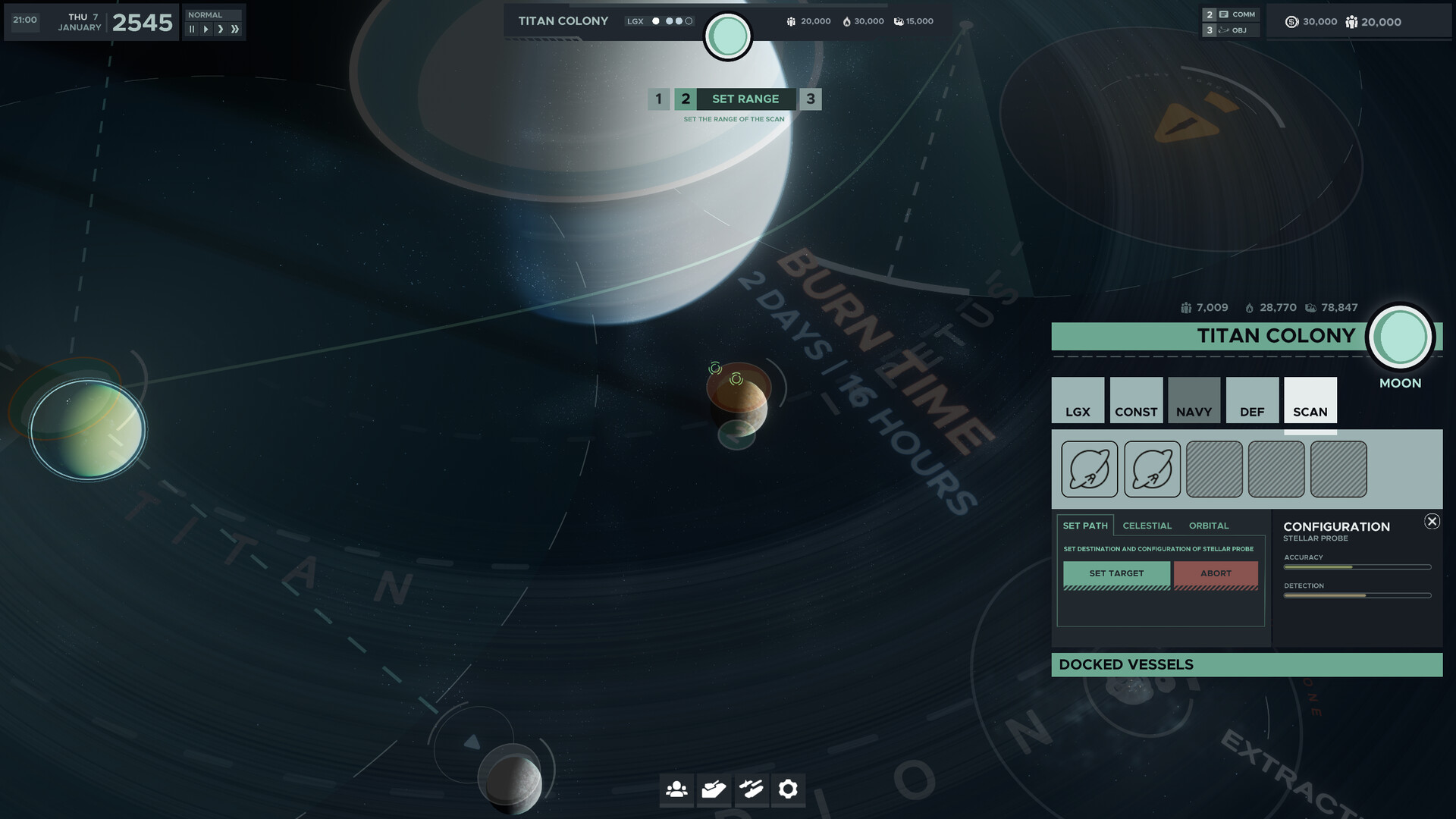
Recon Station | Scans a defined angle of space rather than a circle around itself, with a configurable tradeoff between scan width and scan range. |
Recon stations are the fixed half of the intelligence network described on the Gameplay page. Because each station scans a defined angle, its coverage is a deliberate choice: a wide arc watches more of the nearby system at shorter reach, while a narrow arc sees further out along a single line. Passive scanning returns limited information but keeps the station quiet, and active scanning returns far more detail at the cost of giving away its position.
Shipyards do more than build. They are also where damaged vessels are repaired, and a ship can only dock at a yard large enough to accommodate its size, so the placement and tier of a faction's yards determines how far its heavier ships can operate before a serious hit forces them all the way home.
Structures are placed by dedicated construction ships, which can build outside of a gravity well as well as within one. That matters because the De Vaar jump drive is affected by gravity and cannot be used inside the exclusion zone around a planet or moon, so infrastructure sited clear of those zones sits at a very different point in the supply and travel network than infrastructure parked in close orbit.
Two defensive options have been confirmed. Hidden minefields can be laid to protect strategically important areas, and remote turrets can be placed to cover ground a fleet cannot hold on its own. Both let a commander defend a position without tying down warships that are needed elsewhere, which matters in a game where fleets are meant to be split into small flotillas rather than massed in one place.
Not every structure is available from the start. Research unlocks orbital facilities and colonization options alongside new ship hulls, weapons, and upgrades, so a faction's building options broaden as its technology develops. The research tree covers combat, logistical, and civilian capability, which means investment in construction competes directly with investment in the fleet described on the Ship Design and Classes page.
A colonised planet or moon is managed through its own panel rather than through a single global build menu. The panel is divided into tabs covering logistics, construction, the navy, defence, and scanning, and it reports that body's own stockpiles of population, fuel, and ore separately from anywhere else the faction holds. That separation is what makes the physical supply network described on the Gameplay page visible: a well-stocked colony on one moon does nothing for a fleet operating somewhere else.
Each body offers a limited row of build slots, and some are shown locked rather than merely empty, so how much a given colony can support is a property of the body itself. The panel also lists the vessels currently docked there, which is where damaged ships appear while they wait on repair.
Structures are identified by where they sit rather than by a generic label. Completion notices in the operations feed name both the finished vessel and the yard that built it, and the Enceladus Shipyards are named this way in official material. Extraction sites are likewise marked in the world near the bodies they work.
Installations are physical objects in the battlespace and can be destroyed. Mid-sized stations have been shown being torn apart by an internal blast, with debris scattering outward according to where the final hit landed rather than following a fixed animation. Raiding supply depots and refineries, and blockading colonies, is described as the core option available to a weaker opponent facing a stronger fleet, so a faction's structures need defending as seriously as its warships.
