
EVILBANE is built around online cooperative play. You can take on its content solo or team up in a party of up to four players. The experience is entirely player-versus-environment (PvE), so the demonic forces you fight are the only opposition; no competitive player-versus-player mode has been announced. The official framing is that your choices and your teamwork decide whether a run ends in victory, which puts coordination at the center of the design rather than treating co-op as an optional add-on.
Party Size and Online Play

Group size scales from one to four. A single player can clear content alone, and a full squad of four can tackle the same content together. All play is online, so the game leans on a steady connection. Broadband internet is required, and the store listing names a kernel-level anti-cheat system (Easy Anti-Cheat as of October 2026, after earlier listing Anti-Cheat Expert), which is consistent with an always-online co-op game where every participant needs to be on a level playing field.
Confirmed Multiplayer Facts
Detail | What Is Confirmed |
|---|---|
Party size | 1 to 4 players |
Solo play | Supported |
Mode type | PvE only (no PvP announced) |
Connection | Online; broadband internet required |
Anti-cheat | Easy Anti-Cheat (kernel level) as of October 2026; earlier listed as Anti-Cheat Expert (ACE) |
Core idea | Teamwork and player choices determine victory |
Shared goal | Liberating occupied regions, working toward territory recovery |
Roles | No fixed roles; strategies are meant to form from the situation |
How Co-Op Ties Into Combat and Skills
Co-op connects directly to the moment-to-moment fighting. Each character carries one melee weapon and one ranged weapon and can swap between them freely, and each one runs two Active Skills alongside two Heavenstone Skills (see combat and the Heavenstone System). In a squad, those skills become tools for combination play, letting a team line up its abilities together rather than acting in isolation. Co-op is also the way to engage the game's content, including the missions shown so far: tightly coordinated boss fights and a squad-based infiltration of an enemy stronghold.
Cooperation is framed beyond the four-player party as well. The developer has said the result of each mission carries into the shared world, with squads liberating occupied ground battle by battle toward a common goal of territory recovery. How much one team can move that shared state has not been detailed.
Supporting Your Squad
The team has said it does not want to force fixed roles on players, preferring strategies that form naturally out of the situation. That fits the loadout-driven design: what you bring to a fight comes from your weapons and your Heavenstone Skills, not a role the game assigns you at the start.
Several cooperation systems were described as still in testing. Players can revive allies who are down, and attacks can be chained between teammates, with one player launching an enemy into the air and another finishing with a mid-air quick-time attack. Because the team called these systems in testing, expect them to keep changing before launch.
Solo players are not an afterthought. The developer has said solo play is meant to remain fully enjoyable on its own, and that the team is looking at ways to give a solo run some of the cooperative feel.
Co-Op in the First Steam Playtest
The October 2026 playtest showed how grouping works in practice. Operations are picked at the round table in the Headquarters, and there are three ways in: Quick Play drops you into an available operation, you can create the operation you want and start it, or you can join a Private Operation by entering the code its creator shares. Quick Play can put you into an operation that is already under way, though some Hard operations cannot be joined in progress.
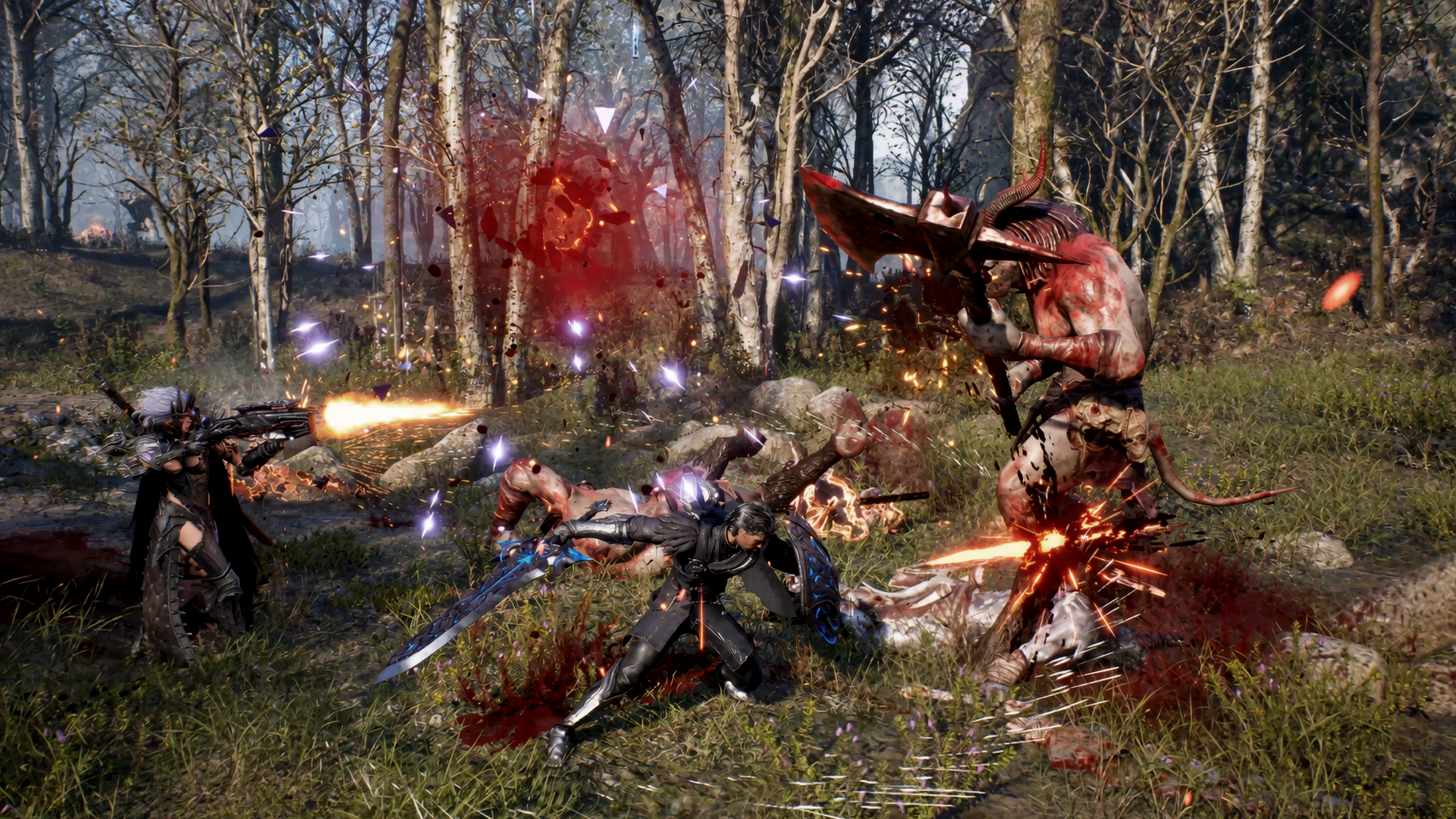
Hosting is handled by the players. Among the players in an operation, the one who can provide the most stable connection becomes the host, so joining first does not make you the host, and an operation can take a moment to start depending on the host's connection. For talking, the playtest had in-game voice chat and eight quick emotes, such as Hello, Help, Thanks, and Retreat. Text chat was not supported in the playtest, so codes had to be shared outside the game.
Some operations were described as hard to handle alone, with the team suggesting that players gather allies for them.
What Is Not Yet Announced
Several multiplayer specifics have not been detailed publicly. Treat the following as unknown until the team confirms them:
Matchmaking rules: the playtest offered Quick Play and Private Operation codes, but how Quick Play picks a group, and whether the full game adds anything like skill-based matching, has not been described.
Cross-play: no cross-platform play between PC and Xbox Series X|S has been confirmed.
Server model at launch: the playtest picked a host from among the players, and whether the full release keeps that model or uses dedicated servers has not been described.
Party management: beyond codes and Quick Play, tools for forming and keeping a standing group have not been shown.