The run loop is the beating heart of Ember and Blade. Rather than a single linear playthrough, the game is built around repeated runs through a dark-fantasy world of escalating demonic chaos. Each attempt sends Fenrix back into the fray to carve a path forward, and each attempt can unfold differently from the last. The official framing is blunt about it: your path is never the same twice.
Run-Based Structure
A run is a single attempt at pushing deeper into the realm. During a run you fight through hordes of demons, gather power, and test yourself against the realm's most dangerous opponents. Because the game blends hack-and-slash action with roguelite progression, the structure leans on variety and momentum: you start, you build, you push as far as your choices and skill will carry you. The mix of fast melee and ranged combat keeps each run kinetic, while the escalating waves of enemies steadily raise the stakes the longer you survive.
Death, Resurrection, and Rebirth
Falling in battle is not a game-over screen here. In the words of the official material, each fall is only the start of another run, and resurrection brings deeper secrets and the chance to twist fate itself. This is the core fantasy that the entire roguelite design rests on: Fenrix is a former human turned immortal demon hunter, and that immortality is bought through a bargain struck at the moment of death. The pact that grants this rebirth is detailed on the The Angel Pact page. Death, then, is a transition rather than an ending, and every loop back through the realm peels away a little more of its hidden truth.
Escalating Hordes
Each run tends to escalate the chaos. The battlefields teem with demons, and the pressure mounts as waves grow more numerous and more dangerous. This survival-horde pacing is what gives the loop its tension: you are not simply progressing through static rooms, you are holding your ground and pushing forward against a tide that keeps rising. Managing your resources well across a run matters, because a strong start can collapse if the swarm overwhelms you before you have built enough power.
Choosing Blessings Each Run
The single biggest reason no two runs feel the same is the Blessings system. During a run, angels grant a choice of heavenly gifts, powers and upgrades that reshape how Fenrix fights. Because the offered blessings vary, the build you assemble shifts from attempt to attempt, and the same player can come out of two runs with wildly different capabilities. Picking blessings well, and picking them to fit the situation in front of you, is the strategic spine of every run.
Carrying Power Forward
The loop is not purely a reset. Resurrection deepens the experience over time, and the broader Progression and Builds systems let Fenrix grow across runs rather than starting from zero each time. For players who want even more out of repeated play, New Game Plus extends the cycle further, layering fresh challenge onto the same world. Taken together, the run loop turns repetition into the point: every death feeds the next run, and every run is a fresh chance to defy destiny.
An Evolving Combat Feel
The shape of a run has shifted over the demo's life. The studio has described moving away from a slower pace where players waited for a build to come online, toward faster, more active combat where blessings increasingly tie into dashes and attacks. A mid-2026 director's note announced the next demo would rebuild combat around that more aggressive feel, so the moment-to-moment rhythm of a run is something the developers are still actively reshaping ahead of Early Access.
Rifts and Mid-Run Choices
Beyond the blessings offered between stages, a later demo update added Rifts as encounters that appear in the field during a run. Stepping into a Rift gives the player a chance to gain additional Arcana, which means a build can be adjusted partway through a run rather than only at set points. This deepens the moment-to-moment decision-making of a run: a player can react to how things are going and steer their power in a new direction on the fly. It reinforces the core idea that no two runs play out the same way, since the mix of blessings, Runes, and Arcana a player ends up with shifts from attempt to attempt.
Expedition and Return
The studio's own phrase for the cycle is expedition and return. A run is an expedition out from the sanctuary; what comes back is spent growing stronger alongside the residents there. The framing it uses is blunt about the death half: death is not the end, it is preparation for the next expedition.
That matters for how a run should be judged. A run that ends early still returns Amber for the Arbor, and the Relics and Runes fitted before setting out persist regardless of how the attempt went, so the failure state is soft by design. The stations that spend those returns are laid out on Progression and Builds.
The Relic Oven
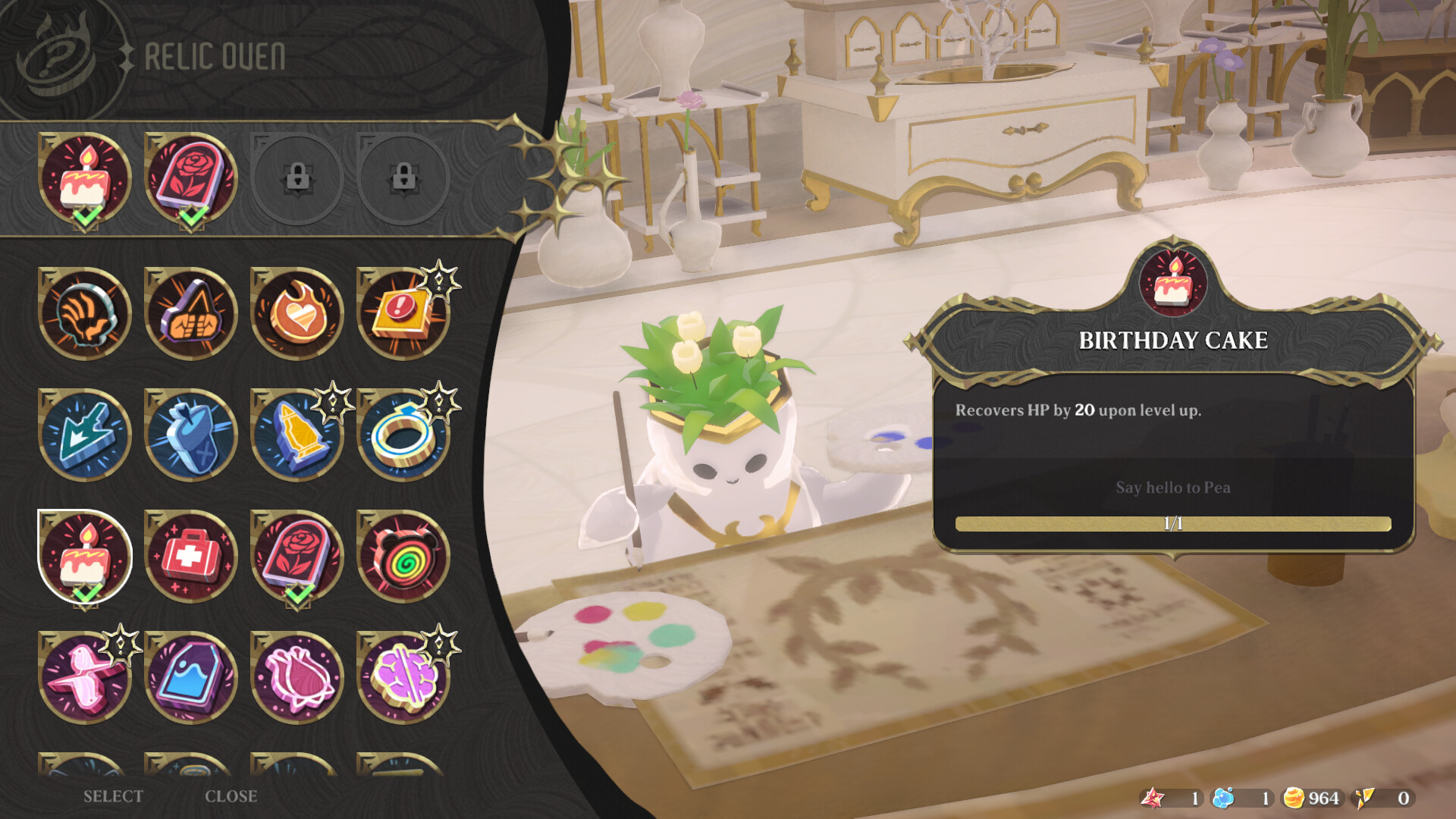
The relic side of the between-run prep has a name and a visible shape in demo footage: the Relic Oven, run out of Pea's workshop. Relics are fitted into a small number of slots before setting out, and not all of the slots start unlocked, so early runs are working with fewer relic effects than later ones.
The relics themselves are small, specific modifiers rather than sweeping build changes. One shown in footage, a Birthday Cake, restores twenty health each time Fenrix levels up during a run. Some are gated behind conditions as light as greeting Pea rather than behind combat milestones. Because this is pre-release footage, the slot count and the individual values should be read as provisional. How relics sit alongside the other permanent layers is covered on Progression and Builds.