

Drakantos is a fast-paced, free-to-play pixel-art MMORPG played from a top-down perspective. It is built by a small independent studio based in Curitiba, Brazil. Rather than rolling a single character, you pick from a roster of more than 20 heroes and use each one's abilities in real time. The game blends a shared open world with instanced missions and a competitive layer, and it leans on free movement and action combat rather than the tile-based, point-and-click feel of older builds.
Combat
The current build uses 100% action combat that is fully adapted to the mouse, with no target system. Instead of locking onto an enemy, your character automatically faces the mouse cursor, and you aim everything yourself. Left-click is your basic attack and right-click is your special attack; holding the right-click button performs an enhanced version of that special. This setup puts positioning and aim at the center of every fight.
Basic attacks work in a stamina-like way rather than on a hard cooldown. You can keep attacking, but timing your damage around a roughly two-second interval is optimal, and overswinging is less effective than measured hits. Melee attacks have charges, which gives them more tolerance for rapid use. Combat sits on top of a world that changes through a day and night cycle, which affects the enemies you face.
Movement
Movement is fully free across 360 degrees and is no longer tile-based. On a keyboard you move in eight directions, while a controller gives full 360-degree movement. This is a genuine free-movement system, not a grid of small tiles, and it replaced the older tile-based and hybrid schemes used during early development. Any description of Drakantos as tile-based reflects a previous build and does not match how the game plays now.
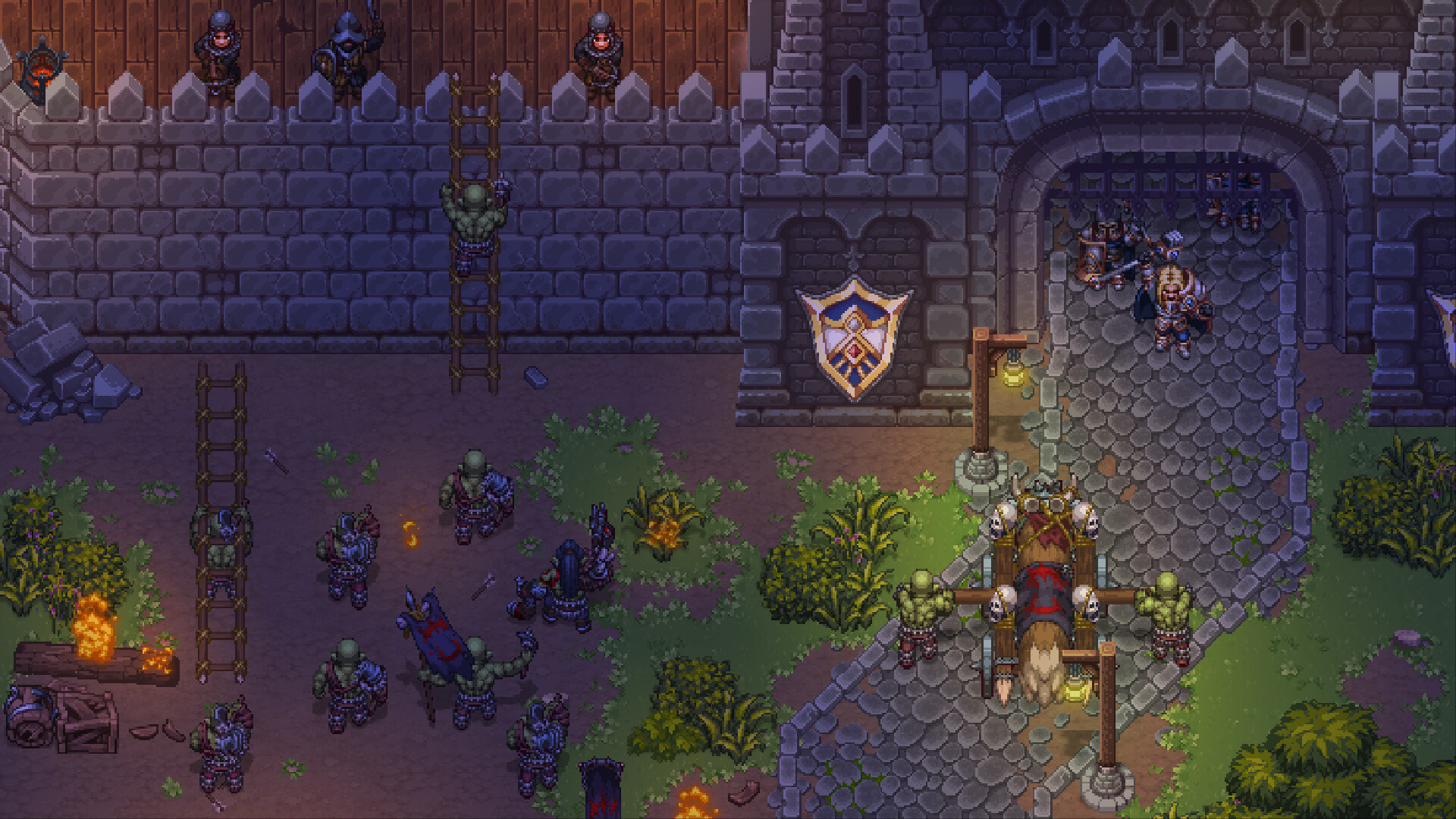
Click-to-move is available on top of that, but only outside instances. Inside an Adventurer's Guild mission it is switched off deliberately, so a party stays together and nobody wanders into a pull by clicking past the group. The inventory follows the same logic: it is not reachable during a mission, which stops a run stalling while someone reads item text. Both restrictions lift again in the open world.
Heroes and Roles
Each hero is effectively a class, with its own abilities, lore, and personality. You unlock every hero on one account and swap freely between them; level and gear are per-hero, but artifacts, trophies, and cosmetics are shared across the account. Heroes fill the familiar tank, healer, and damage-dealer roles, and that trinity matters most in coordinated endgame group content, where some encounters expect a balanced party. Outside of that, the game supports solo play and flexible group compositions. The full roster, confirmed playstyles, and customization are covered on the Heroes page, and build customization through Orbs, Artifacts, and Trophies lets you reshape how each hero plays.
Game Structure
Drakantos is built around two main layers that share the same heroes and progression. The first is a shared MMORPG open world set in the world of Eldras, full of enemies, chests, secrets, puzzles, resource gathering, pets, and story. The second is the dungeon-crawler layer run through the Adventurer's Guild, where you pick missions from a world map. The full detail on both, including resource gathering, fog-of-war exploration, and the guild's rank progression, lives on the Open World and Adventurer's Guild page, and the wider lore and regions are described under Setting and World.
Adventurer's Guild Missions
Guild missions are the core dungeon-crawler content. You choose missions from a world map, and the missions rotate maps and objectives over time so runs stay varied. There are currently 120 different handcrafted maps, with no procedural generation. Party size for a standard mission runs from 1 to 4 players: the standard matchmaking queue is built for 3, while a premade group can take up to 4. Enemy difficulty scales with the number of players, so the content adjusts to your group.
Progress through the guild is measured in Adventurer's Guild Ranks. The full game is planned to reach Rank 14, with content and enemies scaling per rank. The closed beta reached Rank 5, so the higher ranks should be read as a full-game plan rather than something that was fully playable in beta. Deeper content, including the Bosses and Enemies that appear at higher ranks, is covered on its own page.
PvP and Hellgates
Drakantos has a substantial competitive side that the developers frame as a Mini MOBA living inside the MMO. Its arena modes, ranked tiers, open-world duels, and other player-versus-player content are detailed on the PvP Modes page. Hellgates belong here too: rather than a fixed-boss cooperative raid, they are a PvPvE extraction mode. Players enter and fight through demonic enemies to gather loot while sharing the instance with others, can extract at any time or push deeper for more, and lose what they collected if they die. Full Hellgate detail is on the PvP Modes page.
Progression
Heroes level up through play, and progression beyond raw levels comes from the Orb, Artifact, and Trophy systems that customize and enhance each hero's abilities. Because each hero has a separate level and gear, you can develop several heroes at once, while cross-account progression lets artifacts, trophies, and cosmetics carry over between heroes on the same account. This means time spent on one hero still contributes to your overall account power.
Story Missions
Story content is built as single-player content by design. Cutscenes and dialogue address the specific hero you are playing rather than a generic protagonist, and the hero you pick changes what happens: the developers give the example that playing as Orbryn makes his own story mission play differently from the way anyone else experiences it. Story missions are short and are meant to be played once.
Failure is handled gently. Dying in a story mission replays the cutscene that set it up, and some missions place a checkpoint that skips the dialogue and drops you straight back at the boss. A cooperative story mode has been requested by players; the developers have described it as a technical problem rather than a plan, and have argued that the story is the one place in the game where nobody should be hurrying you along, so it should not be assumed.
Endgame Loop
The closed betas stopped short of the endgame, but the developers have described what it is built around. The centre of it is the harder tier of Adventurer's Guild content, which carries more randomization than the levelling missions: which boss is active rotates over time, so players are not grinding the same fight indefinitely, and the encounters layer in more unpredictable elements.
Loot is the pull. Each boss has its own exclusive artifacts, so chasing a particular build means targeting a particular boss, and because almost everything is sellable those drops feed straight into the player economy. Trophies come from the Coliseum, a separate solo challenge where a player fights waves of enemies and then a champion. Hellgates and orbs sit alongside both as further sources.
Two structural details shape how long the endgame lasts. Accessories progress on a per-account line rather than per hero, so once a player caps one hero's accessory tier a newly levelled hero catches up to that tier quickly and the difficulty curve continues from there. And because build variety comes from swapping heroes as much as from gear, players who stall on one hero are expected to start another to open different builds.
Competitive play feeds the same loop. Beyond the ranked ladder itself, the developers described a bar that fills as a player wins PvP matches and pays out a reward chest when it completes, so time in the arena still produces materials, at a smaller rate than dedicated farming.
One optional layer sharpens endgame farming: a demon clown can offer a contract that applies a disruptive twist to a fight already known by heart, such as a giant hand trying to crush the party or players swapping places, in exchange for greatly increased rewards. The developers described this as a deliberate high-risk, high-reward option, activated with a ticket and gated behind a level requirement so it cannot be triggered by accident.