

In Drakantos, heroes are the game's classes. Each hero is a class with its own abilities, lore, and personality, rather than a blank character you build from scratch at creation. You unlock every hero on a single account and swap between them freely, so there is no need to make a new character to try a different class. Level and gear do not carry between heroes: each hero has its own level and equipment. Artifacts, trophies, and cosmetics, however, are shared across the account, which gives the roster a layer of cross-progression.
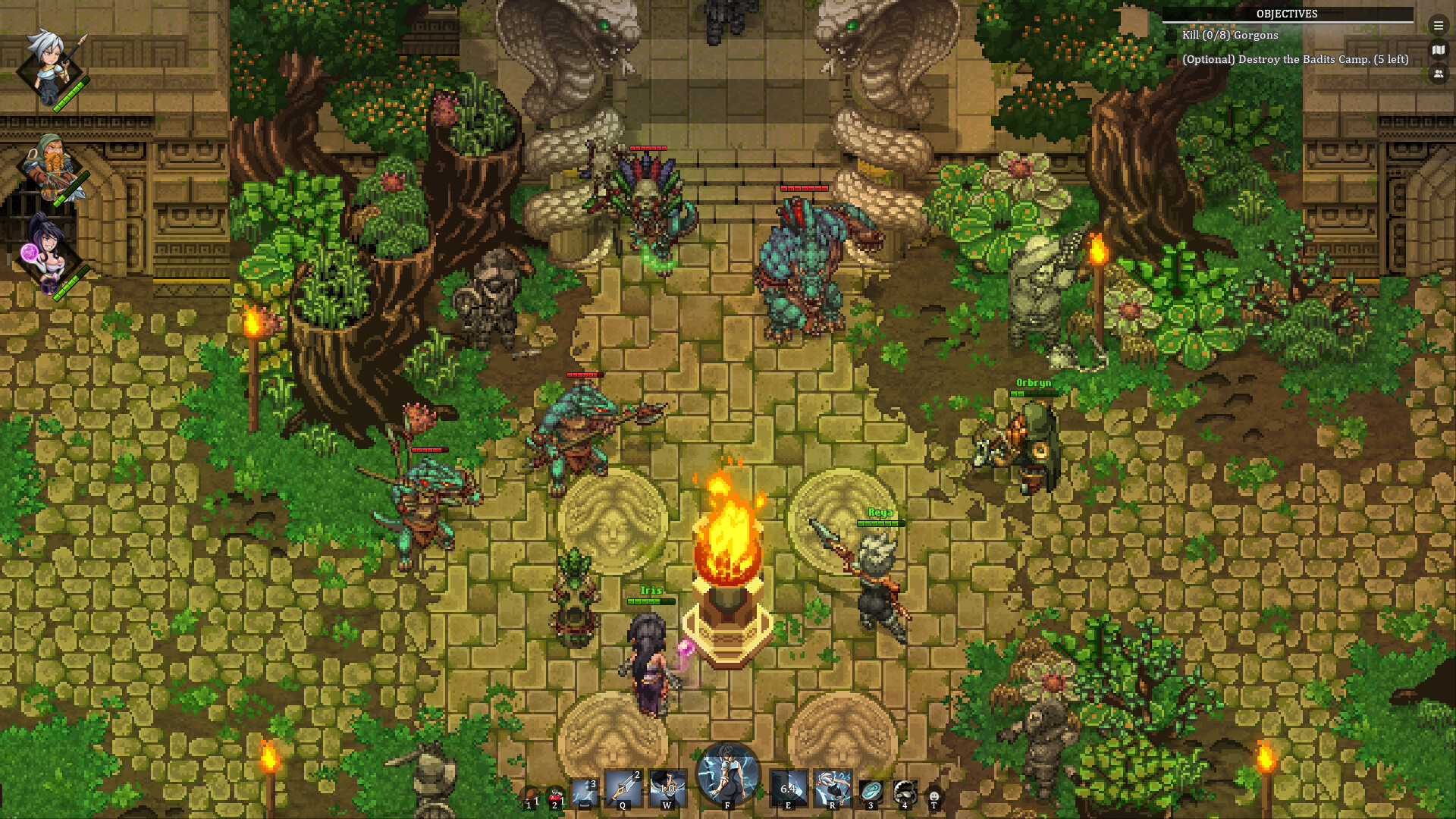
There are 21 unique playable heroes in total: 20 named heroes plus one unrevealed, secret hero. The store premise frames the cast as more than 20 heroes, with more planned to come. Heroes cover the familiar tank, healer, and damage-dealer roles, and several of them take unusual approaches to those roles. Some tanks, for example, lean on agility, crowd control, or illusion rather than raw durability. The roles and playstyles described below are the ones confirmed in official material. For heroes whose kits have not been detailed, specific abilities are not detailed in confirmed sources, and inventing them would be guesswork.
Hero Roster
The 20 named heroes are listed below. The In CBT column marks the 15 heroes that were part of the closed beta starting roster. Note that Gameplay balances all stats in PvP Modes, so a hero's strength there comes down to its kit and the player. A few hero names (Korz, Ophis, Urijor, and Ozul) are also used for bosses in the Open World and Adventurer's Guild layer; the entries here are the confirmed playable heroes that share those names.
Hero | Class / Role | Confirmed Playstyle | In CBT |
|---|---|---|---|
Arryn | Not detailed | Referred to by the developers as a princess, and shown fighting with a bow in official screenshots, so she is a ranged bow user; her individual abilities are not detailed in confirmed sources | Yes |
Byron | Not detailed | Specific abilities not detailed in confirmed sources | Yes |
Faendar | Elf Archdruid | An elf Archdruid from Ereluna who draws on the power of nature, can transform into an owl, and has unlocked the full potential of the Calen Woods so they fight alongside him | Yes |
Irhaal | Damage dealer | An elf and agile damage dealer who wields a twinblade for fast, fluid combat | Not yet |
Iris | Mage illusionist | A ranged, squishy mage who plays like a tank: she mitigates damage and tricks enemies with her illusions | Yes |
Kavras | Not detailed | Specific abilities not detailed in confirmed sources | Not yet |
Korz | Not detailed | A confirmed playable hero who shares a name with a boss; specific abilities not detailed in confirmed sources | Yes |
Liam | Knight (tank) | Described by the developers as the baseline Knight; his ultimate was demonstrated as a long damage-reduction window that also makes him briefly invulnerable on activation | Yes |
Marly | Priest (healer) | A priest who heals and uses holy shields to protect allies while still dealing damage; excels at AoE and defensive abilities | Yes |
Mohazus | Not detailed | Introduced in the first official teaser as a boss players fight in a group, and confirmed at the same time as a playable hero; specific abilities not detailed in confirmed sources | Not yet |
Ojore | Tank (Brawler / Geomancer) | A tank Brawler with Geomancer powers, and the 20th hero added to the roster | Yes |
Ophis | Not detailed | A confirmed playable hero who shares a name with a boss; specific abilities not detailed in confirmed sources | Not yet |
Orbryn | Dwarf Engineer | A dwarf Engineer from Garmorli; specific abilities not detailed in confirmed sources | Yes |
Ozul | Not detailed | A confirmed playable hero who shares a name with a boss; specific abilities not detailed in confirmed sources | Yes |
Reya | Battlemage | The Lightning Queen, a battlemage and the fastest hero in the game; squishy but with very high mobility | Yes |
Thomas | Bard (support) | A bard cat specializing in support and crowd control, with a Resonance mechanic that asks you to match the colors of notes to boost spell effectiveness | Yes |
Urijor | Not detailed | A confirmed playable hero who shares a name with a boss; specific abilities not detailed in confirmed sources | Not yet |
Yuki | Tank (kitsune) | A kitsune tank who relies on agility and mobility rather than bulk; her ice powers provide strong crowd control | Yes |
Yura | Assassin | An assassin from the faraway land of Ryujin whose style centres on the quick draw, aiming to end a fight with a single strike faster than the eye can follow | Yes |
Zeugladius | Paladin Errant | A Paladin Errant chosen by the Archangel of Justice, attacking with a hammer and using his light to shield himself and his companions | Yes |
Beyond the 20 named heroes, a 21st hero has not yet been revealed. The closed beta starting roster covered 15 of the named heroes, and the rest are expected to join over time.
Customization
Every hero supports a deep layer of cosmetic customization. Skins come with unlockable styles that change parts such as hairstyles, hoods, helmets, and armor variations, and dyes let you recolor those parts to taste. Each hero also has over 30 emotes, and every emote has its own unique voice lines. Wingeon has said the game is planned to launch with at least 6 styles per hero, which should be read as a launch target rather than a guaranteed count in the current test build.
Cosmetics are separate from power. Beyond looks, you can reshape how a hero actually plays through Orbs, Artifacts, and Trophies, which change what a hero's skills do and which passives they carry. Because those build pieces are shared across your account, progress you make on one hero feeds into the others. Cosmetic work has continued alongside the roster: alternate skins have been revealed for Yura and Reya, and a young version of Byron was created after them.
There is no character creator, and the developers treat that as deliberate rather than as something missing. Their reasoning is that a creator in a two-dimensional game forces every hero onto shared, generic animations, which is exactly what would destroy the per-hero identity the roster is built on. Customization is therefore layered onto fixed heroes instead, through skins, the styles inside each skin, and dyes.
Byron shows how far a skin can go. He has two complete versions, an undead one and a living one, each carrying its own separately unlockable styles for parts such as hair, beard, hat, and the scroll on his back, so the two look like different characters rather than two colourways of the same one.
Ultimate System
Heroes charge an ultimate by landing hits in combat, so staying active in a fight builds toward your big play. An early devlog described ultimates being able to stack energy beyond 100%, up to 125%. That figure comes from a WIP-era 2024 devlog that predates the CBT2 combat overhaul, so it should be treated as an early design detail rather than a confirmed value in the current build. The general idea, charging the ultimate through combat, is consistent with the game's action-combat direction.
Role Identity and the Trinity
Tank, healer, and damage roles exist, but the way they are expressed is unusual and the developers have explained the reasoning. Every hero's baseline damage is deliberately levelled, so nobody feels weak for picking a support or a tank, and each hero can hold their own alone. Role identity is concentrated in the ultimate rather than spread through the basic kit.
The design came out of a problem the team hit in testing. When healing sat on an ordinary cooldown, a support could hang back, dodge everything, and press one button, which was neither fun to play nor fun to play with; tanks did the same thing with taunts, pulling aggro and then wandering off. Putting those effects on the ultimate, which charges by landing hits and cycling abilities well, forces the player to engage. A healer who plays passively has no healing to give, and a tank has to commit to get the taunt and the defensive burst.
The result is that the trinity matters most against bosses, where the developers find the interaction between roles most interesting, and matters less against ordinary enemies. The team has also acknowledged the wider problem it was designing around, which is that in most games with strict roles the damage queue fills instantly while tanks and healers stay scarce.
Roles are still coarse in confirmed material. Only the heroes with an official teaser have a described playstyle; the rest of the roster is a name and, at most, an origin. Full ability lists, cooldowns, and numbers have not been published for any hero.
One informal role sits outside the trinity. Reya and Irhaal are both described as duelists, meaning they are the picks you want when a map pulls fights apart into isolated objectives and someone has to win a one-on-one or catch an opponent out of position. That is a statement about where they are strong rather than a fourth role in the interface.
Lore and Origins
Each hero carries its own backstory tied to the world's kingdoms, and several origins are confirmed. Faendar is an elf Archdruid from the elven kingdom, while Orbryn is a dwarf Engineer from the dwarven kingdom. More background on these regions is covered under Cities and Locations. Heroes were also gradually revealed through the game's Closed Beta History, with teasers and devlog spotlights introducing the roster over time.