
Loading...
Loading...
Gambling
March 26, 2026 at 08:55 AM
Embed images: added 2 topic-specific images, replaced 1 generic image
Gambling is one of the most profitable activities in Crimson Desert. The game features two card-based gambling minigames: Duo and Five-Card. Both are played in dedicated gambling dens scattered across the continent of Pywel. Players wager Silver against NPC opponents, and skilled (or lucky) gamblers can walk away with substantial winnings. Gambling is one of the fastest ways to accumulate wealth in the early and mid-game, especially when combined with the save-scum method.
Duo is based on the traditional Korean card game Seotda, also referred to in-game as "A Bloom of High Stakes." Five-Card is an expanded variant that introduces color-based mechanics on top of the numerical system. Both games use numbered sticks instead of traditional playing cards, and each gambling den has its own buy-in requirement and stakes.
There are three gambling dens in Crimson Desert, each offering different games and buy-in amounts. The table below summarizes all available locations:

Location | Game | Buy-In | Notes |
|---|---|---|---|
Duo | 15 Silver | First den available; found on the second floor of the Hernand Inn. Enter the building and head upstairs, then go through the closed door on the right. | |
Five-Card | 150 Silver | Located due north of Demeniss or east of Pailune. The only location where Five-Card is played. | |
Duo | 300 Silver | Highest-stakes Duo table. Found in the Tashkalp area in the northeast. Not visited during any main quest, so you must travel there on your own. |
The number of opponents at a table varies from one to three players per session. The roster changes daily, so the same den may feel different on each visit. Higher buy-in locations offer proportionally larger payouts, making them the preferred choice for experienced players looking to build wealth quickly.
Duo is the primary gambling minigame in Crimson Desert. It is available at the City of Hernand (15 Silver buy-in) and Tomasso (300 Silver buy-in). To start a game, approach an empty chair at the gambling table and interact with it.
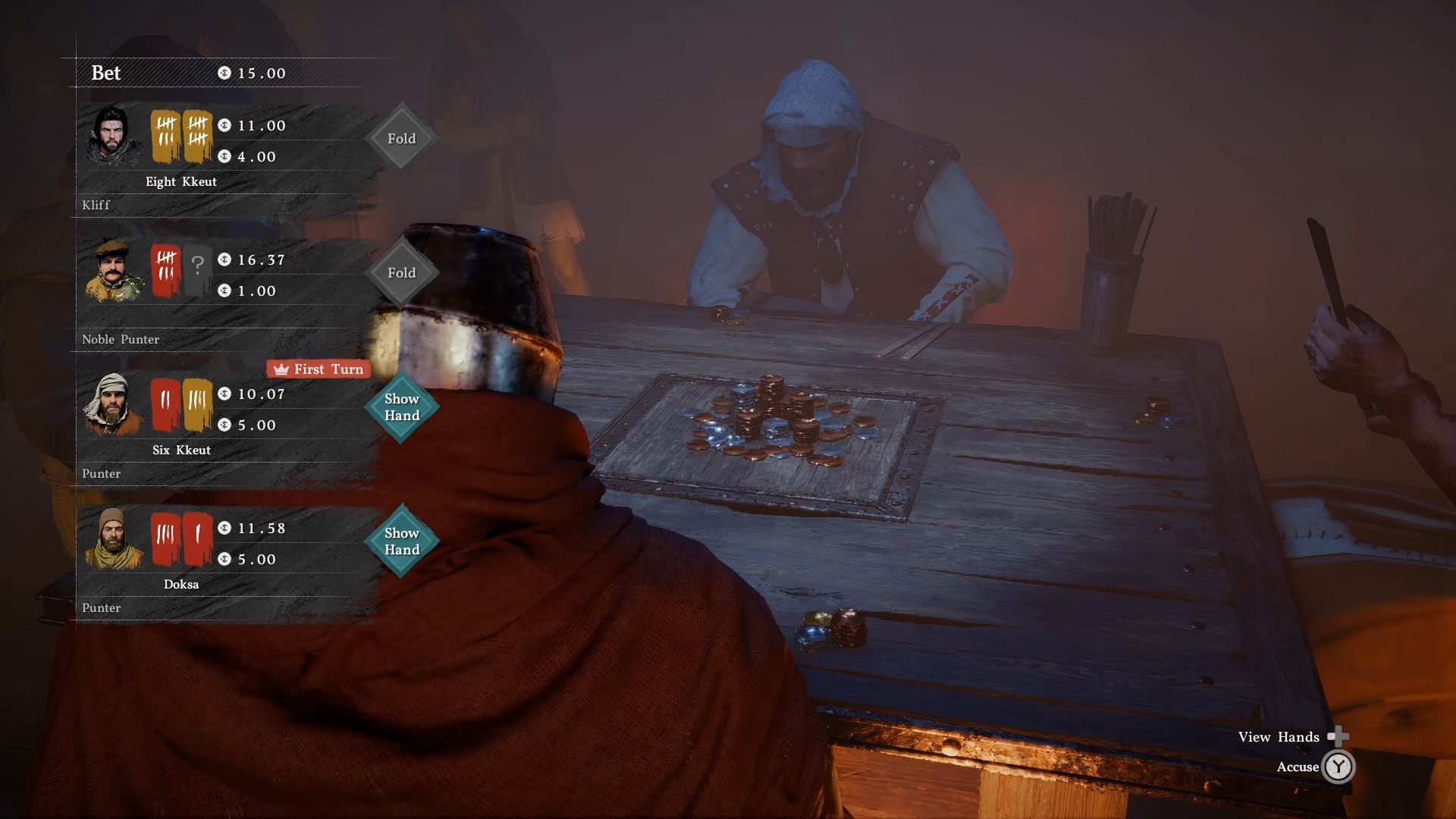
Each player is dealt five numbered sticks. The game automatically selects three of those sticks that combine to total exactly 10, 20, or 30. The remaining two sticks form the player's final hand, called the Duo. If no valid three-stick combination exists, the hand is a Bust and the player automatically loses that round.
Points are determined by adding the values of your two remaining sticks. If the total exceeds 10, subtract 10 from the result. For example, if your two sticks are 6 and 9, the sum is 15, so your hand is worth 5 points. The player with the highest-ranking hand wins the pot.
One of your opponent's two cards is always visible, giving you partial information to inform your betting decisions. You have 10 seconds per turn to choose an action, and if the timer expires the game automatically selects Call.
During each round, you can choose from several actions. Understanding when to use each option is critical for maximizing winnings:
Action | Effect |
|---|---|
Check | Pass your turn without raising. Only available when no opponent has raised. |
Call | Match the current raise to stay in the round. |
Half Raise | Bet half the current pot. A moderate escalation. |
Double Raise | Bet double the previous raise. A strong pressure move. |
All In | Wager all of your current Silver. High risk, high reward. |
Fold | Forfeit the round and lose your current stake. Use this to cut losses on a weak hand. |
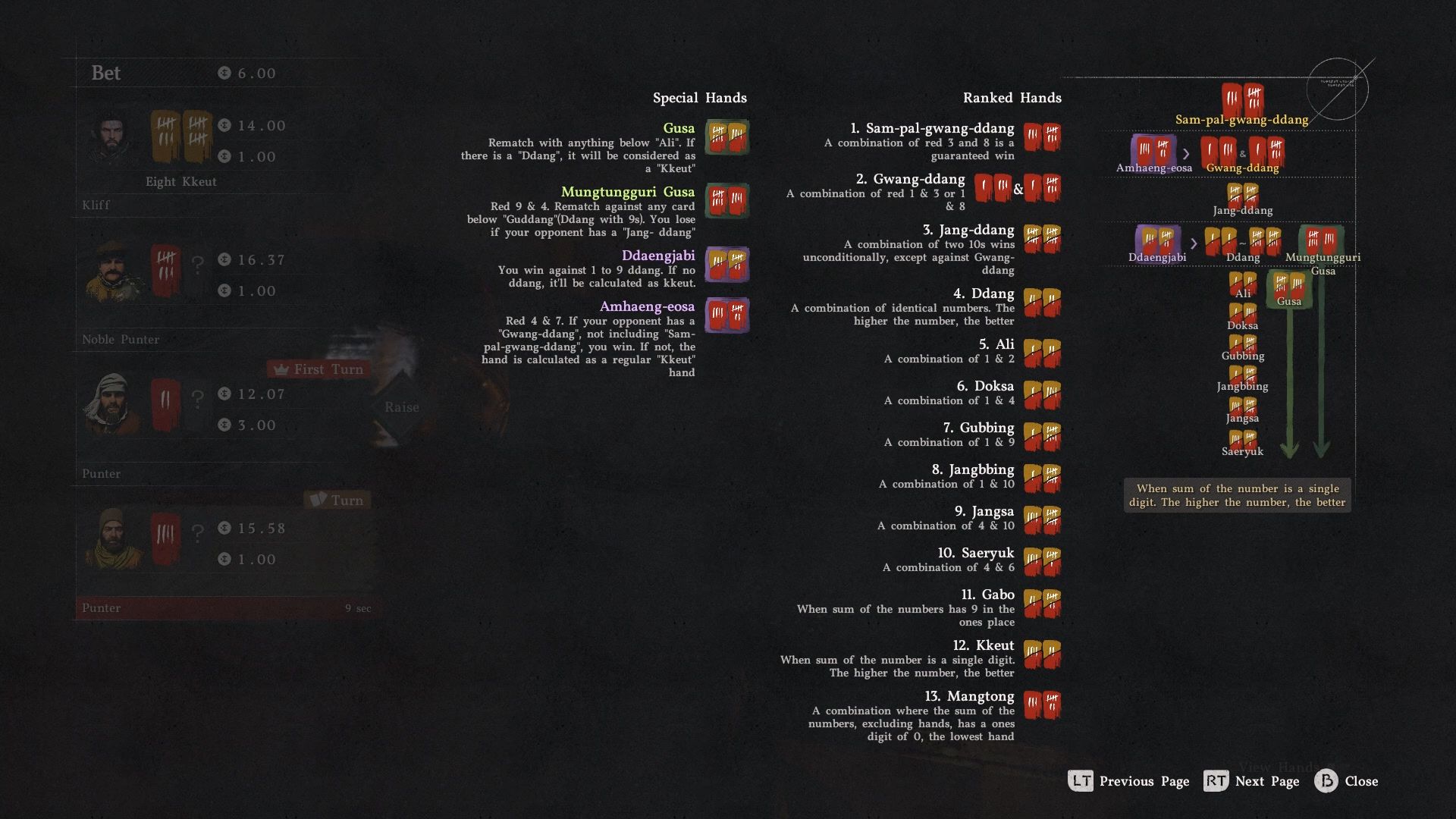
Hands in Duo follow a strict hierarchy. Special hands and pairs always beat standard point totals. Below is the full ranking from strongest to weakest:
Rank | Hand | Description |
|---|---|---|
1 | Ten Pair | Two 10s. The strongest standard hand in Duo. |
2 | Pair (9 through 1) | Any two matching numbers. Higher pairs beat lower pairs (e.g., 9 Pair beats 5 Pair). |
3 | One-Two | A 1 and a 2. The strongest non-pair combination. |
4 | One-Four | A 1 and a 4. |
5 | One-Nine | A 1 and a 9. |
6 | One-Ten | A 1 and a 10. |
7 | Four-Ten | A 4 and a 10. |
8 | Four-Six | A 4 and a 6. |
9 | Perfect Nine | Two sticks that sum to 9 (not already covered by a higher-ranked combination). |
10 | Points (8 down to 1) | Standard point hands ranked by value. An 8-point hand beats a 3-point hand. |
11 | Zero (Mangtong) | Two sticks that sum to 10 (or 0 after subtraction). The worst possible hand. |
Duo includes four special hands that have unique effects. These can override the normal ranking hierarchy in specific situations:
Hand | Cards | Effect |
|---|---|---|
Warden | 4 + 9 | Forces a rematch if all opponents hold One-Two or lower. Otherwise counts as 3 points. |
High Warden | Red 4 + Red 9 | Forces a rematch if all opponents hold 9 Pair or lower. Loses to Ten Pair. |
Judge | 3 + 7 | Wins against any hand from 1 Pair through 9 Pair. Otherwise counts as Zero. |
Executor | Red 4 + Red 7 | Wins specifically against Superior Pairs. Otherwise counts as 1 point. |
Five-Card is the second gambling minigame, available exclusively in Beighen at a 150 Silver buy-in. It builds on the same foundation as Duo but introduces a color mechanic that significantly changes hand evaluation. Sticks come in two colors: red and yellow. The color of your sticks matters just as much as the numbers, and certain color-specific combinations create the strongest hands in the game.

The hand hierarchy in Five-Card is different from Duo because color combinations create premium hands that outrank everything else:
Rank | Hand | Description |
|---|---|---|
1 | Prime Pair | Red 3 + Red 8. The single strongest hand in Five-Card. A guaranteed win with no exceptions. |
2 | Superior Pair | Red 1 combined with either Red 3 or Red 8. Nearly unbeatable, second only to Prime Pair. |
3 | Ten Pair | Two 10s of any color. |
4 | Standard Pair | Any matching number of any color. Higher pairs beat lower pairs. |
5 | One-Two | A 1 paired with a 2. |
6 | One-Four | A 1 paired with a 4. |
7 | One-Nine | A 1 paired with a 9. |
8 | One-Ten | A 1 paired with a 10. |
9 | Perfect Nine | Two sticks totaling 9. |
10 | Points | Standard point hands ranked by value. |
11 | Zero | The weakest hand. |
The key takeaway is that red-colored sticks are far more valuable in Five-Card than in Duo. When building your hand or deciding whether to cheat, always prioritize red 3, red 8, and red 1, as these form the top-tier combinations.
Both Duo and Five-Card feature a cheating system that adds a layer of deception to the gambling experience. Players can both learn to cheat and accuse opponents of cheating.
During a game, one of your opponents will occasionally display a blue outline, similar to the visual cue used when studying enemy combat patterns. When you notice this, use the observation prompt to watch them closely. After observing the same opponent cheat three separate times, you unlock the Cheat ability.
Once unlocked, the Cheat ability activates only when Kliff is the one dealing cards. Hold the button prompt for the Hide Hand command, and a selection menu appears allowing you to pick a specific number and color for one of your sticks. This stick is then automatically added to your hand, replacing one of your dealt cards. In Five-Card, this is especially powerful because you can target a Red 3 or Red 8 to aim for a Prime Pair.
NPC opponents can also attempt to cheat. When you suspect someone is cheating, you can press the Accuse button during the deal phase. Watch for opponents who draw sticks from the side with their thumb facing upward rather than drawing from the top with thumbs facing down. This animation difference is the telltale sign.
Correct accusation: The cheater is kicked from the game and their Silver is distributed among the remaining players.
Incorrect accusation: You are removed from the game and may receive a temporary ban from that gambling den.
The risk-reward balance of accusing makes it a double-edged sword. Only accuse when you are confident you spotted the suspicious animation.
The most efficient way to make Silver through gambling is the save-scum method. This technique exploits the manual save system to eliminate risk entirely, turning gambling into a guaranteed money-making tool. The core idea is simple: save before you play, go all-in on strong hands, and reload if you lose. Each successful cycle takes under a minute, which makes this far faster than playing games out normally.
The Beighen Five-Card table is the sweet spot for this strategy. The 150 Silver buy-in is high enough to generate meaningful profit (300+ Silver per win with multiple opponents) but low enough that you can start using it in the mid-game. To reach Beighen, leave Hernand, cross the river, follow the road north, and cross a second river before continuing along the road to the village. Before heading into the den, activate the Abyss Nexus fast travel point just northwest of the village so you can teleport back whenever you want.
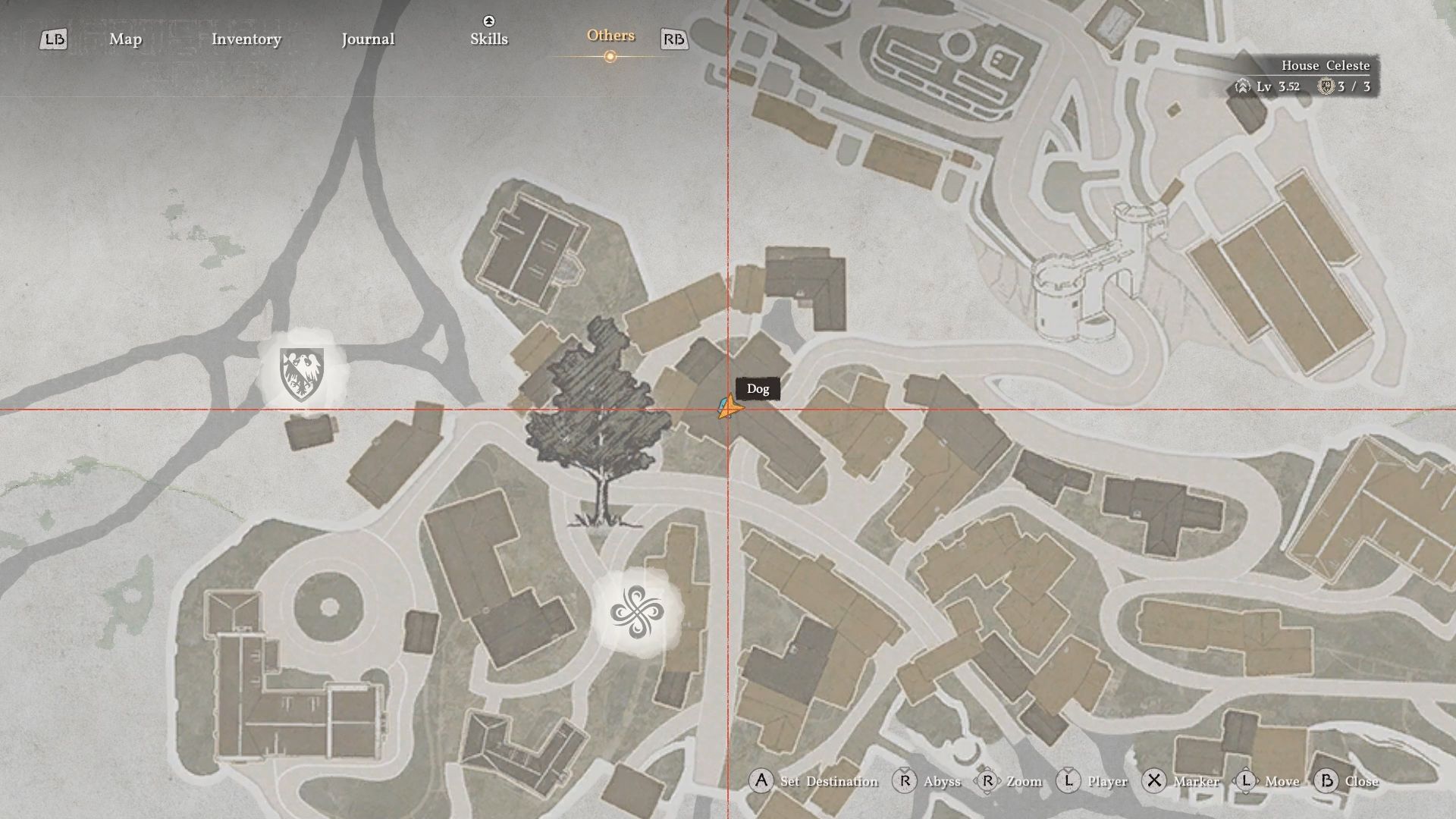
Inside Beighen, look for the building near the well with a guard posted outside. That guard marks the entrance to the local gambling den. The den seats one to three NPC opponents per session, and you need at least two opponents at the table for the strategy to be worthwhile. With only one opponent, the pot is too small to justify the time. If only one player is seated when you enter, back out, reload your save, and sit down again. Reloading refreshes the NPC roster, so you will get a different number of players.
Save your game right before sitting down at the gambling table. This is your safety net.
Sit down and check the table. You need at least two opponents. If only one NPC is seated, stand up, reload your save, and try again until two or three players appear.
Wait for your hand to be dealt. Look at your point total. If your hand is worth 5 points or higher (or you have a special hand like One-Two, a Pair, or better), go All In immediately. If your hand is below 5 points, or you drew a Zero (Mangtong), fold and wait for the next hand within the same session.
NPCs will almost always match your All In. The AI opponents are aggressive during the first round of a match and rarely fold when someone goes all-in early. This is what makes the strategy work: they throw their Silver into the pot even with weak cards.
If you win: Leave the table and create a new manual save. Then reload that save. This refreshes the gambling den with new NPCs and a fresh pot, allowing you to repeat the cycle without waiting. Go back inside and sit down again.
If you lose: Reload the save you made in Step 1. Your Silver is restored to its pre-game amount as if the loss never happened. Walk back in and try again.
The key insight is the reload-after-winning trick. Saving and then immediately reloading that same save resets the gambling den's NPC roster and pot state. Without this step, you would need to wait for the opponents to cycle out naturally, which takes much longer.
As you accumulate more Silver, consider moving to higher-stakes tables. The Hernand den at 15 Silver per game is a good place to learn the mechanics, but the Beighen den at 150 Silver is where the real money starts flowing. Once you have a comfortable Silver reserve (1,000+), the Tomasso den at 300 Silver per game offers the highest returns. The same save-scum cycle at Tomasso generates roughly 20 times more Silver per win than Hernand.
The progression path for gambling earnings is: Hernand (15 Silver) for beginners, Beighen (150 Silver) for mid-game, and Tomasso (300 Silver) for late-game farming. Beighen is the most popular choice for the save-scum strategy because it sits right in the middle of the risk-reward curve and becomes accessible relatively early.
After a productive gambling session, convert your surplus Silver into Gold Bars (500 Silver each) and deposit them at the bank. The bank offers two investment tiers. Low-risk investments always return a positive amount, typically 0 to 2 percent per cycle, which means free Silver on money you are not spending right away. High-risk investments can swing between roughly negative 50 percent and positive 55 percent per cycle, so they are essentially another gamble. For Silver that you plan to keep in reserve, low-risk is the safer choice. Even a modest deposit of 1,500 Silver earning 1 percent returns 15 Silver per cycle with zero effort.
AI opponents tend to call All In bets readily during the first round of a match. This makes the opening round the best time to go aggressive, especially with a strong hand.
In later rounds, NPC opponents become more conservative with their betting. If a game drags on, the potential Silver gains decrease significantly because opponents fold more often.
NPCs can and will bluff. A large raise from an opponent does not necessarily mean they have a strong hand. Pay attention to their visible card and weigh the odds before folding.
In Five-Card, always prioritize red sticks when cheating. Red 3 and Red 8 together form the Prime Pair, which is an automatic win against every other hand.
You can view the full hand ranking chart at any time during a game by pressing the View Hands button. Use this reference until you have memorized the hierarchy.
The Warden and Judge special hands can catch experienced players off guard. If you draw a 4+9 or 3+7 combination, consider the special effects before deciding to fold.
Gambling pairs well with other money-making methods. Visit the Silver and Gold Farming guide for a complete breakdown of all income sources.
Check the Tips and Tricks page for more general advice on progressing efficiently through Crimson Desert.
Duo (detailed article on the Duo minigame)
Minigames (overview of all minigames)
Silver and Gold Farming (complete money-making guide)
City of Hernand (first gambling den location)
Tips and Tricks (general gameplay advice)
