

The Mold is the second hostile faction in Control Resonant, reframed from its appearance in the first Control as a fully other-dimensional threat. In Resonant, the Mold operates at street level across Manhattan alongside the Hiss. For wider context, see the Overview.
Quick Profile
Field | Detail |
|---|---|
Type | Paranatural hostile faction |
Returning from | Control (2019); reframed in Resonant |
Current habitat | Outdoor Manhattan zones |
Framing change | Fully other-dimensional threat in Resonant, rather than post-apocalyptic flora as in the previous appearance |
Operational style | Invasive, parasitic, spreading across surfaces and entities |
Reframing for Resonant
The Mold's earlier framing inside the agency's catalog leaned on biological imagery: spores, fruiting bodies, and an environmental presence that grew like wild flora left to spread. Resonant changes that framing. The Mold is now presented as a fully other-dimensional threat, with the visual and behavioural language pulled toward the alien rather than the botanical.
The change matters because the Mold no longer reads as a static environmental hazard. In Resonant, it is an active hostile faction with its own attack patterns and roles, sharing the open-air engagement space with the Hiss.
Combat Identity
Public combat material has shown two distinct sides of how the Mold interacts with the player.
Aspect | Detail |
|---|---|
Direct hostility | Mold-aligned enemies engage Dylan at street level with their own attack patterns. The combat loop is the standard one: melee strings build resources, abilities stun and open targets up, executions grant the damage buff that carries momentum. |
Mold Turrets | Remedy's pre-release name for a Mold summon that attacks on its own and applies harmful status effects. In the released game this is Growth, one of the two abilities offered after the Collective (see below). |
The Mold turret is the most concrete mechanical detail tying the Mold to Dylan's own toolkit. It points at the wider design pattern: paranatural threats that were once purely problems to contain are now also resources the operative can leverage. See the Melee Combat page for how deployable tools fit the rest of the combat loop.
Fire and Falter
Status effects feed the Falter meter that sets up executions. Two independent accounts, one of the gamescom 2026 demo and one full-game review, state that the Burning status accelerates Falter buildup, and the demo commentary paired a fire ability with the Drill form of the Aberrant to stagger Mold enemies quickly. During that demo the developers also described the Mold as vulnerable to fire, and guides to the released game agree that fire is the Mold's weakness. The same demo account described Mold enemies as larger and slower than the Hiss, leaning on damage-over-time and explosive attacks; that comparison rests on a single account of the showing. One full-game review adds that Dylan can suffer the same status effects himself.
Spread Across Manhattan
The Mold is loose in Manhattan because the lockdown at the Oldest House failed. Both the Hiss and the Mold were previously contained inside or beneath the agency's headquarters; both have now spilled into the city.
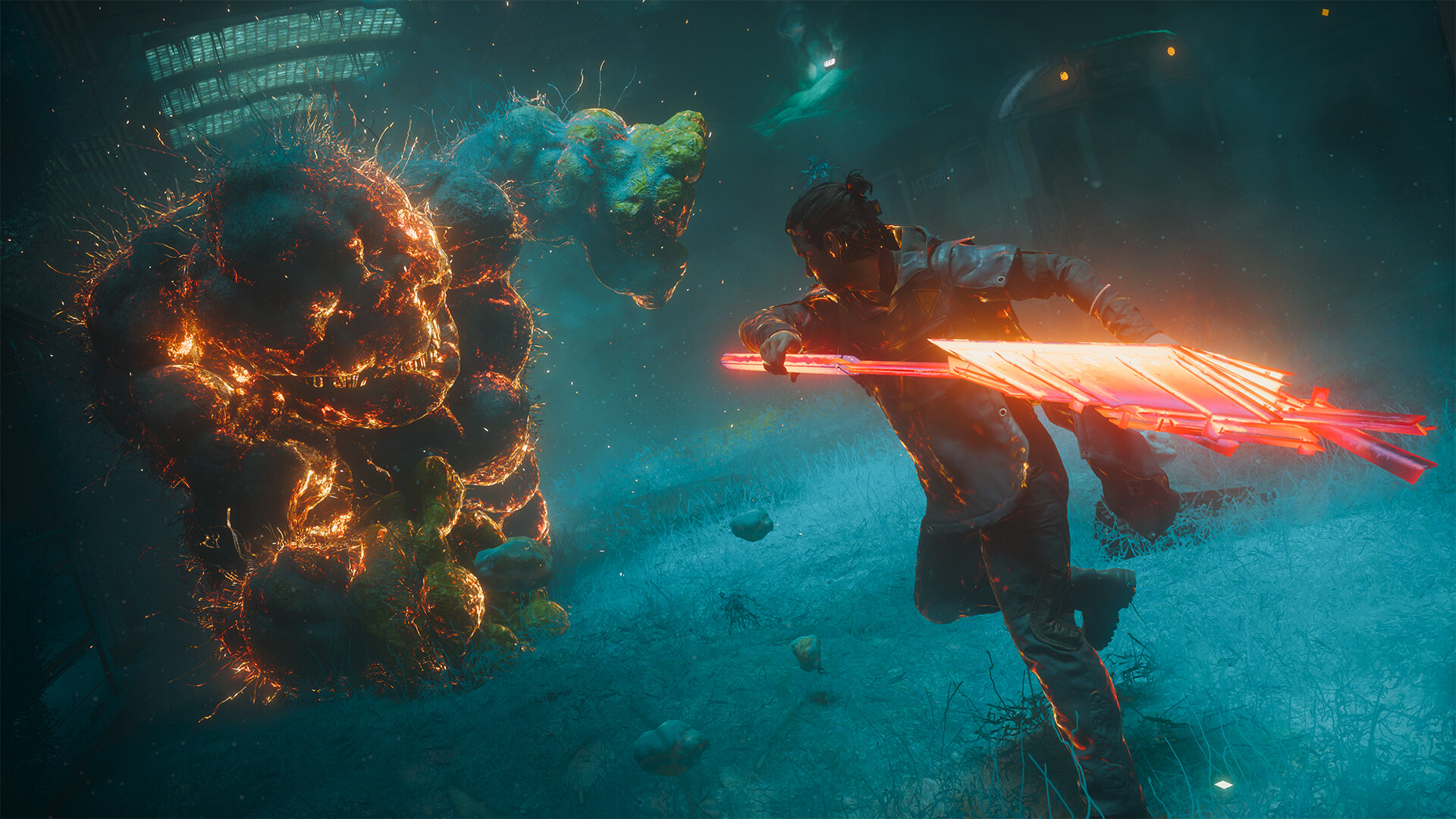
The Mold's outdoor presence is the more dramatic visual change of the two factions. Where the Hiss is recognisable as a hostile group with attack patterns, the Mold reshapes the spaces it occupies. The visual style stays consistent with its other-dimensional framing, and the affected zones feel different from neighbouring areas even before the player encounters a hostile.
Differences from the Hiss
Both factions share Manhattan, but they read differently in play. The Hiss is the familiar problem reframed: same identity, harder behaviour, broader roster. The Mold is the unfamiliar problem foregrounded: a faction that operated mostly as setting in the first game is now an active combatant, with its own enemy types, its own visual language, and its own tool interactions (Growth, the Mold turret ability) that Dylan can leverage.
The two factions are not allies. A June 2026 hands-on described a Resonant entity clearing every Hiss from its surroundings, and a full-game review published on September 18, 2026 describes Mold entities as forces that oppose the Hiss while posing their own danger to Dylan. Remedy has not published whether the two sides fight each other dynamically during play; this page will add it from the released game.
Reframed as Extradimensional
In Control (2019) the Mold read primarily as a post-apocalyptic biological hazard. Remedy's framing for Resonant explicitly pushes the Mold further than that. The studio has stated on the record that the Mold is being positioned in the sequel as a paranatural threat from another dimension rather than as ordinary contaminated flora. That reframing is meant to be visible in how the Mold spreads through warped Manhattan, how its presence interacts with the Pattern, and how the faction's combat roles read against the Hiss alongside it.
The Mold in the Released Game
The released game gives the Mold its own mechanics and its own set of quests. One of the game's achievements, "Budding Mycologist", asks the player to "Deal with the major Mold Incidents in Manhattan." Remedy leaned into the faction's strangeness in a promotional short before launch that asked, "Would you eat the Mold?", and reaching the Mold's Resonant does in fact require Dylan to eat Mold samples.
Aspect | Detail |
|---|---|
Where it spreads | The Park, an optional zone north-east of Central, is overrun by it. Central, the hub zone, has both Hiss and Mold enemies. |
Mold enemies | Flying Mold and large Mold creatures that spit projectiles. |
Weakness | Fire. Burning also speeds up Falter buildup, which makes fire abilities such as Ignite effective against Mold enemies. |
Status effect | Mold attacks build up the Infected status. |
Environmental behaviour | Mold clumps grow when light hits them and conduct electricity, and some puzzles rely on both properties. |
Mold Incidents | Larger Mold outbreaks tracked as their own set of quests; the achievement above covers dealing with all of them. |
Mold Turrets
Mold Turrets was the name Remedy used before release for Mold summons that fire on their own and apply harmful status effects to enemies in range. Pre-release previews also described a turret that could be thrown as a bomb; that thrown, detonating ally belongs to a different pre-release ability, Seekers, whose slot the Volatile Anomaly fills in the released game. They sit in a more tactical close-and-stand build option compared with the heavier melee-pressure routes through the Aberrant.
In the released game the Mold turret is an ability called Growth, one of the two choices offered after defeating the Resonant beneath The Park: it summons a Mold turret that fires Infected projectiles at nearby enemies. The other choice, Spore Burst, fires a rapid burst of projectiles that builds the Infected status. Growth is a different ability from the Volatile Anomaly, the explosive summoned ally offered after the first Resonant.
Underground Presence
Gameplay footage released in August 2026 puts the Mold underground. The mission shown there as the Metro Fault, which guides to the released game list as The Subway Fault, takes Dylan into the Manhattan subway, and the fungal growth is the opposition throughout that descent rather than the Hiss. The tunnels themselves have stopped behaving, with loose trains drifting through the dark, so the Mold encounters there are fought around a moving environmental hazard as well as the enemies.
Dylan also hears his sister's voice while he is down there. Pre-release material did not reveal whether that is Jesse reaching him, the Mold using her voice, or something else, and this page does not cover the story beyond what first-party material states.
Above Ground at gamescom
August 2026 brought the Mold back to the surface. The public build shown at gamescom opened in The Park, one of the seven zones of the released game, whose ground, undergrowth and trees were entirely coated in blue mould, which is the first time the faction has been shown holding open green space rather than interiors or tunnels. It reads as colonisation rather than contamination: the growth has replaced the environment instead of spreading over it.
That slice also showed the Mold producing a Resonant of its own: The Collective, a heaped mass of mould that forms and reforms scowling faces and anchors itself to its arena with tentacles running into the surrounding walls, which have to be cut before its body can be damaged. In the released game it waits beneath The Park behind a Mold Gate that opens only after Dylan has eaten several Mold samples found around the zone. The fight, its rewards and how to reach it are covered on its own page.
Unconfirmed Details
The following were not covered by first-party material before release and have not yet been checked against the released game:
The full roster of Mold enemy types.
Specific moves, tells, and counterplay for individual Mold variants.
Whether the Mold has boss-class encounters separate from the Resonant boss class.
How Mold-affected geometry interacts with Gravity Anomalies and other environmental mechanics.
Whether the Mold's reframing extends beyond the visual style to a deeper lore retcon of its previous incarnation.
This page will be updated as more is revealed.