

This article is a stub
It lacks sufficient information and needs to be expanded. You can help by adding more content.
Crafting in Zeverland is closer to demolition than to recipe hunting. The studio's stated rule is that everything is interactive: anything found can be interacted with and modified the way it could be in real life, and the slogan attached to it is that common sense is your best weapon. In practice the first question about any object is what it is made of and which part of it is useful, not whether a recipe exists for it.
What the System Does
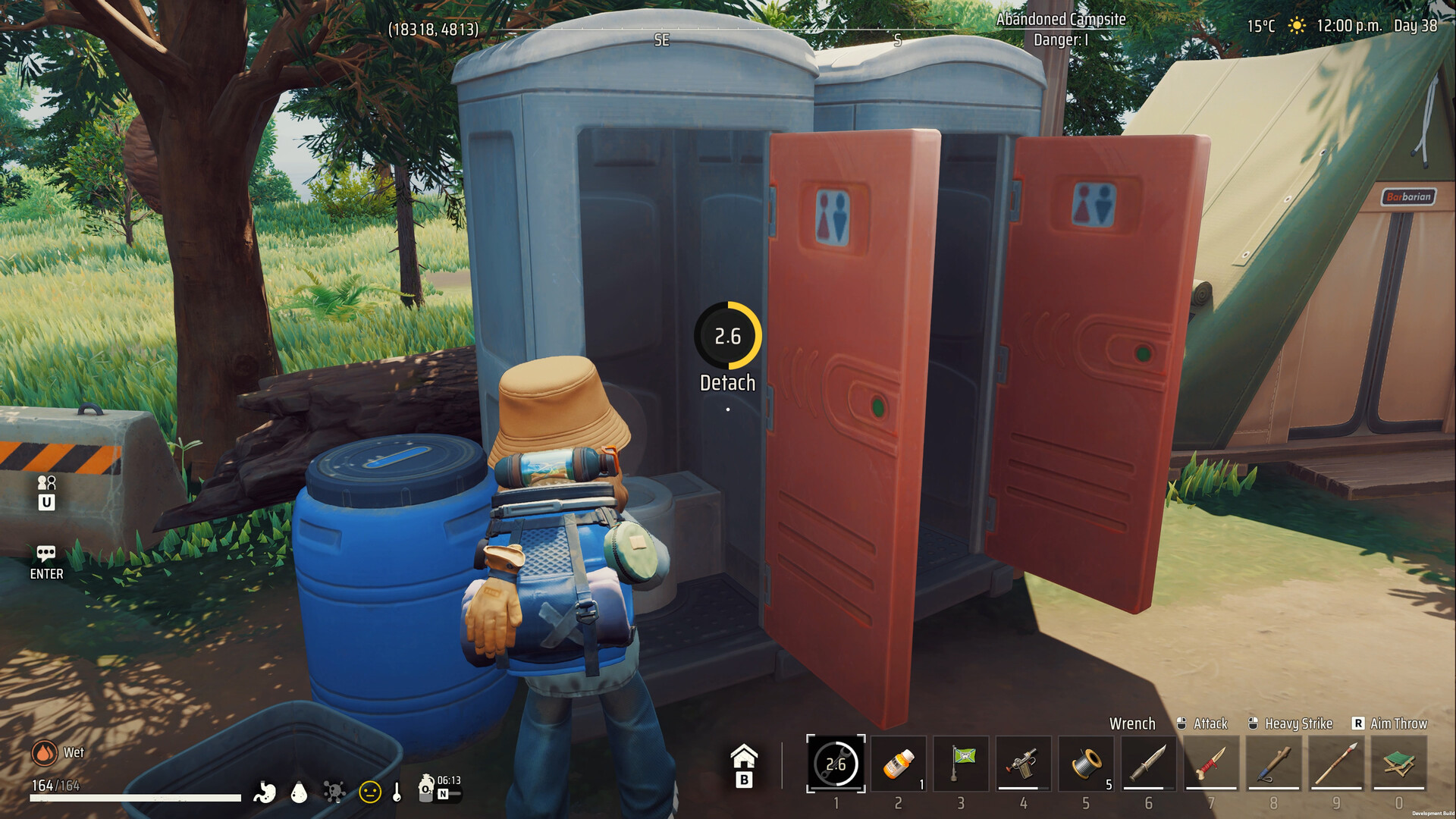
Objects are taken apart for their materials and the parts are recombined into something else, including across categories that most games keep separate. Furniture becomes vehicle interior, plumbing becomes seating, and enemy remains become tools. The examples below all come from the studio's own descriptions of the game rather than from player speculation.
Example | What it demonstrates |
|---|---|
Dismantling a gas station toilet | Fixtures placed in the world are components, not scenery |
Fitting a removed toilet as a driver's seat | A part keeps its function in a context it was never designed for. See Vehicles and RVs |
Welding a bed into an RV | Furniture can be built directly into a vehicle body |
Attaching a Zed head to a baseball bat | Remains are crafting material as well as a weapon part. See Zombies and Infection |
Duct-taping a clothes iron to a tennis racket | Two ordinary objects fuse into a weapon. See Weapon Assembly |
Handling Materials
Several quality of life systems were already present in the second tech test. Items can be bulk dismantled by holding Ctrl to multi-select rather than breaking them down one at a time. Storage groups items of the same type, and materials sort themselves. Companions recruited to a shelter deposit materials automatically once their storage settings are adjusted, although sending one out to scavenge in the first place still needs an explicit order; NPC Companions covers that side.
Not every part of the flow worked. Testers reported that small materials could only be crafted from the backpack, which turned routine production into inventory shuffling, and the studio agreed to work on efficiency. Watering crops one plant at a time was named in the same breath, and Farming and Fishing covers that. On the building side, batch dismantling was reported as built in the month to 3 August 2026, alongside a fly-cam build mode and grid snapping for furniture and decor; Base Building covers those.
Workbenches and Blueprints
Workbenches exist and some of them burn fuel. The second test shipped without a workbench tutorial, which left players guessing at the rules, and the studio listed automatic extinguishing, a target duration setting and a way to skip adding excess fuel as work still to come.
Blueprints are their own item class, found rather than bought. Testers singled out the tactical sniper grip blueprint as too rare to obtain reliably, and the studio said drop rates would be tuned. No recipe list, blueprint list or material cost has ever been published for any build, so this wiki does not carry one. Looting and Scavenging covers where blueprints come from.
Cars as Material
A car is a source of parts as well as a way to travel. Dismantling one yielded metal in the second test, and after testers pointed out that a car is also rubber and glass, the studio agreed to add those outputs. That is one of the clearer illustrations of how the system is meant to read: the value of an object is the sum of what it is physically made from.
Announced, Not Yet in the Game
Change | When it was announced |
|---|---|
A modular firearm system, with accessories that change a weapon's tactical use and improvised modifications such as a plastic water bottle used as a suppressor. A prototype exists and was slated for the following test build | January 2026 |
More weapon assembly, listed among the systems being refined | July 2026 roadmap |
Rubber and glass added to the output of dismantling a car | 1 July 2026 |
Workbench automatic extinguishing, target duration and excess fuel skipping | June 2026 |
Tuned blueprint drop rates | 27 June 2026 |
Container modules for vehicles, pieced together into a home on wheels | 3 August 2026 |