

Combat in Valor Mortis is a demanding, skill-based affair fought entirely from a first-person view. It draws on the Soulslike tradition, rewarding patience, precise timing, and a careful read of each enemy. Rather than overwhelming foes with sheer aggression, the system asks you to balance attack and defense while watching your resources, making every encounter a deliberate exchange.
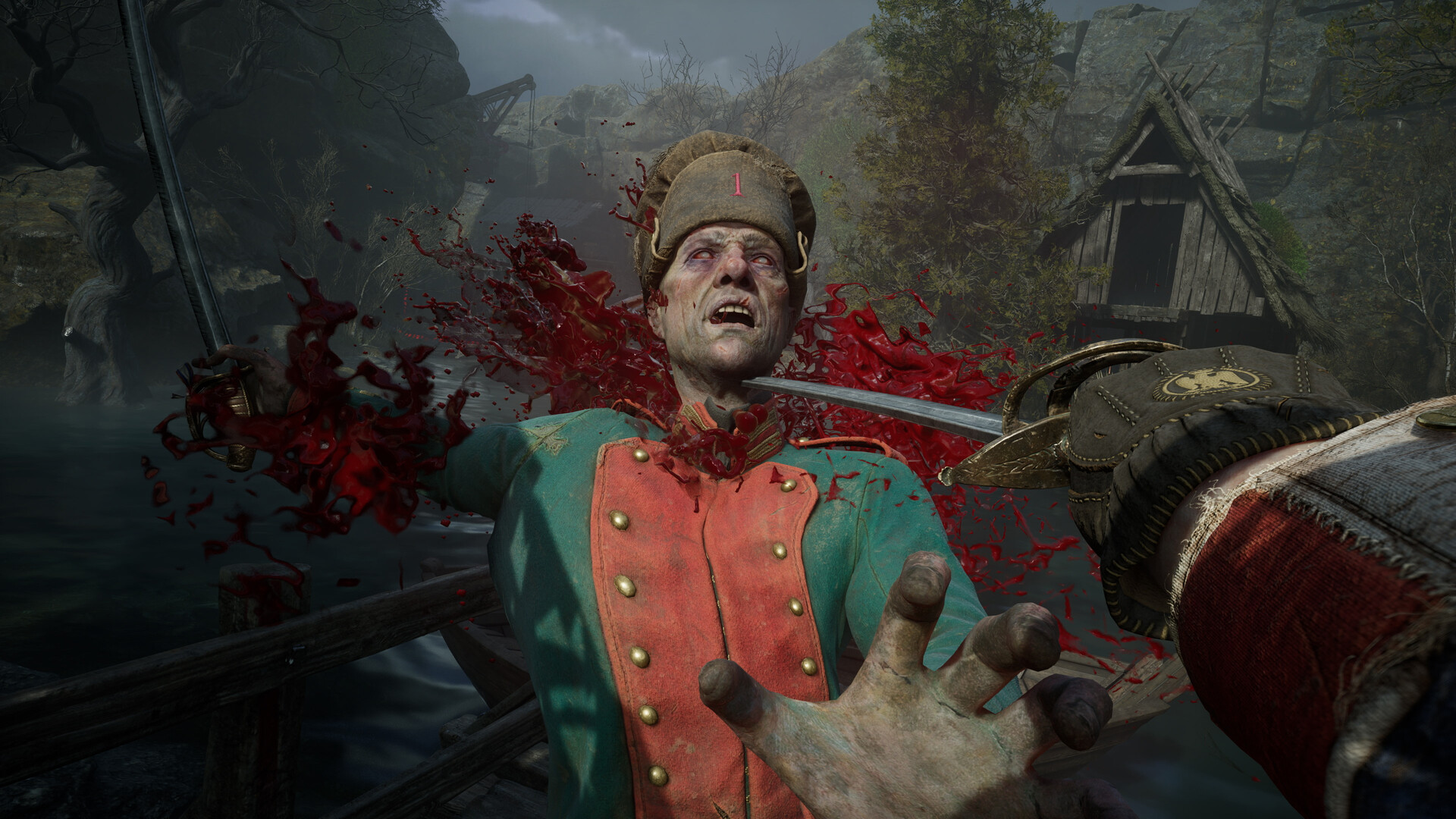
First-Person Melee
All fighting takes place up close and in first person, which gives the violence an immediate, visceral feel. Your melee strikes are the foundation of every encounter, and the various Weapons available shape how you approach a given fight. The first-person perspective places a premium on reading attacks as they come at you, since you do not have the wider view that a third-person camera would provide.
Melee First, Firearms Second
The director has been direct about this: the game has firearms, but it was never meant to be played as a first-person shooter. Hands-on coverage of the most recent builds reaches the same conclusion from the other direction, describing magic, firearms and the quieter approaches as secondary layers on top of a combat system that is fundamentally about parries and thrusts.
The studio has also said the three-way mix of melee, ranged and supernatural was settled before the Napoleonic setting was chosen, which is why the period arsenal reads as a skin over a combat design rather than the other way round.
Attacks
Melee strikes come in two weights. A light attack is quick; a heavy or charged attack costs noticeably more stamina and carries a longer windup in exchange for far more damage. Because the charged swing and the dash draw on the same stamina pool, committing to a heavy attack is also a decision to give up an escape.
Defense: Parry, Block, and Dash
Staying alive depends on three defensive tools, and hands-on accounts of the playable builds have been consistent about how each behaves.
Tool | What it does | Cost |
|---|---|---|
Parry | Negates all damage from the attack when timed correctly and drains the enemy's posture faster than anything else. Mistime it and you take the attack in full | Nothing, if it lands |
Block | Absorbs the blow but drains health gradually, and drains stamina as well. The health lost that way can be won back by going on the offensive, so blocking is a loan rather than a write-off | Health and stamina |
Dash | Repositions and creates space. It is a quick stamina-gated dash rather than a dodge roll, so it relies on distance rather than invulnerability frames | Stamina |
Some attacks cannot be blocked at all. Hands-on accounts of the demo describe unblockable strikes flagged by a red glow, which have to be answered with lateral or backward movement instead.
One popular misreading is worth heading off: the game does not promise damage-free blocking at full stamina. That idea comes from a reviewer saying they expected it to work that way and found it did not, which is an expectation rather than a rule.
Posture and Perfect Parry
Hands-on coverage of the demo describes a posture meter that drains as you successfully parry incoming attacks. Filling that meter opens an enemy up to a heavy punish, and against common soldiers a perfectly timed parry can end the exchange in a single follow-up slash. The system rewards reading and answering attacks rather than mashing through them, so the most efficient kills tend to come from defensive play rather than constant offense.
Pressure: Weak Points, Stagger, and Finishers
Offense is about more than landing hits. Targeting enemy weak points and building stagger lets you break a foe's guard and set up a finisher, a heavier punish that ends an exchange decisively.
Weak points on tougher enemies appear as large glowing growths. Shooting one with the off-hand firearm deals heavy damage and can hurt enemies standing nearby, and one hands-on account of the demo adds a detail that matters economically: destroying a weak point makes the enemy drop Nephtoglobin, the resource the Fire Transmutation runs on. Pressure and resource generation are therefore the same action. The rapier is the exception to the whole arrangement, since it can open weak points on its own without a shot.
Finishers are an official headline feature, listed alongside parries and dashes in the storefront copy. Burn status from the flame power also enables them. Backstabs exist too, confirmed indirectly by a demo patch note fixing a blood effect on backstabbed enemies, though no source describes how the mechanic is performed.
The presentation is graphic. Hands-on accounts describe decapitation and dismemberment as routine outcomes, which is consistent with the storefront's own content notice about violence throughout.
Lock-On and Multi-Enemy Fights
Combat supports a target-lock that fixes the camera on a chosen foe, which helps when a fight has multiple threats at different ranges. The developers have publicly called out lock-on among the systems they are still iterating on, with the goal of making it cleaner to switch focus during crowded encounters, and have promised better camera tracking, smarter target prioritisation, and a longer range that covers ranged as well as melee work. Expect target swap and re-acquisition behavior to keep tightening between the playtest builds and launch.
Resources: Stamina, Ammunition, and Transmutations
Three resources sit on top of the moment-to-moment exchange. Stamina is the most immediate; it powers your dash and limits how aggressively you can move. Ammunition fuels the off-hand pistol shots, so you cannot lean on it forever. Transmutations, the supernatural off-hand powers, have their own resource cost that is tracked through Catalysts and Progression and topped up by world drops. Managing all three at once is a core part of the combat puzzle.
Weapon Wheel and Loadout
Your loadout is a right-hand melee weapon plus one off-hand slot. Every hands-on account of a playable build describes the off-hand as holding either a firearm or a Transmutation, one at a time and mutually exclusive, rather than both at once. The studio's own framing from the reveal is that the game gives you tools to quickly switch between melee weapons, guns and the supernatural, and that you build William's kit to suit each encounter over the course of the game.
Swapping mid-fight is part of the design: a sabre for one room and a rapier for the next, or trading the pistol for fire when you are about to face a group. A playtest patch note refers to a weapon change tutorial, so the swap is taught rather than buried.
No source has published how many slots the selector holds, so this page does not quote a number. Earlier coverage describing a wheel with a specific slot count has not been corroborated by any other account or by the studio.
What the Screen Tells You
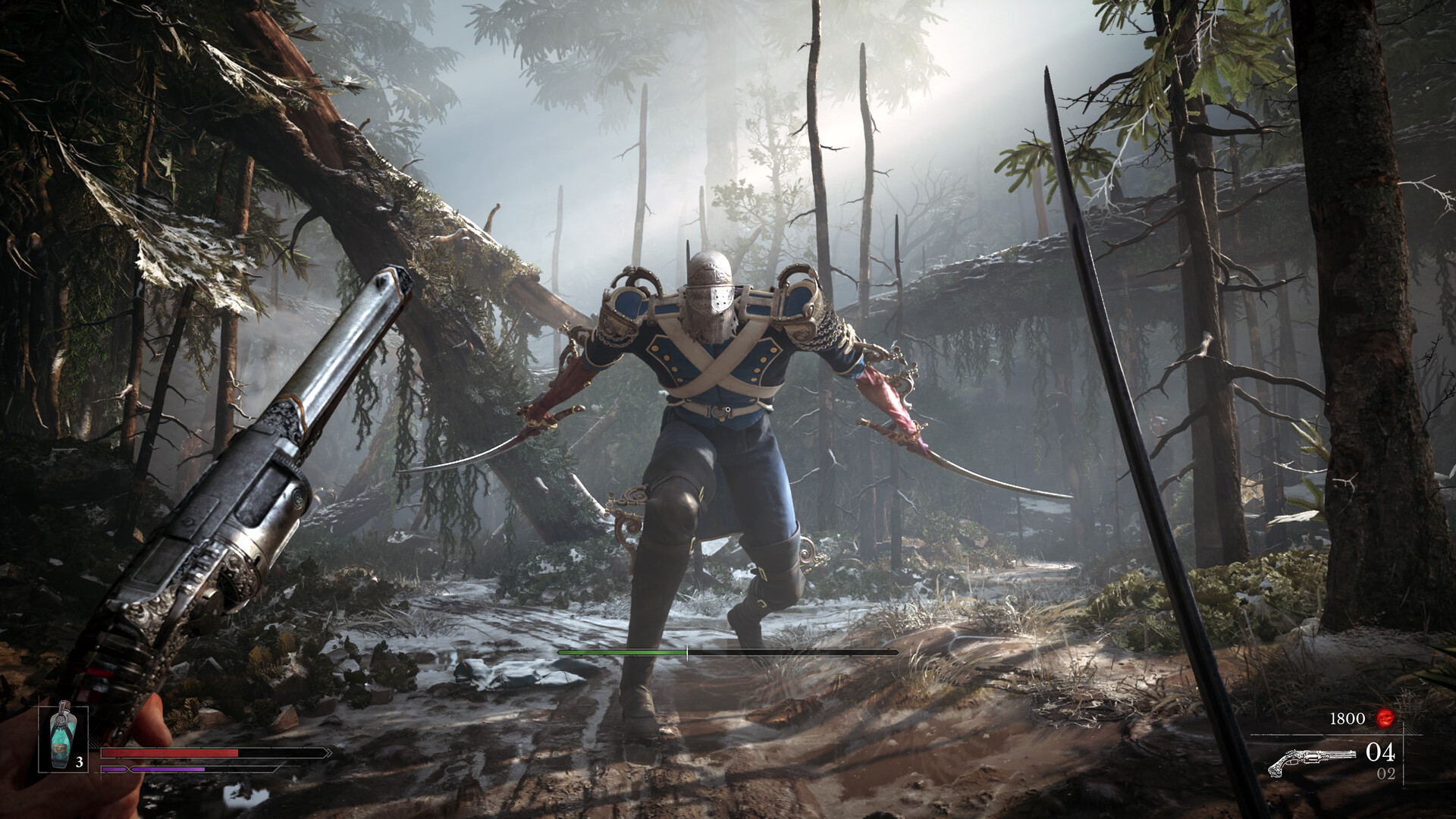
Storefront screenshots show the in-game display, which stays sparse and sits in the two bottom corners so the centre of the view is left clear.
Element | Where it sits and what it shows |
|---|---|
Healing flask | Bottom left. A flask icon with a number beside it for the charges you have left. |
Health bar | Bottom left, a red bar running to the right of the flask icon. |
Second bar | Bottom left, directly beneath health, drawn in violet. It tracks the supernatural side of the kit rather than health. |
Resource counter | Bottom right, a number next to a red emblem. It reads zero in one screenshot and 1800 in another, so it counts something you accumulate. |
Firearm ammunition | Bottom right, beneath the counter, a firearm icon with two figures, one larger than the other. |
Enemy health | A single bar across the lower middle of the screen for whichever enemy you are engaged with. |
There is no minimap, no compass, and no ability tray on screen, which fits the studio's stated aim of keeping the first-person view uncluttered.
Learning the Rhythm
Like other Soulslikes, the first hours are about learning to read enemy windups and answer them with the right defensive tool. Patient play, deliberate weapon swaps, and good resource discipline carry further than aggressive trades. See the Getting Started page for a wider introduction.
A Single Difficulty
Valor Mortis looks set to ship with one fixed difficulty. The strongest evidence is the developer-declared accessibility panel on the PC store listing, where selectable difficulty levels are declared as not present. No playable build has offered a difficulty selector or an easy mode, neither the October 2025 playtest nor the demo, and the studio has talked about keeping it that way while making the game fair and readable rather than gentler.
Treat that as the working expectation rather than a locked commitment until the shipped game settles it. On the assumption that you cannot lower the challenge from a menu, progress comes from learning enemy patterns, managing stamina, and leaning on parries and weak-point pressure. The Difficulty and Accessibility page collects what has been declared.
After the demo the studio named combat readability, the range of hitboxes, and how enemies stagger as the three combat areas it was still working on, alongside a smoother difficulty curve across boss fights. Expect the specifics on this page to shift as that work lands before release.
What Is Still Open
As of September 13, 2026, across the official store listing, the official site, the studio’s Steam development posts, the published trailers and every hands-on account of a playable build, no numbers exist for any part of combat: no stamina values, no damage figures, no posture thresholds, no parry-window length. The number of slots in the weapon selector has never been published. How a backstab is performed has never been described, and the studio has not said whether the target lock changes it was working on after the October 2025 playtest shipped in the form it described. Combat readability, hitbox range and enemy stagger were all still named as open work items in August 2026, so behaviour recorded from the demo may not match the shipped game.
Late preview and camera readability
On September 17, 2026, the studio confirmed dynamic field-of-view scaling for encounters with huge bosses, intended to make them easier to read. This is distinct from the adjustable field-of-view slider introduced before the 2025 playtest.
A September preview build includes a perfect-dodge mechanic for attacks that cannot be parried. That report does not establish an invulnerability-window length or replace the older demo's spacing-based dash description. Two-handed claymore and musket options also broaden the one-handed loadout described above.