
Loading...
Loading...
Turn-Based Combat
August 27, 2026 at 01:08 AM
Added action point interleaving, the hover to-hit preview, per-battle utility refresh, autosave timing and environmental kills
Combat in STAR WARS Zero Company is turn-based and shown from an isometric, top-down camera. You control a squad of operators, moving and acting one character at a time, then handing the turn to the enemy. The goal of every encounter is to outmaneuver foes rather than simply outgun them. Your whole squad acts first, then the enemy takes its turn.
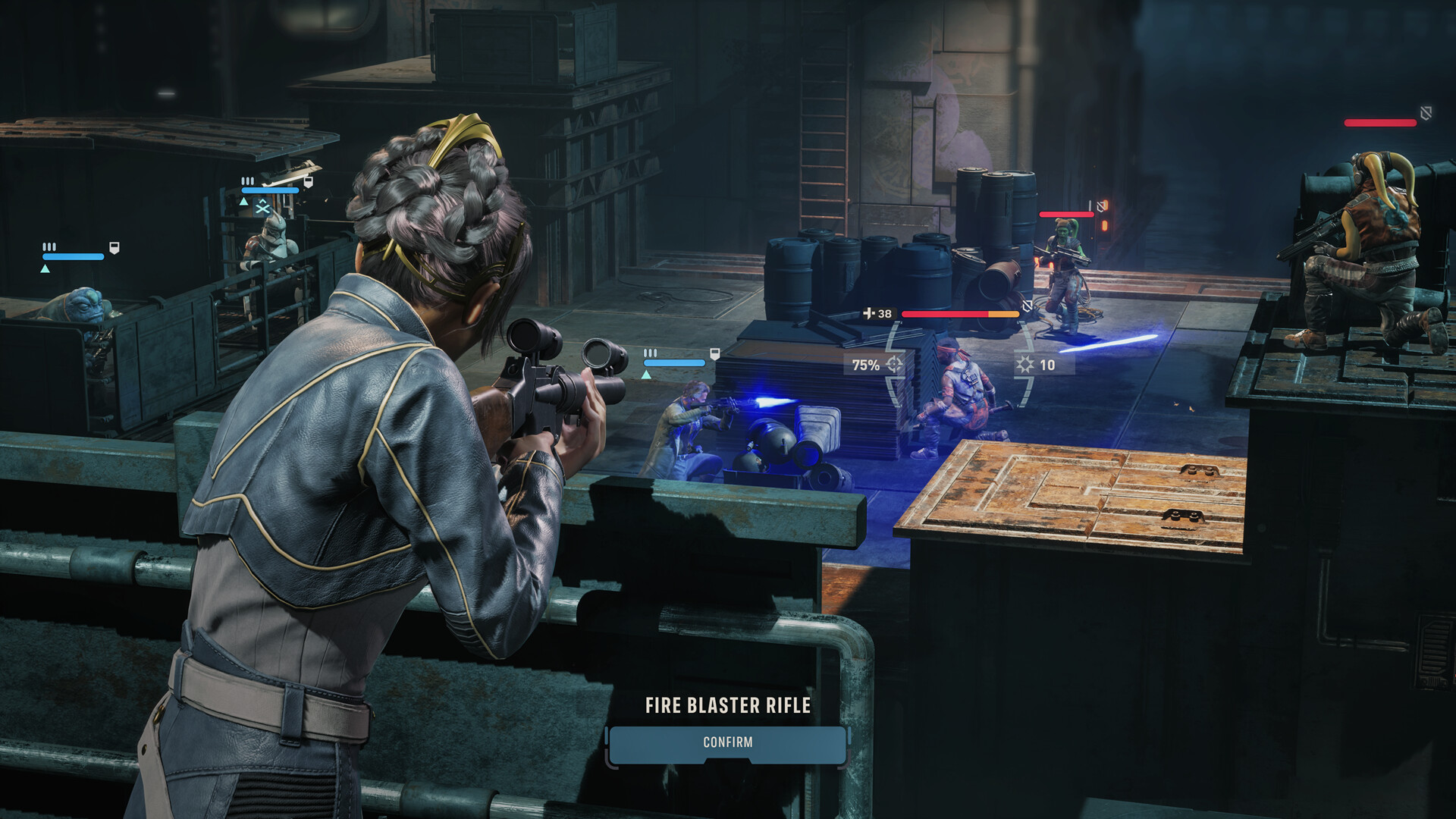
On a character's turn you spend Action Points to move, attack, or trigger abilities, with three points available each turn. Actions can be taken in any order. Positioning matters as much as firepower: you use Cover and Positioning to stay alive, flank enemies to strip their defenses, and control space so the enemy cannot get clean shots. A Chance-to-Hit value sits next to each target, shaped by range and cover, with a Shot Breakdown panel that spells out the details.
Confirming a shot puts those numbers on screen together: the prompt names the weapon being fired and shows the hit chance as a percentage alongside the damage the shot would deal and the health the target has left.
Actions do not have to be spent character by character. You can interleave individual Action Points between Operators, moving one, acting with another, then returning to the first, which the enemy AI does not do. Hovering a prospective destination previews the new hit percentages above every enemy from that spot, so a move can be judged before it is committed.
Action | What It Does |
|---|---|
Move | Reposition the Operator; the AP cost rises with the distance traveled |
Attack | Fire on an enemy in range and line of sight; AP cost varies by weapon type, and some shots use all remaining AP |
Overwatch | Set a firing cone that triggers when an enemy moves through or acts inside it; can interrupt enemy movement, but ends the Operator's turn |
Utility | Use an item such as a Medpac or Concussion Grenade, usually for one AP |
Ability | Activate a Specialization ability to buff the squad, expose a target, or strike |
Call for Backup | Costs no AP; one random Operator picks a teammate to add firepower to its next attack |
Utility items such as grenades and health packs refresh at the start of every battle, including each battle in a sequence that makes up one larger story mission, so holding them back across a mission wastes them. The game autosaves on the first round of a fight, which means a disastrous opening can be restarted; the next autosave before that one sits at the start of the cycle.
Beyond Action Points, the squad shares a resource called advantage. It builds up as you land attacks and is spent on powerful abilities without costing AP. Examples include granting an ally an extra AP, calling in a devastating rocket strike, briefly raising the whole squad's Chance-to-Hit, or taunting enemies into attacking a single Operator. Because advantage is shared, you decide which character spends it and when. The pool tops out at a maximum of 10 advantage at a time, so you cannot stockpile it indefinitely.
When an Operator loses all health it is Downed and takes an Injury. A Downed Operator cannot act but can be Rallied by an ally. Injuries hurt combat stats and stack: a third Injury means permanent death on standard difficulty. A reliable combination is to knock an enemy out of cover with Tel-Rea's Force Push or Kabb's Uppercut, then catch it in a waiting Overwatch.
Levels are built by hand, but enemy placement is procedurally arranged, so a mission is not memorized after one attempt. Combined with permadeath, that keeps each fight tense: a careless move can cost an Operator for good, and on the harder difficulties there is no reloading it away.
Star Wars Zero Company also drops one convention of the genre: there is no fog of war, so the whole enemy force is visible from the start of a fight. With no hidden foes waiting to appear and Overwatch limited to a set cone rather than every direction, the slow wait-and-watch approach common to tactics games is far less rewarding. The design pushes you to advance and take ground instead.
The arenas are heavily destructible, and many of them are built over bottomless drops or ringed by flimsy catwalk railings. Anything that shoves an enemy, a concussion grenade, a Force push, or Kabb's uppercut, can turn that geometry into an instant kill.
Bit Reactor has singled out a set of plays that show what the systems allow once they are combined:
Force pushing or pulling an enemy out of position and into a waiting Overwatch cone.
Bull-rushing an enemy into a turbolift shaft, off a cliff, or into water for an instant kill.
Stacking several Overwatch cones over a reinforcement area before the enemy arrives.
Chaining kills with a Gunslinger, who regains Action Points on a kill and can extend a turn well past its normal length.
Calling for backup so that several bonded Operators fire on one target in a single action.
Clearing an enemy's cover outright with a rocket launcher or an explosive.
Loading an astromech with firebombs, thermal detonators, and droid poppers and using the droid as a weapon.
Sending a droid to scan the map and reveal a cloaked target.
Taking the high ground.
There are no support call-ins and no early exfiltration. Nothing lets you trade an objective for a safe exit, and if Hawks falls the mission fails outright and restarts. Weather is decorative: rain, dust, and the rest never touch visibility or efficiency.
Range is not the same as vision, either. A Sharpshooter can outrange a target it still has no line to, so a squad built entirely from snipers tends to post a lower kill rate than its stat sheet suggests. The design team treats an all-sniper squad as viable but not free.
