
Loading...
Loading...
Operations and Tactical Missions
September 9, 2026 at 09:41 AM
Removed a duplicated block, settled the world-count phrasing, and added a section on mission types being a non-exhaustive list
STAR WARS Zero Company runs on two kinds of deployment. Operations resolve on the galaxy map without a fight, while Tactical Missions send the squad down to a built environment for turn-based combat. Both are chosen at the holotable in the Den, and a campaign cycle is built around them.
Each cycle offers a slate of Operations and Tactical Missions. Offers do not sit there forever: they expire, and story-critical missions become obligatory once enough time has passed. A cycle closes when you pick a Tactical Mission and deploy, which moves the clock forward and refreshes what is on the board.
Operations take place on the galaxy map and cost Intel to run. They can pay out instantly, push the narrative along, or open up further operations and missions. Some present a dilemma and ask you to choose, in the manner of a written adventure, and the choice can move character bonds and open side missions rather than only handing over loot.
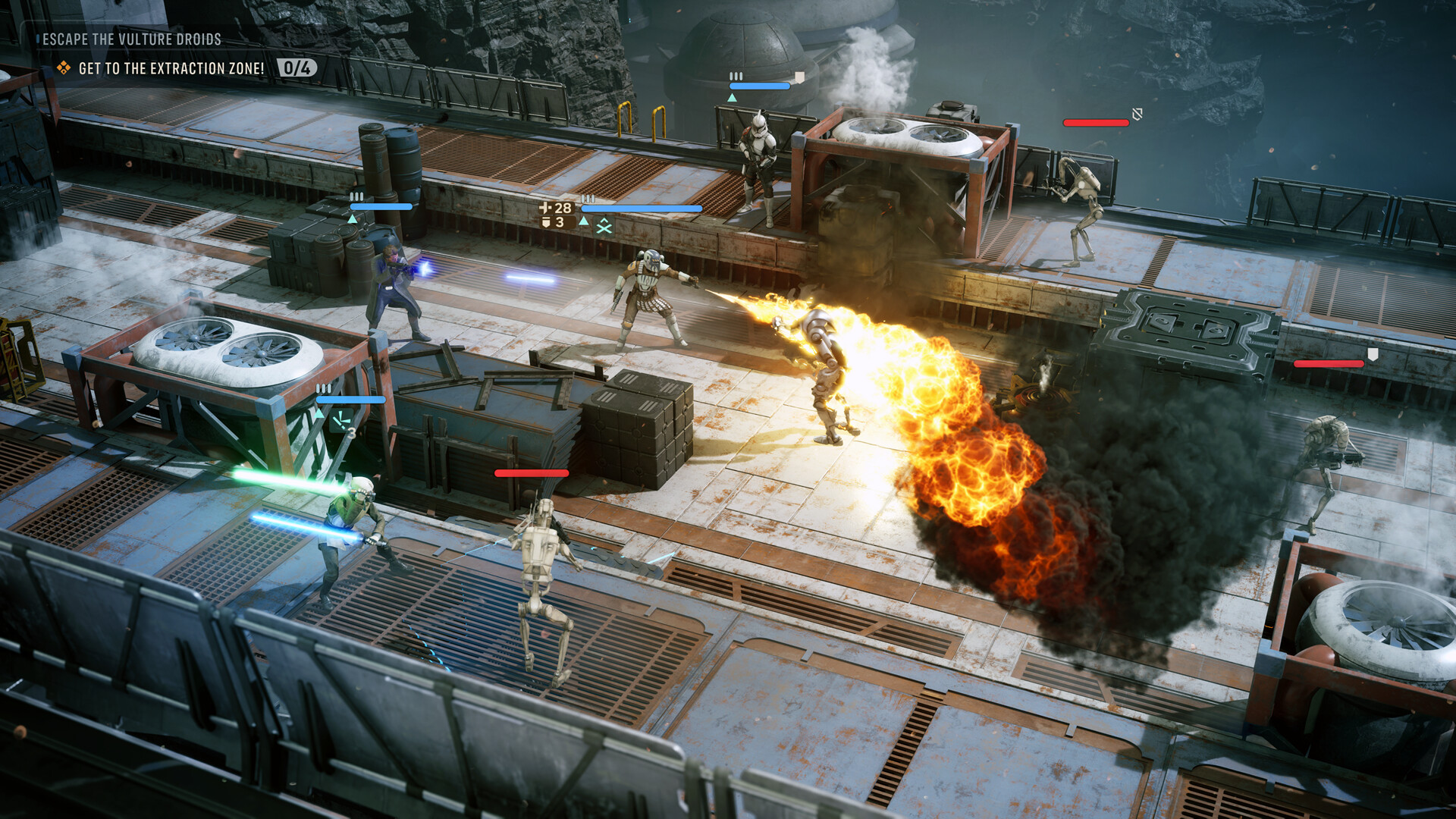
Tactical Missions are the tactical layer proper. You pick a squad, deploy, and complete an objective. Story missions open with a short free-roam phase in third person, where you move through the environment before the shooting starts. That segment is where Zero Company does its espionage, and it can hand you extra Intel and Advantage Points to carry into the encounter.
The free-roam phase is more than a walk to the fight. Some areas open up as places to move through and question, picking up clues and information from the environment and from the people in it, and particular conversations and investigations put a binary choice in front of you.
Extraction missions end the moment the whole squad is inside the zone, with no turn to hold once everyone is there, and fresh enemies keep arriving until that happens. Picking a mission also moves the story on, so the order jobs are taken in is itself a decision rather than a queue.
Bit Reactor describes the mission types as a general set rather than a closed list, so more may exist than have been named. The shipped guidance names five.
Mission Type | What It Asks Of You |
|---|---|
Sabotage | Plant explosives on objectives, then evacuate |
Combat | Named among the mission types without a published description; in practice, clearing the enemy force in an area |
Rescue | Hostage situations |
Retrieval | Named among the mission types without a published description; recovering an object or asset from the map |
Narrative | A unique story centred on a single hero |
Those five labels do not cover every objective the game sets. Earlier official material also described eliminating a high-value target, holding ground over a supply run, and getting the squad out on an extraction, and hands-on accounts of the finished game describe rescuing a hostage from the far side of a map, holding one control point, holding several at once, and simply clearing every enemy in the area. Treat those as objective shapes that turn up inside missions rather than as separate named types.
The spread matters tactically. Setting an overwatch line and waiting works when you are defending a point on a supply run, and works badly on a sabotage, rescue, or extraction mission where the objective forces you to move.
The map covers more than 150 planets where Operations can potentially take place, many of them resolved through war-table choices rather than combat. Tactical Missions are far more selective. Bit Reactor's own wording, unchanged through launch, is "over a dozen unique planets" built as full environments, each developed with the Lucasfilm Games team, and it has never published an exact number. A July 2026 reveal graphic named eleven of them and official posts name Bespin separately, so the graphic was not the complete set. Planets and Locations lists every world named in official material alongside the split between the two layers.
The holotable itself splits into three tabs: Influence, Operations, and Missions. Every mission card carries its own difficulty rating and an expiry counter, so the clock on an offer is visible before you commit to it.
Cards also spell out the stakes on both sides. One shown in official material is flagged as a Crisis Mission at Dangerous difficulty; it names the enemy upgrade the mission would prevent, and lists its rewards as destroying an active Coil upgrade, a gain to Den Level, and a payment of Intel.
Because Intel is finite and offers expire, a cycle is a budgeting problem as much as a tactical one. Every Operation costs a different amount, so the practical advice from the design team is to spend according to the playstyle you are building toward rather than trying to clear the board.
Official material lists five general mission types: Sabotage, Combat, Rescue, Retrieval, and narrative missions built around a single character. It is worth reading that list as a sample rather than a taxonomy, because the wording that introduces it is "some general mission types include", and the same documents name further shapes of work elsewhere, including supply runs and extractions that require an escape. Treating five as the complete set overstates what has been published.
Missions also carry a difficulty rating of Risky, Dangerous or Extreme, and a separate Critical flag marks the ones that advance the story. Those are independent of the type. See Difficulty Settings for how mission ratings relate to the campaign tier.
