

Weapons
Weapons in SOL Shogunate are multiple types with distinct fighting styles, built from classical arms reengineered for off-world warfare. This page covers the katana, elemental infusion, the reach of the kit, and how kinetic weapons sit inside a setting that regulates them.
On This Page
Weapons are the core of the combat identity in SOL Shogunate. Chaos Manufacturing has confirmed that the player chooses from multiple weapon types, each with its own fighting style, and that the arsenal is built from classical weapons reengineered for off-world warfare rather than from conventional firearms. Beyond the katana, no individual weapon has been named, and no roster, damage model, or per-weapon statistics have been published.
Quick Reference
Field | Confirmed Detail |
|---|---|
Weapon Types | Multiple types, each with its own fighting style. The exact number has not been published. |
Signature Arm | The katana, described as one signature weapon among several. |
Design Language | Classical weapons reengineered for off-world warfare. |
Reach | The weapon set covers fighting both at a distance and up close. |
Elemental Infusion | Weapons accept elemental properties. Electricity is the one confirmed example. |
Kinetic Weapons | Present in the setting. Their use is described as limited and regulated. |
Combat Tools | The thrust pack and the nano-fiber grapple are treated as part of the fighting kit. |
Named Weapons | None beyond the katana. |
Weapon Types and Fighting Styles
The studio's own feature copy frames the arsenal as a choice: multiple weapon types, each with unique fighting styles and deadly capabilities. That framing matters more than it first sounds, because it sets weapons up as a swap layer rather than as a single escalating upgrade path. Encounters are built around groups of enemies rather than duels, and the combat foundation the studio describes is movement, resource management, and combos rather than slow attrition. Choosing the right weapon for the shape of the fight in front of Yuzuki is part of that loop.
How many types ship, what they are called, and how they differ mechanically are all undisclosed. Any list of specific weapons circulating ahead of launch is not coming from the studio.
The Katana
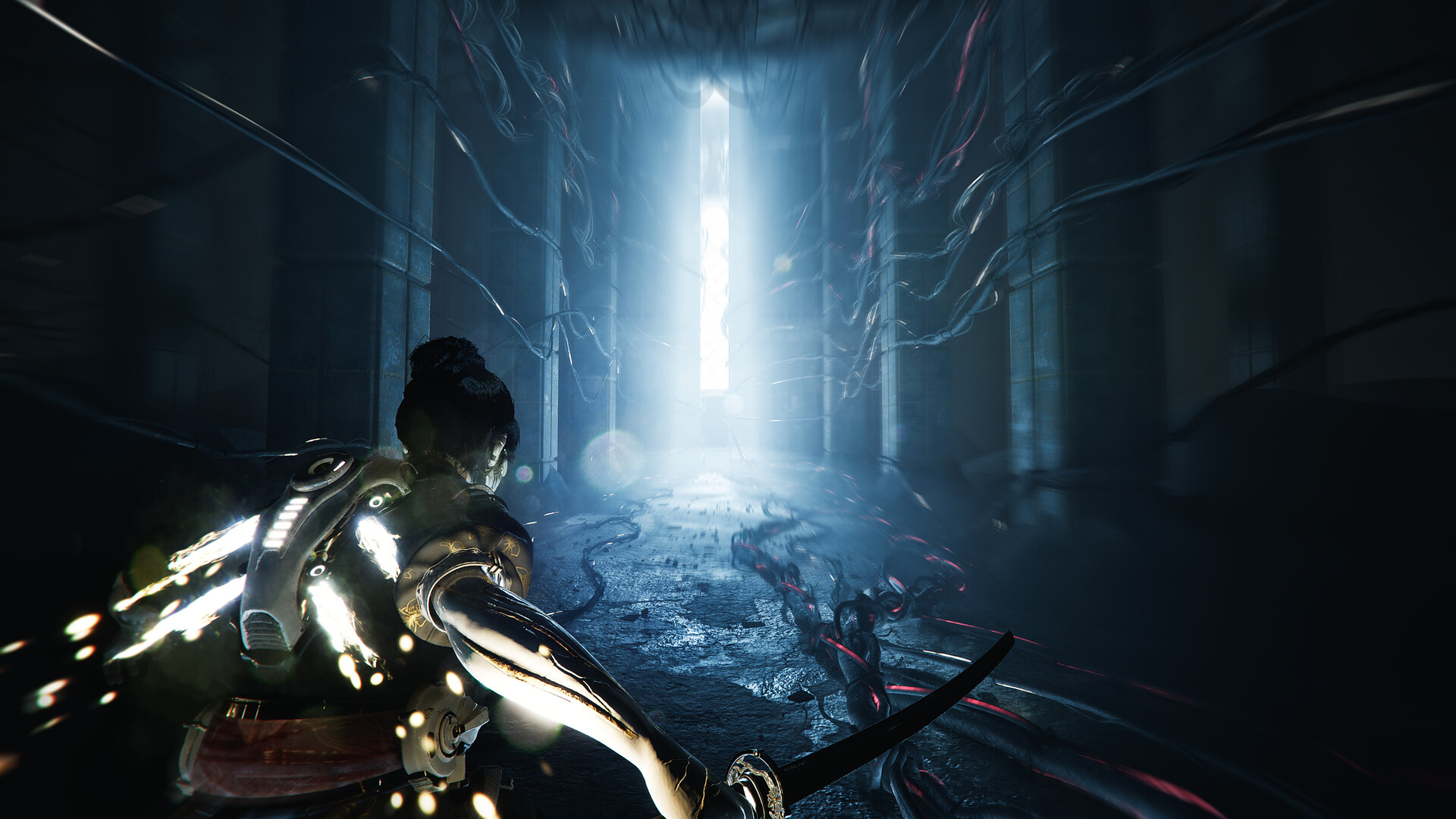
The katana is the signature blade and the arm most closely tied to the protagonist in the reveal material. It is explicitly not the only option. Every description the studio has given places the katana as one signature weapon among several classically designed arms, and the point of the weapon layer is that the player is expected to move off it when an encounter calls for something else.
In-world, the sword carries legal weight as well as mechanical weight. The way of the sword is law under the SOL Shogunate, and bladed combat is codified as the legitimate way to settle a dispute.
Reach: Ranged and Close Quarters
The weapon set is not purely melee. The studio's own feature copy describes the weapon types as covering enemies both at a distance and up close, so the kit reaches further than sword range. The game director has also noted that the upgrade system can unlock certain abilities that work at a distance, though those read as extensions of a melee kit rather than as a separate firearm loadout.
Yuzuki's grappling hooks are positioned as a way to close distance into a melee exchange rather than as a way to fight from afar. Every weapon the studio has described so far stays inside the samurai fantasy.
Kinetic Weapons in the Setting
Kinetic weapons exist in this world. That point has been made explicitly and should not be read as absence. The game director has put the position on record: firing them in space or on the Moon is dangerous for everyone involved, so their use is limited and regulated rather than impossible.
The studio's CEO has given the in-world rationale separately. The society in charge would likely choose to outlaw kinetic weaponry on the Moon, which supports the conceit that conflict is properly settled through more traditional fighting styles. The result is a setting where the blade carries the combat load by law and by design, not one where firearms were never invented or have quietly vanished.
The second half of the rationale is biological. Samurai here carry genetic enhancements that push them well beyond ordinary human limits, which is what keeps a sword competitive against a gun rather than merely traditional. That layer is covered on the Augmentation page.
Elemental Infusion
Weapons accept elemental properties, turning a baseline blade into an energy-charged instrument tuned for a particular kind of foe. Electricity is the publicly confirmed example. The full palette has not been disclosed, so any longer list would be speculation.
Infusions are interchangeable on the same weapon rather than separate weapon classes, which is what makes mid-fight adaptation possible. Active abilities work in the same vocabulary, so a loadout pairs an infused weapon with abilities that lean into the same energy. The elemental-weakness reading that drives all of this is covered on the Vulnerability Matrix page.
Mobility Gear as Weapons
Two pieces of the movement kit are treated as combat tools rather than as traversal that stops working once a fight starts. The game director has described the thrust pack and the grappling hooks as an integral part of the combat repertoire, and the studio is aiming to make fighting while hovering in the air as important as fighting with both feet on the ground.
Tool | Combat Role |
|---|---|
Thrust Pack | Sustains aerial fighting, which the studio is aiming to make as important as ground combat. |
Nano-Fiber Grapple | Closes distance into a melee exchange and repositions the player mid-encounter. |
Gravity-Assist Gear | Not a strike, but it shapes an exchange: it allows lunar gravity to be cheated on the move, falls to be slowed, and momentum to be recovered in ways opponents cannot match. |
The jet pack, the same grapple, and the mounts that cover long surface distances are set out on the Robotic Horse page as a traversal kit; this page covers the half of that kit the studio has placed inside combat.
Adaptable Loadouts
The through-line in how the studio talks about the kit is adaptability. Weapons swap, elemental infusions change, and gene-splice upgrades rotate as the campaign progresses. Before an encounter the player configures which of those are active; during one, the read on the enemy decides which of them should be. A progression tree split across offensive, defensive, and quality-of-life branches sits behind the arrangement, though its structure has not been detailed.
Parrying is in the game but deliberately not load-bearing. Two of the studio's leads have said independently that parry timing matters far less here than in games built entirely around it, so weapon choice, positioning, and target selection carry the skill test instead.
Unconfirmed Details
Several parts of the weapon layer have not been published and should not be assumed:
The number of weapon types, their names, and how they differ mechanically.
Any damage values, scaling, durability, or per-weapon statistics.
Whether weapons are found, crafted, bought, or awarded, and whether each upgrades individually.
The full elemental palette beyond electricity, and whether infusions can stack on one weapon.
Which ranged abilities the upgrade system unlocks, and what limits they carry.
Whether any kinetic weapon is usable by the player, and under what in-world conditions.
How weapon swapping is handled at the input level, including whether it is instant or staged.
This page will be updated as the studio details the arsenal.