Overview
Street Racing is a competitive side activity in Neverness to Everness where players race vehicles through the streets of Hethereau. Races can be run against NPCs at designated locations around the city or against other players in multiplayer lobbies. The activity blends arcade-style driving with meaningful progression: winning races earns Fons, the city's primary currency, and can unlock vehicle parts and cosmetic items. Street racing sits alongside fishing, mahjong, taxi driving, and part-time jobs as one of many recreational activities woven into Hethereau's daily life, offering a change of pace from combat and exploration while still providing tangible progression rewards.
How Racing Works
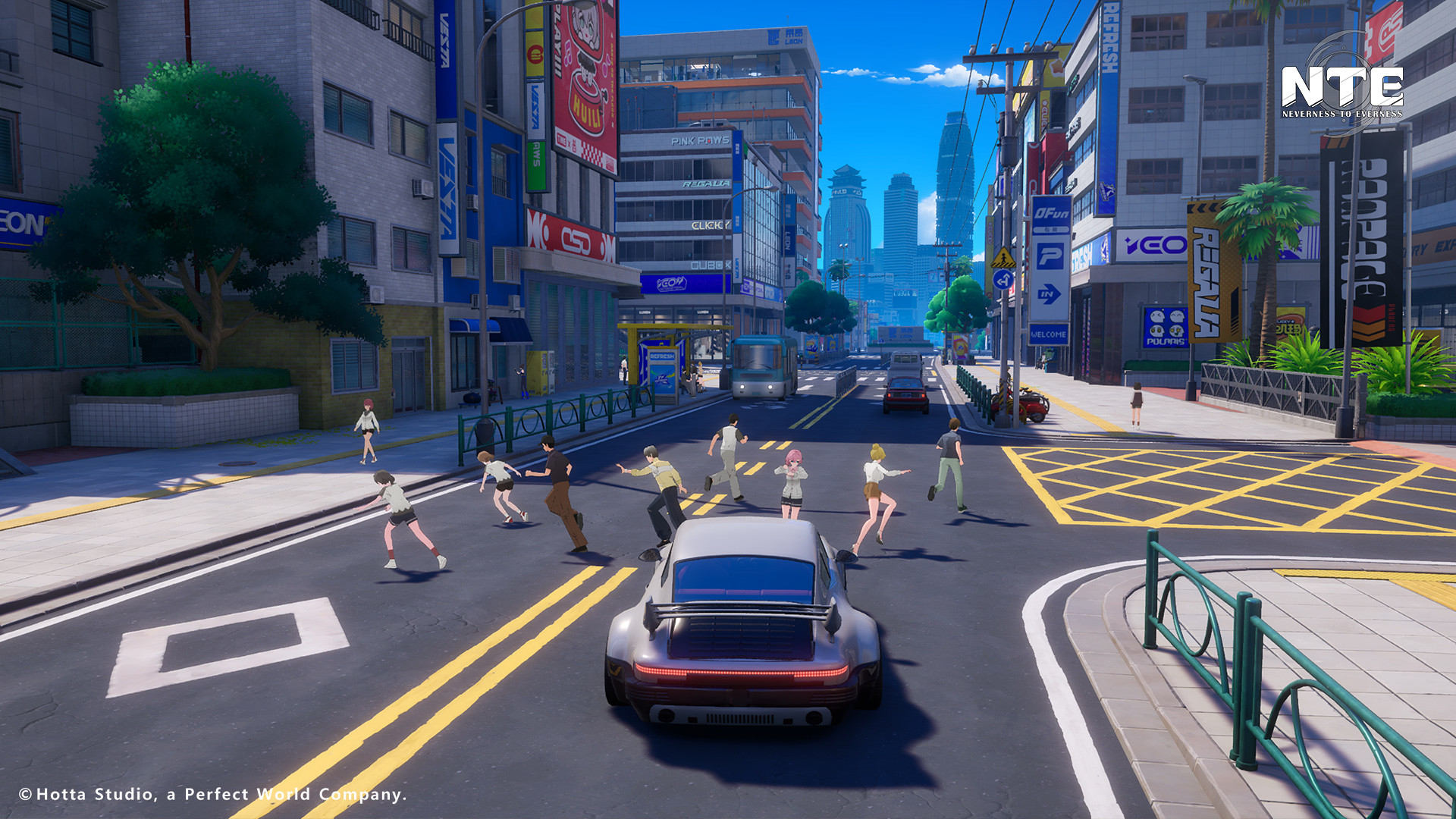
Races take place on the road network of Hethereau, weaving through the city's neighborhoods and districts. The urban layout provides natural variety in race routes, with tight turns through downtown alleys, longer straightaways along the waterfront, and winding paths through residential zones. Players select a vehicle from their personal garage, line up at a starting point, and compete to finish the course in the fastest time.

NPC races are available at fixed locations scattered across the city. These act as introductory challenges and a consistent source of Fons income. NPC opponents follow predictable racing lines and rarely take risks, making them useful for practice and learning new routes. Multiplayer races, by contrast, pit players against human opponents who adapt their lines, take shortcuts, and apply pressure in ways that AI drivers do not.
Racing locations unlock progressively through the City Tycoon system. As players level up their City Tycoon rank, new race starting points and more challenging NPC opponents become available across different districts of Hethereau.
Camera Perspectives
Players can drive in either first-person or third-person view. First-person mode places the camera inside the vehicle cabin, giving a closer sense of speed and immersion. Third-person mode pulls the camera behind and above the vehicle, making it easier to judge turns and see surrounding traffic. Both perspectives are fully available during races, and players can switch between them at any time based on personal preference and the demands of a given course.
Vehicle Types and Handling
Different vehicle categories handle in distinct ways, and choosing the right type for a given course can make a significant difference. The game has a high-fidelity physics engine that models acceleration, braking, weight distribution, and tire grip. Vehicles are susceptible to realistic damage: tires can pop, bodywork takes knockback from collisions, and severe impacts can cause a vehicle to explode entirely. This means reckless driving carries real consequences, especially in tight street sections where walls and obstacles are everywhere.
Vehicle Type | Strengths | Weaknesses | Best For |
|---|---|---|---|
Sedans | Balanced handling and predictable cornering | Moderate top speed, no standout stat | Mixed routes with varied turns and straights |
Muscle Cars | High raw power and strong acceleration | Heavier weight makes tight turns difficult | Routes with long open sections |
Supercars | Highest top speed and responsive steering | Fragile at high speed; crashes are costly | Courses with extended straightaways |
Retro Scooters | Nimble, forgiving on sharp turns | Lowest top speed of any category | Tight urban routes with many corners |
Sport Motorbikes | Fast acceleration and compact turning radius | Requires precise control; easy to wipe out | Technical courses demanding quick reflexes |
Drifting is a core driving mechanic that plays a major role in competitive racing. Initiating a drift lets players carry speed through corners instead of braking hard, but it demands timing and practice. Overcommitting to a drift on a narrow street can send the vehicle into a wall, costing valuable seconds.
Vehicle Customization for Racing
Players who invest in vehicle customization can fine-tune their ride for competitive performance. Customization covers both visual and mechanical changes. On the cosmetic side, players can repaint their vehicle, swap tires and rims, change bumpers, and apply decals. On the performance side, engine upgrades, suspension tuning, and brake improvements directly affect handling, acceleration, and top speed in races.
A vehicle tuned for racing performance carries those upgrades into every race it enters. This gives dedicated racers an advantage over stock vehicles, though driver skill and course knowledge remain the most important factors. The full vehicle list shows all available models along with their base stats, which can serve as a starting point when deciding which vehicle to invest in.
Multiplayer and Crew Racing
Racing supports full cross-platform play, allowing a PC player to challenge someone on PS5 or mobile without restrictions. Multiplayer races add an unpredictable element since human opponents adapt their racing lines, take risks, and apply defensive positioning that NPC drivers never attempt.
Players can also team up with friends and race against street crews in different city districts. Crew-based racing encourages coordinated play: members of a crew can share tuning knowledge, practice routes together, and compete as a unit in ranked events. Multiplayer crews and ranked racing promise to reward reflexes and vehicle tuning knowledge, keeping the competitive scene focused on driving skill.
Friends invited to your world through the co-op mode can join races directly, making it easy to organize impromptu competitions without leaving the open-world session.
Weather and Road Conditions
Hethereau's dynamic weather system directly affects driving physics during races. Rain makes road surfaces slippery, reducing tire grip and increasing braking distances. Wet conditions require drivers to slow down earlier for turns and avoid aggressive drifting that would be safe on dry pavement. Snow and ice are even more punishing, significantly decreasing traction and making high-speed cornering risky.
Weather can change mid-race, so a course that starts under clear skies may transition to rain partway through. Skilled drivers adapt their approach on the fly, shifting from aggressive cornering to cautious braking as conditions deteriorate. Night racing adds a visibility challenge: reduced sightlines make it harder to anticipate turns, especially on unfamiliar routes.
Wanted System Interactions
Reckless driving during races or while traveling through Hethereau can raise the player's wanted level through the crime and wanted system. Crashing into civilian vehicles, destroying property, or borrowing cars without permission triggers a law enforcement response. Each wanted level introduces more aggressive police AI behavior, escalating from simple patrol units to coordinated pursuit teams.
Getting caught results in being sent to a detention center. From there, players can pay a fine in Fons, perform community work to reduce their sentence, or attempt to escape. While the wanted system does not activate during organized race events, free-roaming at high speeds between races can easily attract unwanted attention.
Rewards
Winning races earns Fons, the city currency used for purchasing vehicles, customization parts, housing furniture, and other goods throughout Hethereau. Racing rewards are governed by City Stamina, a weekly resource that caps how many Fons a player can earn from non-combat activities. Once City Stamina is depleted for the week, players can still participate in races for fun and practice, but Fons payouts stop until the weekly reset.
Racing also contributes to City Tycoon progression. Completing races fills City Tycoon experience, unlocking new features like garage expansions, additional race starting points, and higher-tier investment opportunities. As a result, consistent racing is one of the more efficient ways to advance the City Tycoon track while simultaneously earning spendable income.
Tips and Strategies
Learn the routes before competing. Drive race courses casually before entering timed events. Familiarity with turn angles, shortcut opportunities, and obstacle placements gives a significant edge.
Match your vehicle to the course. Use nimble scooters or motorbikes for tight urban circuits and save supercars for routes with long open stretches.
Master drifting. A well-timed drift carries speed through corners and shaves seconds off lap times. Practice on dry roads first, then work on wet-weather drifts.
Invest in performance upgrades. Engine and suspension improvements from the vehicle customization shop translate directly into better race times.
Watch the weather forecast. If rain or snow is expected, consider switching to a vehicle with better traction rather than chasing raw top speed.
Manage City Stamina wisely. Spread racing across the week alongside other part-time jobs to maximize total Fons earned before the weekly cap.
Avoid reckless driving between races. Collisions in the open world raise your wanted level. Keep a clean driving record to avoid costly fines and detention.
Driving Physics Overhaul
Street Racing uses the same overhauled driving model that the current beta ships across the rest of Hethereau's road network. In the previous beta, cars pivoted around their middle point, which made every turn feel floaty and disconnected from the actual wheelbase. The current build replaces that with a more believable handling model: the front tires lead the turn, the rear follows through the arc, and weight shifts forward under heavy braking. The result is that race courses reward clean racing lines and considered braking instead of simply mashing the steering input through a corner.
This shift also changes how drifting feels. Because the car now rotates around a more natural pivot, a well-initiated drift carries momentum through a corner rather than sliding sideways as a single flat sweep. Players coming back from the prior beta should expect to spend the first few races relearning when to commit to a drift and when to scrub speed with the brakes instead. The full list of available cars and motorcycles is covered on the Vehicles page, including which models lean into grip versus which ones are built for aggressive drifting.
Input Feel (Keyboard vs Controller)
Racing is noticeably smoother with a controller than on keyboard and mouse. Steering on an analog stick gives a continuous range of angles, which matters a lot in the new physics model: small wheel adjustments mid-corner are easy to hold on a stick and awkward to modulate on keys, where the input is effectively binary. Braking pressure is similarly easier to meter on an analog trigger than on a single keyboard binding.
Drifting in particular benefits from controller input. Building and holding a drift at the intended slide angle is much harder with discrete keyboard taps, and it is easy to either overrotate or straighten the car too early. Keyboard and mouse are still fully playable, but players who plan to grind the competitive portion of racing or chase time-based extra objectives will generally post cleaner laps on a gamepad. Several of the faster unlockable cars, including the Enforcer, reward that precision the most because their top speed leaves very little margin for a correction once a corner is entered.
Weather and Tires
Hethereau's dynamic weather layer is tied directly into race handling. Rain slicks the road surface and drops available grip, so a vehicle that clings to the racing line on dry pavement can start understeering, oversteering, or outright spinning out in the same corner once the weather turns. High top-speed vehicles are the most punished by this because their cornering already demands careful load management at speed.
Tire upgrades from the customization shop are scoped to specific terrain and weather profiles, and they exist specifically to counter this. Slotting tires that match the expected conditions of a course, for example a wet-weather compound or a tire tuned for mixed urban surfaces, restores much of the grip that raw rain subtracts. Stock tires on a rainy course will spin out under aggressive throttle even with clean inputs, so the practical rule is to check the weather before committing to a race and swap tires when conditions do not match what is currently fitted.
Quick Weather and Tire Checklist
Dry, clear: default tires are fine; focus on line and braking markers.
Rain: expect reduced grip; either swap to wet-appropriate tires or back off the throttle earlier and avoid aggressive drifting.
Mixed or changing conditions: treat corners conservatively, since the surface may shift from dry to wet partway through the race.
Off-road or rough surfaces: fit tires tuned for that terrain before entering courses that leave paved roads.
Vehicle Skin Rewards via Gacha
Vehicle cosmetics, including race-friendly skins, can be earned through the character gacha without any additional Fons cost. The character pull uses a board-game layout: each roll advances your avatar along a path of tiles, and the outer path around the main board contains special reward tiles in addition to the central featured-character tiles. Outer-path tiles can refund dice rolls, grant character outfits, or award vehicle skins, so players who pull on active character banners end up accumulating cosmetic car paint and styling options as a side effect of normal gacha progression.
Because vehicle skins are almost entirely visual, they do not change lap times on their own. They do, however, let dedicated racers customize the look of whichever car they race most often, and they stack with any performance tuning already fitted to that vehicle in the garage. Players focused on racing specifically can simply treat gacha-awarded skins as a welcome bonus on top of the featured-character pulls they were already making, rather than a separate reward track to chase.
Racing also sits under the broader City Tycoon hobbies menu, grouped with other city-side activities. The complete hobby slate for the city and how the slate fits together is covered on the Hethereau Hobbies page, alongside the full Side Activities and Mini-Games index.
Racing in the Hobbies Lineup
Street Racing is one of several hobbies available from the City Tycoon menu. The others are Mahjong (a multiplayer tile game), Tetris (an arcade board-matching game), Super Sound (a rhythm mini-game), City Delivery (a truck delivery run), Owner Selection (a customer-serving mini-game), Swift Travel (the in-city taxi driver job), Pink Paws Heist, and Sea Angler (the fishing mini-game). Racing is unique among these in that it leans heavily on vehicle tuning and handling skill, so its progression curve looks very different from the more social or puzzle-driven hobbies on the same menu.
Related Pages
Vehicles: Overview of all vehicle types and acquisition methods.
Vehicle Customization: Cosmetic and performance modification options.
Vehicle List: Full database of available cars and motorcycles.
Side Activities and Mini-Games: The complete list of leisure activities in Hethereau.
City Tycoon: The progression system that unlocks racing locations and garage features.
Fons: Detailed breakdown of the city currency earned through racing.
Co-Op Mode: How to invite friends for multiplayer races.
Crime and Wanted System: How reckless driving triggers law enforcement responses.
Stamina System: How City Stamina limits weekly Fons rewards.
Stage and Course Structure
The Street Racing hobby at launch is organized into six stages, each of which contains six races for a total of thirty-six distinct courses in the base rotation. Every course ships with a set of extra objectives on top of simply finishing first. Clearing the basic win typically awards a partial reward, while completing the extra objectives (for example, finishing with a sizable lead over the second-place racer, or posting a time under a target benchmark) unlocks the full tier of rewards for that course.
Gating. Access to later stages is unlocked through a mix of tycoon-level progression and incremental completion of earlier stages. The first stage is typically available very early in the City Tycoon loop, while the final stages require a broader progression investment before they become selectable.
Launch-Day Racing Changes
The April 29, 2026 launch build of racing introduces three major upgrades over the Co-Ex Test version:
New maps. Additional racing courses are added to the rotation beyond the closed beta map pool, expanding the variety of environments and layouts the player can expect to encounter during matchmaking.
Matchmaking for online racing. Online races now use a dedicated matchmaker rather than relying purely on friend-only lobbies. This shortens queue times in off-peak hours and ensures a fuller grid of opponents during peak play windows.
Ranked online play. A ranked ladder is introduced, separating casual online races from competitive laddered ones. Ranked wins affect a visible leaderboard rating, giving racing a long-term progression hook beyond just the stage clear rewards. AI racers also fill empty slots when the matchmaker cannot find enough humans within the normal queue window.
Implications for players. Racing is no longer a purely single-player grind or a small-group friend activity; the launch version formally supports competitive multiplayer with matchmaking and ladder rewards. Players chasing maximum Fons per hour should still optimize for the extra objectives on each course first, but the ranked ladder provides an additional reward track for players who care about relative standing rather than just completion.
Version 1.3 Route Additions
Version 1.3 added the Challenge routes Night Raptor, Chapter Nova, First Sense and Silver Crown, alongside new Online tracks. The September 9 update added four Friends-mode tracks; players who had previously met their prerequisites had to complete the required clears again to unlock them.