

Economy and Dynamic Pricing
Complete guide to the economic system in Nivalis, covering neighborhood-based price fluctuations, AI-driven customer behavior, supply and demand, black-market energy trading, advertising, Achievement Points for unlocking areas, and the connection between relationships and business success.
On This Page
Economy and Dynamic Pricing

The economy in Nivalis is not static. Prices fluctuate based on neighborhood conditions, customer behavior shifts in response to environmental and social factors, and the choices you make about where to operate and who to align with ripple through your bottom line. The game treats its economy as a living system, one that rewards long-term planning and punishes complacency. Whether you are running a noodle bar or a nightclub, understanding how money flows through the city is the difference between scraping by and building an empire.
Neighborhood-Based Price Fluctuations
Prices in Nivalis are not uniform across the city. Different neighborhoods have different economic conditions, and these conditions change over time. The cost of ingredients in one district might be higher or lower than in another based on local supply and demand. The same goes for what customers are willing to pay for your dishes and drinks.
This means that where you set up your business matters enormously. A food stall in a low-income area might have cheap rent but fewer customers willing to pay premium prices. A restaurant in a wealthier district costs more to operate but attracts customers with deeper pockets. Watching how neighborhood conditions shift and positioning yourself accordingly is a core part of the economic game.
AI-Driven Customer Behavior
Customers in Nivalis do not just appear at random. Their behavior is driven by systems that respond to environmental conditions, time of day, your business's reputation, and broader city dynamics. By preparing tasty dishes or serving unique cocktails, you attract an increasing number of customers. This is reflected both in the number of visitors to your business and in the growing number of zeros in your account.
Over time, you do not just gain regular customers; you gain devoted friends who come back consistently and spread the word about your establishment. Customer loyalty builds organically through quality and consistency, and it creates a stable revenue base that protects you during slower periods.
Supply and Demand
The supply chain in Nivalis connects several gameplay systems. You can source ingredients by buying them from vendors, catching fish at the docks, or growing crops in your greenhouse. Each source has different costs, time investments, and availability. Vendor prices fluctuate based on supply, so stocking up when prices are low and riding out expensive periods is a viable strategy.
On the demand side, what you serve and when you serve it affects how much money you make. Certain dishes or drinks may be more popular at specific times of day or in specific weather conditions. A hot bowl of noodles might sell better on a cold, snowy day than on a warm afternoon. Learning these patterns and adjusting your menu and prep schedule is part of the economic puzzle.
Factors That Influence Prices
Many overlapping inputs feed into how much you pay for ingredients and how much customers will pay for what you sell. The table below collects the main ones that show up in the moment-to-moment economic loop.
Factor | Effect on Prices |
|---|---|
Neighborhood Income Level | Lower-income districts see cheaper ingredients and rent but lower ceilings on what customers will pay. Wealthier districts cost more to operate but tolerate premium pricing. |
Local Supply | Vendor stocks fluctuate. When local supply is high, ingredient prices fall. When supply tightens, prices spike. Smart buyers stock up during low-price windows. |
Customer Demand | What customers want at the moment depends on time of day, weather, and broader city dynamics. Hot dishes sell better in cold weather; cocktails sell better after work hours. |
Business Reputation | Quality and consistency build a loyal customer base over time. Loyal customers stabilize revenue and let you charge slightly more without losing traffic. |
Weather | Rain, snow, and storms shift customer behavior and energy demand. Cold weather pushes energy prices up; warm weather softens them. |
Vendor Relationships | Repeat business with the same vendor improves their pricing toward you over time. A reliable customer earns better wholesale rates than a one-off buyer. |
Advertising and Reputation | A glowing skyscraper ad drives heavy traffic but costs serious credits. Word-of-mouth from well-placed friends in the city is a cheaper alternative that still moves the needle. |
Faction Alignment | Your standing with CorpSec, underground syndicates, and grassroots groups affects what deals you can access and what areas tolerate your business. Some prime locations are gated behind faction trust. |
Vendor relationships are part of the economic system, not separate from it. Buying repeatedly from the same vendor builds a working relationship that gradually improves the prices that vendor charges you. A reliable customer is worth more to a vendor than a stranger, and the game reflects that in the credits column. This applies whether you are sourcing fresh fish from a dock supplier, produce from a market stall, or imported goods from a specialty seller. Spreading your purchases too thin across many vendors means you never build that working rapport with any one of them, which can leave you paying full retail every time.
How a Vendor Price Is Built Up
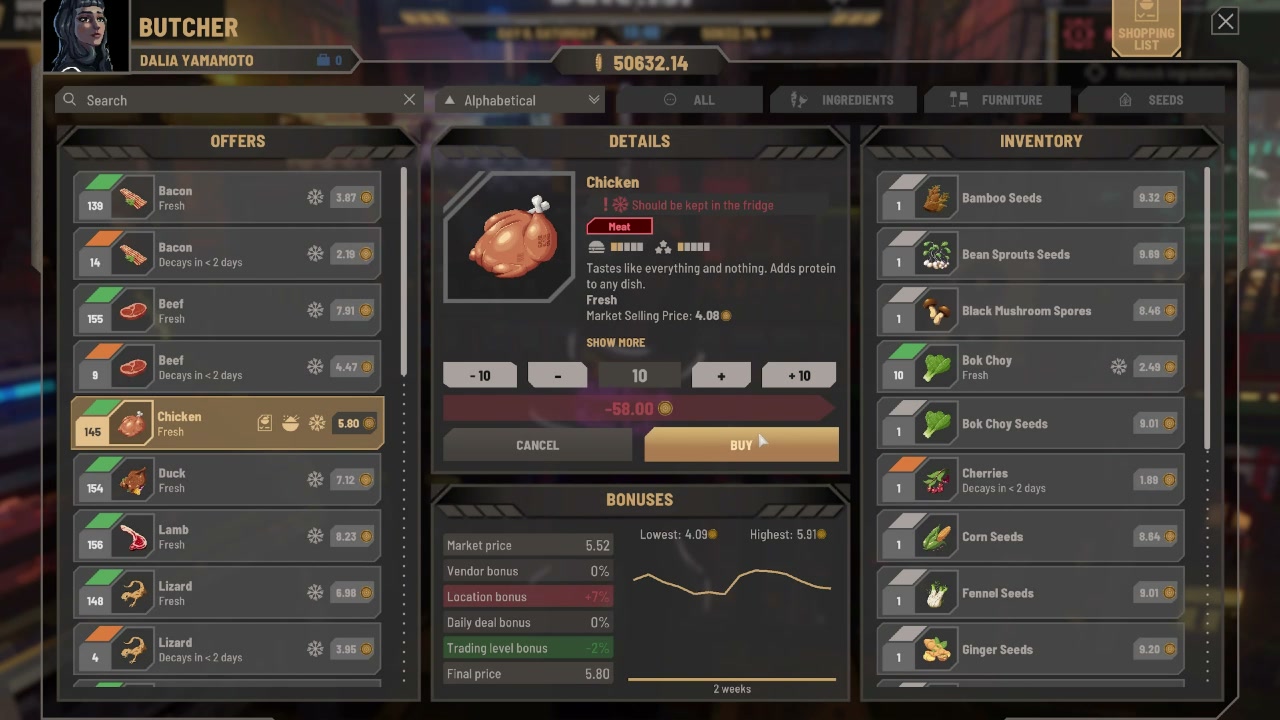
The shop screen does not just show a price, it shows the arithmetic behind it. Buying from a vendor opens a three-panel window: the vendor's current offers on the left, a detail card for the highlighted item in the middle, and your own inventory on the right. Stock is filtered by tab into ingredients, furniture, and seeds, so a single vendor can serve several different parts of your operation. Underneath the detail card, a bonuses panel breaks the final figure into named lines.
The same footage shows a shopping list feature: the HUD carries a "Shopping List" prompt opened with a single key, and the shop window has a matching Shopping List button, so a list can be consulted both from the street and inside a shop. How it relates to the task tracker, which in the footage listed "Restock ingredients" against the player's noodle bar, has not been explained.
Line | What It Represents |
|---|---|
Market price | The base rate for the item at that moment, before any modifier is applied. |
Vendor bonus | An adjustment tied to the individual trader you are buying from. |
Location bonus | An adjustment tied to where the vendor sits in the city. |
Daily deal bonus | A short-lived discount attached to that day's stock. |
Trading level bonus | An adjustment that tracks your own progression as a buyer. In pre-release footage it can be negative as well as positive. |
Final price | What you actually pay per unit once every line above has been applied. |
A worked example from a greengrocer's stall shows how small the individual steps can be: a market price of 2.44 with a location bonus of seven percent, every other line at zero, produced a final price of 2.61. Alongside the breakdown the panel plots a two-week price history for that item with its own high and low markers, which turns stocking up into a judgment call rather than a guess. The detail card also carries a separate market selling price, so the buy side and the sell side of the same ingredient are visible at once and the spread between them is something you can read directly.
A second example, from a butcher's stall shown in an official gameplay video in September 2026, confirms that the lines multiply rather than add and that the trading-level line can cut the other way. Chicken had a market price of 5.52, a vendor bonus of zero, a location bonus of plus seven percent, a daily deal bonus of zero and a trading-level bonus of minus two percent, giving a final price of 5.80. Multiplying 5.52 by 1.07 and then by 0.98 gives 5.79, within a rounding step of the displayed figure, which is consistent with multiplicative stacking. The two-week chart beside the breakdown marked a low of 4.09 and a high of 5.91 for the same item, and the detail card listed a market selling price of 4.08, so chicken bought at 5.80 would have sold back to the market for well under that. Ten units were queued through a quantity picker with single-unit and ten-unit steps, and the total read 58.00 before the purchase was confirmed. All of these figures come from a showcase build several days into a save and can change at launch.
The vendor in that footage was labelled Butcher and named Dalia Yamamoto. The rows visible in that footage:
Item | Condition | Stock | Price per Unit |
|---|---|---|---|
Bacon | Fresh | 139 | 3.87 |
Bacon | Decays in under 2 days | 14 | 2.19 |
Beef | Fresh | 155 | 7.91 |
Beef | Decays in under 2 days | 9 | 4.47 |
Chicken | Fresh | 145 | 5.80 |
Duck | Fresh | 154 | 7.12 |
Lamb | Fresh | 156 | 8.23 |
Lizard | Fresh | 148 | 6.98 |
Lizard | Decays in under 2 days | 4 | 3.95 |
Lizard is sold as a meat alongside the farm animals, and each decaying lot runs at roughly 57 percent of the fresh price, the same pattern the greengrocer example already showed. The shop had a search box, alphabetical sorting, and filter tabs for all items, ingredients, furniture and seeds.
Freshness and Discounted Stock
Vendor stock is not uniform. Each offer carries a condition label, and the same ingredient can appear twice on the same shelf at two different prices: once as fresh stock, and once flagged as decaying within a couple of days. The near-expiry lot is the cheaper of the two, sometimes substantially so. That gives the supply chain a genuine trade-off. Buying discounted stock is efficient if you are cooking with it today, and a waste if it spoils in storage before you get to it, which ties buying decisions back to how much you actually plan to cook. See Cooking and Recipes for how prepared dishes then move into your venues.
Black-Market Energy Trading
One of the game's more morally grey economic activities is black-market energy trading. Electricity demand in Nivalis spikes at night as heating systems, lighting, and entertainment venues draw power. Weather amplifies this further: cold conditions and snow drive heating demand even higher, pushing energy prices up.
Players who are willing to operate outside the law can buy energy at low prices during off-peak periods and sell it at a premium to contacts who need power for off-books operations. The profit margins can be substantial, but the activity sits in a grey area that may affect your standing with certain factions in the city. It is a risk-reward calculation that fits the cyberpunk setting perfectly.
Advertising and Connections
In the crowded market of Nivalis, good advertising makes all the difference. If you can afford a glowing skyscraper ad, it can drive significant traffic to your business. But advertising space on the big screens and neon billboards of the city does not come cheap.
If you cannot afford a skyscraper ad, then the connections you build will make or break your fortunes. Word of mouth through your relationships with NPCs acts as an alternative marketing channel. A well-connected business owner with friends in the right places can generate buzz without spending a single credit on formal advertising. This ties the social and economic systems together: the people you befriend, the favors you trade, and the alliances you form all feed back into your business performance.
Achievement Points and Unlocking Areas
Achievement Points are scattered throughout the city and serve as a progression currency for access. Collecting them unlocks new areas of the city, and with those new areas come new business opportunities. Parts of Nivalis are off-limits early in your career, and Achievement Points are the key to opening those doors.
This system ties exploration directly into economic growth. The more of the city you uncover, the more business locations, vendor connections, and customer pools become available to you. Achievement Points are hidden all over the place, rewarding players who explore thoroughly rather than sticking to familiar routes.
Starting Small, Building Big
The economic arc of Nivalis follows a clear trajectory. You start small: a food stall, a noodle stand, a stim store. These early businesses are modest, low-overhead operations that teach you the basics of the economy. As you earn and learn, you expand to more ambitious ventures, opening a bar, a restaurant, or a nightclub. The ultimate goal, according to the developers, is to own all the nightlife in Nivalis.
Each step up the ladder introduces new economic challenges. A nightclub has higher overhead than a noodle stand. Staff salaries, energy costs, ingredient budgets, and rent all scale with ambition. But so do the rewards. A well-run nightclub in a prime location can generate many times the revenue of a food stall. The economy is designed to make that climb feel earned, with each new business expanding both your revenue and your expenses.
The Bigger Picture
The economic systems in Nivalis do not exist in isolation. They are connected to the weather, the time of day, the city's districts, the factions you align with, and the relationships you build. A business decision is never just about numbers. It is about positioning yourself within a living city where every system influences every other system. The game rewards players who think holistically, who understand that a cheap ingredient today might mean a better dish tomorrow, which means more customers next week, which means enough money to rent that second greenhouse next month.