

This article is incomplete
Some sections are missing or need additional details. Help improve it by contributing.
Marvel's Wolverine was built specifically for PlayStation 5 and does not run on the previous console generation. Insomniac set a 60 frames per second target early and treated ray tracing as part of that target rather than as a separate quality mode.
Performance
The base PS5 runs the game at 60 frames per second with ray tracing, and that is the default mode. Head of technology Mike Fitzgerald has framed it as the game being a 60 frames per second game with ray tracing as the PS5 should have, and senior project director Jess Reiner-Reed has said the team knew from early in development that it wanted 60 frames per second working on the base PS5 in performance mode. On PS5 Pro the game is PS5 Pro Enhanced and uses PlayStation Spectral Super Resolution for image quality and frame rate.
PlayStation also highlights the ultra-high-speed SSD for this title, citing near-instant load times across a campaign that moves between continents. See Locations.
Graphics modes
Reviewers playing ahead of launch described a pair of modes on each console rather than a single fixed setting. On a base PS5 the game offers a performance option and a graphical option. On PS5 Pro the two are named Performance Pro, which runs at 60 frames per second while outputting the visuals of the standard fidelity mode and improving them through PlayStation Spectral Super Resolution, and Fidelity Pro, which runs at 30 frames per second with advanced ray tracing. An advanced ray tracing toggle is described as costing a few frames per second where it is available.
Console | Mode | What is reported |
|---|---|---|
PS5 | Performance | The 60 frames per second option, and the one the studio has talked about as the default target; reported after launch as running with ray tracing enabled |
PS5 | Fidelity | The graphical option, trading frame rate for image quality; reported after launch as 30 frames per second at a higher resolution |
PS5 Pro | Performance Pro | 60 frames per second, fidelity-mode visuals reconstructed through PlayStation Spectral Super Resolution |
PS5 Pro | Fidelity Pro | 30 frames per second with advanced ray tracing |
These names come from review coverage rather than from a published specification. One post-launch hands-on reported the base PS5 pair as Fidelity at 30 frames per second with a higher resolution and Performance at 60 frames per second with ray tracing enabled, with the two Pro modes keeping the same frame rate targets at a higher rendering resolution with more effects, plus an Advanced Ray Tracing option on PS5 Pro. As of September 21, 2026 no first-party surface names the modes, so treat the labels as reported rather than official. The PS5 Pro support itself is first party: the official FAQ states that Marvel's Wolverine uses the PS5 Pro's PlayStation Spectral Super Resolution feature for image quality and frame rates.
Platform features
Feature | Support |
|---|---|
Players | 1, offline play enabled |
DualSense haptic feedback | Supported |
DualSense adaptive triggers | Supported |
Tempest 3D audio | Supported |
Photo Mode | Announced as arriving with the launch update; as of September 21, 2026 no first-party patch note confirms which update delivered it |
Game Help | Supported |
Remote Play | Supported |
Power saver | Supported |
PS5 Pro | PS5 Pro Enhanced, using PlayStation Spectral Super Resolution |
Title ID | PPSA03671 |
Accessibility | 35 storefront accessibility tags; the studio's own published list runs to about 127 individual options across eight categories. See Accessibility Options. |
Download and installation
Pre-loading was widely reported to have opened at midnight local time on September 8, 2026, a week ahead of the September 15 release, which unlocked at midnight local time in most regions. Insomniac confirmed on September 14 that pre-loading was available, but as of September 21, 2026, checked against the product page and its FAQ, the storefront listing, the studio's support pages and its official posts, neither the pre-load date nor the unlock time has been stated on a first-party surface; the studio itself only acknowledged that the game reached September 15 in some regions before others. Disc copies were playable without the launch update, so the game was not download-gated, but the update is worth taking: it carries the accessibility features listed below and every hotfix since. Applying it needs an internet connection and an account for PlayStation.
No install size has been published on a first-party surface. Re-checked on September 21, 2026 against the product page, the storefront product listing, the studio's own support pages and its official posts, none of which carries a file size of any kind. The figures circulating before launch, in the region of 79 to 81 GB, come from a third-party download-size tracker rather than from PlayStation, and are not repeated here as confirmed.
The launch update and later patches
A launch update was confirmed by Insomniac ahead of release. The studio's published options list is explicitly a list of features included in the game on disc and through its first update at launch, and marks the items that arrive by update for disc-based copies. Since launch the studio has published its patch notes on its own support pages: hotfix 1.001.004 on September 15, 2026 and hotfix 1.001.005 on September 19, 2026. Version numbers, fix lists and known issues are kept on Updates and Patch Notes rather than here.
Arriving in the day one update | Notes |
|---|---|
Photo Mode | Announced by PlayStation as arriving with the launch update; as of September 21, 2026 neither published patch note mentions it. Run from Nightmare Cabin |
Replay Cinematic | Replays or restarts the active cinematic |
Audio Description | The descriptive audio track for cinematics, plus its volume control |
Screen Reader languages | French, Italian, German, Spanish (Latin America) and Spanish (Castilian). English and Japanese are on the disc |
Photo Mode shortcut | The d-pad shortcut binding for Photo Mode |
Everything else in the published options list ships on the disc. See Accessibility Options.
Character rendering
Insomniac has singled out character fidelity as the project's main technical investment. Mike Daly has said the team knew it had to make a big tech investment in higher quality hair that could be more carefully groomed, and that it stands up better to the forces of weather. The art team has separately described wanting the hair to move as Logan moves rather than sit on his head like a cap. The wider goal was cinematic-quality character rendering during ordinary gameplay rather than only in cutscenes, which matters more here than in most games because the camera sits tight in on Logan.
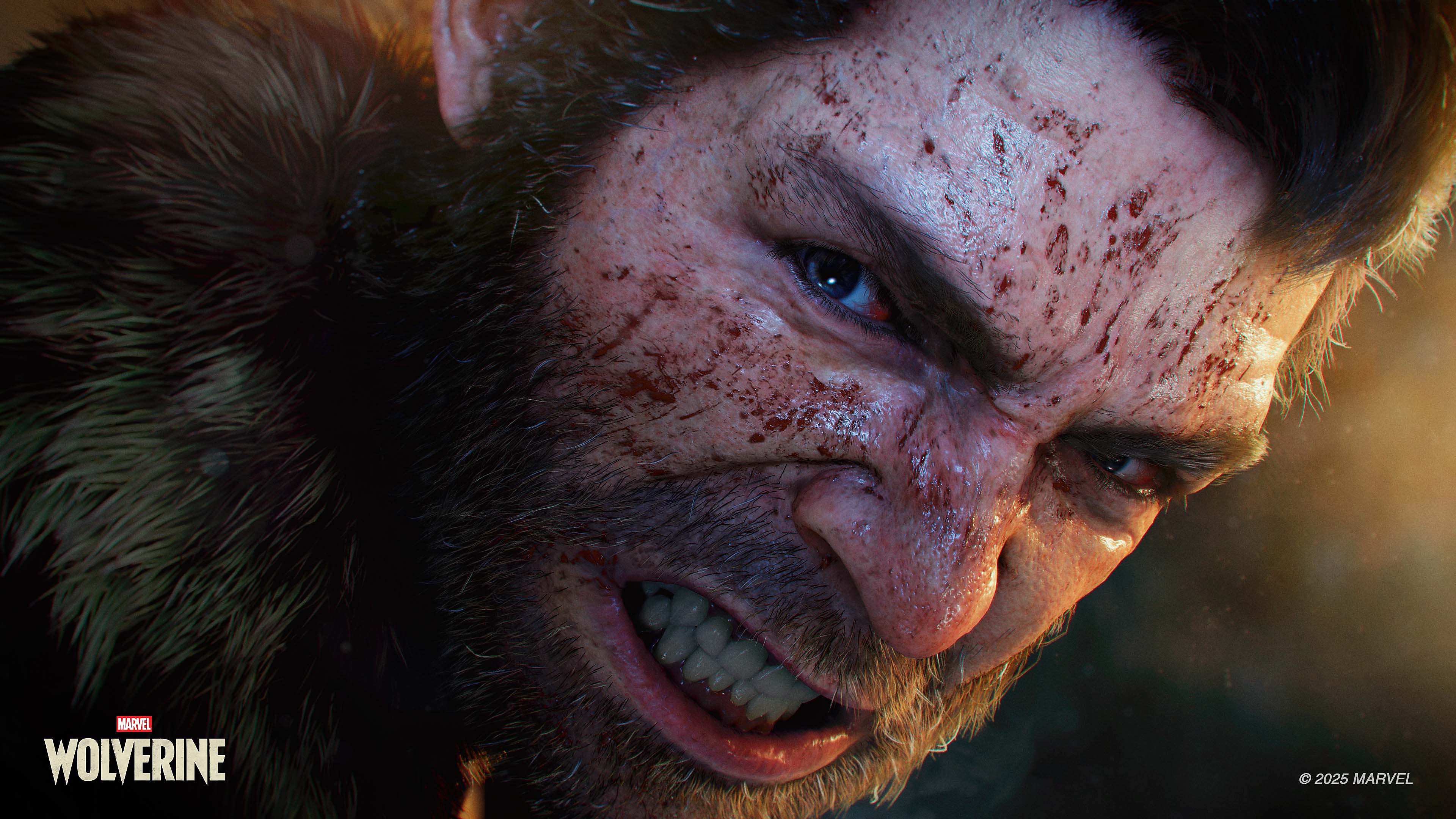
Blood got its own treatment. Senior art director Grant Hollis has described building it to feel viscous and wet, so that it decals everywhere and smears when it hits a wall. How much of that is shown is player-controlled: Violence Preset, Dynamic Blood, Dismemberment, and Visceral Healing are all separate toggles. See Accessibility Options.
Environment capture
The environments lean heavily on photogrammetry. Insomniac ran a series of location-scanning trips during production, sending a scanning team out to record real-world assets and study the natural environments behind both the real and the invented places in the game. The studio has published the numbers from the Japan leg: a route running Tokyo to Joetsu, then to Tsumago-Juku and Magome-Juku, on to Kyoto and back to Tokyo, producing over 600 scans across four biomes, 5.6 TB of data and 189,589 photographs, with more than 100 miles walked carrying around 20 pounds of gear.
The biomes captured on that trip run from snow-covered mountains in the east to an underground train station, and from bamboo forests to sunbaked city streets and roadside temples. Art director Gavin Goulden has described the Canadian reference gathering separately, naming Squamish, North Vancouver and Whistler, and has called the game's version of Vancouver an artistic rendition rather than a reproduction.
Interface
The HUD is deliberately minimalist. Mike Daly has said the interface is intentionally pretty minimalist because the team wants the player's eyes, and thoughts, on the world. Several readouts that would normally be fixed, including the boss and hero health bars, are toggles rather than permanent fixtures. Chase sequences add a temporary red trail marking the route; see Combat.
Audio
The score is by David Fleming, and the game also contains licensed music: a Streaming Mode option toggles between licensed and composed tracks, which exists so that recorded or streamed play does not carry licensed audio. A Single Language Audio option swaps dialogue spoken in other languages to match the chosen voice language, which matters in the Japanese and Madripoorian sections of the campaign.
Tempest 3D audio is used for positional awareness rather than as a presentation flourish, with incoming attacks placed around the player. Composer and performer credits are on Cast and Crew.
Voice and screen languages
The product page and the storefront listing publish the supported languages, which were not listed before launch. Twelve voice languages and twenty screen languages are supported. The Screen Reader and Audio Description cover a smaller set of seven, listed on the accessibility page. Hotfix 1.001.004 fixed a launch bug in which English voices did not play when the console language was set to anything else.
Type | Languages |
|---|---|
Voice (12) | Arabic, English, French (France), German, Italian, Japanese, Polish, Portuguese (Brazil), Portuguese (Portugal), Russian, Spanish, Spanish (Mexico) |
Screen (20) | Arabic, Chinese (Simplified), Chinese (Traditional), Czech, Dutch, English, French (France), German, Greek, Hungarian, Italian, Japanese, Korean, Polish, Portuguese (Brazil), Portuguese (Portugal), Russian, Spanish, Spanish (Mexico), Thai |