

Light No Fire's planet is roughly Earth-sized, which makes traversal one of the genuine problems the game has to solve rather than an afterthought. The wings over the world framing covers everything that moves you across it. Hello Games' own copy promises that players will ride wild beasts through fantastical landscapes and fly dragons over undiscovered ones, and dragons are the only flying mount the studio has confirmed. The full transport stack runs from walking up through cooperative ocean voyages. This article is the traversal overview; specific transport modes have their own articles.
Why Traversal Matters Here
Sean Murray put scale this way during the reveal: mountains that are miles high, taller than Everest, that when you climb to the top of them and look out, you can see rivers and canyons and continents. If you can see continents in the distance from a mountaintop, you cannot reach them on foot in a normal play session. Walking around the equator has been estimated at hundreds of days of continuous real-time movement, and that estimate is reasonable given the press kit's promise of no boundaries, at a scale never attempted before.
Traversal in Light No Fire is therefore tiered. Each mode covers a different range of distance, terrain, and use case:
Mode | Best For | Article |
|---|---|---|
Walking and running | Local exploration around a base, dense terrain, dungeons | |
Ground mounts | Open plains, forests, medium-distance overland travel | |
Flying mounts | Mountain ranges, long-distance reconnaissance, vertical traversal | |
Boats | Ocean crossings, large-group cooperative voyages | |
Swimming | Coastal exploration, shallow water, underwater discovery |
Ground Mounts
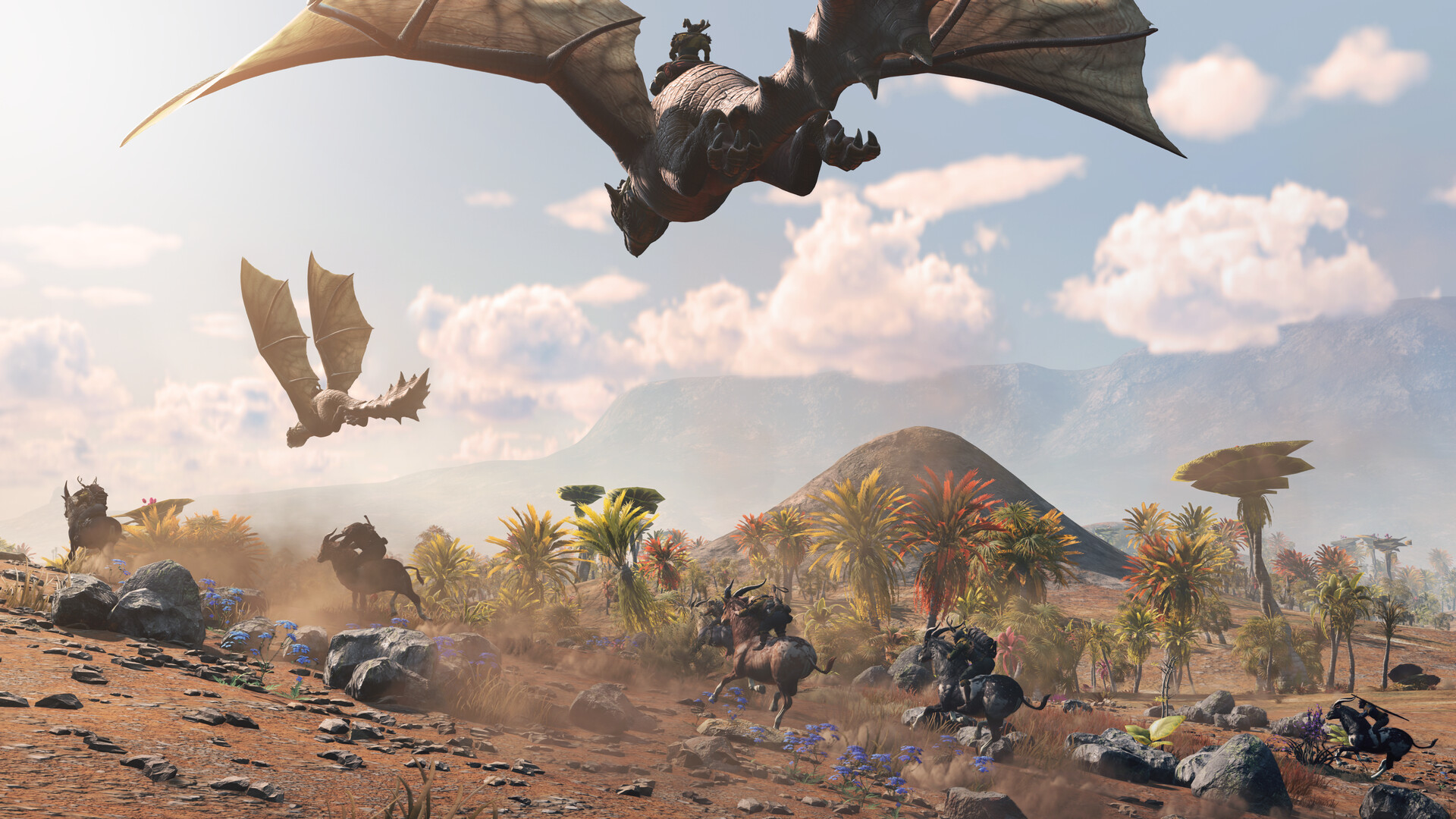
Brief shots in the reveal trailer show characters riding quadrupedal creatures across open terrain. The exact species have not been named by Hello Games, but the press kit confirms players will ride wild beasts through fantastical landscapes. The ground mounts article covers what is visible and what remains unconfirmed (taming mechanics, mount rosters, stamina systems).
Flying Mounts
Dragons are the signature flying mount, dominating the reveal trailer. Multiple shots show players riding saddled dragons over mountain ranges and through cloud layers. A second flying-mount type is also visible: large birds carrying riders. The dragons and flying mounts article covers both categories in detail. Highlights:
Both flying-mount types are shown with saddles, implying a taming or mounting system rather than wild flight.
Multiple players can ride dragons in formation, visible in the trailer.
Flight is continuous (no visible loading screens) and altitude scales up to the curvature of the planet.
Mounted flight is suitable for medium-range travel but, per Sean Murray, not for crossing oceans; long water bodies still need boats.
Boats And Ocean Crossings
Oceans separate continents and are described as real bodies of water needing real travel. Sean Murray confirmed during the August 2025 Voyagers update for No Man's Sky that crossing them needs large boats and crews. Ship building shares technology with No Man's Sky's walkable, room-by-room Corvette construction system shipped in that update.
The boats and ships article covers what is known about construction and crew mechanics. The oceans and sailing article covers ocean geography, swimming, and underwater exploration. Cooperative crewed boats are positioned as the primary mode for crossing major bodies of water.
Walking, Running, And Climbing
On-foot movement is the foundation everything else is layered on top of. The reveal trailer shows continuous movement from ground level up mountain slopes with no loading transitions. Sean Murray confirmed that every mountain can be climbed, which positions climbing as a core movement verb rather than a restricted activity. Specific stamina, fatigue, and climbing mechanics have not been documented in detail.
Fast Travel
Hello Games has emphasised the journey rather than the destination. Whether the game includes magical or technological fast travel (portals, teleporters, waypoint warps) has not been confirmed. The press kit framing of an unexplored Earth suggests Hello Games wants players to experience the distance rather than skip past it, but a constrained fast-travel system (e.g. limited home-portal recall) cannot be ruled out.
What Has Not Been Shown
Stamina, hunger, and fatigue effects on traversal speed.
Whether mounts have separate stamina systems and can tire.
Cargo or passenger capacity for mounts (can two players share a dragon?).
Specific rideable species (the trailer shows silhouettes but does not name them).
Whether weather hazards (storms, fog, lightning) affect flight and sailing.
Whether boats can be solo-operated or strictly need multi-player crews.
Whether the game includes underwater submersibles or only swimming for deep-ocean exploration.
Whether ground mounts can ford rivers, climb light terrain, or carry cargo.
Combat mechanics while mounted (mounted melee, archery, dragonback combat).
Why the Mode Hierarchy Matters
Traversal tiers will likely gate progression. Early in the game, walking and ground mounts may be the only options. Flying mounts probably require taming, completing some goal, or reaching a milestone before they become available. Boats need crafting infrastructure, materials, and crew coordination. Ocean continents probably stay out of reach until you have invested in the build-up. None of this gating has been explicitly described, but it follows naturally from how the planet's geography is structured.
The multiplayer article covers how cooperative play interacts with traversal, and the base building article covers how settlements often grow around natural traversal hubs (river junctions, mountain passes, harbour bays).
Related Reading
For specific transport modes, follow the linked articles above. For the geography that drives the traversal design, see world and planet and biomes. For the broader gameplay loop, see the overview and gameplay articles.