
Loading...
Loading...
Multiplayer
April 4, 2026 at 11:48 PM
Embedded 1 image from gallery
Multiplayer is a central pillar of Honor of Kings: World. The game supports cross-platform play between PC and mobile, with shared servers that allow players on different devices to group together seamlessly. Multiplayer content ranges from 2-player co-op story missions to 8-player raids, with multiple systems in place to help players find groups and ensure that solo players are never locked out of content.
Honor of Kings: World uses a unified server architecture that does not segregate players by platform. PC and mobile players share the same game world, the same matchmaking pools, and the same social systems. A player on PC can invite a friend on mobile to their party, and both will experience the same content at the same time. This cross-platform approach ensures that the player population is not fragmented and that queue times remain short regardless of which device a player uses.
Most story missions can be completed cooperatively with 2 to 4 players. When playing in a group, the mission's difficulty scales to account for the additional players, increasing enemy health and damage output to maintain challenge. Co-op story missions allow friends to experience the narrative together, with each player controlling their own Flowborn and equipped Flow styles.
Instanced dungeons are designed for groups of 2 to 4 players. These are self-contained challenges with multiple rooms of enemies, environmental puzzles, and a final boss encounter. Dungeon difficulty tiers provide increasingly challenging versions of the same dungeon with better loot rewards, encouraging repeated clears at higher difficulty as the party's gear and skill improve.
Raids represent the highest-tier group content in the game, supporting up to 8 players. These encounters are designed around complex multi-phase boss fights that require tight coordination between all participants. Raid bosses have mechanics that specifically demand team roles, such as players splitting to handle separate threats simultaneously, designated players managing aggro, and coordinated burst windows where the entire group focuses damage at once.
Raids offer the best equipment rewards in the game and serve as the primary endgame challenge for organized groups. Success in raids often depends on the party having a good mix of different Flow styles to cover damage, healing, and utility roles.
Players can form parties through direct friend invites, guild rosters, or the automated matchmaking system. Direct invites allow players to build a specific group composition, while matchmaking pairs available players of similar level and gear score for the selected content.
The matchmaking system uses rank-based criteria to pair players of similar progression level, reducing the chance of mismatched groups where one player significantly outpowers or undergears the content. Players can queue for matchmaking while continuing to explore the open world, and a notification alerts them when a group has been assembled.
For players who are struggling with a particularly difficult boss encounter, the summoning system provides a way to call for help from other players. Activating a summon signal broadcasts a request to nearby players or to the matchmaking pool, inviting them to join the fight in progress. This system is designed to reduce frustration during difficulty spikes by making assistance readily available without requiring pre-formed groups.
When a player queues for group content but cannot fill all party slots with human players, AI companions automatically fill the remaining positions. These AI-controlled characters use preset Flow styles and follow basic combat logic, ensuring that solo players can access all multiplayer content even during off-peak hours or when friends are unavailable.
AI companions are functional enough to complete most content at standard difficulty, though their performance does not match well-coordinated human players. For the hardest raid content, a full group of human players is strongly recommended.
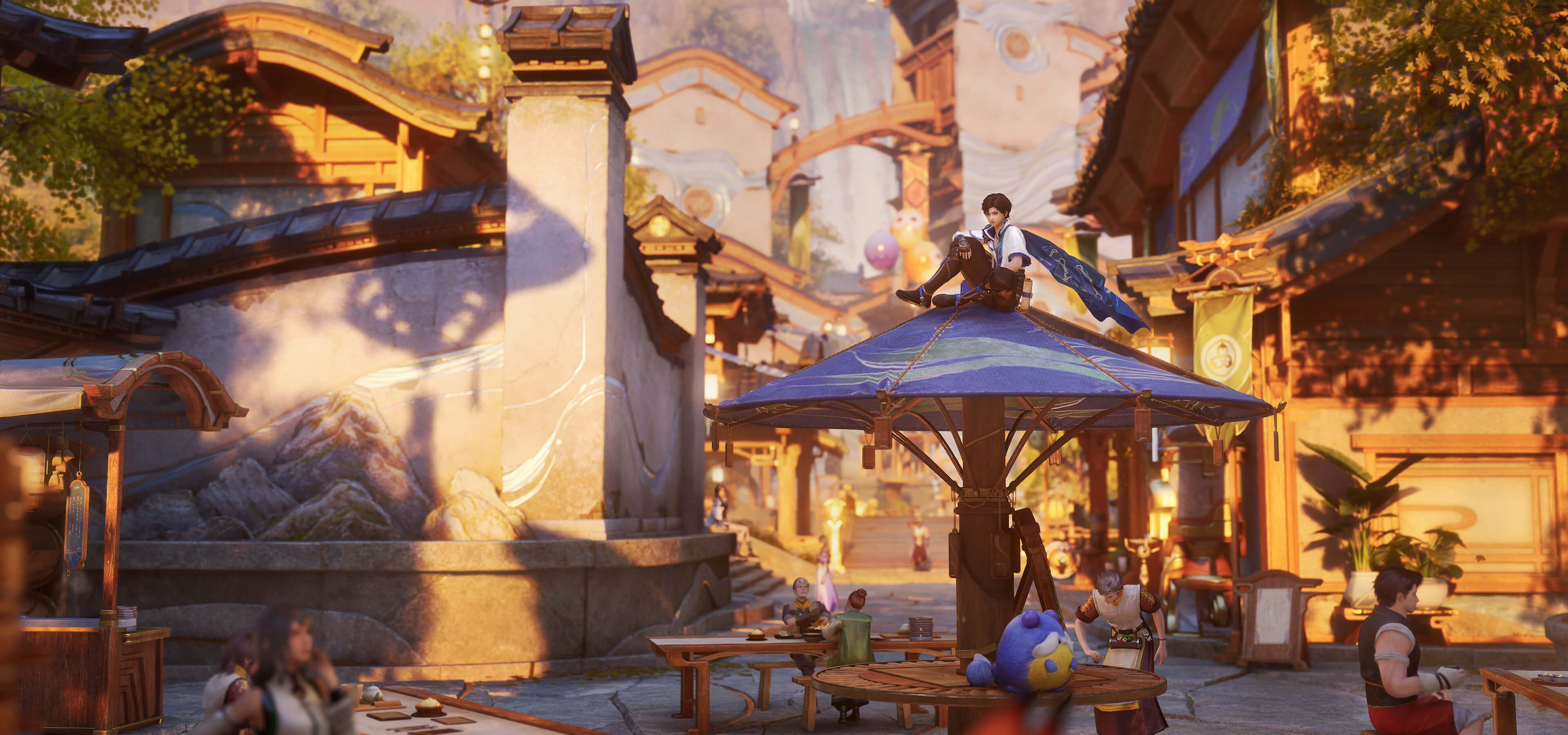
Major settlements like Chang'an and Frostcloud Town serve as social hubs where players can meet, trade, display cosmetics, and organize groups. These hubs are populated with other players in real time, creating a persistent social environment between combat outings.
The guild system provides a framework for long-term social organization. Guilds offer cooperative activities, shared progression goals, territory control mechanics, and dedicated guild spaces. Guild membership gives players access to exclusive vendors, group content queues, and social events that are not available to unguilded players.
The dual-class system encourages diverse team compositions in group content. Because each player brings two Flow styles, a 4-player party effectively has access to eight different combat kits. Teams that bring a mix of damage, crowd control, healing, and utility styles can handle a wider range of encounter mechanics than groups that stack a single damage type.
Elemental interactions between Flow styles also reward coordination. Applying elemental effects in sequence can trigger chain reactions that deal bonus damage or inflict enhanced status effects. These synergies give pre-made groups that plan their style loadouts a meaningful advantage over randomly assembled parties.