

Getting Started
A practical onboarding guide for new players: how to follow Don't Starve Elsewhere right now via Steam wishlists and the developer newsletter, the three failure states to avoid, the survival pillars, solo and co-op options, what is different from earlier entries, and a pre-launch checklist.
On This Page
Don't Starve Elsewhere is an upcoming co-op survival adventure that moves the long-running series into a fully 3D, multi-tiered wilderness. The game has been formally unveiled but is not yet playable. There is no demo, no beta, and no early access build. This page covers what is possible right now and what to watch as launch approaches. For the broader pitch and feature summary, see the main overview.
Players new to the series do not need to study older games. Elsewhere is set in a brand-new world separate from the location used in earlier entries, and several core systems are reworked. Plan to learn the new ruleset rather than transfer habits from prior installments.
How to Play Right Now
There is no playable build of Elsewhere available yet. The Steam product page is live, and wishlisting it is the single most useful thing a prospective player can do today. Wishlists ping you when the storefront flips to a release date or when a demo period opens.
Outside of Steam, the most direct way to track development is the Klei newsletter. Klei has said outright that wishlisting and the newsletter are the best way to keep up with Elsewhere, because it does not intend to post about the game much in Don't Starve Together's community spaces. Signups receive announcement emails for trailer drops and store updates without depending on social feeds. For the current state of platform availability, see Platforms and Release.
Three Things to Avoid
Klei has summarized survival in Elsewhere as three rules. Each one corresponds to a distinct failure state and ties back to a system that is new or reworked. Treat the table below as the shortest possible cheat sheet for what will get you killed.
Rule | What It Means | System |
|---|---|---|
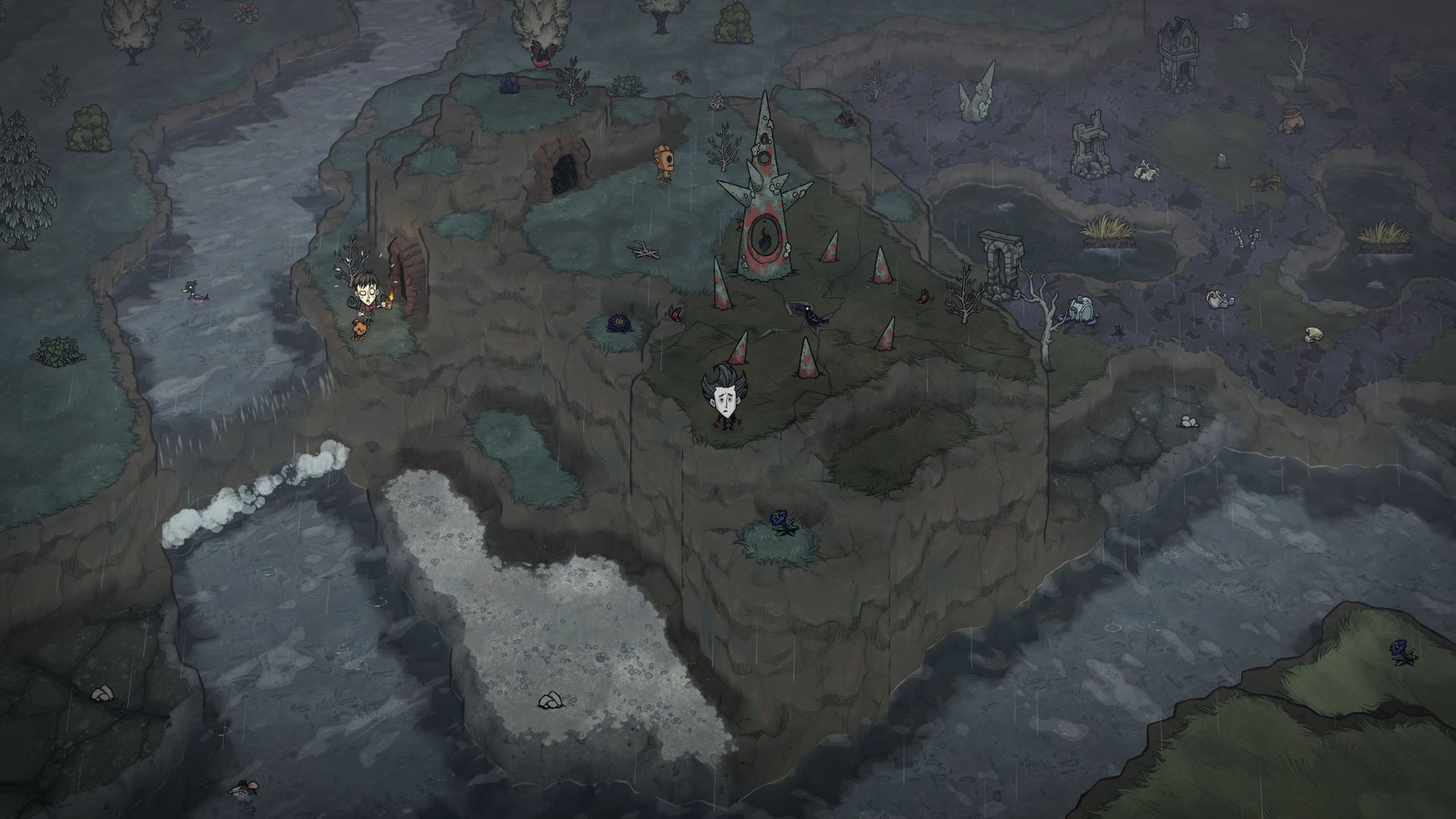
Don't Fall | The world has real elevation. Mountains, cliffs, and tiered terrain are part of normal traversal, and falling from height is a punishable mistake. Look before you leap. | |
Don't Linger in the Fog | A creeping Fog spreads across the landscape and corrupts what it touches. Standing in it for too long drains sanity. Pass through quickly or back out. | |
Don't Starve | Hunger is a constant pressure. Food is gathered, hunted, farmed, and cooked, and an empty stomach kills as reliably as any monster. |
Survival Pillars
Survival rests on three overlapping pressures. Hunger is the headline one, answered by gathered, hunted, or farmed food. Sanity is confirmed too, with the new wrinkle that the Fog is what takes it. Neither has been described as an on-screen gauge, so treat the shape of the interface as unknown. Traversal hazards are the third pressure: elevation means falling damage, and biomes such as snow-covered peaks and stormy redwood forests apply environmental strain on top of whatever creatures live there. A deeper breakdown lives in the Survival Basics article.
Solo or Co-Op
The game supports both single-player and online co-op. The Steam page lists in-game chat, online co-op, and Steam Family Sharing. Group size, dedicated servers, persistent worlds, and crossplay specifics have not been disclosed in detail. The Multiplayer article tracks every confirmed and unconfirmed detail about playing with friends.
What's Different From Earlier Don't Starve Games
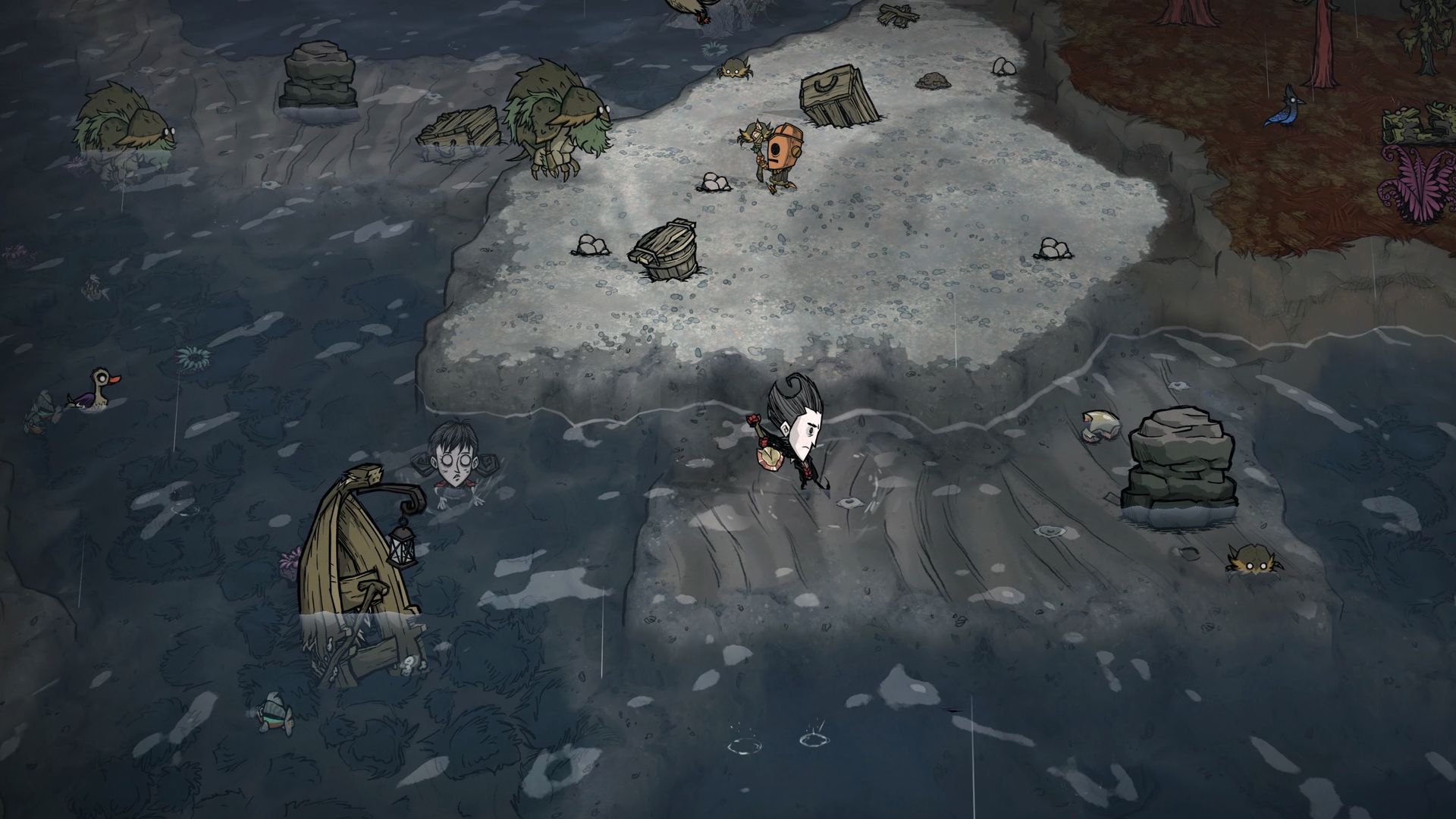
Veterans of the series should approach Elsewhere as a new game rather than a sequel that ports forward old habits. Four headline differences shape the early experience.
Movement has a vertical axis. The flat plane of earlier entries is gone, and terrain now stacks at real heights, so routes run over and under obstacles instead of around them.
There is a jump button. A long-requested feature, jumping is now part of basic traversal alongside climbing and swimming.
The world is multi-tiered. Mountains, plateaus, rivers, sea coastlines, and cave systems exist as actual layers you climb between rather than screen transitions.
The Fog is new. Earlier entries did not have an aggressive, spreading hazard system that doubles as a sanity drain and a temptation to push deeper for hidden rewards.
Equally important is what does not carry over. The art style is brand new, and whether cosmetics bought in Don't Starve Together can be used here is still undecided: Klei has said it wants to find a way but has not settled on one. Locations, biomes, creatures, items, and most lore are distinct from the prior series setting. For background on the studio behind the game, see Klei Entertainment.
Pre-Launch Checklist
Use this short, ordered list to stay ready between now and whenever the game opens up to players.
Wishlist the game on Steam. The most reliable single notification channel for release date and demo windows.
Sign up for the Klei newsletter. Klei has named it, alongside a Steam wishlist, as the way to follow this game.
Follow Klei's official channels for trailer drops and behind-the-scenes posts as they land.
Pin down friends who plan to co-op with you, since online co-op is confirmed.
Bookmark this wiki. Articles are updated as official information is verified.
Most early-game specifics, including starting tools, opening hours, default keybinds, console availability, and the release date, have not been publicly disclosed. As verified information lands, it will be folded into the pages on the Multi-Tiered World, the Fog System, and 3D Movement.