
Loading...
Loading...
3D Movement
August 26, 2026 at 04:40 AM
Corrected two image descriptions, including the cliff still, which shows more than the previous description said
3D Movement is the foundational design shift that defines Don't Starve Elsewhere. It is the first series entry built around a world you climb through rather than cross, which Klei sums up in its own heading for the feature: an elevated experience. Alongside that comes a dedicated jump button, long asked for by the community and now a base-game action. Together, these two pieces unlock vertical traversal and introduce falling as a new way for a run to end. For broader context see the Overview and the Survival Basics primer.
It is worth being precise about what has and has not changed, because the reveal materials answer this directly. The art has not been replaced: survivors and creatures in the official stills are drawn in the same flat, hand-drawn style the series has always used, and the tone is the same dark whimsy. What changed is the ground under them. Terrain now stacks into peaks, plateaus, valleys and caves at genuinely different heights, and the camera looks across that stack rather than down at a single flat plane. Klei has not described this as a switch to 3D graphics, and neither does this page: the three dimensions in question are the ones you move through. The studio's own framing is verticality: a multi-tiered wilderness you climb, swim and spelunk through. That distinction matters because a jump button only means something once the world has somewhere to jump to.
A jump button is now a core movement input, and it was one of the details outlets picked out of the reveal first. Elsewhere folds jumping into the base game as a first-class action rather than a scripted animation attached to specific objects. Klei's own description of the world puts climbing peaks, swimming rivers and seas, and spelunking caves at the centre of traversal, and the jump shown in the reveal trailer is what ties those layers together, so platforming-style traversal reads as an intentional design pillar rather than a one-off flourish. Hopping ledges, crossing broken bridges, leaping rivers at narrow points, and pushing across uneven terrain are all on the table.
Adding height also adds a new way to die. Falling from elevation is one of three core failure states, sitting alongside the Fog and starvation. The studio sums the survival challenge with a three-part directive: don't fall, don't linger in the Fog, and above all else, don't starve. This pillar is tied directly to the Multi-Tiered World. Because terrain stacks vertically, players are constantly on or near a drop, so a missed jump can cut a run short. Fall-damage thresholds, lethal heights, and any equipment or biome modifiers have not been disclosed.
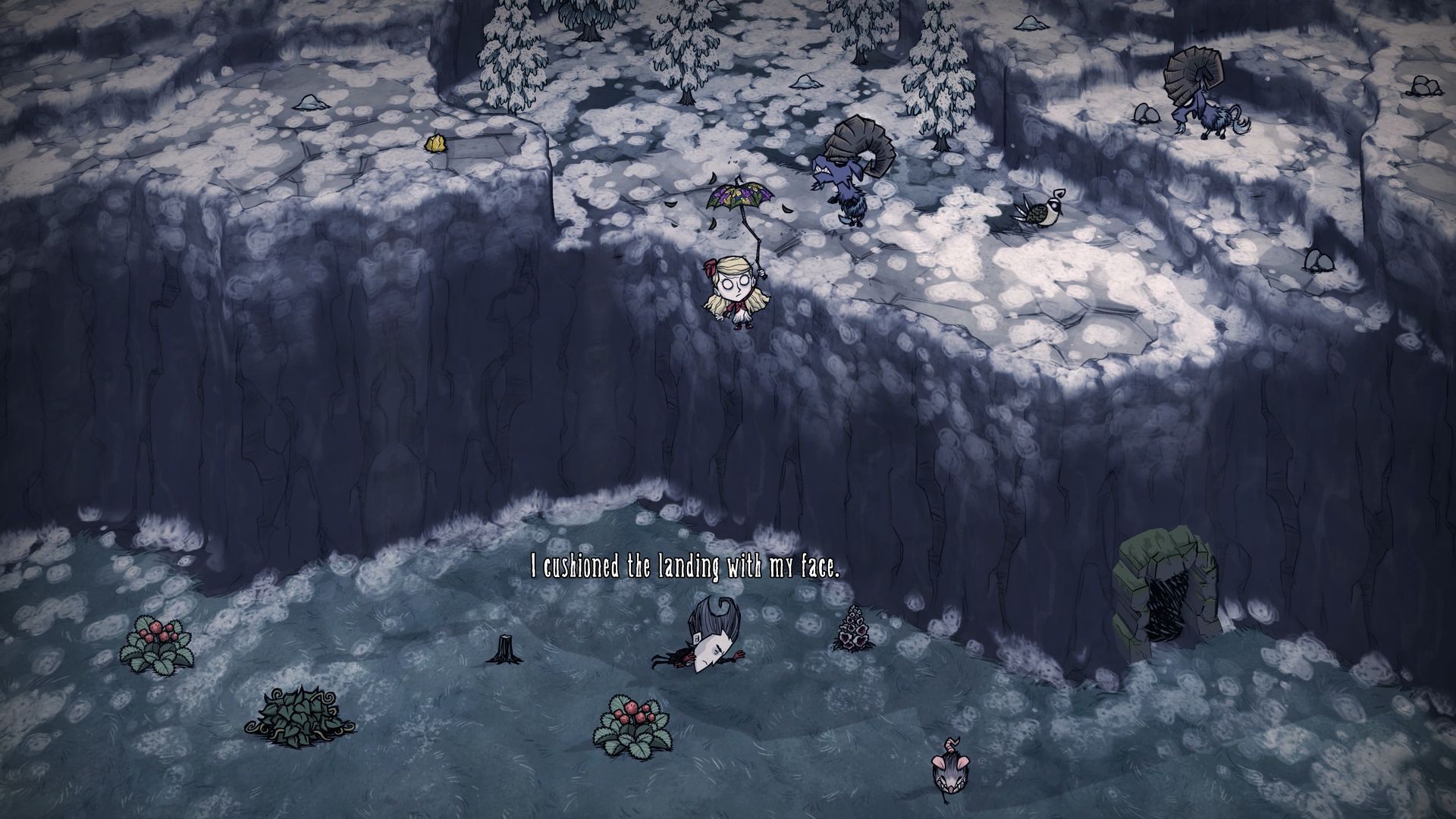
One of the official reveal stills is set on a snowy cliff and is the closest thing to a demonstration of this system that has been published. Klei's own label for it has Wilson being knocked off the cliff, which is a useful detail on its own: the fall is something that happens to him rather than a misstep. Two heavy horned animals stand on the ledge he came off, one of them squaring up to the survivor still up there, though the studio has not said whether they are what put him over the edge.
What the picture adds is that he survives it. Wilson is lying face down in the snow at the base of the drop, and the game is showing a line of his on-screen text above him: I cushioned the landing with my face. A fall from that height therefore costs something without ending the run outright, which narrows what "don't fall" means in practice. It also establishes that the game puts survivor quips on screen as readable text, which lines up with the storefront listing subtitles for every language it supports.
A second survivor is at the top of the same drop, holding an open parasol above her head as she comes down off the ledge. The parasol is open, it is over her, and she is descending. What it does is not stated anywhere, so this page records the picture and nothing more. Whether it slows a fall, steers one, or is simply an item she happens to be carrying is unconfirmed, and how similar items behaved in earlier games is not evidence for this one.
Each biome layer presents a distinct traversal challenge. The world is broken into elevation bands and water regions, each calling for a different movement skill.
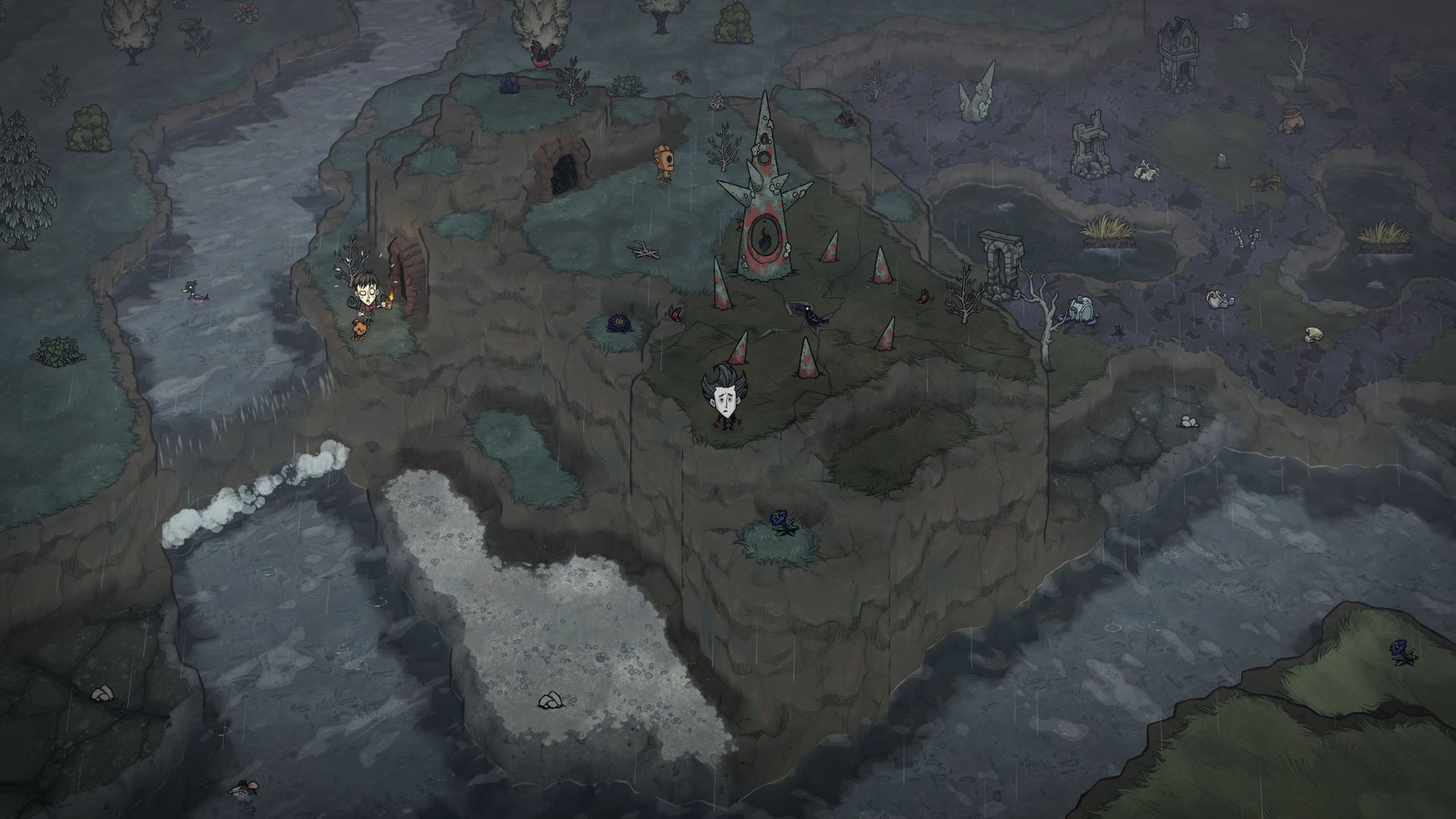
Mountain peaks: snow-covered high-altitude terrain that has to be climbed, with cliffs and ledges that demand careful jumps.
Rivers and seas: water bodies that have to be swum across, opening routes that did not exist in the 2D entries.
Cave systems: winding underground networks spelunked from the surface down, with vertical descents into the dark.
Forests and lower ground: surface traversal where jumping helps with gaps, fallen trunks, and uneven terrain.
The 3D shift changes how exploration is structured and what survival skill looks like. Routes can now run over a peak, around a sea, or through a cave instead of along a single plane. Each biome can demand its own movement skill, risk planning becomes three-dimensional, and base placement gains new variables in access routes, fall risk, and water crossings. For early-game priorities under these rules, see Getting Started.
Treat the items below as open until the studio publishes specifics.
Button mappings for jump, climb, and swim.
Jump height, distance, mid-air control, and any double jump.
Fall-damage thresholds and any landing roll or recovery mechanic.
Climbing rules and whether ropes or ladders exist as crafted aids.
Swim speed and any stamina or oxygen mechanics in water.
Sliding, sprinting, dodging, vaulting, or other movement verbs beyond jumping.
What the open parasol does during a descent, and whether it is equipment, a consumable, or scenery.
How much a survivable fall costs, and at what height a fall stops being survivable.
