
How it Works
Blood craving tracks Coen's hunger as a Dawnwalker in The Blood of Dawnwalker. At night, his health bar doubles as a hunger meter: the two are the same resource. Taking damage makes him hungrier. Getting hungry makes him weaker. The lower the bar drops, the closer he gets to losing control of his vampire instincts.
The system activates nightly, and Coen starts every night hungry. If he lacks blood when darkness falls, the craving escalates. This is not a slow-burn mechanic you can forget about. It demands regular attention and forces decisions about how and when to feed.
Daylight works differently. Health does not regenerate on its own during the day, and hex casting spends health rather than a separate resource, so the daytime restore is food rather than blood. See Hex Magic.
UI Signals
The May 2026 hands-off demo confirmed three visual cues that warn the player as craving rises.
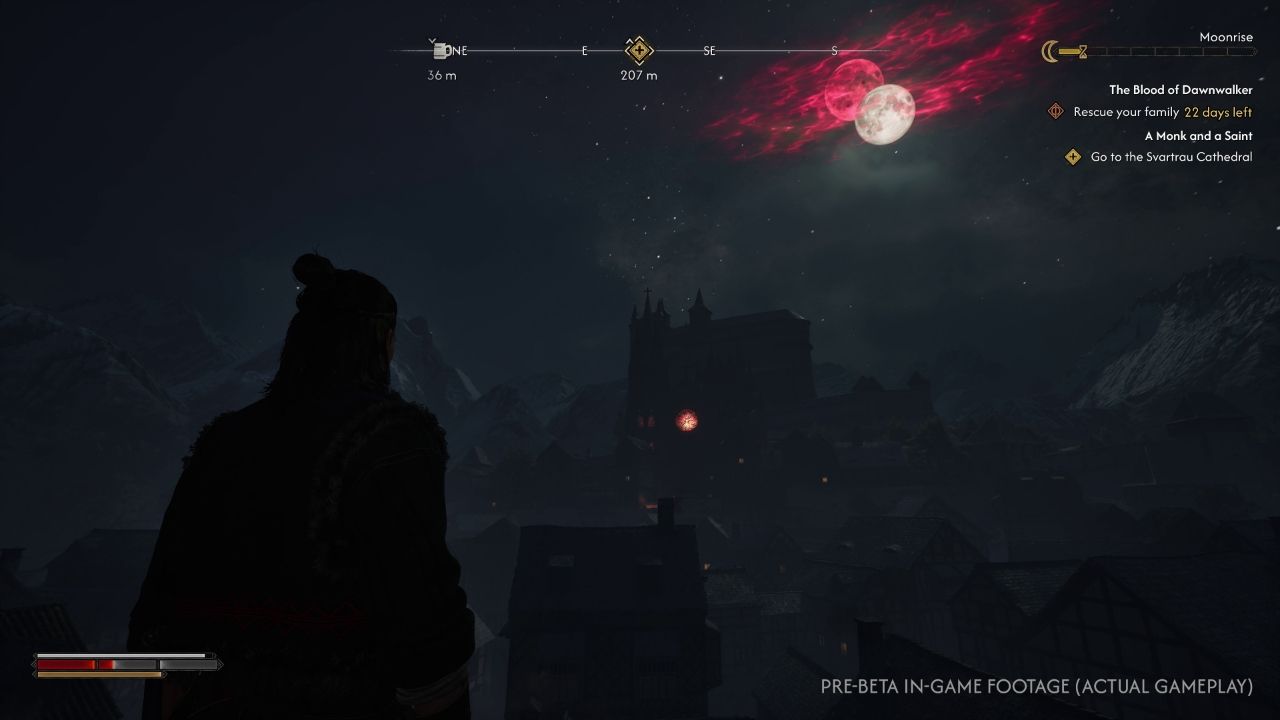
Red frame: a red border creeps in around the screen edges when the hunger meter falls into the danger band. The lower the bar, the heavier the red.
Distorted conversations: dialogue audio and subtitles begin to warp when Coen is talking to an NPC while critically hungry. The visual effect signals that he is fighting the urge.
Give in to hunger prompts: dialogue choices include a dedicated option labelled along the lines of give in to hunger. Selecting it triggers a feeding animation on the NPC Coen is speaking with, which can drain or kill them depending on context.
Black tendrils visibly creep around Coen's mouth and eyes during the critical state, which serves both as in-fiction signposting and as a final warning before involuntary draining takes over.
Loss of Control
If blood craving reaches critical levels, Coen can involuntarily drain NPCs. The game takes control away from the player in these moments. Coen lunges at someone mid-conversation and drains their blood whether you wanted it or not.
If the target is a quest-giver, an ally, or a faction leader, the consequences cascade. That dialogue is gone. That quest might be locked permanently. The faction might turn hostile. In extreme cases, important story characters can die from the drain, closing off entire narrative branches. The developers have described scenarios where Coen might decide to drain a companion completely without warning, making hunger management a matter of narrative survival as much as physical survival.
Feeding Methods
Source | Description | Social Cost |
|---|---|---|
Enemy blood | Biting defeated enemies during night combat. Available whenever a fight goes well. | None. Combat targets are not part of the social fabric. |
Vampire blood | Draining other vampires. Higher quality, and the only way to absorb new vampiric powers. | None directly, but ancient vampires are rare and dangerous targets. |
Animals | Feeding on deer, bears, wolves, and other wildlife in the open world. Restores hunger without involving any NPC. See the Bestiary. | None. The May 2026 demo flagged animal feeding as the safe alternative when no enemy is nearby. |
Human NPCs | Feeding on civilians or unaligned humans. Can be partial (unconscious target) or total (death). | High. Killing a quest-giver or ally locks out their content. Even partial drains can scare witnesses and raise infamy. |
Forced draining | Triggered when the meter bottoms out. The game picks the nearest valid target. | Severe. The player has no control over who Coen reaches for. |
Corruption
Feeding does more than keep Coen upright. The blood he drinks fills a second track, Corruption, which is the progression axis for his vampiric side. Guide coverage of the shipped game places its meter beside the health bar as a set of fangs that fill red and rank up, with the current rank printed over them. Blood from any source fills it: animal, human or vrakhiri.
The distinction the game draws is at the top of the track. Ordinary blood carries Coen through the lower ranks, while the higher tiers of vampiric ability require vrakhir blood specifically, which is why draining one of the regime's boyars is worth so much more than draining a guard. Vials of blood found as loot also add to the meter, but they are the same items used for healing and for brewing stronger restoratives, so spending them on Corruption is usually a poor trade.
Corruption is reported to be one-way: there is no cure and no way to walk it back. What remains a choice is the source. Feeding on animals and on hostile combatants raises the track without costing the valley anyone, while feeding on ordinary people is where the moral weight and the lost content live. See Vampire Mythology for what Corruption means in the fiction.
Strategy
The intended play loop is to feed strategically during fights and on wildlife rather than waiting until the meter is in the red. Engaging in night combat tops up the bar naturally through biting takedowns. Heading into a long dialogue scene at low hunger is the most reliable way to lose an important character to an involuntary kill. Building a route through a night that includes at least one combat encounter or one animal feeding stop keeps the meter safe.
The notoriety system tightens this further. As infamy rises, Brencis adds patrols and curfews, which makes it harder to find safe feeding opportunities, which raises the risk of an involuntary kill, which feeds back into the consequence layer.
What Coen Can Feed On
Feeding is not limited to people. An achievement covers drinking from ten animals, humans, or monsters, which confirms all three are valid targets. That matters for pacing: the valley's wildlife and its monsters give the player a way to manage hunger without spending a human life, and without the consequences that come with losing control near an NPC who matters.
Corruption limit
Corruption reaches a maximum rank of 15, separate from Coen's character level cap of 50. Higher ranks open advanced Vampirism perks and ultimately its Ultimate Perks. Hastened Corruption increases the rate of progress, and its upgraded effect allows Overfeed. Raising Corruption provides progression; the consequences of feeding on a particular NPC depend on that target and the circumstances.
Wild Blood
Critical hunger begins at one nighttime Health Segment or less. Feed before important conversations when health is in that range. Endless Hunger increases the number of night Health Segments and provides a larger buffer.
Corruption rank | Wild Blood effect for 3 time segments |
|---|---|
2 | +15% Activation Charge Passive Restoration |
5 | +30% Activation Charge Passive Restoration |
10 | Begin combat with +1 filled Activation Charge |
These animal-blood bonuses require the Wild Blood perk. Update 1.1 on Steam fixes receiving Wild Blood without owning it. Animal feeding still raises Corruption, while avoiding the risk of draining a human NPC.