

Cooking is Alabaster Dawn's healing-and-buff progression system. Players gather ingredients out in the field, cook them at settlement kitchens, and end up with two categories of consumable: healing bulbs that restore HP, and buff dishes that grant temporary combat or utility bonuses. A separate Palate Level stat scales how strong each meal becomes, rewarding variety over stockpiling.
Why It Exists
The cooking system is intentionally separate from gem crafting and weapon trees. It is not about stat ceilings; it is about combat readiness across a single play session. A healthy cooking inventory means Juno enters a boss fight with a partial HP buffer, a temporary attack or defense bonus, and an emergency restore in case the parry timing slips. It is also the game's answer to the classic action-RPG anti-pattern of hoarding heal items: the leveling-based Palate Level stat encourages eating dishes as you go rather than saving them for a rainy day.
Healing Bulbs
Bulbs are the basic healing item. Two main tiers exist in the launch build:
Standard healing bulb. Restores a partial chunk of HP. Picked up in the field or cooked from common ingredients. Stackable up to a small inventory cap.
Massive healing bulb. Restores full HP. Rare drop; usually reserved for boss attempts.
Bulbs are consumed with the F input mid-combat. There is a brief animation, so use a parry or dodge to create a safe window before consuming.
Buff Dishes
Buff dishes are prepared meals that grant a temporary bonus when consumed. The exact dish list expands as the campaign opens up new ingredients and recipes; categories of buff include attack power, defense, stamina recovery, elemental resistance, and gathering speed. Buffs from cooking stack with bulb healing in a fight.
Recipes are unlocked through gameplay rather than a dedicated cookbook menu: gathering ingredients in the field, finishing certain side quests, and chatting with NPCs in Lyhamn (notably Orlanda the chief farmer in Old Kamu Village) all surface new recipes the kitchen can prepare.
Palate Level
Palate Level is a separate progression stat for cooking. It increases as Juno eats a variety of meals over the course of the campaign. As the level climbs, the strength of each prepared dish scales upward, so a buff dish cooked at a higher Palate Level is meaningfully stronger than the same recipe cooked at a low level.
The mechanic is designed to prevent two failure modes. First, eat-only-the-best-recipe builds: lower-tier recipes still raise Palate Level, so eating a variety of cheap food eventually scales the cap of every dish. Second, hoard-and-never-eat builds: dishes do not contribute to Palate Level until consumed, so saving a stack of food forever simply caps your cooking output.
Practical Routine
Gather as you travel. Resource nodes are common in the field. Detour briefly during settlement quests to top up your kitchen.
Cook before bosses. Two or three buff dishes plus a stack of bulbs equals a meaningful margin when stepping into a boss room.
Vary the menu. Eat what you cook, including the cheap recipes. Palate Level scales every dish, including the rare ones.
Pair with gems. Cooking buffs stack with gem effects. Combine an attack-up gem with an attack-up dish for a brief but meaningful damage window.
Where to Cook
Cooking happens at settlement kitchens. The first kitchen is in Lyhamn, and additional kitchens open as new settlements come back online during the Chapter 1 rebuild and beyond. Save Anytime is supported, so cooking before a hard fight can be safely interleaved with exploration.
How Cooking Works In The Field
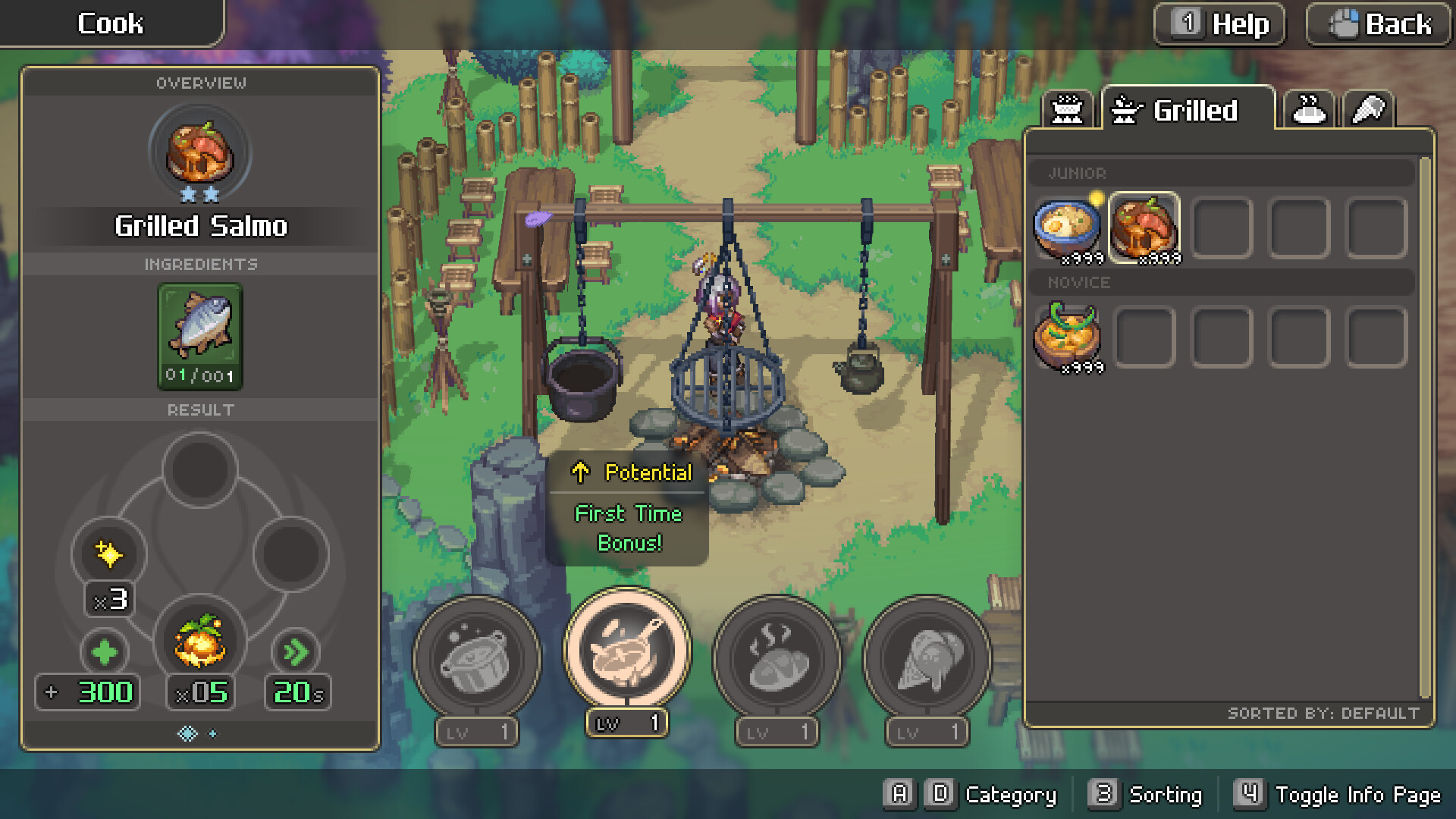
To cook, Juno needs to be at a cooking pot. Cooking pots are located at fixed spots inside settlements and at certain rest areas; the first cooking pot is in Lyhamn Center, and another opens at Lumber Corner in Koro Valley once the local Nest is woven. Each cook requires both a Recipe and the Recipe's specific Ingredients. Ingredients are consumed; Recipes are not, and can be reused indefinitely. When Juno cooks and eats a meal, the food charges up her Divine Gear with a buff and refills her Healing Bulbs.
Seasonings: The Optional Layer
Seasonings are a separate type of pantry item from Ingredients. A seasoning is not part of any recipe; it is an optional add-in chosen at the cooking pot, and adds an extra Boost on top of the recipe's normal effect. The launch build has only one seasoning: Scorchili, a small flame-shaped pepper foraged in southern Koro Valley. Scorchili adds a Crescendo +30% finishing-attack bonus on top of any cooked meal. Future patches are expected to add more seasonings, with one per Aspect being a likely framework.
Boosts vs Healing Bulb Updates
A single cook always produces two effects:
Boost charges: each recipe grants a specific buff (for example, Trouble Whisper or Kin Whisper). The buff is held in a small charge bank, and Juno activates one charge at a time during combat for a temporary effect window. After a charge is consumed, attacking enemies recharges the next one. Once the last charge is spent, the boost is fully expended and another cook is needed.
Healing Bulb update: the speed, charges, and power of Juno's Healing Bulbs are reset to the values defined by the most recently cooked recipe (modified by Palate Level). A Bulb update lasts until Juno cooks again, so it is the meal's lasting effect on Juno's defensive baseline.
Palate Level
Using a boost in combat increases Juno's Palate Level for that recipe's type (Cooked, Grilled, etc.). A higher Palate Level scales the strength of every dish of that type and adds bonus charges to the Healing Bulb update from that type. The maximum Palate XP a recipe can grant on a single use is gated by its Complexity rating (Novice, Junior, etc.); recipes also grant double XP the first time they are cooked. The launch build only includes Cooked-type recipes, but the system is designed to support multiple cooking types tied to different villages and Chronicle progress points.