

Valor Mortis takes place in an alternate-history version of 19th-century Europe, set during the campaigns of Napoleon Bonaparte. In this reimagining Napoleon's war does not end. It drags on without resolution, grinding across the continent and leaving devastation in its wake. Against this backdrop of perpetual conflict a supernatural plague takes hold, corrupting the land and the people caught within it. The result is a grim, horror-tinged world where the ordinary brutality of war is compounded by something far darker.
An Alternate-History Europe
The game's foundation is the endless war waged by Napoleon. Where real history saw his campaigns rise and fall, this version imagines a conflict with no end in sight, one that has worn the land down and left it ripe for corruption. The studio has since put the two halves of that premise in sequence: as Napoleon's conquest halts in Eastern Europe, the plague spreads across the continent in its wake. The stall and the sickness are presented as one event rather than two. The setting therefore leans into an eastern stretch of the European continent, giving the world a distinct flavor compared to the more familiar western battlefields of the era, and the occupied east is where the game places the player. The architecture and street layouts of its plague-stricken cities draw on the look of the early 1800s, grounding the alternate history visually. The combination of recognizable historical grounding and outright supernatural invention is central to the game's identity.
The studio has said plainly that the game is not aiming for historical accuracy, while still tying itself to historical themes, figures, and events. That balance shows in the environments: storefront screenshots include a ruined village street still strung with festival garlands and ribbons, closed off at the far end by a church with a golden onion dome and a cross, architecture that places the setting firmly in the eastern half of the continent rather than the western battlefields the era is usually associated with.
The Supernatural Plague
At the heart of the story is a supernatural plague that corrupts everything it touches. It is not merely a disease but a force that warps soldiers and the land alike, turning the war zone into a place of dread. Tied to this corruption is a substance referred to as Nephtoglobin, which appears to be a kind of plague-altered humour or compound that the corrupted carry in their bodies and that fuels William's own resurrected powers. The precise mechanics of how Nephtoglobin is harvested and refined remain to be filled in at launch, but it links William's Transmutations directly to the same force that is destroying the world around him.
Enemy Factions
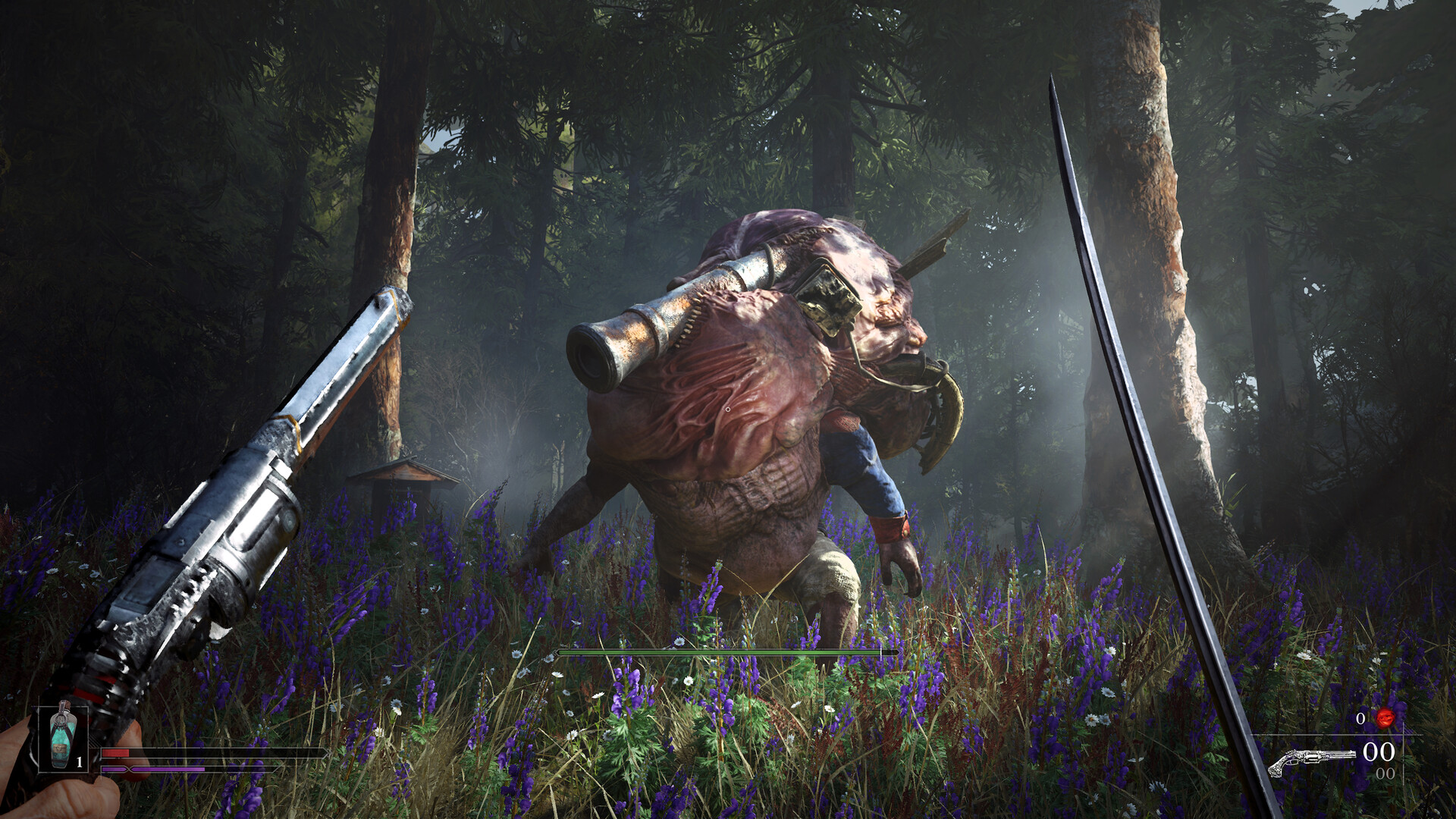
The most visible threat is Napoleon's own Grande Armée, now corrupted and twisted by the plague. They go by the in-game name of the Eternal Guard. Among them is an elite unit called The Relentless. The studio describes them as elite soldiers who are endlessly loyal to Napoleon's cause, drawn from long lines of volunteers of whom only the most resilient are ever accepted into their secret training facilities. They are nephto-infused, which makes them faster, more aggressive, and considerably more dangerous than anything encountered before them, and they fight with what the studio calls inhuman aggression, speed, and strength. They carry massive greatswords and keep their faces hidden in battle behind full helmets, though a developer update did lift one of those helmets to hint at what the training does to the men underneath. Beyond the soldiers, the war has spawned outright abominations. One such creature, The Orphan, lurks in the city sewers and was revealed in the April 2026 gameplay trailer. Named human leaders such as General Lothaire, the Eagle-Bearer, and Sergeant Gaspard "Cannonhand" Dubois stand at the top of the corrupted hierarchy and serve as major boss fights.
Alongside the corrupted soldiers, the plague twists ordinary townspeople into corrupted villagers. These common foes attack with everyday items such as tools, torches, and farm equipment, and they lunge in unpredictable, almost feral bursts rather than fighting with a soldier's discipline. They were first shown in the nighttime village level of the November 2025 "Crimson Plague" gameplay trailer, and they are among the enemies William faces in the later chapter of the public demo.
The studio has been explicit that the level built around them is a turning point for the story rather than just a change of scenery. It is the first time William sees the true horror of what Napoleon's supernatural conquest has done, and it is framed as a crisis of conscience: he joined the army in good faith and finds himself witnessing crimes committed by his own side. What surfaces there, the fate of the civilians and a local commander's petty vengeance, is presented as a symptom of something deeper rather than an isolated atrocity. The tone drives the design too, since a confined village at night rewards moving carefully, listening, and using the surroundings instead of charging in.
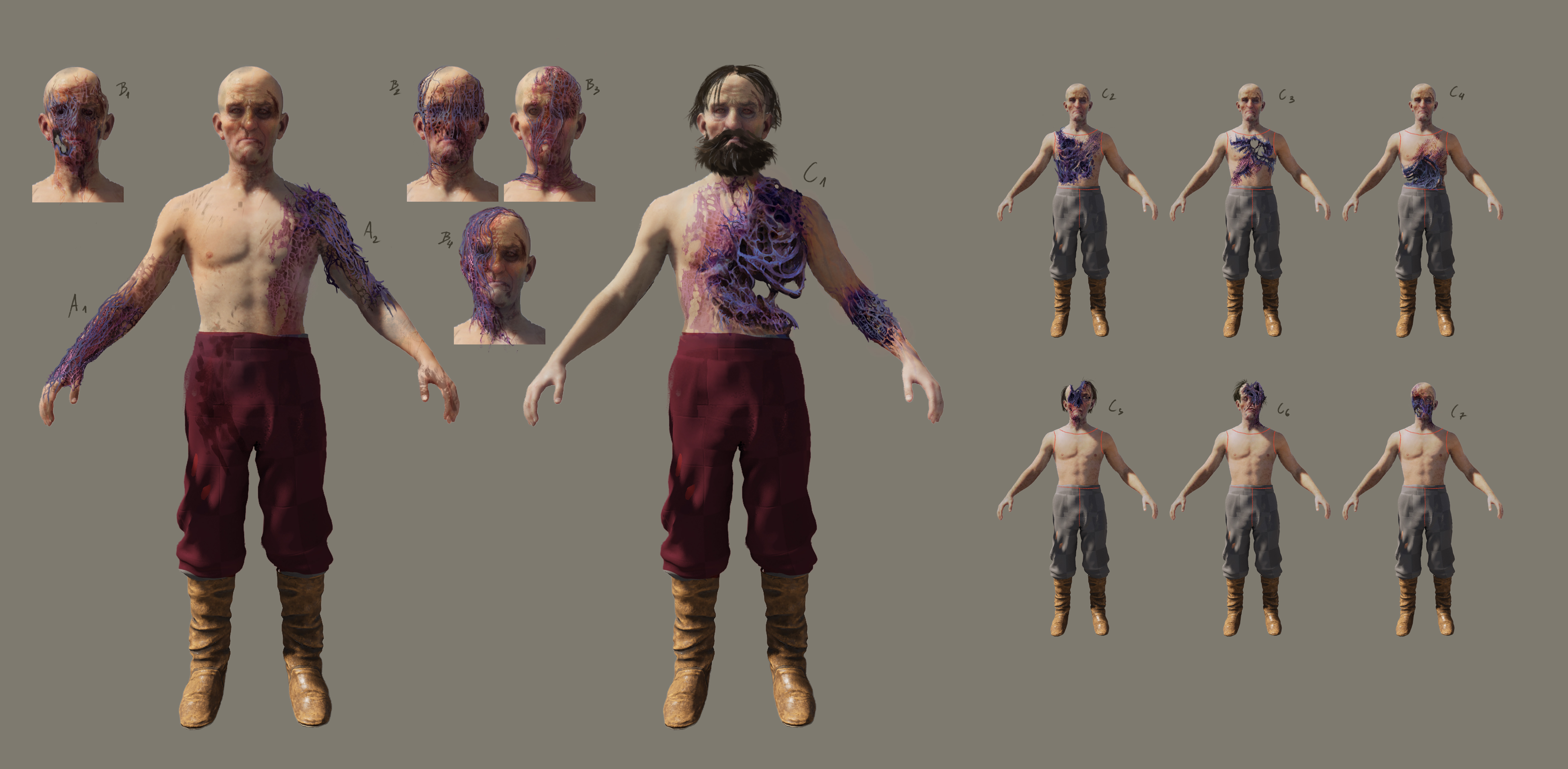
Concept art the studio published in July 2026 shows how the villagers were built: ordinary townspeople stripped to the waist, in knee breeches and tall, worn leather boots, with sheets of violet plague tissue spreading over an arm, a shoulder, a chest, or half a face. The sheet lays out lettered head and body variants side by side, so that a crowd of them does not read as identical. They can be fought directly in the later chapter of the public demo.
The Resistance and The Shrike
Not everyone left alive in the occupied east has been corrupted. In August 2026 the studio revealed a human resistance standing against the empire, led by a figure it calls The Shrike. It describes The Shrike as "the rebel leader fighting Napoleon's Empire in occupied Eastern Europe", and frames the movement as a resistance of the commonfolk rather than a rival army. The Shrike had not appeared in any earlier trailer, playtest build or demo.
That resistance is also the target William is pointed at. The voice of Napoleon in his head is described as guiding him to usurp The Shrike's resistance of the commonfolk, which places the player character on the empire's side of a conflict between people, not only on the front line against the plague. How that tension resolves has not been shown.
The same reveal introduced ordinary people William meets as he crosses the corrupted countryside. Two are named. The studio presents them, along with William and The Shrike, as the cast of what it calls a "supernatural retelling of the Napoleonic Wars".
Name | Role as described |
|---|---|
Resurrected Legionnaire of the Grande Armée and the player character. | |
The Shrike | Rebel leader fighting Napoleon's Empire in occupied Eastern Europe, and the leader of the commonfolk's resistance. |
James Stewart | A fellow soldier. |
Lucjan Skawiński | A lamplighter. |
Beyond those descriptions the studio has not said how any of the three relate to William, whether they can be spoken to or fought, or how large a part they play. Nothing further should be assumed until the game ships.
The Questions the Studio Has Posed
In September 2026 the studio framed its Story Trailer around three questions it said the finished game answers. They are the clearest statement so far about where the plot is going, and all three remain open.
Question, in the studio's words | What it implies |
|---|---|
Why can't he remember his past? | William's memory is damaged. Nothing before this had suggested amnesia |
What is that beast in the sandy desert? | A desert location and a creature in it, neither previously shown nor placed in the world |
Who is a friend and who is a foe? | The small surviving cast is not simply allied with William |
The studio added that there are not many other survivors remaining and that each of them will play a pivotal role in determining William's fate, which puts a short named cast rather than a large one at the centre of the ending.
Press material accompanying the trailer added two details that have not been repeated on any first-party surface: that The Shrike has supernatural abilities, and that James Stewart is the son of a Scottish blacksmith. It also framed William's situation as a choice between staying loyal to Napoleon and joining the resistance, which the studio's own wording does not say. Treat all three as reported rather than confirmed, and in particular do not assume the game contains a branching allegiance choice on that basis.
Documents and Keepsakes
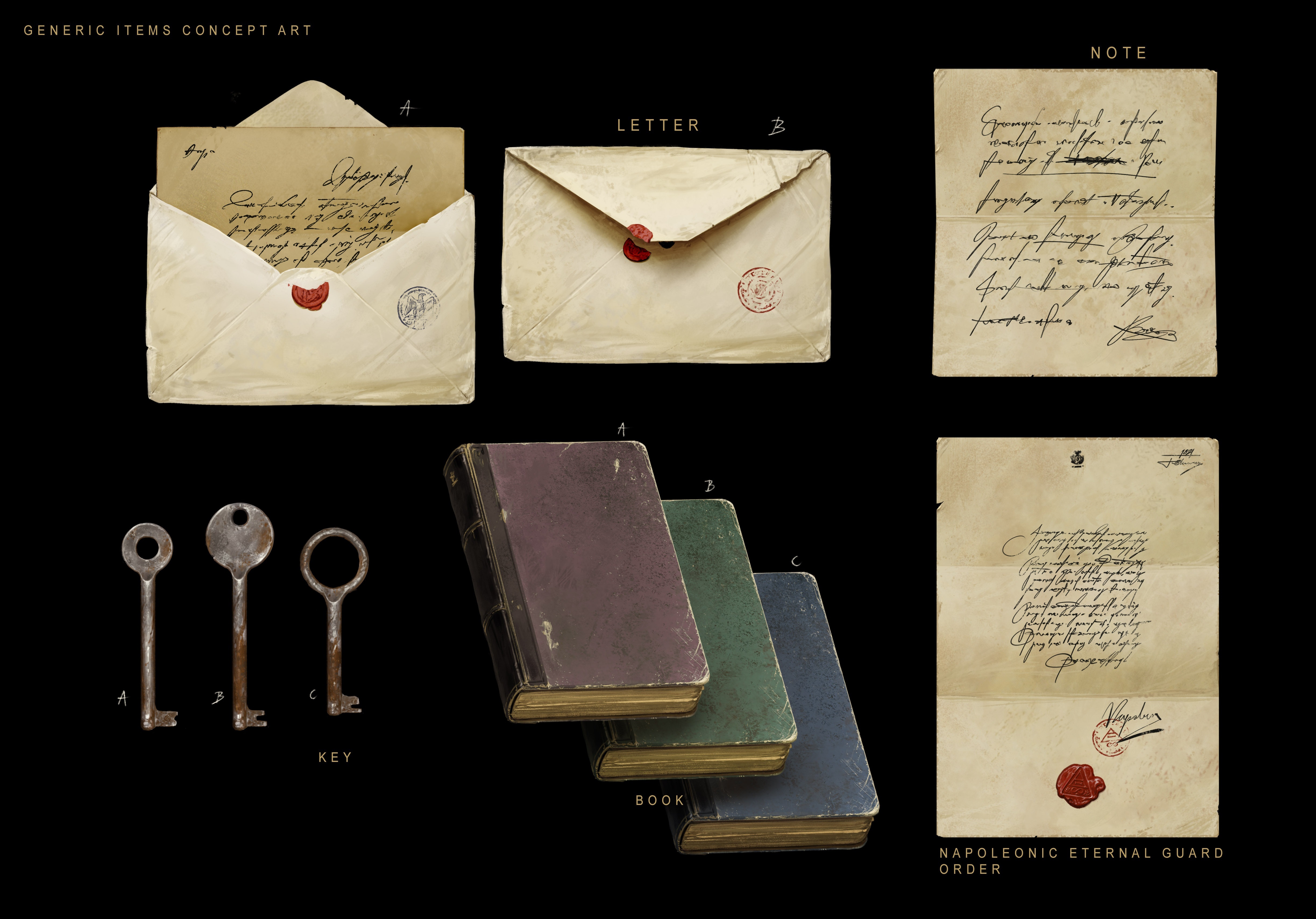
The world is also dressed with smaller readable objects. Concept art for these props covers sealed letters carrying red wax and an eagle stamp, loose handwritten notes, plain iron keys, and cloth-bound books, alongside a formal document titled as a Napoleonic Eternal Guard order, signed and sealed in red wax. Objects like these are the main way the setting explains itself away from cutscenes, and the studio has said they were drawn in detail even though most players will pass them by.
William's Place in the Story
Against this backdrop stands William, a former soldier of Napoleon's Grande Armée. William is killed early in the war and resurrected with the power to wield and corrupt the very plague that is consuming the world. He is guided through this strange afterlife by Napoleon's own disembodied voice, voiced by the actor Vincent Cassel, and is the player's window into the conflict. His personal arc is covered on the William page; from a setting standpoint he is the one figure able to push back against the Eternal Guard on its own supernatural terms.
Themes and Tone
Tone-wise, the game leans into horror, body corruption, and the futility of an endless war rather than glory or heroism. The plague has hollowed out everything it touches, and the war is no longer about flags or territory but about whatever the corrupted forces actually want. Set against that, William's resurrection becomes both a chance for the world and a question about what he has been turned into. These themes feed back into combat as well, where finishers and Transmutations make the violence direct and personal.
What Is Still Open
As of September 13, 2026, across the official store listing, the official site, the studio’s Steam development posts, the published trailers and every hands-on account of a playable build, the studio has not said how the conflict between Napoleon's instruction and The Shrike's resistance resolves, whether William can refuse it, or whether the game branches at all. It has not explained the origin of the plague or of Nephtoglobin, has not described the conspiracy it says is drawn from Napoleon's own writing, and has given no personal detail for The Shrike beyond the role. James Stewart and Lucjan Skawinski have one line of description each and no published voice credits. The desert and its beast, raised as a teaser question in September 2026, have not been placed anywhere in the world.
September story and cast update
The launch overview describes William as an English volunteer disillusioned with monarchy and inspired by Napoleon's vision of a unified Europe. He wakes on a battlefield with little memory, among survivors who claim to be his former comrades. The Shrike fights for people under imperial occupation, and her voice joins Napoleon's in William's head partway through the story.
The announced Voice Cast pairs James Alexander with William Dowsett, Jennifer English with The Shrike, Vincent Cassel with Napoleon Bonaparte, Adam "Nergal" Darski with Captain Raphael, Mars Lipowski with Lucjan Skawiński, Will de Renzy-Martin with James Stewart and Yvan Chamoiseau with Louis Moreau. Captain Raphael and Louis Moreau are named credits; the reveal does not establish their quests or allegiances.