
Loading...
Loading...
Campaign
May 26, 2026 at 01:51 PM
Added galaxy-as-meta-menu structure, region/planet/system layered progression, fleet roles, civilization types, hive-world 6-mega-city detail, texture-paint biome system, multi-orientation battle maps, Exterminatus cost
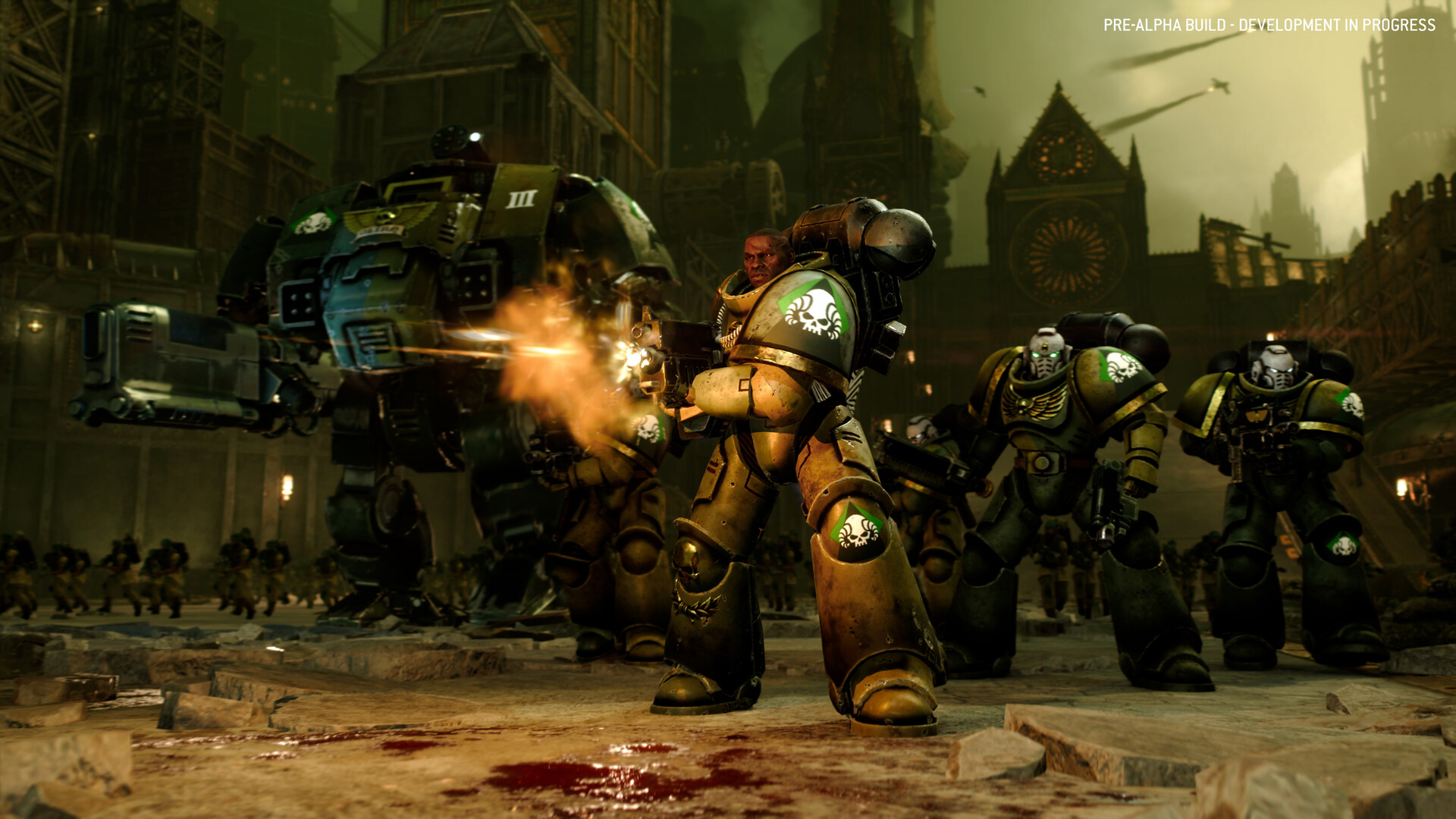
The campaign in Total War: Warhammer 40,000 operates at a galactic scale and is structured as a hybrid between a traditional turn-based campaign and a meta-progression layer that ties multiple campaigns together. Players expand their control region by region on individual planets while fleets move between worlds through zones of concentrated conflict called Crusade Theatres. The campaign was discussed in detail during the Show and Tell livestream on 30 April 2026 and the earlier developer roundtable.
The galaxy view functions as a hybrid between a campaign selection menu and a meta-progression overview. Players do not move armies directly across the entire galaxy on a single turn timeline. Instead, the galaxy view offers several campaigns to take part in, each set within a defined region of contested space. Completing campaigns produces lasting changes that influence which campaigns and battles become available next, and how powerful or prepared the player's faction will be when entering the next theatre.
Each individual campaign takes place within a Crusade Theatre: an area of the galaxy seen as a hot point for conflict where multiple factions are fighting one another. Within a Crusade Theatre fleets move between planets along established star lanes, fight battles for individual worlds, and project power into adjacent systems. According to creative director Ian Roxburgh's framing in the developer roundtable, each completed campaign feeds into a higher layer that gradually shifts across the sector, and eventually across the galaxy as a whole, so individual victories carry weight beyond the campaign in which they were won.
Lead designer Simon Mann has described the campaign as operating on several nested layers. At the lowest layer the player fights real-time battles for individual regions on a planet. Capturing a region (for example a hive city) hands its resources and infrastructure to the player and creates a staging point for the next region. Capturing all the regions on a planet hands the planet itself, which in turn opens up access to the rest of that system. Star systems are connected by star lanes within a Crusade Theatre, and Crusade Theatres themselves are arranged across the galaxy view at the top level.
Fleets serve three confirmed roles. They transport armies between planets, drop forces directly into battle from orbit, and call in off-map bombardments both in the campaign and during real-time battles. Fleet upgrades have been described as one element of the war economy. Fleet-versus-fleet space combat has not been confirmed for launch.
Three campaign formats have been confirmed. Full campaigns are the closest analogue to traditional Total War campaigns. Short campaigns offer a more contained experience. Single decisive battles let players engage only in the real-time battle layer without a campaign context. Single-player, online player-versus-player, and co-operative modes are all confirmed.
Each star system contains several planets that vary considerably in character. Confirmed civilisation types referenced in press materials include hive worlds (densely populated industrial superplanets), agri worlds (vast agricultural producers), mining worlds, fortress worlds, and frontier worlds (sparsely settled outposts). Each planet has its own type of civilisation regardless of its biome. The hive world shown in the Show and Tell livestream featured six mega cities visible at full 3D resolution from the planet view.
Four planet biomes have been confirmed. Each influences the visual character of battles fought on those worlds, and the development team has described a texture-paint system that lets the same underlying battle map shift its surface treatment to match a different biome.
Biome | Description |
|---|---|
Arid | Dry, barren planets with exposed terrain and minimal vegetation, often with sparse points of interest on the outskirts. |
Temperate | Mixed-climate worlds with varied terrain, including forests and settlements. |
Ice | Frozen worlds with glacial landscapes and extreme cold; the texture-paint system shifts arid surfaces to snowy when needed. |
Waste | Devastated or toxic planets scarred by war, pollution, or catastrophe. |
Battle maps within a planet vary by region rather than being identical reskins. The same underlying map can appear with different biome textures depending on which planet hosts it, and the same region can be fought across multiple orientations: north to south or east to west, and as either an attack or a defence battle. Confirmed map types include dense hive cities, hive outskirts, arid wastelands, and ice plains. The first showcased map, Upper Hive Plateau, illustrates the dense-urban end of the spectrum with multi-storey buildings and anti-aircraft fire visible in the background.
Exterminatus, the apocalyptic destruction of an entire planet, is confirmed as a campaign action. The development team has characterised it as a costly option rather than a routine tool: it permanently destroys the planet, and players are unlikely to be able to deploy it freely throughout a campaign.
