

This article is incomplete
Some sections are missing or need additional details. Help improve it by contributing.
The hunt for the pieces of the Scion takes Lara Croft across four distinct regions, each tied to a different ancient civilization and presenting its own environmental challenges. The developers have built these settings in Unreal Engine 5, with photorealistic surfaces, dynamic lighting, and detailed architecture intended to make each location feel distinct. Areas that appeared only as flat background imagery in the 1996 original are now fully realized 3D environments in the reimagining.
Confirmed Regions
Region | Description |
|---|---|
Jungles of Peru | Dense South American jungle terrain and the Lost Valley, the opening setting of the original Tomb Raider’s adventure, reimagined here with modern visuals and rebuilt gameplay. Rooms that were self-contained in the original now open into semi-connected spaces, and the area is filled with secrets, collectibles, and reimagined puzzles such as the returning cog puzzle. |
Ancient Ruins in Greece | A region of ancient Greek ruins, with weathered stone architecture and sites tied to the broader Mediterranean world of the Scion's history. |
Deserts of Egypt | An Egyptian desert setting featuring ancient structures, sun-drenched courtyards, and the environmental extremes of a vast arid landscape. |
A Mysterious Mediterranean Island | An island described as shrouded in myth, with its exact nature and contents left unrevealed ahead of the game's release. The setting is tied to the Atlantis mythology that gives the game its subtitle. |
Peru’s Lost Valley
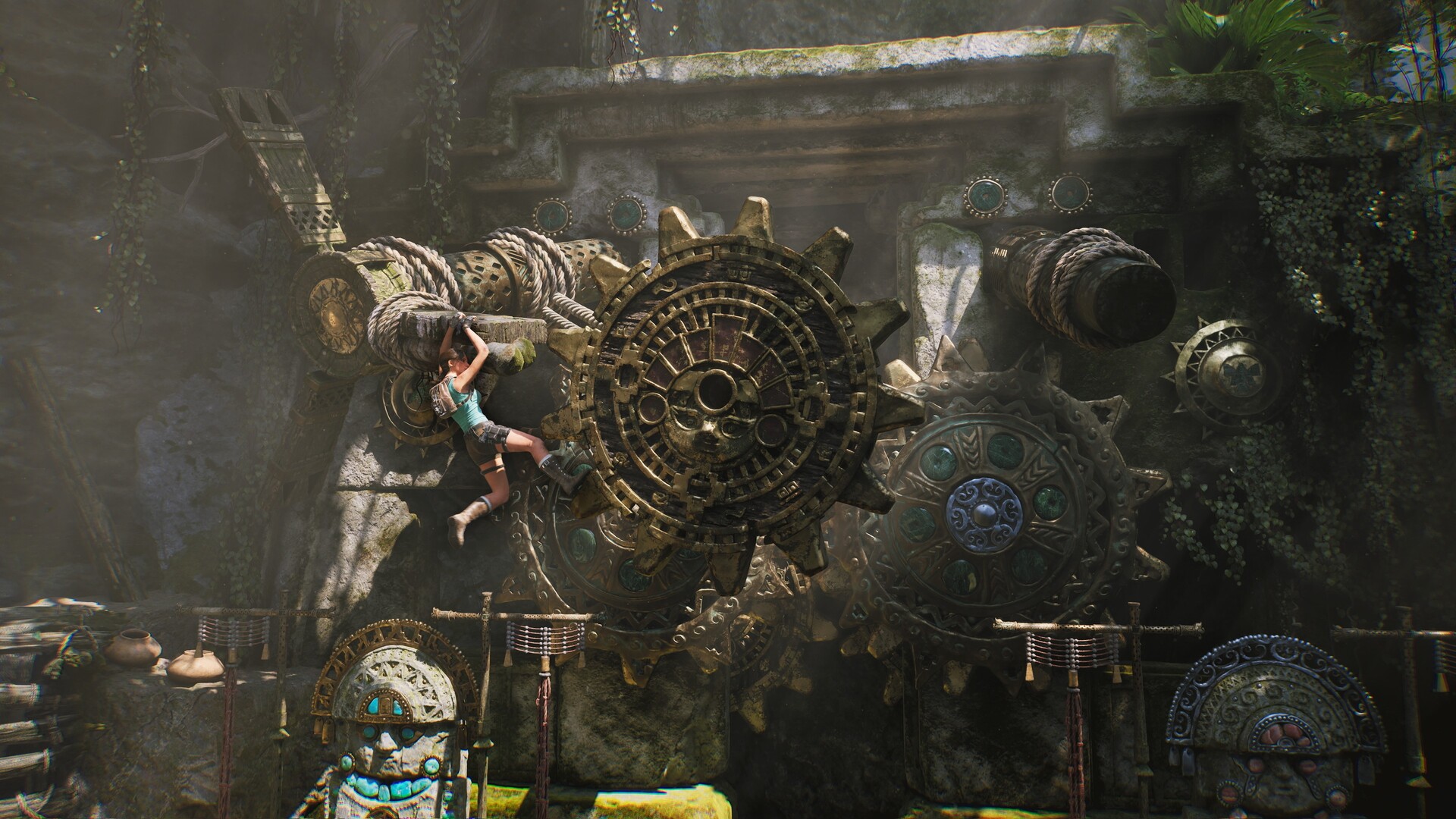
The first region shown in depth is Peru’s Lost Valley. The developers describe rebuilding its puzzles from the ground up: where the original moved the player from one self-contained room to the next, the reimagining opens those spaces into semi-connected environments that can be traversed and approached from new angles. Every space is designed as a real place first, rich with secrets, collectibles, and resources to reward exploration. Returning favorites such as the cog puzzle come back reimagined and grounded in the surrounding world. Dinosaurs are confirmed to play a prominent role in this region, redesigned with feathers to match current paleontology, including feathered velociraptors and a red-feathered Tyrannosaurus rex.
In hands-on coverage the opening stretch of the Lost Valley contains no combat, putting the focus on finding a way through an area full of side paths, collectibles, and hidden items, before velociraptors and the Tyrannosaurus rex appear later in the region. A wrist-mounted grapple is used to haul a massive cog into place, redirecting water flow to clear a path deeper into the jungle.
Peru is the game's opening region, and the studios have detailed it more than any other. It is not a single space but a sequence of connected areas that build toward the valley itself.
Area | What has been confirmed |
|---|---|
Mountain Caves | The approach to the valley, reworked with improved traversal and rebuilt puzzles. A newly added ice slide sits along this stretch, giving the early game a thrill before the jungle opens up. |
City of Vilcabamba | An Incan city with reworked puzzles and traversal. Official material states the Inca built it to escape the Spanish conquest. |
Lost Valley | The destination: a lush tropical jungle hidden in the mountains, with waterfalls, overlapping microclimates and the region's dangerous wildlife. Home to the rebuilt cog puzzle and the waterfall puzzle. |
Tomb of Qualopec | Reached through the Lost Valley's waterfall puzzle. The hands-on demo shown in June 2026 tasked players with uncovering its entrance. |
The structural change from the original is the biggest one. Where the 1996 game was built room by room, this Peru is built from larger interconnected spaces, which the game director says is what makes the sense of scale possible. The sensory design follows the same route: cracking ice and crunching snow give way to mud underfoot, tropical birdsong, and other sounds that players learn to read as warnings.
Secrets are treated as a promise to returning players. The design director has stated that all of the original secrets in Peru are present, with more added on top.
The History Beneath Peru
The region carries a written history that ties directly into the Scion. Official material states that Vilcabamba was built by the Inca to escape the Spanish conquistadors, and that one of the Atlanteans, Qualopec, gave the Inca knowledge for which they revered him. While he was active he helped control the dinosaurs the Inca found in a hidden valley. With the Inca gone, those animals rule the valley again.
The narrative director has described Qualopec and Vilcabamba as expanded from background relics into part of a much larger Atlantean cosmology tied to creation, the elements and the Scion, making Peru the start of a pattern that repeats globally. Incan culture now runs through the art as well: murals, carvings and stone architecture reflect it, and objects Lara scans surface documents about the region's history.
Environment and Presentation
Unreal Engine 5 enables detailed stone textures and weathered architectural surfaces across every region, with dynamic shadows and ambient lighting that shift as Lara moves through torch-lit corridors, open-air ruins, and underground chambers. Each region is designed to feel geographically and culturally distinct, giving the broader treasure hunt a sense of real-world scope. Scot Amos has described the visual upgrade as taking spaces that were once flat background images and rebuilding them as full 3D environments players can actually traverse.
Whether the locations are structured as discrete levels, open zones, or a mixture of both has not been confirmed ahead of launch. Further details about interior layouts, environmental hazards, and specific landmark sites within each region are expected closer to release.
Greece and Egypt
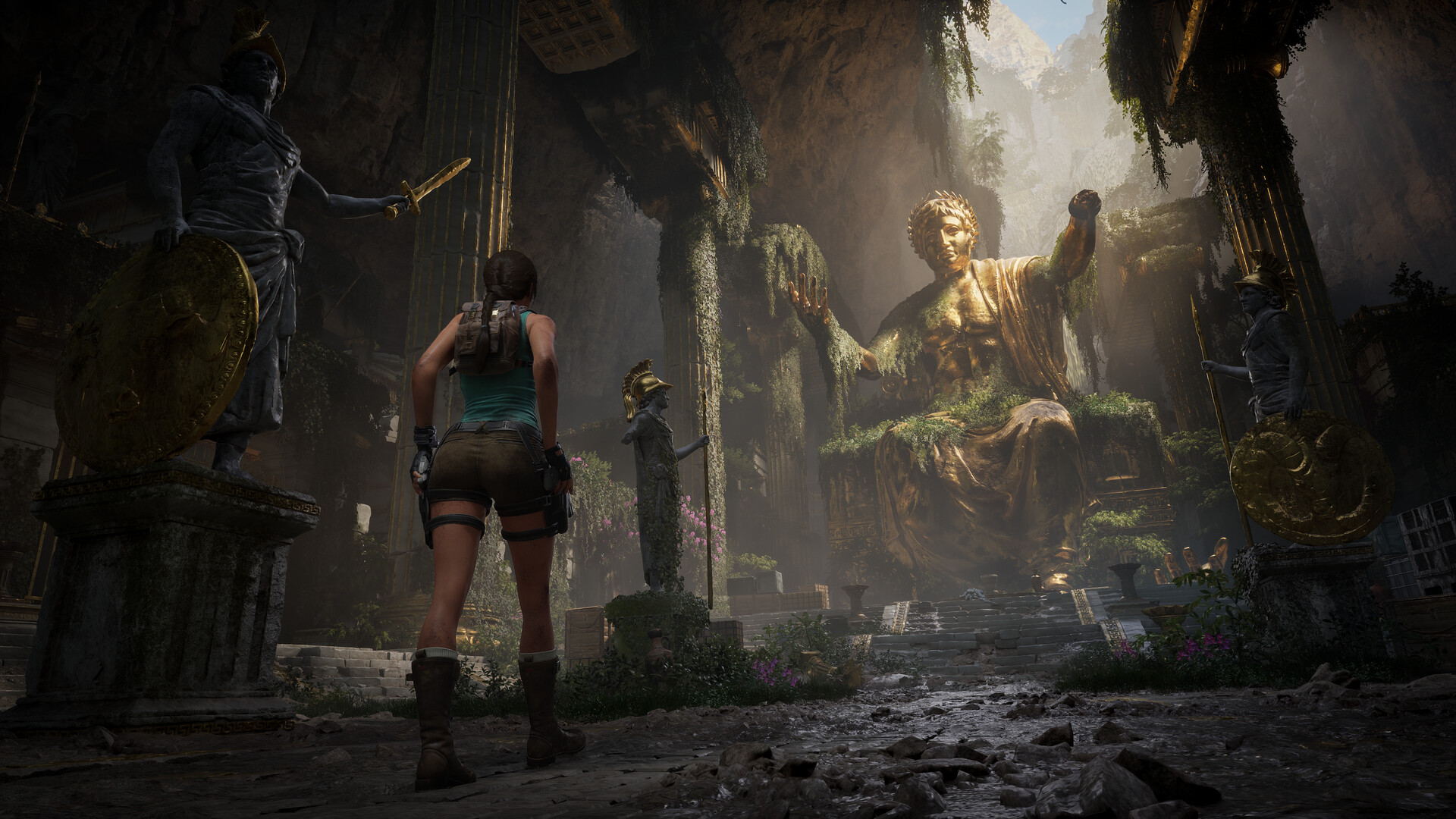
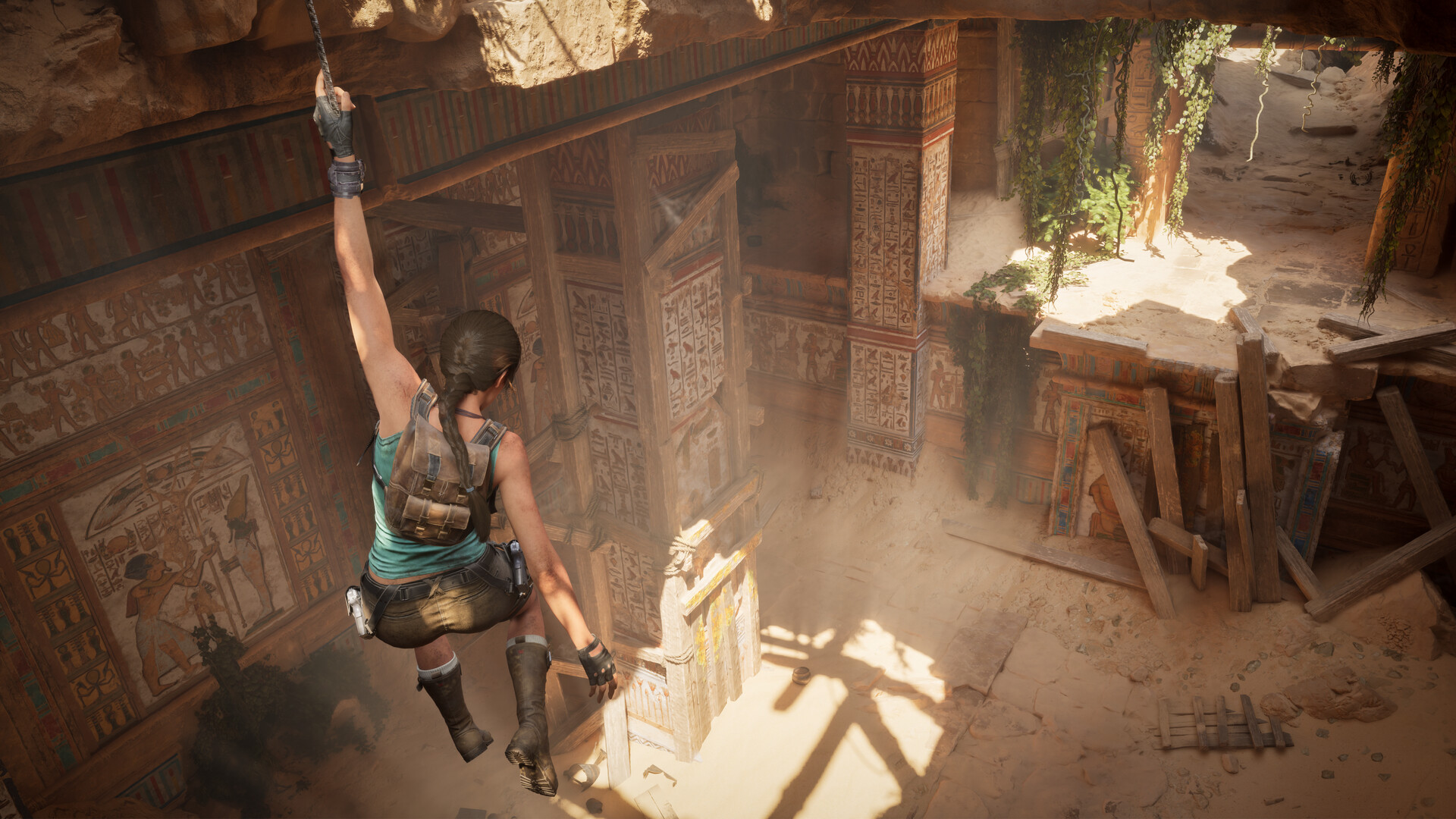
Less has been shown of the other regions, but official screenshots give a first look at both. The Greek section is set in a colossal ruined interior, sunlight falling through a broken ceiling onto a huge seated gilded figure overgrown with vegetation, flanked by armoured warrior statues carrying gold shields and spears. The Egyptian material shows Lara rappelling on a rope into a painted tomb chamber whose walls are covered in coloured hieroglyphic reliefs, with timber scaffolding propped against the stonework, suggesting an excavation already in progress when she arrives.
Neither region's layout, puzzle set, nor inhabitants have been detailed, and the Mediterranean island remains almost entirely unrevealed.