

This article is incomplete
Some sections are missing or need additional details. Help improve it by contributing.
Tomb Raider: Legacy of Atlantis rebuilds its gameplay systems entirely. The studio has confirmed that both combat and exploration have been reimagined from scratch rather than carried over from the 1996 original's mechanics. The result is a modernized action-adventure that honors the tone and spirit of the source material. The developers describe the experience around three core pillars: puzzles, traversal, and combat.
Design Philosophy
Will Kerslake, credited as Game Director during the reveal cycle, summarized the design philosophy as making the original "feel like 1996, but play in 2026." In practice this means systems like combat and traversal have been completely re-tuned to meet modern standards while signature moments and the franchise's core identity are preserved. Scot Amos, the Head of Studio at Crystal Dynamics, has described the project as a "love letter" honoring Core Design's original DNA and intent.
Modernized Controls and Difficulty
The studio has stated that the controls and camera are modernized so the game feels like a modern third-person action title rather than the original 1996 release. Difficulty has been adjusted for modern player tastes. Specific control bindings and the exact control scheme have not been detailed ahead of launch.
Exploration and Traversal
Exploration is a confirmed pillar of the game and has been rebuilt from the ground up. Lara navigates treacherous landscapes across the four confirmed regions, using her strength, agility, and a grappling hook to climb, leap, and swing across perilous terrain. Areas that appeared only as flat background images in the 1996 original are now fully realized 3D environments in the reimagining, with rooms that were once self-contained opened into semi-connected spaces that can be approached from new angles. Each space is built as a real place first, rewarding exploration with secrets, collectibles, and resources. The exact climbing and swimming systems and full movement set have not been detailed beyond the grappling hook and acrobatic traversal shown so far.
Movement seen in hands-on play includes leaping and hanging between ledges, swinging from poles with timed releases, crossing wide gaps with the grappling hook, and diving into water to swim. Reviewers noted a slight floatiness to Lara’s movement that recalls how she felt to control in earlier games in the series. The opening stretch of Peru’s Lost Valley is built around exploration and puzzles rather than fighting, with side paths that lead to collectibles and hidden items; some pickups yield rare materials that feed the game's confirmed cooking and resource system.
In hands-on previews Lara also carries a scanner she can raise with a button press to hone in on points of interest in the environment. When she comes across a tool or artifact set into the background, the scanner surfaces more information about it, and the same mode helps her pick out documents and treasures worth investigating. Previews described the scanning as a light, optional aid rather than an always-on overlay.
The studio has since confirmed the base traversal set. Lara's core kit covers jumps, sprinting, climbing and a wall scramble, combining moves from the original game with those from the more recent entries into a single toolkit. Her grapple tool is the piece that is genuinely new: beyond swinging gaps, she uses it to manipulate objects in the environment, solve puzzles, ascend, and rappel down into spaces she could not otherwise reach.
Level design guides the player without an on-screen breadcrumb trail. The team adds markings to climbable surfaces, colour pops, and focused lighting so the eye is drawn along the intended route, and the camera pulls back during long climbs to emphasise the scale of the space. Long jumps require a run-up, with Lara leaning into a last-moment saving grab so the landing depends on committing to the reach.
Pacing is deliberately unhurried. The game director has described Legacy of Atlantis as a slower experience than most modern action titles, built so players stop and take in the environments. Players who prefer speed are not blocked, though: the traversal set is designed to allow movement chains, and the team has openly invited speedrun attempts.
Combat
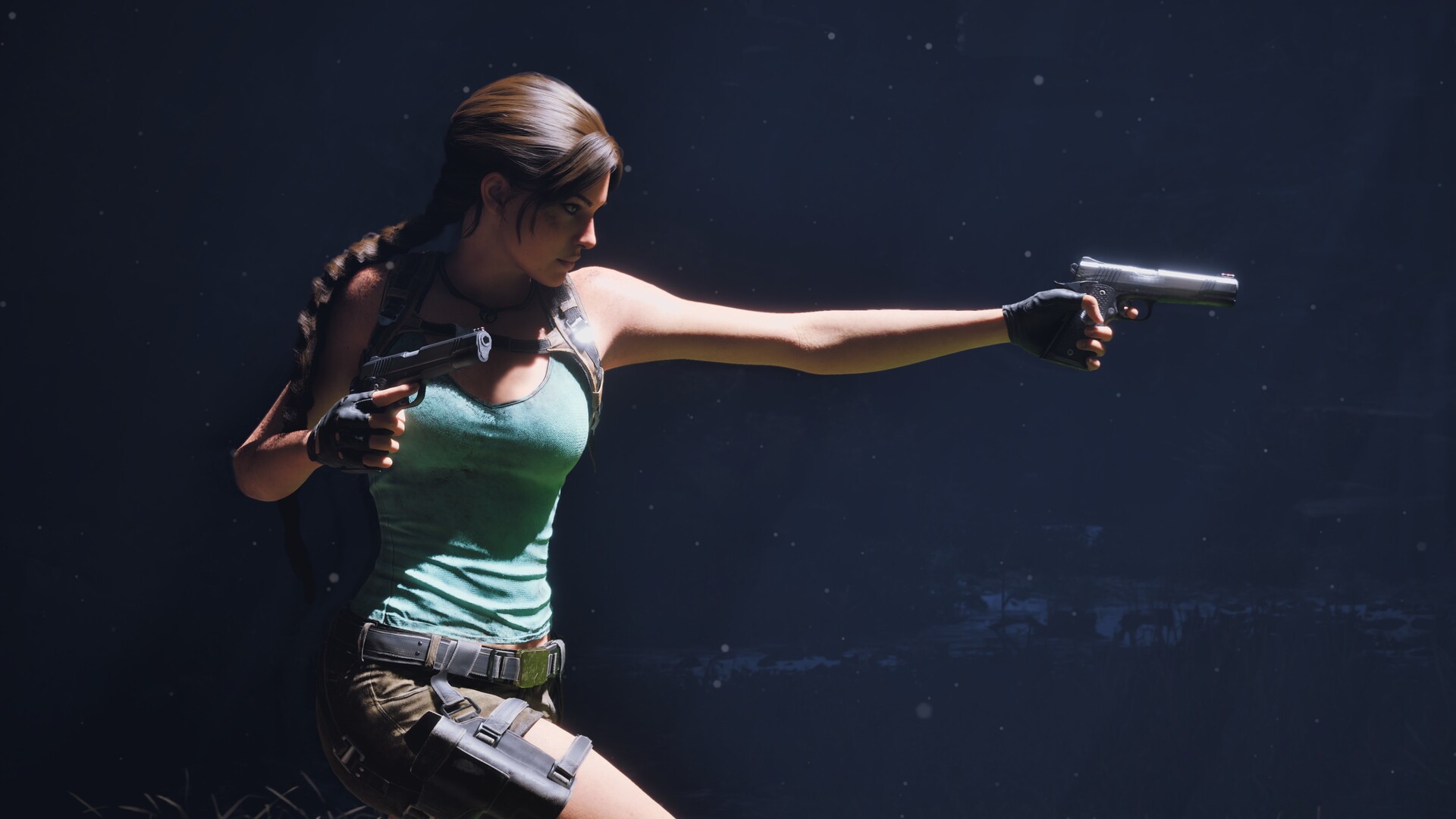
Combat has been fully rebuilt for modern controller-based play. Lara faces savage wildlife, human mercenaries, and mythological creatures across the adventure. She is armed with her iconic dual pistols and other unlockable weapons, and uses acrobatic abilities to unleash attacks against enemies. Dinosaurs play a prominent role, and the Tyrannosaurus rex returns as a signature set piece. The wolves encounter from the original is also confirmed as carried over in reimagined form. Scot Amos has described the T-Rex as "reborn as a contemporary action-adventure set piece," intended to create a brand-new memory for new players while feeling for longtime fans like experiencing that moment for the first time again. In the reimagining the dinosaurs have been redesigned with feathers in line with current paleontology: the velociraptors are feathered and the Tyrannosaurus rex carries red feathers, while the developers keep the encounter recognizable to longtime fans.
Beyond the dual pistols and the named creature encounters, the full unlockable weapon roster and the complete enemy lineup have not been detailed. The specific weapon and enemy lists from the 1996 original are not confirmed for this reimagining, since combat was rebuilt from scratch.
Combat Controls and the Focus System
In hands-on play, Lara fires her dual pistols by holding the right trigger, and can aim precisely with the left trigger while firing one pistol at a time on the move. The dodge button rolls, dives, and cartwheels her clear of incoming attacks. Both dealing and taking damage fill a Focus meter, which she spends on a gymnastic flip that lets her keep firing as she evades. The game director has since described Focus as letting the player slow down time and showcase moves Lara performed in the original game, which matches what players reported feeling in hands-on sessions. The studio also describes Focus as the key that unlocks her acrobatics in combat. The game director has described Focus Mode as the currency of combat, and as the system that lets Lara's classic acrobatics coexist with modern third-person shooting without leaving her exposed. The developers have said combat difficulty can be tuned separately from puzzle difficulty, and that on-screen guidance can be dialed up or down to taste.
Shooting, Cover and the Acrobatics Button
The studio has since described the combat layer in its own terms. It is built as a modern third-person shooter, with aim assist and target snapping to keep the shooting readable on a controller. An over-the-shoulder mode is available, and in it Lara can dodge quickly in any direction.
The acrobatics button is contextual. In over-the-shoulder mode it is a directional dodge; while she is moving it helps her create distance and change direction quickly. Acrobatics also build focus, and dodging an attack is worth more focus than dodging nothing, so evasion feeds the system rather than interrupting it.
The game director has been explicit about what this combat is not. “This isn’t a cover shooter,” he has said, describing the intent as players taking the initiative rather than stopping to wait for an opening. Cover still arrives with the human mercenaries rather than the wildlife. The design director describes the mercenaries as adding a new dimension to combat, cover, on the grounds that animal enemies do not naturally support classic cover-based encounters. The game director draws the same split from the player’s side: fighting animals is about learning attack patterns and dodging, while human enemies ask players to mind their position, move around the arena to get outside enemy range, and take opportunities to break line of sight. See Creatures and Enemies for the roster itself.
Where the Weapons Come From
Only the dual pistols are described as truly Lara’s. Official material states they were a gift from Conrad Roth and that they carry a piece of her family’s history. Every other weapon she uses across the adventure is sourced from the world itself, and she is described as instinctively knowing how to wield each one to best effect. The full list of those world-sourced weapons has not been published.
Progression
The studio’s sixth behind-the-scenes episode is presented as covering combat and progression together, and skill-tree progression and crafting were shown there for the first time. Neither has been detailed: no skill list, no crafting recipes and no upgrade structure has been published. The design director has said that a player who wants to carry the dual pistols the whole way through can do exactly that, so the progression layer is not presented as something the game forces on you.
Survival and Resources
Exploration feeds a confirmed survival layer. Gathering resources from the environment lets Lara cook dishes that grant gameplay buffs, or brew healing tonics, so players choose between eating for an advantage and holding materials back for recovery. The design director has framed this as a way of rewarding curiosity: the players who search a space thoroughly are the ones who can afford to be reckless later.
The full recipe list, the buff types, and any upgrade tree attached to the system have not been published.
Puzzle-Solving
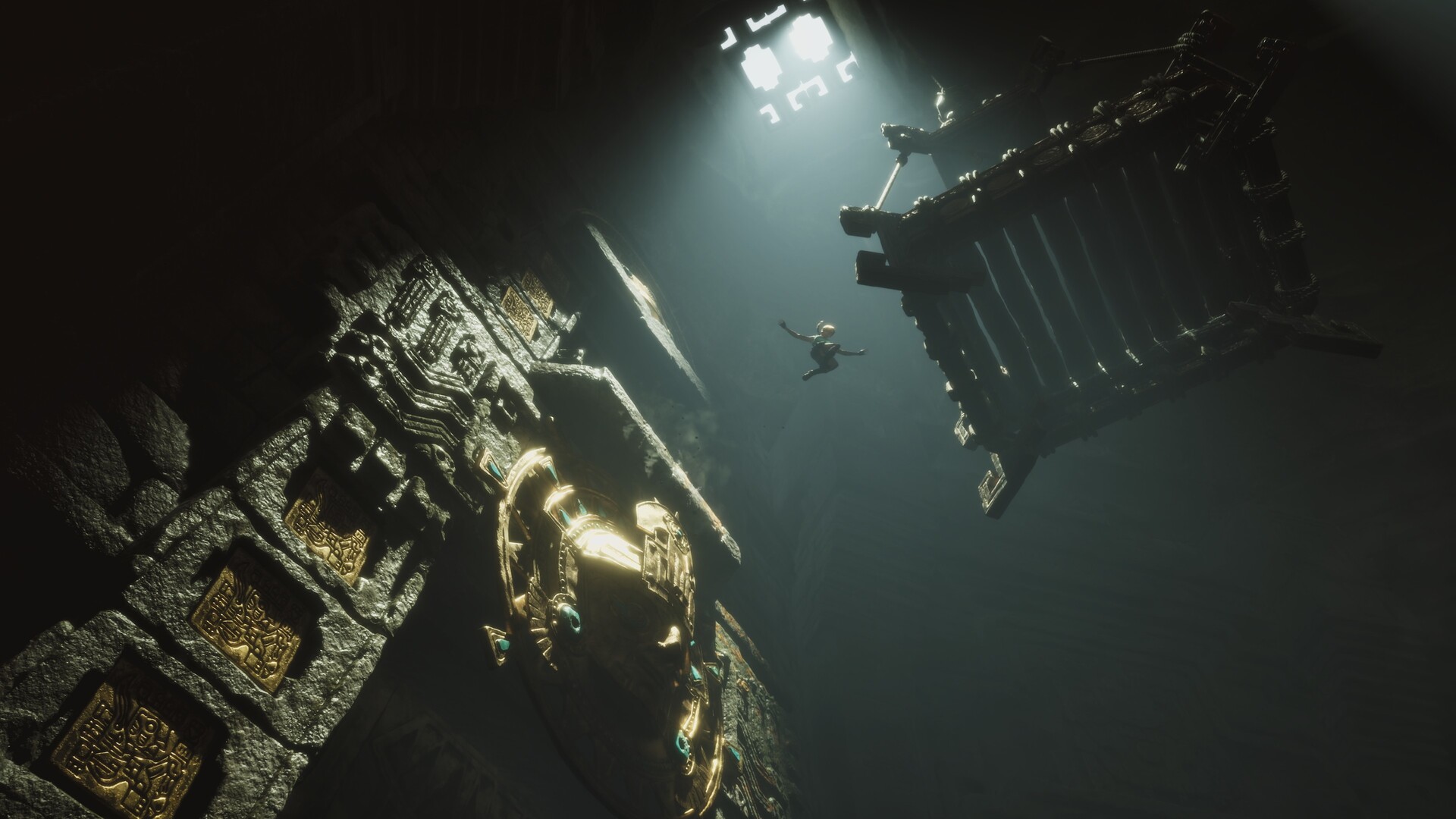
Puzzle-solving is a confirmed major pillar. In Peru’s Lost Valley, the puzzles have been rebuilt from the ground up. Confirmed puzzle mechanics include manipulating water flow, redirecting light beams, activating pressure plates, and deciphering symbols, with solutions that combine knowledge the player has uncovered with clever thinking. Returning favorites such as the cog puzzle come back reimagined and grounded in the world around them, and rolling boulder traps are confirmed as one of the carried-over hazards from the original. The total number of optional tombs or challenges and the full reward structure have not been announced.
The team has described puzzles as the soul of the series and the core of this game. Some are cerebral and rule-based, such as working out how to redirect a light beam; others are exploration-led, where the challenge is finding the pieces or reaching the vantage point from which the answer becomes obvious. Puzzle objects are deliberately not signposted with prompts. Instead they carry an implied function that invites investigation, with subtle cues appearing as Lara gets closer.
Two Peru puzzles have been detailed. A rebuilt waterfall puzzle in the Lost Valley leads to the Tomb of Qualopec, expanded from the original layout. A second draws on Quipu, the Incan system of knotted, coloured cords: players search the area to uncover a Quipu pattern and then recreate it using levers, reading the differences between the knots to find the correct solution.
Players who want help can get it without breaking the flow. Lara's own narration offers gentle nudges, and a scanner hint system can point toward the next step. The team has confirmed those scanner hints are entirely optional, so players who want to solve everything unaided can. Combat difficulty and puzzle difficulty can also be tuned separately. Internally the team reports iterating six to eight times on a puzzle that works from the start, and ten to twelve times, usually including a couple of full overhauls, on the harder ones. See Puzzles and Traps for the full breakdown.
Technical Foundation
The game runs on Unreal Engine 5, which the studio uses to deliver detailed environments across the four confirmed regions. The Steam store listing confirms twelve language options, single-player only, Steam Achievements, HDR support, full controller support (including DualSense controllers), and Denuvo Anti-tamper technology on PC. The PlayStation product listing adds a PS5 Pro Enhanced mode: PlayStation Spectral Super Resolution for sharper detail and image clarity, a choice between a Fidelity mode for maximum visual quality and a Performance mode for fluid gameplay, and up to 4K output resolution. The same listing confirms Tempest 3D AudioTech, and DualSense vibration and trigger effects. Frame rate targets, ray tracing settings, and accessibility features have not been confirmed in detail.
Age Ratings
The North American board has rated the game Teen. Several regional boards have issued classifications as well, listed below.
Board / Region | Rating | Content Descriptors |
|---|---|---|
Brazil | 12 | Inappropriate language, violence |
Germany | 16 | Violence, expletives |
Indonesia | 15 | Violence, use of language |
North America | Teen | Blood, suggestive themes, violence |
Europe | 16 | Strong violence |
Korea | 15 | Violence |
Australia | M | Violence |